The White Woman’s Burden: Ruling over the Victorian Kitchen.
Abstract: Victorian cookbooks reveal the essentials of everyday life, betray attitudes and personalities, and reflect the evolution of the sense of national identity. As a gendered genre of minor writing, these volumes operate on the motherly or sisterly mode, prescribing the dos and don’ts of almost everything a young woman should know. Victorian values, convictions and prejudices suffuse the advice, recipes and illustrations contained in books of household management and cookbooks, contributing to the definition of a national set of references and preferences. By addressing a British as well as a colonial readership, the women authors of household manuals and cookbooks combined to naturalise and spread Victorian values and prejudices.
Keywords: Victorian Britain, Cooking, Domestic economy, Values, Prejudice
Résumé : À l’époque victorienne, les livres de cuisine et les manuels d’économie domestique révèlent l’essentiel de la vie quotidienne, trahissent les attitudes et les personnalités, reflètent l’évolution du sens de l’identité nationale. En tant que genre d’écriture mineure, ces volumes fonctionnent sur le mode du conseil maternel, prescrivent les choses à faire et à ne pas faire, et guident les jeunes femmes dans chaque étape de leur vie domestique. Les valeurs, convictions et préjugés de l’époque saturent les recommandations, les recettes, et même les illustrations. Ils contribuent à définir un ensemble national de références et de préférences. En s’adressant à un lectorat britannique et colonial, les auteures de manuels ménagers et de livres de cuisine sont parvenues ensemble à naturaliser et à propager les valeurs et préjugés de leur époque.
Mots-clés : Époque victorienne, Cuisine, Économie domestique, Valeurs, Préjugés
Introduction
Cookery books are useful in the kitchen, but in the library or in the study, they can also be the starting-point of research relating to topics far more diverse than food preparation. This is especially true for nineteenth-century cookbooks, which were rarely separate from more general advice manuals, instructing young women in the art of running a decent household. Between recipes, or sometimes even within them, the prose of Victorian cookbooks reveals the essentials of everyday life, embodies attitudes and personalities, reflects the evolution of the sense of national identity as well as the state of international relations. For these reasons, cookery books are precious sources for the cultural historian.
Precisely, because they are not really literature, Victorian cookbooks provide an almost unmediated access to their female authors’ minds. As a gendered genre of minor writing, these volumes operate on the motherly or sisterly mode, prescribing the dos and don’ts of not only food preparation, but of almost everything a young woman should know when embarking on the heroic mission of running a properly ordered British household.
Of course, a cookbook, as a printed reference guide, implies order, rationalisation, and pragmatism, but in nineteenth-century Britain, order meant more than practical arrangement. It was a paramount virtue. Benjamin Disraeli, the novelist Prime Minister, famously wrote that “cleanliness and order are not matters of instinct; they are matters of education, and like most great things, you must cultivate a taste for them” (Disraeli 111). The purpose of books of household management was, precisely, to instil order in the kitchen, at home as well as in the Empire, and to educate servants that they may develop a taste in cleanliness, tidiness, respect of rules and hierarchy. Instinct, Darwinians believed, drove the actions of primary people and lower-class individuals; education, by contrast, governed the choices of civilised nations and well-bred Britons.
The purpose of this article is to illustrate how Victorian values, convictions and prejudices discreetly, or sometimes not so discreetly, suffuse the pages, advice and recipes contained in books of household management and cookbooks, contributing to the definition of a national set of preferences. The first part will look at cookbooks in Britain in their several editions and notice how, from “plain” to “enlightened,” British cuisine evolved throughout the second part of the nineteenth century, influenced as it was by the contemporary political context and scientific discourse. Theories and hypotheses proposed in apparently unrelated disciplines—history, biology, and anthropology— permeate culinary writings and iterate class, gender, and ethnic stereotypes.
The second part will highlight the progressive naturalisation of the notion of British supremacy, through the standardisation of British taste. Its transformation into a criterion of national identity consolidated the bonds between the four countries in the United Kingdom and unified the Empire, transporting “home virtues” across the seas in a civilising mission. Culinary hybridism, however, suggests that the colonial experience affected both colonisers and colonised. How the women authors of household manuals and cookbooks, addressing a British as well as a colonial readership, combined to naturalise and to spread Victorian values and prejudices is what this paper seeks to uncover.
From “Plain” to “Enlightened” cooking
In the expanding business of cookbook publication, the once-informal oral transfer of information became a process of official instruction in Victorian Britain. The most celebrated book of household management of the period was undoubtedly Mrs Beeton’s. But Isabella Beeton was not a pioneer of household guides: her much acclaimed predecessor Eliza Acton (1799-1859) had paved the way for her success.
First published in 1845, Eliza Acton’s Modern Cookery in All its Branches, Reduced to a System of Easy Practice, for the Use of Private Families was a ground-breaking book because it targeted the domestic reader rather than the professional audience and introduced the now-commonplace practice of listing ingredients, exact quantities and suggested cooking times. By 1860, the title had been altered to Modern Cookery for Private Families. Under its different titles, the book ran through 13 editions between 1845 and 1853, and many others followed.
In the introduction of Modern Cookery in All its Branches, Eliza Acton insisted on the distinct Englishness of her culinary preferences: “our first and best attention has been bestowed on […] what are usually termed plain English dishes” (1845 xi). “Plain” in this context not only qualifies a lack of seasoning, but also highlights both the physical quality of wholesomeness, and the moral quality of honesty, typical of English cuisine according to this author. Taking on board the statement of the French chef Anthelme Brillat-Savarin who famously wrote, “Tell me what you eat and I will tell you what you are” in his 1826 essay Physiologie du Goût ou, Méditations de Gastronomie Transcendante, Acton established a clear parallel between ways of cooking and ways of being. Mrs Acton displays her own mastery of the unsophisticated British ways when she describes her book as containing “explicit and minute instructions as may, we trust be readily comprehended and carried out by any class of learners” (1845 x). Her high moral standards show through the fact that her recipes “are scrupulously specified, [and] confined to such as may be perfectly depended on, from having been proved beneath our own roof and under our own personal inspection” (1845 x). The adjectives “explicit”, “scrupulous” and “trustworthy” qualify the methodology of the book, the recipes, and the character of the author alike. Another quality is self-reliance: Acton enacts it herself, as she tells her readers that she has “trusted nothing to others,” and invites “the young housekeepers of England” to whom she dedicated her book to depend on their own resources in “making what cannot be purchased in this country—unadulterated bread of the most undeniably wholesome quality” (1887 v). By ingesting certain foods, she suggested, consumers also developed specific moral qualities.
English plainness, Acton conceded, could accommodate some more fanciful additions, and her book included Eastern recipes for chutneys, as well as French classics. Boasting of her acquaintances across the Channel, Acton stated that the French “excel greatly” in baking pies (1845 346), they prepare “good, wholesome, palatable soups, without great expense” (1845 1), their fruit is “admirably confected” (1845 494) and the brioche “is made in great perfection” (1845 339). In 1845, Anglo-French relations were excellent as the Bourbon monarchy had been restored, and Louis-Philippe I had been made a Knight of the Order of the Garter in 1844. Mrs Acton’s enthusiasm for the nation across the Channel encouraged her to include over one hundred French recipes. Yet, though she was a Francophile, Acton took the liberty of distancing the delicate English taste from the coarser French one, which could swallow orange-blossom petals, and bear garlic mixed with shallots. When explaining how orange-flower candy is made, the author warns her readers that “the French, who are very fond of the delicious flavour of the orange-blossom, leave the petals in the candy; but a more delicate confection, to English taste, is made as follows” (1845 527). When comparing the English and French ways of making “forced tomatas” [sic] she observed that “the French pound the whole of [the] ingredients with a bit of garlic” but, according to her, “this is not absolutely necessary, and the garlic, if added at all, should be parboiled first, as its strong flavour, combined with that of the eschalots, would scarcely suit the general taste” (1845 319). Still, once adapted to the more delicate British palate, foreign (mostly French) recipes were acceptable, and included by Mrs Acton for the reason that they “now so far belong to our national cookery, as to be met with commonly at all refined modern tables” (1845 xi). The fact that a dish was cooked and consumed in England sufficed to make it English—by virtue it seems of the jus soli common law being extended from people to food.
Indeed, some inspiration may be drawn from France who now was an ally, from Belgium, where Victoria’s uncle Leopold was king, from Germany, the native land of Prince Albert, and Eliza Acton concluded: “Without adopting blindly foreign modes in anything merely because they are foreign, surely we should be wise to learn from other nations” (1887 vii). And she included recipes for Brussels sprouts and German stew as well as from the colonies: mulligatawny soup, chutney, and coconut cheesecake. The thirteenth edition of Modern Cookery (1853) provided curry recipes including Bengal curry, dry curry, common India curry, Selim’s curry, and curried egg.
Mrs Acton’s pragmatic approach instructed the English housewife on ways and recipes to avoid waste and recycle leftovers, accommodate home-grown products, and enjoy the plainness of British traditional foods, occasionally indulging in a few foreign imports. In contrast, Mrs Beeton’s Book of Household Management, first published in 1861, set itself a higher aim. This magnum opus is still in print. It contains, in between recipes, myriad instructive paragraphs on history, on fauna and flora, on the provenance of staple goods, and advice on how to choose and preserve them. It is in these intermediary commentaries that Beeton’s vision of hierarchy between species, genders, and ethnic groups is skilfully imparted. To Beeton, the art of cookery is important not only because it provides sustenance to the family, but also because it is an instrument of seduction. In the opening paragraph of the preface, she warns her readers against the savoury temptations that could lure their husbands away from the lawful family table:
there is no more fruitful source of family discontent than a housewife’s badly-cooked dinners and untidy ways. Men are now so well served out of doors—at their clubs, well-ordered taverns, and dining-houses—that in order to compete with the attractions of these places, a mistress must be thoroughly acquainted with the theory and practice of cookery. (iii)
Colour plates delicately suggested ways to compete with these public places of gustatory delight. In order to keep the stove burning and the household running, impeccable order was a necessity that the mistress and all her servants must observe. Beeton’s injunction to the wives of England to behave as the unflinching leaders of domestic armies was published in 1861, the year prince Albert died prematurely, leaving Queen Victoria in total power over the destiny of her subjects.
“As with the commander of an army, or the leader of any enterprise,” wrote Isabella Beeton, “so is it with the mistress of a house. Her spirit will be seen through the whole establishment; and just in proportion as she performs her duties intelligently and thoroughly, so will her domestics follow in her path” (1). If, as the saying goes, an Englishman’s home is his castle then, according to Mrs Beeton, every Englishwoman’s home is her battlefield, her creation and her kingdom: “She ought always to remember that she is the first and the last, the Alpha and the Omega in the government of her establishment; and that it is by her conduct that its whole internal policy is regulated” (18). As the enlightened domestic despot, Beeton’s ideal housewife should be educated in contemporary sciences. The author herself had absorbed contemporary discourses in many fields and injected what she had gathered from them into her ponderous volume.
Evolutionism
Isabella Beeton’s views are tainted with the evolutionary hypothesis, formulated by Darwin in 1859, but which had been “in the air” for some twenty years, affecting the perception of anthropologists to establish a scale between stages of development, and that of art historians to explain the evolution of art through time. Mrs Beeton adapted evolutionism to the kitchen when she explained: “As in the Fine Arts, the progress of mankind from barbarism to civilisation is marked by a gradual succession of triumphs over the rude materialities of nature, so in the art of cookery is the progress gradual from the earliest and simplest modes, to those of the most complicated and refined” (39). Drawing a parallel between the four-phased development of humanity and that of the culinary art, Isabella Beeton envisions the progress from Barbarism to Civilisation in four steps, leading up to the Victorian dining table. “Man, in his primitive state, lives upon roots and the fruits of the earth, until, by degrees, he is driven to seek for new means, by which his wants may be supplied and enlarged” (39). From the hunter-gatherer of prehistoric times, Man becomes a herdsman, acquires more settled habits and is thus driven to develop his agricultural skills. Only once the fourth stage of social progress has been attained can the art of cookery commence; “and although the fruits of the earth, the fowls of the air, the beasts of the field, and the fish of the sea, are still the only food of mankind, yet these are so prepared, improved, and dressed by skill and ingenuity that they are the means of immeasurably extending the boundaries of human enjoyments” (39). Beeton’s zealous and anthropocentered evolutionist views also show in her side comments, such as the one on Mammalia where she states that “man […] stands at the head of this division of the animal kingdom” (298). Darwin’s concepts of evolution and adaptation are enthusiastically approved and help Mrs Beeton explain many things. First, acclimation is possible—the proof is in the onion as “this plant was first introduced into England from continental Europe […] it originally was produced in a southern climate, and has gradually become acclimatized to a colder atmosphere” (233). Secondly, atavisms sometimes remain and the successfully modified species can coexist with coarser specimens, as is the case with hogs: “Although the domestic has been more or less modified by long culture, yet the wild species remains unaltered, insomuch that the fossil relics may be identified with the bones of their existing descendants” (389). Thirdly, evolution and adaptation can be facilitated through migration. This is to be inferred from the example of the deer: “During the last four or five years a few spirited English noblemen have made the experiment of breeding foreign deer in their parks, and have obtained such a decided success that it may be hoped their example will induce others to follow in a course which will eventually give to England’s rural scenery a new element of beauty, and to English tables a fresh viand of the choicest character” (536). When migration is not sufficient, cross-breeding can help produce excellent specimens. When discussing the various merits of different breeds of fowls, Mrs Beeton remarks that foreign chickens, even though they cannot compete in beauty with British-born ones, can be mated with advantage with them:
For elegance of shape or quality of flesh, the Cochin cannot for a moment stand comparison with our handsome dunghill […] yet our poultry-breeders have been immense gainers by the introduction of the ungainly celestial, inasmuch as new blood has been infused into the English chicken family. Of this incalculable advantage we may be sure; while, as to the Cochin’s defects, they are certain to be lost in the process of “cross and cross” breeding (452).
The pliable Cochin hen and fallow-deer are just two examples of the anthropomorphic stance which infiltrates most of the 960 pages of the book dedicated to the kitchen and to food preparation.
Gender stereotypes
Sometimes, anthropomorphism is suggested as in the case of the foreign hen whose blood would rejuvenate the British stock, but in other passages, the comparison between animals and human beings is straightforward. For instance, when giving advice on the best way of fattening sheep, Mrs Beeton notices: “All sheep will not do this alike; some, like men, are so restless and irritable, that no system of feeding, however good, will develop their frames or make them fat” (320). Neither the grazier of the sheep, nor the wife of the man is to blame for this sad situation, “as nothing militates against the fattening process so much as restlessness” (320). Restless individuals are useless in the fields and at home, seems to suggest the author who recommends
to find a dull, indolent sheep, one who, instead of frisking himself, leaping his wattles, or even condescending to notice the butting gambols of his silly companions, silently fills his paunch with pasture, and then seeking a shady nook, indolently and luxuriously chews his cud with closed eyes and blissful satisfaction, only rising when his delicious repast is ended, to proceed silently and without emotion to repeat the pleasing process of laying in more provender, and then returning to his dreamy siesta to renew the delightful task of rumination. Such animals are said to have a lymphatic temperament, and are of so kindly a nature, that on good pasturage they may be said to grow daily (320).
Restlessness is a reproachable trait in masculinised sheep as much as in feminised hens. Indeed, Mrs Beeton deplores that “some hens are very capricious as regards sitting; they will make a great fuss, and keep pining for the nest, and, when they are permitted to take to it, they will sit just long enough to addle the eggs, and then they’re off again” (445). Such fidgety individuals must be trained with severity or with tricks. Therefore, “the safest way to guard against such annoyance,” according to Mrs Beeton, “is to supply the hen with some hard-boiled eggs; if she sits on them a reasonable time, and seems steadily inclined, like a good matron, you may then give her proper eggs, and let her set about the business in earnest” (445).
Domestication seems to have benefitted the sheep and hens, as greatly as it has human beings. However, this placid, home-centred way of life is not universally advantageous in the animal kingdom. Indeed, ducks are a noticeable exception. “It is to be regretted that domestication has seriously deteriorated the moral character of the duck,” writes the indignant author. The moral flaw is thus described: “In a wild state, he is a faithful husband, desiring but one wife, and devoting himself to her; but no sooner is he domesticated than he becomes polygamous, and makes nothing of owning ten or a dozen wives at a time” (451).
Gender stereotypes and bias serve and support Beeton’s anthropomorphic understanding of animals. The fowl-house often becomes a mirror of the human abode, and the author prescribes authoritative patriarchy as the best model of home management:
The most useful cock is generally the greatest tyrant, who struts among his hens despotically, with his head erect and his eyes ever watchful. There is likely to be handsomer and stronger chicks in a house where a bold, active—even savage—bird reigns, than where the lord of the hen-house is a weak, meek creature, who bears the abuse and peckings of his wives without a remonstrance. (462)
A spirited, domineering cock is desirable, and certainly discerning, for he may see the intrinsic value of an ungainly, masculine hen that less experienced roosters might disdain: “Crowing hens, and those that have large combs, are generally looked on with mistrust; but this is mere silliness and superstition—though it is possible that a spruce young cock would as much object to a spouse with such peculiar additions, as a young fellow of our own species would to a damsel who whistled and who wore whiskers”(462). In the poultry harem, butch hens and pretty chickens alike are devoted to their husband and experience human emotions, especially that of grief. “If the cock should, by any accident, get killed, considerable delicacy is required in introducing a new one. The hens may mope, and refuse to associate with their new husband, clustering in corners, and making odious comparisons between him and the departed; or the cock may have his own peculiar notions as to what a wife should be, and be by no means satisfied with those you have provided him” (463).
Widowhood was a frequent occurrence in nineteenth-century Britain, and in 1861, Queen Victoria and a large part of the nation with her mourned Prince Albert. Mrs Beeton’s advice on poultry economy and psychology serve also as life guides for young wives and potential widows.
Mrs Beeton’s didactic prose often reflects strong biases, and even when she tries to describe what she believes to be facts of nature, the semantic field she chooses invites a metaphorical reading, which discloses her social prejudice on gender, class and ethnicity. Beeton’s attitude can be understood as mirroring the contemporary nature vs. culture debate, which placed the second term higher. Some immoral attitudes result from personal choice—as is the case of the duck who deliberately became polygamous, and for these Mrs Beeton has no patience. When the trait is a natural one, however, Mrs Beeton is more tolerant to the diversity of the animal community, and provides taxonomic explanations for the cause of apparent differences. Concerning rabbits, she classifies them in four kinds that reflect the four stages of civilisation that had served in the opening chapter as a framework for the evolution of mankind, and explains, that they
are divided into four kinds, distinguished as warreners, parkers, hedgehogs, and sweethearts. The warrener, as his name implies, is a member of a subterranean community, and is less effeminate than his kindred who dwell upon the earth and have “the world at their will,” and his fur is the most esteemed. After him, comes the parker, whose favourite resort is a gentleman’s pleasure-ground, where he usually breeds in great numbers, and from which he frequently drives away the hares. The hedgehog is a sort of vagabond rabbit, that, tinker like, roams about the country, and would have a much better coat on his back if he was more settled in his habits, and remained more at home. The sweetheart is a tame rabbit, with its fur so sleek, soft, and silky, that it is also used to some extent in the important branch of hat-making (488).
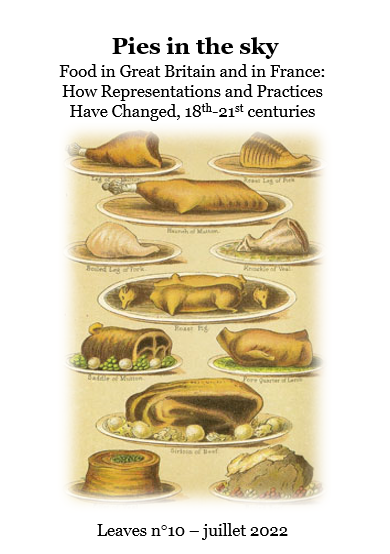
The first kind of rabbit is as remote from the sweetheart as a caveman is from an Englishman. As a distant relative, the warrener is spoken of with vague respect for the sake of his primitive virility. The transitional kind of rabbit, the parker, is noted for his fertility and usefulness. The condescending tone used to describe the first two kinds becomes scathing when Mrs Beeton depicts the hedgehog. This “vagabond rabbit” who “would have a much better coat on his back if he was more settled in his habits” (488) is an unmistakable anthropomorphic reference to travelling workers (often Irish people), gypsies, and nomads. It reveals both a class and an ethnic prejudice. Mrs Beeton’s judgemental stratification of people, animals and food is illustrated in ornamental monochrome and colour plates. While natural barbarism is conveyed in black and white images of raw materials, the triumph of civilised cuisine shines in colour plates.
Patriotism
While Mrs Acton used the common sense discourse of patriotism to support plain English cooking, Mrs Beeton more assertively waves the patriotic flag in the face of the culinary leaders—the French. The author takes things very much to heart when she hears English cuisine criticised: “It has been asserted, that English cookery is, nationally speaking, far from being the best in the world. More than this, we have been frequently told by brilliant foreign writers, half philosophers, half chefs, that we are the worst cooks on the face of the earth” (49), and she embarks on the self-appointed mission to set the national reputation right. It seems to Mrs Beeton that, generally, the products of English farming are vastly superior to those produced anywhere else in the world, and that “one great cause of many of the spoilt dishes” arises “from a non-acquaintance with ‘common, every-day things’” (49). Lack of practical education then is to blame and Beeton makes it her duty to remedy the situation. Her book is more than a collection of recipes: it is an instrument of patriotic propaganda. One of Beeton’s strategies to restore British housewives’ morale in the face of the enemy is to gather them under the banner of a national emblem: Roast beef. Mrs Beeton explains that it “has long been a national dish in England. In most of our patriotic songs it is contrasted with the fricasseed frogs, popularly supposed to be the exclusive diet of Frenchmen” (307). The author even goes as far as to quote the patriotic ballad “The Roast Beef of Old England.” When the mythologised meat needs to be defended as the uncontested British specialty, the author engages in a written duel against the French editor Léon Curmer, asserting again and again the superiority of English raw material:
It has been all but universally admitted that the beef of France is greatly inferior in quality to that of England, owing to inferiority of pasturage. M. Curmer, however, one of the latest writers on the culinary art, tells us that this is a vulgar error, and that French beef is far superior to that of England […] No, M. Curmer, we are ready to acknowledge the superiority of your cookery, but we have long since made up our minds as to the inferiority of your raw material (302).
Mrs Beeton’s propaganda strategy relies on the promotion of national products, and she misses no chance of speaking highly of the humblest English product. For instance, she introduces the “useful and wholesome” gooseberry as “indigenous to the British Isles” and specifies, “the high state of perfection to which it has been here brought, is due to the skill of the English gardeners; for in no other country does it attain the same size and flavour” (205). Similarly, “the white Aylesbury duck is, and deservedly, a universal favourite. Its snowy plumage and comfortable comportment make it a credit to the poultry-yard” (452).
Foreign depreciation is also useful in a patriotic rhetoric, and Mrs Beeton’s criticisms may concern raw materials, ways of cooking them, or national characteristics. Slavery is particularly odious to Mrs Beeton and she recounts an anecdote that took place in “one of the native states of Africa” where a family of thirty-two were made slaves for the killing of a pig and concludes her story with the moral that, “in the barbarous justice existing among these rude people, every member of a family is equally liable as the individual who committed the wrong, the father, mother, children, relatives,—an entire community, to the number of thirty-two souls, were sold as slaves, and a fearful sum of human misery perpetrated, to pay the value of a thieving old sow (384). A human being is worth less than a pig for “these rude people” who still practice slavery, which had been abolished in Britain less than thirty years previously. Sometimes, the abolitionist plea is less direct. When it complains about fowls with clipped wings or kept in small dark cages, it euphemistically condemns prisons:
It may be urged, in the case of domestic fowls, that from constant disuse, and from clipping and plucking, and other sorts of maltreatment, their wings can hardly be regarded as instruments of flight; we maintain, however, that you may pluck a fowl’s wing-joints as bare as a pumpkin, but you will not erase from his memory that he is a fowl, and that his proper sphere is the open air. If he likewise reflects that he is an ill-used fowl—a prison-bird—he will then come to the conclusion that there is not the least use, under such circumstances, for his existence; and you must admit that the decision is only logical and natural. (460)
In countries where severe punishment is current, people become depressed and resentful. Mrs Beeton’s anthropomorphic chickens will experience the same feelings when put in penitentiary circumstances, and produce a nasty flesh. The more generous and benevolent British system ensures that Britain provides a safe growing place for human, animal and plant life. For example, sheep reared on the English Downs make a superior breed because “the herbage of these hills is remarkably nutritious” due to “the natural healthiness of the climate, consequent on the dryness of the air and the moderate elevation of the land” which are all “eminently favourable” (341). This excellent race is perfectly adapted to its environment, and does not thrive in other parts of the globe. “The mutton of the South-Down breed of sheep is highly valued for its delicate flavour, and the wool for its fineness; but the best specimens of this breed, when imported from England into the West Indies, become miserably lean in the course of a year or two” (341). As if to warn her readers against the sorrows of colonial exile, she explains: “their woolly fleece gives place to a covering of short, crisp, brownish hair” (341). When transplanted from home abroad, species often decline. However, when the opposite displacement occurs, successful results more frequently happen.
Non-Western (and in Mrs Beeton’s eyes, less advanced) countries display the characteristics of distant ages. The travel in space is also a travel in time so that some parts of the globe such as India still perform ancient sports and rituals, and the readers learn that boar-hunting, which “has been for some centuries obsolete in England, the animal no longer existing in a wild state among us” is still a pastime “in our Indian empire, and especially in Bengal” (376). As if animated by the memories of their ancestors, modern Britons in Bengal pursue boar-hunting “with all the daring of the national character; and as the animal […] is a formidable foe, the sport is attended with great excitement” (376). Not individual cruelty but rather the atavistic survival instinct triggered by the backwards environment is to blame for the questionable behaviour of British colonialists.
To those who defend the value of localism, such as Dr. Paris, who, in his work on Diet, contends that “Foreign spices were not intended by Nature for the inhabitants of temperate climes; they are heating, and highly stimulant” (183), Isabella Beeton opposes the proto-globalist argument that “Man is no longer the child of Nature, nor the passive inhabitant of any particular region. He ranges over every part of the globe, and elicits nourishment from the productions of every climate” (183). Then, using precedence as a justification for expansionism, the author plainly states her vision of the globe as a giant market: “if we go to the East for tea, there is no reason why we should not go to the West for sugar” (183). Maybe her readers were ready to believe that the whole purpose of the Empire was to supply England with exotic foodstuff, and eager to follow a husband posted in the colonies for this noble purpose.
Colonialism
In the second half of the nineteenth century, white women living in the empire were more numerous than ever before. English wives who embarked for the colonies invariably took with them all the equipment necessary to preserve a British-style standard of living, among which a household management book, likely to be Mrs Beeton’s. More and more authors however specialised in the specific case of colonial housewives. We have seen how Mrs Beeton’s small script paragraphs often naturalise prejudices based on sex, class and ethnicity. So even before she left Britain, the colonial home-maker would have read in her mother’s or her sister’s copy of Mrs Beeton’s book many “facts” about life and food that made her internalise a stratified view of the world, where the leaders are the most developed British males. Then, she would probably acquire Flora Steel and Grace Gardiner’s Complete Indian Housekeeper and Cook (1888) dedicated to “The English girls to whom fate may assign the task of being housemothers in our Eastern Empire” (title page). This very influential book consolidated British confidence in imperial rule and its reproduction on a household scale (Blunt 422). It follows the same pattern as Mrs Beeton’s book, starting with recommendations to the mistress on her duties, followed by some fifty pages on servants’ duties, including the list of equipment each will require for the effective fulfilment of their duties. The rest of the book consists of anecdotes, advice and recipes.
Just like Mrs Beeton’s Book of Household Management, publications targeted towards the colonial reader can be seen as instruments of propaganda. Their prefaces, dedication pages, and small print comments define the white woman’s burden as that of maintaining high British standards in the most trying circumstances. The general of her domestic army in England, the homemaker literally became an empress in India. “We do not wish to advocate an unholy haughtiness,” boldly wrote Steel and Gardiner, “but an Indian household can no more be governed peacefully, without dignity and prestige, than an Indian Empire” (11). A paragon of dignity and Christian virtue in England, the housemistress had to keep up her exemplary conduct in the colonies and “always remember her responsible position, never approving a mean action, nor speaking an unrefined word. Let her conduct be such that her inferiors may respect her” (Beeton 19). In the colonial context she became a veritable ambassador of British manners. Very often, the British posted in India came from middle-class backgrounds and liked to think of themselves as the local aristocracy. Their readers likely imitated the patronising tone Steel and Gardiner use when describing Indian people, customs and food. This tone was part of the colonial rhetoric, which insisted on the selflessness of the coloniser and the primitive inaptitude of the locals. A successful Anglo-Indian housewife should shun the example of “many Indian mistresses, who put up with a degree of slovenliness and dirt which would disgrace a den in St. Giles, on the principle that it is no use attempting to teach the natives” (Steel and Gardiner 1). This superior attitude reflects the class prejudice observed at home in books by Mrs Beeton and Mrs Acton. The latter author complained in her preface about the kitchen waste due to the inaptitude of servants “who, more than any other class of people in the world, would appear to be ignorant of the true value of money” (1845 viii-ix). To the class bias, racial stereotype was added to construe Indian servants as “absolute children” (Steel and Gardiner 3).
To elaborate their epic tales of success in their perilous mission as female ambassadors of civilisation, the usual narrative steps are required, and include a change of setting, the facing of obstacles, overcoming them, and a change in character or shift in perspective, making the author come back to the ordinary world a better person with a lesson to share. This explains why,
[u]ndoubtedly, there would be exaggeration for difficult living conditions, difficulties in sourcing food supplies and the incompetence of domestic cooks. In writing about the colonial household, female authors had a fine balancing act to follow. It was important to illustrate the hardship of supervising large numbers of incompetent native servants in the colonial household that was so different to the British family home. At the same time authors had to express triumphantly that in the end memsahibs always coped against all the odds. The colonial women had to be seen as doing empire’s work, ensuring that the colonial household was run smoothly and their families and visiting administrators were well nourished. (Leong-Salobir, 2015 143)
Culinary hybridism highlighted the shift in perspective undergone by both the colonial housewife and her local domestics. While English and European recipes were selected for official receptions, local dishes formed the ordinary diet of Anglo-Indians. Angela C. Spry wrote in 1894 that “curry is eaten in almost every household at least once daily, generally at breakfast” (Leong-Salobir, 2015 139). Indeed, curry formed an important part of the culinary repertoire of everyday life in British India and anglicised versions of the local cuisine featured more and more in cookbooks. As “Retired Indian officers and their wives offered recipes for British women running households in India, adapting British cuisine to Indian conditions,” they also “included instructions for Indian dishes” (Leong-Salobir, 2015 140). Curry thus evolved as a practical, economical, and culturally hybrid dish that could be made from leftover meat, poultry, and vegetable seasoned with preservative spice. In India, it testified to the adaptation both coloniser and colonised were ready to operate on their national diet. In Britain, “along with the commercialisation of curry powders in the nineteenth century, curry became a defining dish of empire” (Leong-Salobir, 2015 138).
Curry was popularised by memsahibs who “served as important agents for many upper middle- and middle-class families to acquire the tastes of Indian material culture. They played a large role in the transfer of culinary culture. By providing recipes of Indian dishes they enabled even the lower middle-class and working-class women to have a share in the imperial experience and the benefits of empire”, and a taste of what had become Queen Victoria’s favourite meal since 1887 when she first tasted a curry dish prepared for her by her devoted servant Abdul Karim (Chaudhuri 242).
Conclusion
Cookery books by both British and Anglo-Indian authors propagated ideas of British superiority, sided with Britain’s allies, and romanticised the “exotic.” They also brought a microcosm of British society to India within the domestic sphere, which reinforced and supported Britain’s imperial mission. As noted by Cecilia Leong-Salobir, “these publications also served as a tool of empire as they helped to strengthen the colonial community. The colonial home was seen as a bastion of white imperialism where the memsahib imposed the rituals and tasks that defined colonial culture” (Leong-Salobir, 2015 150). Whether intentional or not, these sources reflect the active role women played in imperialism. They reveal women as power players in the imperial conquest. Susan Zlotnick convincingly suggests that “Victorian women could neutralize the threat of the Other by naturalizing the products [such as curry] of foreign lands” (53). Through this process, Victorian women could “domesticate imperialism” at both the symbolic and the practical levels.
In enacting small-scale military or imperial rule within the home, British and Anglo-British women supported and spread European values and prejudices while also spreading the newly defined British culinary culture. Yet, the effects of empire did not go just one-way. Colonial culture also implied modifications and adaptations in national culinary and domestic practices, and shaped contemporary British history and identity.
Works cited
- Acton, Eliza. Modern Cookery in all its Branches. Longman, Brown, Green and Longmans, 1845.
- Acton, Eliza. Modern Cookery for Private Families. Longmans, Green and Co., 1887.
- Beeton, Isabella. The Book of Household Management. Beeton, 1861.
- Blunt, Alison. “Imperial Geographies of Home: British Domesticity in India, 1886-1925.” Transactions of the Institute of British Geographers, vol. 24, n°4, 1999, pp. 421-440.
- Chaudhuri, Nupur. “Memsahibs and Motherhood in Nineteenth-Century Colonial India.” Victorian Studies, vol. 31, n° 4, 1988, pp. 517-535.
- Chaudhuri, Nupur. “Shawls, Jewelry, Curry, and Rice in Victorian Britain.” Western Women and Imperialism: Complicity and Resistance, edited by Nupur Chaudhuri and Margaret Strobel, Indiana UP, 1992, pp. 231-146.
- Chaudhuri, Nupur and Margaret Strobel. “Introduction.” Western Women and Imperialism: Complicity and Resistance. Indiana UP, 1992, pp. 1-15.
- Disraeli, Benjamin. Wit and Wisdom of Benjamin Disraeli, Earl of Beaconsfield, Collected from his Writings and Speeches. Longmans, Green & Co, 1883.
- Ferguson, Niall. Empire: How Britain Made the Modern World. Penguin, 2004.
- Gilmour, David. The Ruling Caste: Imperial Lives in the Victorian Raj. Farrar, Straus and Giroux, 2005.
- Leong-Salobir, Cecilia. Food Culture in Colonial Asia: A Taste of Empire. Routledge, 2011.
- Leong-Salobir, Cecilia. “Spreading the word: using cookbooks and colonial memoirs to examine the foodways of British Colonials in Asia, 1850-1900.” The Routledge History of Food, edited by Carol Helstosky, Routledge, 2015, pp. 131-155.
- Steel, Flora, Annie Webster, and G. Gardner. The Complete Indian Housekeeper and Cook. 2nd ed., F. Murray, 1890.
- White, Eileen, editor. The English Cookery Book. Historical Essays. Prospect Books, 2004.
- Zlotnick, Susan. “Domesticating Imperialism: Curry and Cookbooks in Victorian England.” Frontiers: A Journal of Women Studies, vol. 16, n° 2-3, 1996, pp. 51-68.
About the author(s)
Biographie : Béatrice LAURENT est Professeur de civilisation britannique et d’études victoriennes à l’Université Bordeaux-Montaigne. Après une thèse sur les peintres préraphaélites, elle a coordonné un ouvrage collectif sur William Morris (News from Nowhere, 2004). Elle est également l’auteur de La Peinture anglaise (2006), de Provence and the British Imagination (co-direction, 2013), et de Sleeping Beauties in Victorian Britain: Cultural; Literary and Artistic Explorations of a Myth (direction, 2015). Ses recherches s’intéressent aux passerelles entre art, littérature, sciences et société pour mettre au jour les similitudes conceptuelles et leurs représentations, notamment durant la période Victorienne.
Biography: Béatrice LAURENT is Professor of Victorian Studies at the Université Bordeaux-Montaigne. A Pre-Raphaelite scholar, Béatrice has edited a volume of essays on William Morris’s News from Nowhere (2004). She also authored La Peinture anglaise (2006), and edited Provence and the British Imagination (2013) and Sleeping Beauties in Victorian Britain: Cultural, Literary and Artistic Explorations of a Myth (2015). Her broader field of research covers the zones of conceptual overlapping between art, literature, science and society, particularly in Victorian Britain.