Shift or Dissolution? Fantasy Literature and the Emergence of “All-age”
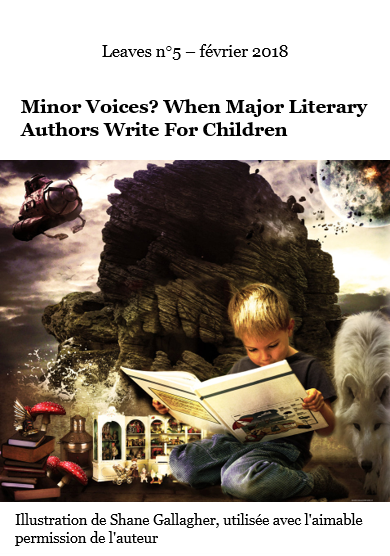
Abstract: From its origins in ancient myths and legends to its modern manifestations, the fantasy genre has undergone many shifts from being recognized as “major” for adult audiences to being considered “minor” children’s literature, and vice versa. In recent years, however, a new category has emerged in addition to this binary of children’s texts and adult texts: the so-called “all-age” literature, which pertains to fantasy in particular. Therefore the question arises whether this is the beginning of the established binary’s dissolution, or whether it is merely another shift that gradually allows fantasy to enter the realm of “major” literary texts once again. This paper examines whether all-age fantasy literature dissolves the established binary between children’s and adult literature, or whether all-age merely shifts the perception of fantasy as a children’s genre towards fantasy as suitable for adult readers while leaving the binary itself intact. With Philip Pullman’s His Dark Materials trilogy serving as an example, it will be shown that both shift and dissolution can take place at the same time.
Keywords: Fantasy, Philip Pullman, His Dark Materials, Children’s literature, All-age
Résumé : Depuis ses origines dans les mythes et légendes de l’Antiquité jusqu’à ses plus récentes manifestations, la fantasy a subi de nombreuses mutations. Jadis reconnue comme un genre « majeur » destiné à un public adulte, elle est à présent considérée comme « mineure » et associée à la littérature pour enfants. Une nouvelle catégorie venant perturber l’opposition binaire entre textes pour enfants et textes pour adultes et connue sous le nom de littérature « pour tous les âges » (all-age) a toutefois récemment vu le jour. Sommes-nous fondés à voir là les prémices de la dissolution des anciennes catégories ? Ou bien simplement un glissement de plus qui permet à la fantasy de réintégrer la sphère des textes réputés « majeurs » sans remettre en question l’existence même de ces catégories ? Ce sont là les questions qu’aborde cet article à la lumière de la trilogie de Philip Pullman, His Dark Materials. Nous verrons ainsi comment les processus de glissement et de dissolution peuvent opérer conjointement dans une seule et même œuvre.
Mots-clés : Fantasy, Philip Pullman, His Dark Materials, Littérature « jeunesse », Littérature pour tous les âges
From its origins in ancient myths and legends to its modern manifestations, the fantasy genre has undergone many shifts in perception. During different periods of time fantasy texts were either considered suitable for children or for adults. In recent years, however, a new category has emerged in addition to this binary of children’s texts and adult texts: the so-called “all-age” literature, which pertains to fantasy in particular. Therefore the question arises whether this is the beginning of the established binary’s dissolution, or whether it is merely another shift that gradually allows fantasy to enter the realm of “major” literary texts once again.
In this paper, this question will be examined taking Philip Pullman’s His Dark Materials trilogy as an example. Pullman’s texts were officially labeled and marketed as children’s literature upon publication in the U.K. Yet critical reviews and the complex layers of meaning within the story can be seen as evidence that the books are not intended solely for child readers. Nor do they appeal exclusively to them. This proves the strict binary between children’s and adults’ texts to be questionable, indicating that it could dissolve into “all-age” at least with regard to this particular trilogy.
For fantasy texts in general, however, the resulting uncertainty in categorization can also be seen as the beginning of a shift in perception, gradually allowing the fantasy genre back into the realm of “major” adult literature as well. The Dark Materials trilogy shows that both shift and dissolution can take place at the same time, the blurring of boundaries with regard to one particular work not necessarily meaning that the same process is happening to other texts as well, but rather triggering a shift.
Shifts in the Perception of Fantasy Literature
Fantasy, or “the presence of the impossible and the unexplainable” as Mendlesohn defines the term (Mendlesohn 11), is a genre that may well be as old as storytelling itself. Very early written texts like the Epic of Gilgamesh, for example, are fantasy according to this definition. The Odyssey, the Niebelungenlied, and many other “classics” are fantasy texts. They are considered to be “literary” and “major” in the sense that they are complex and worthwhile for an intelligent, critical, adult reader. However, contemporary fantasy is not always seen in such favorable light: it is often classed as “genre” fiction to distinguish less sophisticated, simple entertainment from “literary” fiction. Only in children’s literature does fantasy appear to have maintained a higher status (Nikolajeva 2012, 61).
Of course, fantasy for children cannot be discussed without taking the context of children’s literature in general into consideration. First of all, the very idea that children might need, want or require literature specifically addressed to them did not emerge until the middle of the 19th century. Until then, the concept of children as small adults was still wide-spread. With the Enlightenment, children came to be seen as individuals for the first time—individuals that first and foremost required education and shaping to become adults. With Romanticism a new construction of childhood emerged, however. In this view childhood was seen as an ideal and natural state that should not be tamed and overcome by education but, on the contrary, was to be preserved. Works such as Máire Messenger Davies’ Children, Media and Culture (2010) or Neil Postman’s much debated The Disappearance of Childhood (1982) discuss this and in far more detail. What is important to note here, though, is this: the consensus is that childhood is a social construct, and the idea that there should be a separate kind of literature for children was constructed along with it. There are rivaling views on what texts for children should or could be like, and scholars such as Jacqueline Rose (The Case of Peter Pan, 1992) even question the existence of a genuine children’s literature: “Children’s fiction sets up a world in which the adult comes first (author, maker, giver) and the child comes second (reader, product, receiver)”, she states (Rose 1-2). Adults write, sell and buy books for children. Fantasy for children—but not only fantasy—included philosophical and ethical aspects that spoke more to adults than to children from the very beginning (Nikolajeva 2012, 50).
Characteristics such as a happy ending and a plot about growing up (Sullivan 442, 445), simple story structure and flat, static characters (Nikolajeva 1999, 69) are frequently attributed to children’s literature. However, even a book that includes all of these aspects would not necessarily be a children’s book. Therefore, the question of what children’s literature is and how the term can be defined shall be answered in a more pragmatic way in the context of this paper: children’s literature includes texts sold to and read by children. The fact that the matter is very complex should not be forgotten, but this simplified definition shall suffice for now.
With this context in mind, then, it can be said that children’s fantasy has been around just as long as children’s literature. Early examples for fantasy texts explicitly marketed to a child audience are works such as E.T.A. Hoffmann’s The Nutcracker and the Mouse King (1816), Lewis Carroll’s Alice in Wonderland and Carlo Collodi’s The Adventures of Pinocchio (1881) (Nikolajeva 2012, 50). By the end of the 19th century, there were still authors writing fantasy for adults as well, but an interesting phenomenon could also be observed: stories that had originally been aimed at an adult audience—like James Barrie’s Peter Pan—were now adapted to fit the new category of children’s literature, so that they could be marketed to this new target audience (Mendlesohn and James 29).
Power relations and conflicts between good and evil have always been at the heart of the genre (Nikolajeva 2012, 50). In some cases, the portrayal of these issues was and is somewhat formulaic, with very clear and simple messages to the reader about what is right and what is wrong. But still, like almost any kind of children’s literature, dual address is inherent in children’s fantasy. The vast majority of children’s books is written, marketed, and purchased by adults, even if they are then passed on to children, and thus these books tend to include at least some aspects that are attractive to adults as well.
But just as the fantasy genre as a whole has undergone dramatic shifts of perception from “major” literature to “minor” genre fiction, the popularity of fantasy for children changed over time. In the UK and Europe as a whole, the so-called Golden Age of children’s literature came to an end in the early 20th century. The First World War not only led to paper shortages, but also caused a change in the role that children played in society. They were no longer deemed “innocents” that could dwell in protected “gardens” (Paul, Ross Johnston and Short i) or fantastical tales, but instead were considered active to present or future war efforts. In the middle of the century, though, fantasy for children reached a new peak, with works like J. R. R. Tolkien’s The Hobbit (1937) and C. S. Lewis’s The Chronicles of Narnia (1950-1956) having paved the way for many new writers: a new golden age of children’s fantasy began in the 1960s (Mendlesohn and Edwards 78; Said). With texts such as Ursula K. Le Guin’s A Wizard of Earthsea (1968) or texts by Diana Wynne Jones, complex secondary worlds were introduced, traditions were played with, and the genre flourished—at least for a while.
The next shift came in the 1970s. Again, changing constructions of childhood were crucial to the development of children’s literature and triggered change (Bonacker IX). Up until this point, children had been seen as vulnerable, easy to influence, and in need of protection from any potential threats. This view was widespread in Europe. In German, the term Bewahrpädagogik describes the educational focus of this time quite precisely: bewahren means to keep someone or something from taking harm, or to preserve the status quo. This concept of the vulnerable and easily manipulated child, however, was replaced by the idea of a more independent and emancipated child in the 1970s—a child who could also be a more sophisticated reader.
The trend in children’s literature turned towards realism. Children, it was argued, wanted to read about the challenges they recognized from their own lives, without sugarcoating or whitewashing of hard facts. Fantasy was accused of being escapist by some critics; others would call it tomfoolery, as Ursula Zierlinger points out (Zierlinger 334). Either way, fantasy books for children did not sell particularly well until the early 1990s, when works like J. K. Rowling’s Harry Potter series and Philip Pullman’s His Dark Materials trilogy conquered bestseller rankings and readers’ hearts alike. Pullman’s books in particular also gained critical acclaim, despite the fact that at first glance they could be considered “minor” in two ways at once: first, in being marketed as children’s books upon publication in Great Britain, and second, in being fantasy rather than literary realism. In fact, though, it is far more complicated to categorize the trilogy either as a children’s or an adult text, as genre or literary fiction, or as “minor” or “major.”
Philip Pullman’s His Dark Materials and Fantasy for All Ages
With regard to the trilogy being “genre” fiction or not, it is primarily statements by Pullman himself that fuel the debate. On several occasions, he claimed that his books are, in fact, “stark realism” (Pullman Interview, 1999, qtd in 2010 Mythopoeic Society) rather than fantasy; that the fantastical elements—witches, angels, talking armored bears, and portals between worlds, to name but a few—are only there to highlight the realism of conflicts and emotions. Upon closer inspection, however, this line of argumentation does not at all prove that His Dark Materials is not fantasy. Instead, it shows clearly just how much Pullman is part of the fantasy tradition whether he is willing to admit it or not. As Maria Nikolajeva puts it: “The best examples of classical fantasy for children use the fantastic form as a narrative device, as a metaphor for reality” (Nikolajeva 2012, 60).
In this sense, then, Pullman’s trilogy can be considered genre fantasy fiction. At the same time, though, it is also recognized as literary. The His Dark Materials books ask fundamental questions of humanitarianism, religion, and moral values. The story alludes to the biblical fall of man, yet here the loss of innocence is depicted as the positive outcome even though it comes at a high cost. Lyra is “Eve! Mother of all! Eve, again!” (Pullman 1997, 320) in the witches’ prophecy and the Church ruthlessly attempts to kill her.
Both characters and narrative structure are highly complex—especially in the later books of the trilogy—and there are many intertextual references; starting with the trilogy’s title itself, which refers to a line from John Milton’s Paradise Lost (Prael 70; Nikolajeva 1999, 67-69): “But all these in their pregnant causes mixt / Confus’dly, and which thus must ever fight, / Unless th’ Almighty Maker them ordain / His dark materials to create more Worlds” (Milton 55). As a result, the books of the trilogy have won several literary awards like the Carnegie medal and the Whitbread Book Award (Beckett 117; Prael 66; Nikolajeva 1999, 63).
This leads straight to the next question at hand: whether His Dark Materials could be considered children’s or adult fiction. As mentioned above, Pullman’s books were classified and marketed as children’s books upon publication in the U.K. But with the Whitbread Book Award, The Amber Spyglass won a prize for adult literature—the first book to ever do so in the history of this award (Prael 66).
The same aspects that make His Dark Materials “literary” also mark the trilogy as a text for adults. It cannot be assumed that a child reader would understand the intertextual references Pullman makes, or grasp the wider context of the existential issues at stake. Besides, children’s literature is often—and far too easily—defined as having simple, linear storylines, clear distinctions between good and evil, and noncomplex characters, neither of which is true for His Dark Materials. As a matter of fact, the main characters Lyra and Will are excellent examples for both points. Will kills a man very early on (Pullman 1997, 7) and Lyra is introduced as a liar. At the end of the third book, she herself reflects on this: “I know I haven’t always told the truth, and I could only survive in some places by telling lies and making up stories” (Pullman 2001, 516).
This indicates that the trilogy could be considered adult fiction as well. In the United States and other countries, the books were also marketed as such (Nikolajeva 1999, 63). They were outfitted with darker, edgier covers, placed in the adult sections of bookstores, and reviewed by critics as too complex for children to comprehend and cope with.
Nonetheless the books were originally published as children’s texts. After all, the protagonists are young people—Lyra is twelve years old and Will is fourteen—and the story tells of their coming-of-age and self-discovery, kidnappings, chases, magic, and adventure. At least in Northern Lights the narrative structure is also relatively linear and clear, even though it grows more complex in the sequels, and ultimately the young heroes have to overcome powers that are bigger than they are. In Northern Lights, the threat is introduced like this: “And so the legend grew of a mysterious group of enchanters who spirited children away. Some said their leader was a beautiful lady, others said a tall man with red eyes, while a third story told of a youth who laughed and sang to his victims so that they followed him like sheep” (Pullman 1995, 45).
This description foreshadows that the beautiful Mrs. Coulter is behind the kidnappings, it adds an extra touch of scariness for young readers through the man with red eyes, and with the mention of the singing youth leading the children away, it seems to allude to the older tale of “The Pied Piper of Hamelin”. Even in this short paragraph, Pullman plays with multiple layers of meaning. It is impossible to say whether Pullman’s books are adult or children’s fiction because they are both at the same time, combining aspects of what would typically be considered children’s and adult fiction. It has been pointed out before that all children’s literature includes some aspects of the adult in the form of implicit dual address, but the complexity of His Dark Materials goes beyond that. Adults, in this case, are not only co-readers or purchasers; they make up an important part of the main readership. His Dark Materials is all-age literature.
It should be noted here that the term “all-age” is somewhat over-simplified and in a way even misleading. It is also not identical with “crossover literature” (Falconer 2004). All-age refers to books being read and enjoyed by readers of different age groups, without claiming that the work in question was originally for only one target audience from which it then crossed over to the other. In this context, age should be considered as a proxy variable: it is not the age itself that is important, but other aspects that go along with it, like maturity, acquired knowledge and socialization.
According to Jean Piaget’s Cognitive Stage Theory (Piaget 1970), four stages of cognitive development can be identified. In the sensorimotor stage, infants begin to discover the world through concrete interactions with what is directly in front of them. This is followed by the preoperational stage, in which language use and an understanding of symbolic meanings are acquired, while perception is still dominated by an egocentric perspective and a focus on concrete objects or events. The operational stage is characterized by an increase in logical thinking and organization, but only in the fourth stage—the formal operational stage—is abstract thinking fully developed. According to Piaget, this stage begins around the age of twelve. However, subsequent research has shown that cognitive development is a continuous process and that the pace of an individual’s development can vary widely, even though the order in which cognitive skills are acquired is the same (Hoppe-Graff 156). Age and age-based stages can serve merely as an approximation.
Therefore the reason that children might not understand intertextual references or symbolism is not their age in and of itself. It could be because they have not yet developed abstract thinking, and because children are unlikely to come across some topics until they reach a certain point in the school curriculum. Thus, all-age literature does not simply serve different age groups; it manages to address different interests and different levels of comprehension and literacy which simply tend to occur most often during one period of life or another. This should be kept in mind when using the term “all-age.”
All-age literature, and especially all-age fantasy, became popular in the late 1990s and this trend has persisted until today. Still, the phenomenon itself is much older. In addition to the dual address inherent in most children’s literature, all-age texts were especially popular during certain periods in the past. This can be observed in the 1850s (Ewers 19), and even earlier if one takes fairy tales into account. In the 1970s, too, a brief high of all-age fantasy took place, despite the fact that in children’s literature realism grew more popular soon after (Ewers 16).
All-age literature is defined as such by two dimensions working together: content and marketing. The marketing dimension, which is sometimes also labeled as “form” (Ewers 5) includes aspects such as cover design or placement in certain sections of a bookstore – or, online, recommendations in separate lists and categories. The books in question are fitted with a cover that is neither in the style of a children’s book, nor too “grown-up”, and they are either listed in publisher’s children’s and adult catalogs or in a catalog of their own. At a time when all-age has been recognized as a trend, even titles that are considered to be literary fiction for adults by their authors are marketed as books for younger readers, too. The writers Margo Rabb and Kate Axelrod detail this in essays about their own experiences. Neither of them writes fantasy, but their reports illustrate the problems and challenges of marketing when it is unclear which age-group a book might appeal to.
On the content level, all-age expands on the dual address of children’s literature. This usually includes the use of different and complex themes, references, and multiple layers of meaning in the same story, as shown in the discussion of His Dark Materials above. As soon as a book’s potential to reach a wide audience is recognized, this usually reflects in its form and marketing. When the all-age appeal only shows after publication, the formal aspects are sometimes added later. This was the case with Pullman’s books, as they were originally marketed as children’s books in the U.K., or as adult fiction in the U.S., but when it became apparent that they sold well in both markets, publishers reacted accordingly and either designed editions for children and adults, or came up with all-age editions that adjusted the form of the books to match the different levels of their content, chiefly by changing covers to suit each audience.
Fantasy literature lends itself to all-age particularly well because it traditionally deals with universal themes that are relevant at any age—the fight between good and evil, different concepts of society, and the question of belonging. In His Dark Materials, alternate forms of societies and magic merge in the maternal structures of the witch-clans or the warlike society of the armored bears. The theme of a fight between good and evil, innocence and seduction, is crucial, particularly because Pullman questions what exactly constitutes “good” and “evil.”
Similarly, in the all-age fantasy saga The Tales of the Otori by Lian Hearn—an alias of Gillian Rubinstein—one of the key questions is whether it is possible at all for people to live in peace with one another. In Brilliance of the Moon the concern is voiced that violence might continue in a vicious cycle forever, but there is also hope that “Everything that has a beginning has an ending” (Hearn Across the Nightingale Floor, 72) and that in the end peace will come even if it is at the price of bloodshed. The author herself elaborates on these themes on her website (Hearn, LianHearn.com).
The question of belonging is also addressed in Hearn’s books, but a particularly striking use of the fantastic to heighten the conflicts of finding one’s place in the world can be observed in Ursula K. Le Guin’s Gifts (2004). In the society where the main character Orrec grows up, people are defined by the special magical gifts they possess. At first he does not fit in because he doesn’t seem to have a gift at all. Then, it appears as though his gift were so deadly and uncontrollable that he refuses to use it. But soon he discovers that it was all a trick by his father: Orrec really does not have a magical gift, but he could continue to pretend. However, he gives up the place and people he had always known instead in order to find his own path despite the uncertainties and risks involved: “That is a great fear among Uplanders: to be among strangers. But where is it not?” (Le Guin 273).
In addition to its universal themes, fantasy literature opens up the boundaries between the life experiences of adults and children because the fantastic breaks through the patterns of everyday life, thus focusing on something that is unknown and fascinating to both adults and children alike. To use the Harry Potter books as an example: In Harry Potter and the Sorcerer’s Stone (Rowling 1997), young Harry transfers to a new school, which is an experience particularly relevant for children that are about to finish elementary school. For adults, such a transition is less exciting as they have already passed it. Yet in the case of Harry Potter, the school in question is a magical one—and this is something that is strange and unfamiliar to everyone.
All in all, Pullman’s His Dark Materials trilogy is a near-perfect example of all-age. It combines different layers of meaning—from coming-of-age story to issues of humanity and religion—with a genre that offers even more elements appealing to different age groups. The trilogy is marketed to and appreciated by both audiences as well, as can be seen both in sales figures, critiques, and literary awards (Becket 117). This, then, triggers two more questions: does all-age fantasy like Philip Pullman’s His Dark Materials dissolve the boundaries between children’s and adult literature? If this is the case, what are the implications for the fantasy genre?
The Dissolution of “Minor” and “Major”
There are three prominent views of what all-age literature does to the binary of adult and children’s literature. The first is that all-age books are, for the most part, not children’s texts at all; that they are simply adult books with a new cover because this new cover sells well. “Isn’t this necessarily creating a literature that only appears to be addressing children, when in fact it is peering at the adults?”, wonders literary critic Tilman Spreckelsen (1). The second view is also predominantly held by academics but directly contradicts this. Here, the claim is that all-age literature is only fit for children and that adult readers of such texts degrade themselves to a childlike level (Löffler 32-34). The third view is that there really is no longer a boundary between children’s and young adult literature on the one hand and adult literature on the other (Ewers 6-11). On the content level, this can be said to be true for Pullman’s trilogy, with its multiple layers of meaning, complex story structure, and intertextual references, as has been shown above. The fact that His Dark Materials has won awards for both adult and children’s literature and that it is widely received by both groups—as books, movie, and soon as a TV series (Johnson and Noel)—further proves this point.
As to the claim that all-age is not children’s literature at all, a somewhat flippant counter-argument could be that this very much depends on definition. If children’s literature is literature read by children, then His Dark Materials are certainly children’s books. But aside from that, if one takes a closer look at the content, several typical characteristics of children’s literature can be identified as well, from the young age of the protagonists to the elements of adventure and even the author’s statement that “There are some themes, some subjects, too large for adult fiction; they can only be dealt with adequately in a children’s book” (Pullman Carnegie Medal Speech, 1995, qtd in Millner 7).
This leaves only the third option: that His Dark Materials really is all-age and that there are, at least with regard to this trilogy, not necessarily thematic boundaries between children’s and adult texts. Thus, the discussions of Pullman’s books depict the debate about the existence of all-age in a nutshell. What is rarely addressed in this context, though, is the question whether all-age dissolves the boundaries between children’s and adult literature, or if it merely inserts an additional category in between while leaving the boundary itself intact. Trying to answer this question on a content level would be near impossible. Depending on which definitions are chosen for the terms “children’s literature” and “adult literature” the outcome might change completely. Thus, we will take a look at the public discourse instead. The simple fact that there is a new term—all-age—indicates that these books are thought of as belonging to a new category. In addition, all-age literature has experienced popularity before and still the construct of children’s texts on the one hand and adult texts on the other remains stable.
However, the need to create a new formal category still shows that the strict binary is rather questionable. As shown above, a categorization based on content characteristics is also more complicated than it might seem at first glance. With the growing popularity of all-age fantasy, this has become very obvious on a wide scale. The trend that was started by books like His Dark Materials or the Harry Potter series brought this issue to the foreground. The boundaries between children’s and adult literature have always been fuzzy, to the point where the possibility of children’s literature has been questioned, but this fuzziness has been glossed over by the belief in a strict binary. It is this belief that has been shaken by the emergence of all-age; the boundaries are now more easily recognized as questionable, and thus they begin to dissolve upon closer observation.
With regard to Pullman’s books, it is so hard to categorize them that the debate they create indicates the dissolution of the children’s / adult literature binary. Of course, a single trilogy cannot annihilate a long-established boundary on its own, but together with many other texts and changing perceptions of childhood, it can blur the distinction between “minor” children’s literature and “major” adult texts. Thus, it can be said that all-age fantasy, at least to some extent, indeed dissolves the boundaries between children’s and adult fiction. This answers one of the two questions posed earlier in this paper. The second one still remains: what does this dissolution mean for the fantasy genre?
For fantasy texts in general, the uncertainty in categorization when it comes to Pullman’s books can also be seen as the beginning of a shift in perception. While fantasy has been considered “minor” literature for children and hardcore fans for a long time, His Dark Materials proves this categorization doubly wrong. The trilogy not only makes the distinction between adult and children’s literature impossible; it also makes it impossible to maintain a clear binary between “genre” and “literary” fiction. After all, it has been granted literary awards and has been well received by critics. His Dark Materials shows that both shifts in the perceived “literariness” of a genre and the dissolution of boundaries between readership groups can take place at the same time. This process happening with regard to one particular work does not necessarily indicate a change in general, but it can be seen as the beginning of a shift in the way different kinds of boundaries are perceived.
Conclusion
It is impossible to tell whether the blurring of boundaries – both between children’s and adult literature and between genre fantasy and literary fiction – is a temporary phenomenon or not. Perhaps the popularity of all-age will soon begin to decline once again. Then, fantasy might be considered “minor” once again, only for children and particular fans of the genre. Or maybe the shift in appreciation that can be observed with regard to Pullman’s His Dark Materials will continue to a point where fantastical texts are recognized as “major” adult literature again, even if they are contemporary works and not part of the classical canon that contains the Odyssey and Gilgamesh. A third possibility would be that all-age fantasy literature has actually triggered a change in the perception of boundaries and binaries that will last and dissolve the distinction between adult and children’s literature for good.
However, the notion of children’s literature is tied closely to the idea of childhood itself, so as long as children are seen to have their own specific wants and needs, they will most likely also have literature ascribed to them. Thus, a complete disappearance of this category is unlikely, even if the boundaries dissolve more and more.
To sum up, it can be said that all-age fantasy questions established binaries, has potential to dissolve their boundaries to a certain degree, and can thus trigger shifts in perception, both with regard to genre and to age-based readerships. In the end, though, only time will tell whether the popularity of all-age literature will continue, and whether or not it will bring any long-term change.
Bibliography
Primary Sources
- Hearn, Lian. Across the Nightingale Floor: Journey to Inuyama. Episode 2. New York: Firebird, 2005.
- Hearn, Lian. Brilliance of the Moon. London: Macmillan, 2004.
- Le Guin, Ursula K. Gifts. New York: Harcourt Publishing, 2004.
- Milton, John. Paradise Lost. New Edition. Ed. Merritt Y. Hughes. Indianapolis & Cambridge: Hackett Publishing Company, 2003.
- Pullman, Philip. Northern Lights. London: Scholastic UK Ltd, 1995.
- Pullman, Philip. The Subtle Knife. London: Scholastic UK Ltd, 1997.
- Pullman, Philip. The Amber Spyglass. London: Scholastic UK Ltd, 2000.
- Rowling, Joanne K. Harry Potter and the Sorcerer’s Stone. London: Bloomsbury, 1997.
Secondary Sources
- Axelrod, Kate. “The time my grown up novel was marketed as young adult.” Literary Hub. 05/01/2016. ˂http://lithub.com/the-time-my-grown-up-novel-was-marketed-as-young-adult/˃.
- Beckett, Sandra L. Crossover Fiction: Global and Historical Perspectives. New York: Routledge, 2009.
- Bonacker, Maren. “Vorwort.” Das Kind im Leser. Phantastische Texte als all-ages-Lektüre. Ed. Maren Bonacker. Trier: WVT, 2007.
- Davies, Máire Messenger. Children, Media and Culture. Maidenhead: Open University Press, 2010.
- Ewers, Hans-Heino. “Von der Zielgruppen- zur All-Age-Literatur. Kinder- und Jugendliteratur im Sog der Crossover-Vermarktung.” Quo vadis Kinderbuch? Gegenwart und Zukunft der Literatur für junge Leser. Ed. Christine Hauk and Anke Vogel. Wiesbaden: Harrassowitz Verlag, 2011. 13-22.
- Falconer, Rachel. “Crossover Literature”. International Companion Encyclopedia of Children’s Literature. Ed. Peter Hunt. London and New York: Routledge, 2004. 556-575.
- Hearn, Lian. “Between the Darkness and the Light. The Themes of the Tales of the Otori.” LianHearn.com. n.d. ˂http://lianhearn.com/blog/between-the-darkness-and-the-light/˃.
- Hoppe-Graff, Siegfried. “Denkentwicklung aus dem Blickwinkel des strukturgenetischen Konstruktivismus.” Theorien der Entwicklungspsychologie. Ed. Lieselotte Ahnert. Heidelberg: Springer VS, 2014. 148-173.
- Johnson, Ian and Jeni, Noel. “BBC One commissions adaptation of Philip Pullman’s His Dark Materials.” BBC Media Center. 04/11/2015. ˂http://www.bbc.co.uk/mediacentre/latestnews/2015/his-dark-materials˃.
- Löffler, Sigrid. “Das All-Age-Programm. In den Bestsellerlisten dominieren Jugendbücher, die Grenzen zur Erwachsenenliteratur verschwimmen. Die Verkindlichung der Gesellschaft – Ein Essay“. Börsenblatt 11 (2009). 32-34.
- Mendlesohn, Farah and Edward James. A Short History of Fantasy. Revised and updated edition. Libri Publishing, 2012.
- Millner, Laura. “Far From Narnia. Philip Pullman’s Secular Fantasy for Children.” The New Yorker. 12/26/2005. ˂http://www.newyorker.com/magazine/2005/12/26/far-from-narnia˃.
- Nikolajeva, Maria. “Children’s, Adult, Human …?” Transcending Boundaries. Writing for a Dual Audience of Children and Adults. Ed. Sandra L. Beckett. New York, London: Garland Publishing Inc., 1999. S. 63-80.
- Nikolajeva, Maria. “The Development of Children’s Fantasy.” The Cambridge Companion to Fantasy Literature. Ed. Edward James and Farah Mendlesohn. Cambridge University Press, 2012. 50-61.
- Paul, Lisa, Rosemary Ross Johnston and Emma Short (Eds.). Children’s Literature and Culture of the First World War. New York: Routledge, 2016.
- Piaget, Jean. “Piaget’s Theory.” Carmichael’s Manual of Child Psychology. Vol. 1. Ed. P. H. Mussen. New York: Wiley, 1970. 703-732
- Postman, Neil. The Disappearance of Childhood. New York: Delacorte Press, 1982.
- Prael, Iris. “Die Hintertür zum Paradies ist offen. Philip Pullmans fröhlicher Materialismus.” Das Kind im Leser. Phantastische Texte als all-ages Lektüre. Ed. Maren Bonacker. Wissenschaftlicher Verlag Trier, 2007. 63-79.
- Rabb, Margo. “I’m Y.A., and I’m O.K.” The New York Times. 20/07/2008. ˂http://www.nytimes.com/2008/07/20/books/review/Rabb-t.html?_r=0˃.
- Rose, Jacqueline. The Case of Peter Pan, or The Impossibility of Children’s Fiction. New Cultural Studies. University of Pennsylvania Press, 1992.
- Said, S. F. “The Grown-up World of Kiddult Books.” The Telegraph, 01/11/2003. ˂http://www.telegraph.co.uk/culture/books/3588398/The-grown-up-world-of-kidult-books.html˃.
- Spreckelsen, Tilman. “Feindliche Übernahme.” Frankfurter Allgemeine, 07/08/09. ˂http://www.faz.net/aktuell/feuilleton/kinderliteratur-feindliche-uebernahme-1840004.html˃.
- Sullivan, C. W. III. “High Fantasy.” Encyclopedia of Children’s Literature. Ed. Peter Hunt. London, New York: Routledge, 2004. 436-446.
- Zierlinger, Ursula. “Viel geschmäht und heiß geliebt: Fantasy Literatur – Ein Gegenstand für den Deutschunterricht?” Mitteilungen des Deutschen Germanistenverbandes. Vol. 3 (2010). 333-340. Mythopoeic Society/ The Free Library. ˂http://www.thefreelibrary.com/The+marriage+of+heaven+and+hell%3f+Philip+Pullman%2c+C.S.+Lewis%2c+and+the…-a0227196957˃.
About the author(s)
Biographie : Après avoir obtenu sa Licence en Communication et Études Anglophones à l’Université Martin Luther Halle-Wittenberg, Marie-Helene Mittmann poursuit actuellement des études en Master sur la littérature pour enfants et jeunes adultes à l’Université d’Erfurt. Elle s’intéresse tout particulièrement aux histoires pour enfants dans la littérature et autres médias.
Biography: Marie-Helene Mittmann is a currently enrolled in the MA program “Children’s and Young Adult Media” at Erfurt University after completion of her Bachelor’s degree in Media and Communication Studies / British and American Studies at the Martin Luther University Halle-Wittenberg. Her main research interest is storytelling for young audiences, both in literature and in other media.