Marketing Modernism for Children; or How Joyce’s The Cat and the Devil and Woolf’s Nurse Lugton… Were Made into Picture Story Books in English, Italian, and French
Abstract: This article examines how two stories invented by Virginia Woolf and James Joyce who did not intend to publish them were made into a series of picture story books in English, Italian, and French. Variations on Woolf’s Nurse Lugton… and Joyce’s The Cat and the Devil reflect the reception of Joyce’s and Woolf’s works for adults and the hierarchy established between them by the canon. Their publishing history is best understood in the light of the promotion of their works by Modernist writers. It brings to light more collective structures of production of Modernism. Publishing houses, translators, and illustrators all contribute to the control and promotion of the image of the two Modernist authors bootlegged into children’s literature.
Keywords: Virginia Woolf, James Joyce, Nurse Lugton, The Cat and the Devil, Modernism, Picture story books
Résumé : Cet article porte un regard diachronique sur le devenir littérature de jeunesse de deux récits pour enfants que Virginia Woolf et James Joyce ne destinaient pas à la publication. Les albums illustrés en anglais, en italien et en français tirés de ces récits, Nurse Lugton… de Woolf et The Cat and the Devil de Joyce, reflètent la hiérarchie établie très tôt entre leurs auteurs par le canon. Leur histoire éditoriale se comprend à la lumière des stratégies de promotion des auteurs modernistes et montre le Modernisme comme un système produisant des œuvres plus collectives qu’il n’y paraît. Maisons d’édition, traducteurs et illustrateurs contribuent au contrôle et au marketing de l’image des deux auteurs modernistes qui s’invitent sur le marché de l’album illustré.
Mots-clés : Virginia Woolf, James Joyce, Nurse Lugton, The Cat and the Devil, Modernisme, Albums illustrés
This essay purports to show how a series of adaptations of two stories by Virginia Woolf and James Joyce by Children’s publishing houses have ironically contributed to reinforcing the hierarchical perception of these writers while paradoxically disseminating Modernism’s questioning of hierarchies between major and minor art. Such popularisation of High Modernist writers by Children’s literature, which makes Woolf and Joyce available to a younger, more popular, massive, and international readership, at once reflects, contradicts, and preserves the Modernist canon in complex ways, highlighting that the binary opposition between the major and the minor still holds pride of place in the literary debate, and the book market, today.
Virginia Woolf and James Joyce’s posthumous picture story books are cases in point to understand our and Modernism’s ambiguous attitude to the binary system contrasting major and minor art, readerships, and marketing processes, not only because they probably are the most famous faces of Modernism, but because their marketing strategies embodied that ambiguous attitude and, more importantly perhaps, because the Modernist canon gradually emerged through a hierarchical opposition of those two writers. Both were outsiders—Virginia because as an Englishwoman she was denied a formal education, James because he spent most of his adult years in exile away from Ireland—, but when she met him in 1920, she was as unimpressed by the “insignificant man, wearing very thick eyeglasses, a little like Shaw to look at, dull, self-centred, & perfectly self-assured” (Woolf Diary II 68) as she was by Ulysses,1 which the Hogarth Press—the publishing house she founded and ran with her husband Leonard—did not publish.
Such distaste and distance also characterise the reception of their works in Europe. Pierre-Éric Villeneuve explains that “English Studies in France during [Woolf’s] lifetime focused on the Joycean revolution. To this day [1996] French critics continue to refer (or defer) to Joyce” (109). Tellingly, Gallimard published James Joyce in their prestigious reference La Pléiade edition, which is not unrelated to the formation of the French literary canon, in 1982 (Œuvres I) and 1995 (Œuvres II) but only published Virginia Woolf’s Œuvres romanesques I and II in 2012. The same discrepancy was observed in Italy, during the fascist era and later. Joyce embodied universal values: “[a]s Moravia put it for most of the writers and intellectuals who lived under the fascist regime, Joyce was, as a man and as a writer, ‘the incarnation of Europe’” (Zanotti 336), whereas Woolf was believed to explore the feminine psyche: “[t]he writing of Proust and Virginia Woolf with their exploration of inchoate states of being and consciousness were particularly important in stimulating a renewed interest in the novel and its capacity to translate into language the complexities of subjectivity” (Caesar 206).
This divergence in reception is reflected in the table of contents of The Norton Anthology of English Literature, that self-professed expression of the Western canon. In the first edition (1962) Virginia Woolf appeared alongside Joseph Conrad in a section entitled “Directions in Modern Fiction” with “The Mark on the Wall.” That section disappeared in the second edition (1968) where Conrad’s Heart of Darkness and Woolf’s short story joined the “Twentieth Century” section. Other texts by Woolf were added in the fourth edition (1979), comprising three short stories and three essays—“Monday or Tuesday,” “An Unwritten Novel,” “The Mark on the Wall,” “Modern Fiction,” A Room of One’s Own, and “Professions for Women”—, and although the list varies in the seventh edition (2000), it still excludes her novels, deemed higher in the hierarchy of literary genres than essays or shorter fiction—“The Mark on the Wall,” “Modern Fiction,” A Room of One’s Own, “Professions for Women,” “A Sketch of the Past,” and “The Legacy”. This poses a stark contrast to the selection of works by James Joyce. From the first edition—“Araby,” A Portrait of the Artist as a Young Man, Ulysses, and Finnegan’s Wake—to the seventh—“Araby,” “The Dead,” Ulysses, and Finnegan’s Wake—, the list shows the slightest of variations. Woolf is considered a thinker and writer of the feminine self rather than a stylist, a role assigned to Joyce, whose thick novels have featured alongside his short stories from the beginning. When viewed from such a perspective, the canon—which assigns Virginia Woolf a minor rank among major authors whereas Joyce is deemed a major writer—reveals how the notions of “major” and “minor” establish lasting and yet debatable hierarchies within hierarchies. Readers who value Woolf might challenge those hierarchies, arguing that Joyce is considered a major author because he is more in line with the male-dominated tradition of fiction and its male-centred perspective. This is very complex, since Modernism might be defined partly by its unsettling reflection on hierarchy, centrality, and marginality.
My hypothesis is that such a difference in perception may account for the contrasted marketing and reception of a series of illustrated children’s books posthumously derived from texts that neither James Joyce nor Virginia Woolf intended to publish. This essay will thus focus on Joyce’s The Cat and the Devil (1964, 1965, 1981), after a letter he sent his grandson Stephen in August 1936 and its translations into French (1966) and Italian (1967), together with the variations on the Nurse Lugton… tale Virginia Woolf made up for her niece, probably in 1924. Woolf’s tale was found in the Mrs Dalloway manuscript and published in English as a picture book (1966) after the edited text first appeared in the TLS (1965). Nurse Lugton’s Golden Thimble was translated into Italian (1976) and French (1983). Another English edition, Nurse Lugton’s Curtain, based on a second manuscript then appeared (1991). This new edition was then translated into French (2013) with new illustrations.
What are these picture books about? “The metaphor of the gulf, and the question of bridges, are vital for considering the picture books by Woolf and Joyce” (359), Hope Hodgkins, who compares the two, notes. However, if “[b]oth of these high modern children’s books endeavor to bridge the child-adult gulf through fantasy, not realism, thereby following a tradition of imaginative cross-writing in evidence since the Victorian era” (360), this is not central thematically to the tales themselves. Strikingly, they feature no child character, even though they were originally invented for one child in particular, a grandson or a niece. The two Modernist authors thus rejected the Victorian formula according to which any children’s book should foreground a child or group of children,—and the publishing houses who later made them into children’s books did not have the identification process to rely on to attract putative young readers. Both tales are very brief and linear. Woolf imagines old Nurse Lugton in her cosy British home embroidering a curtain with animals in an exotic landscape. As she snores, the lush landscape becomes animated and the animals cavort to a lake to drink. The pattern also shows a town where the animated human figures feed the animals. The tone becomes more menacing when the Queen’s procession, also featuring power figures such as the Prime Minister, a General, businessmen, and an executioner, crosses the embroidered town. The figure of the nurse then also becomes more threatening, as the animals perceive her as an ogress whose magic nevertheless protects them. When the nurse is woken up by a fly, the animals become motionless patterns again. The way Hope Hodgkins contrasts Woolf’s tale—a “brief descriptive fancy rather than a plot with action or development” which “contains little excitement” (Hodgkins 361), which she reads mostly as a metaphor of creativity—with that of Joyce is typical of the way the tales are understood through the prism of the values projected onto their authors. Whereas the shapelessness of Woolf’s story is frowned upon—when its ambiguous circularity or complex relationship with conventional Victorian (boys’) adventure stories or (girls’) domestic tales could be investigated— the logical structure of Joyce’s tale is underlined: it “does have a shaped narrative, with conflict, climax, and denouement” (362) as well as a literal bridge. In the story Joyce crafted as part of a letter to his grandson, the devil makes a deal with the mayor of Beaugency: if he builds a bridge over the Loire in one night, he will gain the soul of the first person who walks across it. The devil builds the bridge but the next day, the Mayor sends a cat over the bridge to the devil, who curses the townspeople but is happy to keep the cat. That Woolf’s tale is more original and ambiguous than Joyce’s story—which is a variation on the traditional trickster tricked structure, conventionally staging the figure of the Devil—has been overlooked by Hodgkins, which illustrates the long-established hierarchy between the two authors.
This essay purports to show that the ambiguous attitude of Modernist artists to the market and middlebrow readership paved the way for such posthumous transfers of major authors—although the Norton Anthology might take issue with that phrasing—to the minor genre of Children’s books—although advocates of Children’s literature might cringe at the derogatory term. It will then demonstrate that publishers and their strategies are central to that transfer and, finally, that editing, translating, and illustrating play an ambivalent role in the cultural and commercial reframing of the tales and their authors for mass-market consumption.
Why Modernist Woolf and Joyce Made it to Children’s Literature
Since it emerged as a theoretical field, Children’s literature studies have defined Children’s literature as a paradoxical space between adult and child. It is an “essentially adult trade” in which “the adult comes first (author, maker, giver) and the child comes after (reader, product receiver)” (Rose 88, 1). I would argue that similar ambiguities about readerships within Modernism paved the way for the posthumous appropriation of tales written for a private audience by major authors such as Woolf and Joyce by the minor genre of picture story books.
In the wake of Andreas Huyssen’s After the Great Divide (1986), studies of Modernism and the market have focused not on the poetics of texts but rather on their edition, production, circulation, and marketing, pointing to paradoxical “strange moments […] in the history of Modernism, when modernists’ public anti-mass-market rhetoric seemed to be undercut by flirtations with consumer culture” (Morrison “Selling Modernism” 155). The great cultural divide now appears to have been bridged by Modernist artists more than had been assumed.
Both Virginia Woolf and James Joyce more or less consciously or cynically organized their self-promotion in newspapers and magazines, which “helped to construct, in Mark Morrison’s phrase, the ‘public face’ of modernism”2 (Zacks 789). Modernism’s interactions with marketing and commerce and its gradual acceptance by mainstream culture have only recently come to light. In 2010, a collection of essays edited by Jeanne Dubino placed Virginia Woolf “smack in the middle of” the Literary Marketplace, acting both “in and on the marketplace”3 (Howard 158):
Woolf deployed an array of tactics in her efforts to master the marketplace, including increasing the value of her work through the release of limited editions and autographed copies, recycling work so that it could be reprinted in multiple forms (in both periodicals and books or in more than one periodical), composing “silly” books to counterbalance her serious yet less economically viable novels, and colluding with advertisers to craft an image as a highbrow writer. (150)
Similarly, Catherine Turner reads Joyce’s Ulysses as “the marriage of modernism and commerce” (221). Published in Paris in 1922, it remained banned in America until 1934, so that
[W]hen Random House finally acquired the rights to publish the novel, its publicists had only to play on its preceding reputation. Smuggling and bootleg operations during the intervening years had generated interest in Joyce’s novel, both as a work of modernism and as an icon of popular culture, that crossed socioeconomic classes. The memorable advertisement published in the Satuday Review of Literature entitled “How to Enjoy James Joyce’s Great Novel Ulysses” suggested that anyone could appreciate the novel. (Zacks 106-107)4
The Irish artist in exile and the “High Priestess of Bloomsbury,” as Arnold Bennett disapprovingly called Woolf, likewise worked at widening their audiences. They were so good at it that, although “[t]he modernist bohemia adopted a trenchant, sometimes surly, policy of self-imposed apartheid when it came to the philistine public,” its views and ways of life gradually shaped those of the middle-class they wished to remain segregated from: “[b]y the end of the twentieth century, the culture intrinsic to market society had spread from the avant-garde enclave to society at large, transforming, in its course, the everyday lives of the very philistine masses the early modernists haughtily kept at arm’s length” (Cooper 2, 4).
It comes as no surprise, then, that, after they died in 1941, both Woolf and Joyce were “recycled” (Howard 150) and “smuggled” (Zacks 106) into the minor genre but major sector of Children’s literature, a booming market in the 1960s. That neither they nor their works were iconic yet, although both were influential and on their way to joining the canon, probably helped. In Italy, both Woolf’s and Joyce’s lighter works were translated first. Virginia Woolf was introduced “through her two most playful books, both of which she considered a joke as did Leonard” (Bolchi 200). The Italian translations of Orlando (1928, trans. 1933) and Flush (1933, trans. 1934) were published by Mandadori, who also published Joyce, before that of Mrs Dalloway (1925, trans. 1946) (200). Likewise, Joyce’s drama and poetry were translated first, so that “Joyce’s entrance into the Italian literary world did not centre on the work for which he was internationally known” but on “‘the production which went largely unappreciated and unperformed in the English-speaking world […]’ (Bulson 2001, 17)” (Zanotti 330). It was no crime of lese-majesty, then, to associate their names with Children’s literature. Rather, their transfer to that new segment paralleled their adoption into the canon.
In the 1960s, Virginia Woolf’s sales were booming (Marler 37) and James Joyce was raising increasing interest in the academia and the general public. “After the Second World War, attention to Joyce in French academic quarters was not non-existent, but it could hardly be called ample,” but by the end of the 1960s “most of Joyce’s works as well as significant secondary texts were available in French translation. Three general introductions were also published during this epoch: Jean Paris’s richly detailed and well-illustrated study Joyce par lui-même (1957); Joseph Majault’s Joyce (1963); and Jean-Jacques Mayoux’s James Joyce (1965)” (Slote 372; 373). Likewise, “[b]y [1964] there was enough secondary material emerging on Virginia Woolf for one critic to publish a survey entitled ‘L’Univers woolfien’” (Marler 37). In the 1960s “[b]oth D[ubliners] and P[ortrait of the Artist as a Young Man] were taught at the university level” (Slote 374), while J. J. Wilson “taught the first course on Woolf at Smith College in 1966” (Marler 38), the very year when Nurse Lugton’s Golden Thimble was released. Le Chat et le diable was published in France that same year, while “[f]or Joyce’s birthday in 1966, the Centre Culturel Américain sponsored a conference that included an international group of scholars as well as French writers such as Butor, Mayoux, and his student Hélène Cixous (Gaugeard 1966, 10). Since that event predated the first International Joyce Symposium by one year, it could well have been the first colloquium dedicated solely to Joyce” (Slote 374). The 1960s were propitious times for Modernist Woolf and Joyce to make it to Children’s literature: both they, as iconic writers in the bud, and their works, as increasingly canonical texts, were being reproduced and disseminated in English and in translation but all were still in the making, and Children’s literature was likewise a developing segment of the literary market, boosted by the emergence of children’s psychology, pedagogy, and the fledgling interest of parents in schooling and literacy.
In a way, Children’s literature is not unlike Modernism in that both create a contact zone between highbrow and middlebrow, the happy few and international readers, snobbism and cultural mass-market through reduplication and versioning. Both “recycle” (Howard 150) and replicate, “reprint[ing] in multiple forms” texts that “cross […] socioeconomic classes” (Zacks 107) and gather readers of all ages, conferring value to “silly” (Howard 150) texts—in the case of Virginia Wolf’s and James Joyce’s stories, minor texts that were not originally publication-oriented. From that perspective, the child reader is the contemporary equivalent of uneducated people or female readers for Modernist writers and publishers.
How Publishing Houses Made Woolf’s and Joyce’s Tales
However this may be, Virginia Woolf’s and James Joyce’s transfer to the market of children’s picture story books proved a long process of dissemination, resistance and ambiguity. This, I argue, is partly due to major highbrow publishing houses’ attempt to control the circulation of the tales and the high-quality values attached to their authors.
The Cat and the Devil was first illustrated by Richard Erdoes in 1964 and published by Dodd, Mead & Co (New York), a family business that published major American and British authors, such as Agatha Christie, Rupert Brooke, or George Bernard Shaw. In 1965, a British edition illustrated by Gerald Rose was published by Faber and Faber (London). It was founded in 1929 and very closely associated with Modernism, since it had been run by T. S. Eliot and its catalogue featured Ezra Pound, W. H. Auden, and T. S. Eliot alongside James Joyce, so that his picture book appeared in the same catalogue as his novels.
In 1966, a French translation by Jacques Borel (the first translator of Joyce’s poetry in French who also contributed to the Pléiade edition of Œuvres) illustrated by Jean-Jacques Corre was published by Gallimard (Paris), a major French publisher whose catalogue includes Marcel Proust, Paul Valéry, and Céline. Le Chat et le diable was thus released alongside authoritative editions of James Joyce’s novels5 and Lettres de James Joyce (1961). Gallimard’s second version of Le Chat et le diable, illustrated by renowned Roger Blachon, came out in 1978 between the final two volumes of Lettres (II 1973, III 1981) and four years after Jacques Aubert’s translation of Gens de Dublin (1974).
Even when Joyce’s tale found its way into publishing houses specializing in Children’s books, they were connected with major authors. In 1967, it was translated into Italian by Enzo Siciliano with illustrations by Flaminia Siciliano. This was after Ulise, Melchiori’s Italian translation of Ulysses, came out “just in time for Christmas 1960” (Zanotti 348). Joyce, who had waged “influence on Italian writers” “from the mid-1950’s onwards” (346), was then “in the air,” a “‘model for the Italian writers of the sixties’” (Pedullà 1999, 201)” (348). Enzo Siciliano was a prominent man of letters, critic and prized novelist. He and his wife, a translator from the French and an actress in Uccelacci e uccellini (The Hawks and the Sparrows, 1966), were on friendly terms with Paolo Pasolini and Alberto Moravia, whose Storie de la preistoria she illustrated in 1977. Il Gatto e il Diavolo was published by Emme Edizioni (Milan), a publishing house founded two years earlier, specializing in educational and highbrow, arty books for children with a focus on classics, such as Voltaire, Maupassant, Stevenson, Fitzerald, or Tolstoi.6 Likewise, when an English version of the Gallimard / Blachon appeared, it was published by Faber & Faber (London) in 1980, and in 1981 by Shocken Books (New York), an American publishing house that was originally German but closed in 1939 and relocated in Mandatory Palestine and then New York, and whose catalogue includes Franz Kafka, Walter Benjamin, and Hannah Harendt. In 1990, it was published by Canadian Breakwater Books, which mainly publishes poetry, fiction, and “kid’s lit.,” as their website puts it.
The mid-1980s and 90s, which have been called “a marketer’s heyday for children’s publishers” (Lynch-Brown, Tomlinson 242), marked a change, as the Gallimard / Blachon was translated and disseminated by middlebrow Children’s publishers. An Italian translation came out in 1985, the same year Altea published a Spanish El Gato y el Diablo. They are part of worldwide group Santillana, whose first sector is educational and Children’s books. In 1995, Insel Verlag published it in German. They had already released a version of Die Katze und der Teufel in 1976, with illustrations by Jan de Tusch-Lec. Insel Verlag has no specific Children’s literature collection but publishes classical texts for children in its WeltLiteratur collection, “Insel Bücherei.” The Zürich-based German translation of the 1964 Dodd & Mead/Erdoes was then reissued. The Gallimard/Blachon was translated into Polish by a Children’s publisher as Kot i diabeł (2008). In 1997, a bilingual English/Hungarian version, A Macska és as ördög, was released with illustrations by Péter Vladimir. In 2005, a Croatian translation entitled MaČak I Vrag with original illustrations by Tomislav Torjanac was published by a house dedicated to educational and Children’s books. In 2012, Kočka a Čert, a Czech translation with original illustrations by Sašha Švolíková was published by Argo, a leading Czech publisher with a large educational department that also publishes major international literature. The becoming Children’s literature of Joyce’s letter seems well under way as, in 2010, a softcover version was put out in the Gallimard jeunesse collection, “L’Heure des histoires,” for readers as young as three—“dès trois ans.” Their website even provides teaching material, a “fiche pédagogique enseignant,” which makes it eligible for “individual reading” or “personal reading” in class (Lynch-Brown, Tomlinson 234). It has “reached the status of children’s classics,” as Giorgio Melchiori claimed in 1988 (Sigler 539).
It is striking how closely the development I have just described—from editorial control by publishing houses central to the canon of adult literature in the 1960s to dissemination into minor, middlebrow, and children-oriented publishing houses in the 1980s and 1990s, leading to a globalisation of the text—parallels the publishing history of Nurse Lugton…7
In 1966, the first version of Woolf’s tale, Nurse Lugton’s Golden Thimble, was illustrated by Duncan Grant, a prominent member of the Bloomsbury group. Grant’s frontispiece plus five illustrations were commissioned by Leonard Woolf, who added a brief “Foreword” to contextualise the tale he published at the Hogarth Press:
Mr Wallace Hildick, when examining the MS of Virginia Woolf’s Mrs Dalloway, now in the British Museum, discovered the short children’s story which is here published under the title Nurse Lugton’s Golden Thimble. The story appears suddenly in the middle of the text, but has nothing to do with it. It was in fact written for Virginia Woolf’s niece Ann Stephen when she, as a child, was on a visit to her aunt in the country. (4)
This edition, unlike the first version of The Cat and the Devil, the Dodd & Mead / Erdoes, cannot conceivably have been aimed at child readers, with its purple fabric cover, gold title letters, lilac paper, and anti-narrative, austere black and white drawings. It is arguably a book of childhood rather than a Children’s book, aimed at nostalgics of their own youth or the Bloomsbury Group, which was drawing general and academic interest in the 1960s. Enzo and Flaminia Siciliano’s Italian version, Il Ditale d’oro (1976), which appeared nine years after their Il Gatto e il diavolo, was likewise published by Emme. In 1983, five years after Blachon’s Le Chat et le diable, the French version of Woolf’s tale, Frédéric Armel’s Le Dé en or, was published by Nathan, a publishing house renowned for its educational and Children’s books without Gallimard’s highbrow associations. The illustrator, Napo, declared that he was delighted to find Virginia Woolf in a list of titles Nathan owned the rights for but had to insist to illustrate it (Napo). In 1991, Harcourt Children’s Books (New York) and Bodley Head (London), which had become the Children’s literature department of Random House, co-published Nurse Lugton’s Curtain, based on a second manuscript found in the Charleston papers (University of Sussex).8 This is highly meaningful, as both Random House and Harcourt Brace are mentioned by Catherine Turner as instrumental to the construction of Modernism for highbrow and middlebrow audiences in the United States. Nurse Lugton’s Curtain is explicitly aimed at a child audience, with its simplified, more logical and less ambiguous version of the text. It is illustrated by Julie Vivas, an Autralian artist prized for her Children’s books. Like the Gallimard / Blachon The Cat and the Devil, the Harcourt Children’s, Bodley Head / Vivas Nurse Lugton’s Curtain was translated into Spanish as La Niñera Lugton (1992), Portuguese as A Cortina da Tia Bá (1993), and Polish as Niebieska zasłona (2008) by publishers with large Children’s literature departments. In May 2015 Children’s publisher Zeplin Kitap released Dadinin Perdesí, a Turkish translation with original illustrations by Melanie Mehrer.
However, James Joyce and Virginia Woolf do not occupy the same position in the canon, and the discrepancy in value observed in the Norton Anthology as well as in academia, is mirrored—and perhaps perpetuated—in Children’s literature. Joyce’s story has been called a classic of Children’s literature, even before it arguably won that title for itself, but Woolf’s has not. But in what sense is Joyce’s The Cat and the Devil a “classic”? In their illuminating article on the sociology of Children’s Literature, Jean-Claude Chamborédon and Jean-Louis Fabiani distinguish between two types of publications, according to their rhythm of production and life-span:
On pourrait pour faire apparaître la spécificité du marché de la littérature enfantine, l’opposer schématiquement à la littérature générale pour public cultivé. Celle-ci offre deux types de biens : — des « classiques », ouvrages consacrés, qui composent le « fonds » des différents éditeurs, à renouvellement lent ; — des nouveautés aspirant au statut de classiques, ce qui est au principe d’un renouvellement rapide de l’offre. La deuxième, dans l’hypothèse extrême du cas pur d’un marché sans légitimité, se caractériserait par des reprises (qui ne sont pas forcément des classiques) et par des nouveautés au rythme de renouvellement plus lent. (63)
As a market, then, Children’s literature is comparable to highbrow literature, with classics that sell steadily and two categories of new titles aspiring to the status of classics, one with titles that are replaced rapidly, and another with variations (“reprises”) on previous titles that are replaced more slowly. Woolf’s and Joyce’s picture books seem to fall in the second category. Furthermore, the stability of the tastes of educated parents engenders a stable offer based on reprints and recycling, phenomena that characterise the publication history of both The Cat and the Devil and Nurse Lugton…:
La stabilité relative de la demande (des goûts), l’absence relative de légitimité expliquent que ce soit une production à renouvellement lent, autorisant donc beaucoup de reprises ; ces reprises (en dehors d’un petit répertoire étroit de grands classiques consacrés, dont le type est Perrault) ne sont pas forcément des classiques selon la signification commerciale et économique de ce terme (biens culturels à durée de vie, donc de vente, fort longue). (64)
Despite divergent critical responses, neither Woolf’s nor Joyce’s picture story books are “classics” proper but both fall in the same category of “slowly replaced” books chosen by educated parents eager to prepare their children for major authors, although Joyce’s tale engendered more and more rapidly disseminated versions. In the first four years, there were four illustrated versions of The Cat and the Devil in three languages, and eleven versions in six languages by 2000, whereas in the first two years there were two versions of Nurse Lugton… in two languages and seven versions in six languages by 2000.9 However, only Joyce’s tale is marketed as a schoolbook whereas the latest French version of Woolf’s tale, Un Dé en or (2013), newly translated by Céline Decamps, illustrated by Jasmine Bourrel, and downloadable at Numériklivre, only dreams of the classroom, with its liminal summary and endnotes, and the faded blue lines of its pages that are reminiscent of those of schoolchildren’s exercise books. What is more, although the text and illustrations of The Cat and the Devil have remained stable, even in translation, Woolf’s Nurse Lugton… has varied. It seems to me that these discrepancies may be accounted for by the nature of the tales themselves as well as by the values projected onto the authors through their texts.
What Picture Books Make of Woolf’s and Joyce’s Tales
Hope Hodgkins’s suggestion that “the picture books by Woolf and Joyce embody each author’s aesthetic concerns, boiled down to a few casually jotted pages” (355) sums up the reception frame of and marketing claim for these editions. The hardcover of the 1991 Harcourt Children, Bodley Head / Vivas Nurse Lugton’s Curtain advertises: “by the author of Mrs Dalloway,” and the preface letter by Stephen Joyce added after 1980 to the 1978 Gallimard / Blachon The Cat and the Devil makes it clear that the James Joyce of this book is accessible to children but that, should they nevertheless have questions, these “can be answered when the children reading The Cat and the Devil grow older and go on to read Dubliners, A Portrait, and Ulysses” (Sigler 541). Picture story books by major world famous authors are advertised as introductions to their more serious, or difficult, books for adults—Joyce & Woolf for Dummies, as it were. This tallies with Chamborédon and Fabiani’s observation that as far as Children’s literature is concerned, the ordinary highbrow culture / mass culture opposition does not hold and that the market is more complex and ambivalent:
Dans le cas de la littérature pour enfants, la relation du créateur au public est compliquée par la présence des adultes (parents), de sorte que les oppositions ne sont pas absolument superposables à l’opposition productions grand public / productions d’avant-garde telle quelle a cours dans le domaine de la littérature générale. Le public, comme spontanéité créatrice, — routine et conformisme étant attribués à la censure adulte — échappe à la dichotomie classique conformisme / avant-garde, ce qui donne une force particulière à la position de l’éditeur d’avant-garde : les novations esthétiques peuvent revendiquer un public large et un succès prochain, sans reporter leurs espoirs de consécration sur la postérité. De même et inversement, les éditeurs à production « de masse » peuvent refuser de se laisser enfermer dans l’image du producteur pour grand public, préparant les futurs lecteurs des futurs Guy des Cars, en invoquant les fonctions propédeutiques et préparatoires de la lecture, formation à la lecture en général (Enid Blyton préparant à Beckett aussi bien qu’à des Cars, selon la décision que dictera aux enfants devenus grands leur libre arbitre culturel). (76)
Minor—understand Children’s—literature becomes a vantage point from where the values of major—understand Modernist, highbrow—literature may be envisioned and understood. Today’s conception of Children’s books closely resonates with the features of Modernism, as though it originated there. Indeed, has Beverly Lyon Clark not demonstrated that it was Modernism, with its stubborn interest in the major and the minor, that created the gap between Literature and Children’s Literature? But, today, Children’s literature may be defined by its very ignorance of such a gap in a way that paradoxically shares key features with Modernism: “La convergence contemporaine de la littérature pour enfants et de la littérature pour adultes dans un commun intérêt pour les formes simples, les jeux de feinte naïveté, les explorations du langage et les contraintes formelles explique enfin l’émergence récente de livres—et plus précisément d’albums—qui sont des ‘livres-d’enfants-pour-grandes-personnes’” (Nières-Chevrel §46). It could be argued, then, that Children’s literature has played a key role in the dissemination and marketing of Modernist aesthetics, poetics, and canon. As I read them, the picture story books smuggled into Joyce’s and Woolf’s lists of works partake of that general transfer of values associated with each author from the highbrow to the middlebrow, a transfer that does not go without certain forms of resistance observable in the readerships targeted.
Joyce’s tale is simple in that it falls “under the Aarne-Thompson tale type 1911, stories known as ‘Devil’s Bridge’ variants” (Sigler 537). English and French versions underline its association with medieval farce—the structure of the tricked trickster—through visual references to the Middle Ages. Erdoes’s title page is framed like a manuscript, Corre dresses the characters in typical medieval leggins and heuzes, and Blachon’s Beaugency is medieval, complete with a chamber pot being emptied onto a passer-by’s head (3R).10 Rose adds visual gags, mostly related to the body of the devil. When the devil speaks French, the movement of his hands is represented by the juxtaposition of three different positions of his arm; on the last page, the devil turns his back to the readers and seems to be leaving the book (9LR; 10L). Blachon, who has the cat play with the devil’s tail—tale?—(14L), also adds farcesque gags, while Erdoes’s devil bows like an actor at the end of the book (23L).11 The Gallimard / Corre is perhaps the most adult-oriented of these Children’s books, with its square format and black and white drawings tending to stylisation. It also plays with the pedagogical function of children’s books, with drawings that stand for words, as in the title on the title-page. This device sometimes disrupt the reading, as when three figures of Joyce in the guise of an anachronical devil with heuzes, patchy cape, and modern glasses on the right page drive off the text to the left hand side page with only two lines of the seven line text covering the double page (28-29). The devil Joyce then proliferates to seven figures gesticulating opposite a Mayor lying on his stomach, dividing the text into two lines at the top of the double page and three at the bottom (30-31). At the end of the story, the same figure, oriented now upwards, now downwards, jumps through the lines of text, dividing lines and even words (56-57. Fig. 1). All editions explore visual and verbal language, as Joyce’s devilish creativity with words elsewhere is playfully transferred onto the Children’s books. Although the devils’s language, “Bellsybabble,” as in Finnegan’s Wake, is briefly alluded to, the devil does not speak it; he speaks French. Still, Erdoes shows Bellsybabble as Egyptian and Copt-like symbols in a bubble (21LR);12 so does Corre (62-63), while Flaminia Siciliano represents “diavolebio” (7L) as flames (6R). Rose (7LR) and Siciliano (5R) also give a literal visual representation of the phrase “every woman held her tongue.”
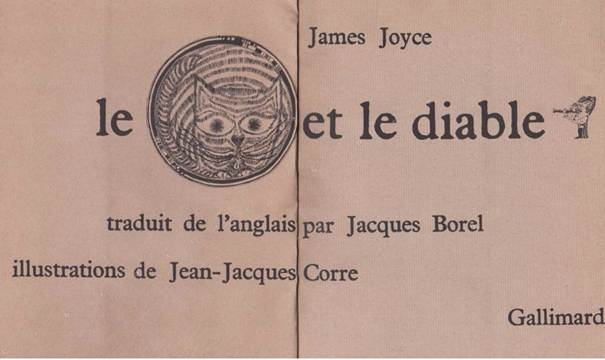
Most of all, in Rose, Corre (see fig. 1), and Siciliano—even though less strikingly, perhaps—the devil is portrayed as Joyce himself. Siciliano even depicts a young boy with a devil’s mask holding balloons, who might very well be Stephen Joyce playing along with his grandfather’s joke (7L). The devilish boy appears opposite the signature, Nonno, grandfather, and the P.S. of Joyce’s letter, which imply an addressee. I agree with Hodgkins that “[t]he tinge of self-mockery in Joyce’s picture book is far from the serious aesthetic implied by Woolf ’s [illustrated by Vivas], but neither text is commensurate with its adult creator’s famed originality and brilliance” (363). I would add and emphasize that the illustrators make up for the lack of “originality and brilliance” in Joyce’s tale but tone them down in Woolf’s, in keeping with the widely spread belief that Joyce is a stylist and Woolf a painter of the feminine psyche.
Unlike the Joyce picture books, the Hogarth / Grant and Harcourt Children, Bodley Head / Vivas editions of Woolf’s tale have one readership prevail to the near exclusion of the other. In Joyce’s tale, young readers might identify in turn with many tricksters, the devil, the Mayor, or finally the cat and, even if the moral of the tale is carnivalesque, there still is one to be discussed. In contrast, Woolf’s tale offers no possible identification—the embroiderer is unaware of the world she creates; she protects the animals but they perceive her as an ogress; the animals are empowered through no will or action of their own but only while the nurse is asleep. Even adult critics have had a hard time making sense of that story, reading it as a metaphor of the artist’s creation, but one that is neither feminine, conscious, nor fulfilling. It is a transformation tale that brings forth no permanent change either for the nurse or the embroidered animals. Such ambiguity corresponds to neither the “moral preoccupation of the nineteenth century” which still pervades Children’s literature “though in far less insistent and preachy form” (McLeod 31), nor the contemporary shift towards the promotion of artistic practices and tastes. The austere black and white anti-narrative illustrations by Duncan Grant that only rarely correspond to the text opposite simply ignore the possibility that a child might leaf through the book. They project Grant’s nostalgia for his own Victorian childhood onto his friend Virginia’s story. Conversely, the latest Harcourt Children’s, Bodley Head / Vivas emphasizes the transformation with cinema-inspired pictures, but ignores the political undertone of the tale. The animated animals encounter a parade: “The old Queen came by in her palanquin; the general of the army passed; so did the Prime Minister; the Admiral, the Executioner; and great dignitaries on business in the town, which was a very beautiful place called Milamarchmantopolis” (Woolf / Vivas 10R). The indirect critique of imperialism with the reference to political, military and economic exploitation enforced through violence is downplayed by the double-page illustration showing a joyful parade of children in the guise of the figures of power mentioned in the tale. Here, the illustrations “translate” for children, “[a]djusting the text in order to make it appropriate and useful for the child, in accordance with what the society thinks is ‘good for the child’” (Shavit 172). As politics and violence are not deemed “good for the child,” the illustrations defuse them in an attempt, perhaps, also to “[a]djust[…] plot, characterization and language to the child’s level of comprehension and his reading abilities.” (172) Julie Vivas disregards Virginia Woolf’s suggestion of the somewhat scary and unsettling porosity between the world of the embroiderer and the world of her embroidery. So does Duncan Grant, who does not illustrate the passageway between Nurse Lugton’s Britain and her exotic landscape but gives a visual representation of their separatedness. He represents the Queen as a medieval Virgin clearly delineated and standing in contrast with the sketchy, almost blurry animals drawn in the background, reasserting the frontier between civilisation, or Nurse Lugton’s England, and its other, the embroidery’s animated exotic landscape. Like the editors of the Norton Anthology, although for different reasons, neither Grant nor Vivas appear to expect—or want—to find politics outside of Woolf’s two political essays whereas Woolf’s minor texts, her essays, her reviews, her “silly” novels—and perhaps her posthumous children’s books—are central to the politics of her writing which, precisely, questions the frontier between the centre (the civilized world of Nurse Lugton) and the margins (the idealized and yet paradoxically endangered and dangerous world of the animated animals).
Finally, some illustrators “smuggle” external values into Virginia Woolf’s story, offering a reading not of the tale only, but of the author’s work and legacy. The 1983 French translation omits part of the procession. The Queen is accompanied by a number of dignitaries (“le général en chef,” “le premier ministre, et d’autres grands dignitaires en voyage d’affaires,” Woolf / Napo 7L) but the Admiral and the Executioner are nowhere to be found. However, the political complexity and ambiguity not of the text itself, the vocabulary of which is stubbornly simple, but of its connotations and resonances, is precisely what Napo “bootlegs” back into his illustrations. Through pictorial references to Walt Disney and Le Douanier Rousseau, and imaginary half-familiar half-exotic animals, Napo reinscribes Woolf’s reflection on the tension between England and Elsewhere, or the centre and the margins, a spatial variation on the major and the minor, within the book. The frontier between old Nurse Lugton’s quaint “Olde England” and the intricate jungle of the animated animals is visually porous: on every page graphic elements escape the frames, and at the end of the story the embroiderer’s Victorian sitting room does not return to its original order but is visually contaminated by the disorder of the jungle. Unlike Grant or Vivas, Napo depicts the Nurse as an ogress, who looks very much like Disney’s Captain Hook and occupies the position of the panther in Henri Rousseau’s Le Lion, ayant faim, se jette sur l’antilope (“The Hungry Lion” 1905), thus depicting the artist and British citizen as a predator (Fig. 2). Napo addresses a political child, one who might be interested in anti-Imperialism or, at least, in the representation of domination.14
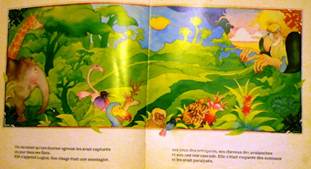
Reproduced by permission of the illustrator.
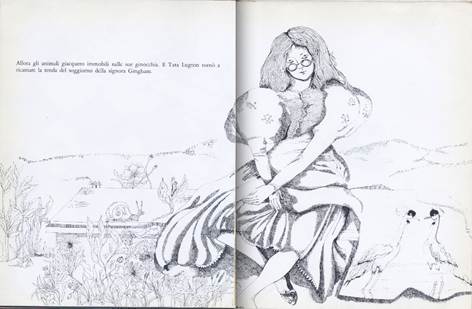
The 1976 Italian edition omits the powerful procession altogether. Flaminia Siciliano also “bootlegs” a political discourse within the tale, one that is not there in the first place but reflects Woolf’s feminism in her major novels and essays as it was promoted in Italy in the 1970s—where Three Guineas was translated in 1975. The delicate, spirally, black and white drawings inspired by surrealism strive to provide an equivalent for Woolf’s feminine writing. Flaminia Siciliano replaces the creator / destroyer paradox of Nurse Lugton… with another through interpicturality: the passive / active figures of Sleeping Beauty and the Madonna. Lugton becomes a far less contentious but perhaps more inspirational young Mary-like figure. The last double-page illustration echoes Botticelli’s Madonna con il Bambino e due angeli (“Madonna and Child and Two Angels” c. 1468-69) and Madonna con il Bambino e cinque angeli, or Madonna del Magnificat (“Madonna of the Magnificat” c.1470) (Fig. 3). The representation of female creativity is much more conventional and conservative than in the tale since the religious undertones return her to her ancient function as sacred vessel. Flaminia Siciliano addresses young girls in search of positive feminine role models, projecting Woolf’s interest in the feminine psyche expressed in other works such as Mrs Dalloway, which was very influential in Italy at the time, onto Il ditale d’oro. There might be similar contraband politics in Siciliano’s Il Gatto e il diavolo, with a hint that “la gente di Beaugency” (1L), a well-off 1940s crowd, with pearl necklaces, cigarettes, bow-ties and sunglasses are more than willing to let the devil and the mayor play their tricks as long as it allows them to cross the bridge and prosper. Still, the satirical dimension is in keeping with the carnivalesque tone of Joyce’s tale.
Joyce’s tale has been called a “classic,” I would argue, precisely because its farcesque dimension inscribes it within a reception frame common to major and minor literature. It pleases both children and adults, with its traditional structure, pamphlet-like reference to the actual Mayor of Dublin and visual allusions to Joyce, and open political satire. Woolf’s, on the contrary, is much more ambiguous and indirect, as it stubbornly refuses to become major but considers its themes—creativity, domination, empowerment—in minor mode, one that is more disturbingly and contentiously political.
The publication histories of Nurse Lugton… and The Cat and the Devil are strikingly similar, not only in the 1960s and 1970s when the tales were first bootlegged in Children’s literature but also today, with an increasing dissemination of both stories in translation in a large variety of languages with original illustrations, after a period of reduplication of one set of illustrations that have become “standard”—Blachon’s for Joyce and Vivas’s for Woolf—in the 1990s.
As I read it, the proliferation of Virginia Woolf’s and James Joyce’s posthumous picture story books sheds a new light on Modernism, which no longer appears the product of isolated—Romantic—geniuses, as it emphatically promoted itself. As we observe it through the prism of the minor genre but major market of Children’s Literature, it appears to be a gradual, collective, and partly retroactive construct. Modernism is “co-authored” (Zacks 7) by writers, publishers and illustrators. It ought to be studied not simply as a group of texts but also as a mode of production and marketing of books and authors. In this case, however independent of hierarchies that gradual, collective process of transfer from major literature to Children’s, or supposedly minor literature, might seem, it should be noted that it has translated the received hierarchy between Woolf and Joyce within the new, more popular market. The popularisation of Woolf and Joyce through their appropriation by Children’s picture story books has in fact paradoxically preserved the hierarchy the tales themselves playfully question—Joyce rewriting a standard tale in a letter to his grandson, Woolf contentiously rethinking the culturally constructed frontier between England and the faraway territories it controls.
The editions I have focused on in this essay show a discrepancy in publishing, marketing, and reception which may be accounted for by the narrative contrast between the tales, Joyce’s trickster tricked structure being much more familiar and straightforward than Woolf’s tangentially political and falsely circular tale. I would argue, however, that it also reflects the contrasting perception of James Joyce’s and Virginia Woolf’s works as well as of their image as highbrow, Modernist authors. Joyce’s tale, based on elements that may be reassigned to major literature, produces stable iconotexts that variously find a contact zone between major literature and Children’s literature. As a result, a standard version emerges, which tends to limit the emergence of new variations. On the contrary, Woolf’s tale, which makes it difficult for readers to reassign its minor elements to major conventions or traditions, engenders a much more contrasted series of variations, and seems to stubbornly eschew the binary system of values. Each new creative version of Nurse Lugton… finds a new articulation between minor and major in that it explores and actualises—or denies altogether—the political potential of the tale.
Notes
- 1On Virginia Woolf’s complex reception of Joyce, see Heffernan.
- 2Zacks is referring to Mark Morrison. The Public Face of Modernism. Little Magazines, Audiences, and Reception, 1905–1920.
- 3For a discussion of “Bloomsbury’s complicity in its own commodification” (29), see Jane Garrity.
- 4On Joyce, Ulysses, and celebrity, see Goldman.
- 5Auguste Morel’s translation of Ulysses (1929) was revised by Valéry Larbaud and Joyce himself. Joyce also revised the Italian translations of his works. See Éric Bulson, “Joyce Reception in Trieste: The Shade of Joyce.” Esp. 317-318.
- 6From 1969 to 1983, their collection “Il puntoemme” published theory and pedagogy.
- 7This generic title refers to the variations of original manuscripts and titles of Woolf’s published tale.
- 8This collection contains the correspondence of Vanessa Bell, Clive Bell, and Duncan Grant, which were left at their house in Charleston.
- 9It is difficult to trace all the editions of these children’s picture books since many are out of print, and children’s literature tends to be randomly referenced in library catalogues, so that I may have overlooked a few.
- 10When the picture books are unpaged, I indicate the page numbers as follows: 1L and 1R refer to the double page the young reader sees, when the book is spread open, with 1L on the left and 1R on the right.
- 11This illustration is reproduced on the cover of James Joyce Quarterly 45.3/4 (2008). It may be seen on the James Joyce Quarterly blog: https://jjqblog.wordpress.com/covers/jjq45-3-4/ [accessed 20 March 2016].
- 12I would like to thank Mara Alpert, Children’s Literature Department, Central Library, Downtown Los Angeles, for her kind help.
- 13https://www.livre-rare-book.com/search/current.seam?reference=&author=&title=le+chat&description=&keywords=&keycodes=&ISBN=&minimumPrice=0.0&maximumPrice=100000.0&minimumYear=0&maximumYear=0&sorting=RELEVANCE&bookType=ALL&topic=101106156&ageFilter=ALL¢ury=ALL&country=FR&l=fr&actionMethod=search%2Fcurrent.xhtml%3AsearchEngine.initSearch
- 14On the editions illustrated by Grant, Napo, and Vivas, see Caroline Marie’s “(Re)-Imaging the Imaginary of a Children’s Story by Virginia Woolf: Nurse Lugton… through the Prism of Three Illustrators.”
Bibliography
- Norton Anthology of English Literature. Ed. M. H. Abrams. New York, London: Norton & Co, 1962; 2nd ed., 1968; 4th ed., 1979; 7th ed., 2000.
- Bolchi, Elisa. “The ‘Grand Lady of Literature’: Virginia Woolf in Italy under Fascism.” Virginia Woolf and the Literary Marketplace. Ed. Jeanne Dubino. New York: Palgrave Macmillan. 2010. 199-208.
- Botticelli, Sandro. Madonna con il Bambino e due angeli. c. 1468-69. Tempera on wood. Museo nazionale di Capodimonte, Milan. ˂http://www.polomusealenapoli.beniculturali.it/museo_cp/cp_scheda.asp?ID=11˃.
- Botticelli, Sandro. Madonna con il Bambino e cinque angeli. c. 1470. Tempera on wood. Musée du Louvre, Paris.˂http://cartelfr.louvre.fr/cartelfr/visite?srv=car_not_frame&idNotice=1190&langue=fr˃.
- Bulson, Éric. “Getting Noticed: James Joyce’s Italian Translations.” Joyce Studies Annual 12 (2001): 10-37.
- Bulson, Éric. “Joyce Reception in Trieste: The Shade of Joyce.” The Reception of James Joyce in EuropeII. France, Ireland, and Mediterranean Europe. Eds. Geert Lernout, Wim Van Mierlo. New York: Thoemmes, 2004. 311-319.
- Caesar, Ann Hallamore. “The Novel, 1945-1965.” A History of Virginia Woolf in Italy. Eds. Letitzia Panizza, Sharon Wood. Cambridge: Cambridge University Press, 2000. 205-217.
- Chamborédon, Jean-Claude, Jean-Louis Fabiani. “Les Albums pour enfants, le champ de l’édition et les définitions sociales de l’enfance.” Actes de la recherche en sciences sociales 13 (1977): 60-79.
- Clark, Berverly Lyon. Kiddie Lit. The Cultural Construction of Children’s Literature in America. Baltimore: Johns Hopkins University Press, 2003.
- Cooper, John Xiros. Modernism and the Culture of Market Society. Cambridge: Cambridge University Press, 2004.
- Garrity, Jane. “Selling Culture to the ‘Civilized’: Bloomsbury, British Vogue, and the Marketing of National Identity.” Modernism/Modernity 6.2 (1999): 29-58.
- Gaugeard, Jean. “Joyce, demain…” Les Lettres françaises (10 février 1966): 10.
- Goldman, Jonathan E. “Joyce, the Propheteer” NOVEL: A Forum on Fiction 38.1 (2004): 84-102.
- Heffernan, James. “Tracking a Reader: What Did Virginia Woolf Really Think of Ulysses?” Parallaxes: Virginia Woolf Meets James Joyce. Eds. Canani, Marco, Sara Sullam. Newcastle upon Tyne: Cambridge Scholars, 2014. 2-24. See online version on “The Modernist Lab at Yale University.” ˂https://modernism.research.yale.edu/wiki/index.php/Woolf’s_Reading_of_Joyce’s_Ulysses,_1918-1920˃.
- Hodgkins, Hope Howell. “High Modernism for the Lowest: Children’s Books by Joyce, Woolf, and Greene.” Children’s Literature Association Quarterly 32.4 (2007): 354-367.
- Howard, Alice. “Dismantling the Modernist Myth: Samuel Beckett and Virginia Woolf in the Literary Marketplace.” Journal of Modern Literature 36.1 (2012): 153-162.
- Huyssen, Andreas. After the Great Divide. Modernism, Mass Culture, Postmodernism. Bloomington: University of Indiana Press, 1987.
- Joyce, James. The Cat and the Devil. Illus. Richard Erdoes. New York: Dodd & Mead, 1964.
- Joyce, James. The Cat and the Devil. Illus. Gerald Rose. London: Faber & Faber, 1965.
- Joyce, James. The Cat and the Devil. Illus. Roger Blachon. London: Faber & Faber, 1980.
- Joyce, James. The Cat and the Devil. Illus. Roger Blachon. New York: Schocken Books, 1981.
- Joyce, James. The Cat and the Devil. Illus. Roger Blachon. Newfoundland: Breakwaters Books, 1990.
- Joyce, James. Le Chat et le diable. Trans. Jacques Borel. Illus. Jean-Jacques Corre. Paris: Gallimard, 1966.
- Joyce, James. Le Chat et le diable. Trans. Jacques Borel. Illus. Roger Blachon. Paris: Gallimard, 1978.
- Joyce, James. Le Chat et le diable. Trans. Jacques Borel. Illus. Roger Blachon. Paris: Gallimard, coll. L’Heure des histoires 44, 2010.
- Joyce, James. El Gato y el Diablo. Trans. Miguel A. Diéguez. Illus. Roger Blachon. Madrid: Altea, coll. Altea benjamín, 1985.
- Joyce, James. Il Gatto e il diavolo. Trans. Enzo Siciliano. Illus. Flaminia Siciliano. Milan: Emme Edizioni, 1967.
- Joyce, James. Il Gatto e il diavolo. Trans. Giulio Lughi. Illus. Roger Blachon. Trieste: EL, 1985.
- Joyce, James. Gens de Dublin. Trans. Jacques Aubert. Paris: Gallimard, 1974.
- Joyce, James. Die Katze und der Teufel. Trans. Fritz Senn. Illus. Richard Erdoes. Zürich: Rein Verlag, 1964.
- Joyce, James. Die Katze und der Teufel. Trans. Fritz Senn. Illus. Jan de Tusch-Lec. Frankfurt: Insel Verlag, 1976.
- Joyce, James. Die Katze und der Teufel. Trans. Fritz Senn. Illus. Roger Blachon. Frankfurt: Insel Verlag, 1995.
- Joyce, James. Kočka a Čert. Trans. Trans. Martin Pokorný. Illus. Sašha Švolíková. Prague: Argo, 2012.
- Joyce, James. Kot i diabeł. Trans. Michał Ronikier. Illus. Roger Blachon. Poznań: Media Rodzina, 2008.
- Joyce, James. Lettres de James Joyce I. Trans. Marie Tadié. Paris: Gallimard, 1961.
- Joyce, James. Lettres de James Joyce II. Trans. Marie Tadié. Paris: Gallimard, 1973.
- Joyce, James. Lettres de James Joyce III. Trans. Marie Tadié. Paris: Gallimard, 1981.
- Joyce, James. MaČak I Vrag. Trans. Mihaela Velina. Illus. Tomislav Torjanac. Zagreb: Mozaik knjiga, 2005.
- Joyce, James. A Macska és as ördög. Trans. Imre V. Szilvia. Illus Péter Vladimir. Budapest: Ab Ovo, 1997.
- Joyce, James. Œuvres I 1901-1915. Ed. Jacques Aubert. Paris: Gallimard, coll. La Pléiade, 1982.
- Joyce, James. Œuvres II 1915-1932. Ed. Jacques Aubert. Paris: Gallimard, coll. La Pléiade, 1995.
- Joyce, James. Ulise. Trad. Georgio Melchiori. Milan: Mondadori, 1960.
- Joyce, James. Ulysse. Trad. Auguste Morel. Paris: Gallimard, 1929.
- Lynch-Brown, Carol, Carl M. Tomlinson. “Children’s Literature, Past and Present: Is There a Future?” Peabody Journal of Education 73.3/4 (1998): 228-252.
- Marie, Caroline. “(Re)-Imaging the Imaginary of a Children’s Story by Virginia Woolf: Nurse Lugton… through the Prism of Three Illustrators.” L’Imaginaire: Texte et image / The Imaginary: Word and Image, Word and Image. Interactions 8. Eds. Clüver, Claus, Matthijs Engelberts, Véronique Plesch. Leiden, Boston: Brill, Rodopi. 29-46.
- Marler, Regina. Bloomsbury Pie. The Making of the Bloomsbury Boom. New York: Henry Holt & Co, 1997.
- McLeod, Anne Scott. “Censorship and Children’s Literature.” The Library Quarterly: Information, Community, Policy 53.1 (Jan. 1983): 26-38.
- Moravia, Alberto. Storie de la preistoria. Illus. Flaminia Siciliano. Milan: Emme, 1977.
- Morrison, Mark. The Public Face of Modernism. Little Magazines, Audiences, and Reception, 1905–1920. Madison: University of Wisconsin Press, 2000.
- Morrison, Mark. “Selling Modernism.” Rev. of Marketing Modernisms: Self-Promotion, Canonization, and Rereading, ed. Kevin J. H. Dettmar and Stephen Watt, Who Paid for Modernism? Joyce Piell Wexler, and Marketing Modernism in Fin-de-Siècle Europe, Robert Jensen. Modernism/Modernity 5.2 (1998): 155-162.
- Napo. Phone conversation with the author, 17 Sept 2012.
- Nières-Chevrel, Isabelle. “Faire une place à la littérature de jeunesse.” Revue de l’histoire littéraire de la France 102.1 (2002): 97-114. ˂https://www.cairn.info/article_p.php?ID_ARTICLE=RHLF_021_0097˃.
- Pedullà, Walter. “Dalla Resistenza ai fatti a Ungheria.” Storia generale della letteratura italiana. Eds. Borselino, Nino, Walter Pedullà. Milan: Motta. 622-81.
- Rose, Jacqueline. The Case of Peter Pan, or the Impossibility of Children’s Fiction. Philadelphia: University of Pennsylvania Press, 1984.
- Rousseau, Henri. Le Lion, ayant faim, se jette sur l’antilope. 1898-1905. Oil on canvas. Fondation Beyeler, Riehen. ˂http://www.fondationbeyeler.ch/fr/collection/henri-rousseau˃.
- Shavit, Zohar. “Translation of Children’s Literature as a Function of Its Position in the Literary Polysystem.” Poetics Today 2.4 (1981): 171-179.
- Sigler, Amanda. “Crossing Folkloric Bridges: The Cat, the Devil, and Joyce.” James Joyce Quarterly 45.3/4 (2008): 537-555.
- Slote, Sam. “‘Après moi, le déluge’: Critical Response to Joyce in France.” The Reception of James Joyce in Europe II. France, Ireland, and Mediterranean Europe. Eds Geert Lernout, Wim Van Mierlo. New York: Thoemmes, 2004. 362-381.
- Turner, Catherine. Marketing Modernism Between the Two World Wars. Amherst, Boston: University of Massachussets Press, 2003.
- Villeneuve, Pierre-Éric. “Virginia Woolf and the French Reader: An Overview.” South Carolina Review 29.1 (1996): 109-121.
- Woolf, Leonard. “Foreword.” Nurse Lugton’s Golden Thimble. By Virginia Woolf. London: Hogarth Press, 1966. 4.
- Woolf, Virginia. A Cortina da Tia Bá. Trans. Ruth Rocha. Illus. Julie Vivas. São Paulo: Ática, 1993.
- Woolf, Virginia. Dadinin Perdesí. Trans. Merve Tokmakçioğlu. Illus. Melanie Mehrer. Istanbul: Zeplin Kitap, 2015.
- Woolf, Virginia. Le Dé en or. Trans. Frédéric Armel. Illus. Napo. Paris: Nathan, 1983.
- Woolf, Virginia. Un Dé en or. Trans. Céline Decamps. Illus. Jasmine Bourrel. Numériklivre, 2013.
- Woolf, Virginia. The Diary of Virginia Woolf II1920-1924. Eds. Anne Olivier Bell, Andrew McNeillie. London: Hogarth Press, 1978.
- Woolf, Virginia. Il Ditale d’oro. Trans. Enzo Siciliano. Illus. Flaminia Siciliano. Milan: Emme Edizioni, 1976.
- Woolf, Virginia. Niebieska zasłona. Trans. Magna Heydel. Illus. Julie Vivas. Kraków: Znak, 2008.
- Woolf, Virginia. La Niñera Lugton. Trans. Flora Casas. Illus. Julie Vivas. Madrid: Debate Infantil, 1992.
- Woolf, Virginia. Nurse Lugton’s Curtain. Illus. Julie Vivas. London: Bodley Head, New York: Harcourt’s Children Books, 1991.
- Woolf, Virginia. Nurse Lugton’s Golden Thimble. Illus. Duncan Grant. London: Hogarth Press, 1966.
- Woolf, Virginia. Œuvres romanesques I & II. Ed. Jacques Aubert. Paris: Gallimard, coll. La Pléiade, 2012.
- Zacks, Aaron. “Marketing Modernism Between the Two World Wars.” Rev. of Marketing Modernism Between the Two World Wars, Catherine Turner. Libraries and Culture 40.1 (2005): 106-107.
- Zanotti, Serenella. “James Joyce among the Italian Writers.” The Reception of James Joyce in Europe II. France, Ireland, and Mediterranean Europe. Eds Geert Lernout, Wim Van Mierlo. New York: Thoemmes, 2004. 329-361.
About the author(s)
Biographie : Caroline Marie est Maître de Conférences à l’Université Paris VIII-St-Denis. Sa recherche porte essentiellement sur les emprunts aux arts du spectacle dans l’œuvre de Virginia Woolf et sur les transferts esthétiques et culturels depuis l’œuvre de Virginia Woolf. Elle s’intéresse également à la mise en image de Virginia Woolf et de ses romans. Elle travaille en outre sur le théâtre britannique du XXe siècle et l’adaptation.
Biography: Caroline Marie is a Senior Lecturer at Université Paris VIII-St-Denis. Her research interests include trans-aesthetics in Virginia Woolf’s novels and essays as well as cultural and aesthetic adaptations and appropriations of Virginia Woolf’s works. She is interested in the translation of Virginia Woolf herself and her works into pictures. She also published articles on 20th-century drama and adaptation.