Questioning Ideologies: Erskine Caldwell’s Children’s Books
Abstract: This article examines the ideology of Erskine Caldwell’s books on and for children, Georgia Boy (1943), Molly Cotton-Tail (1958), and The Deer at our House (1966). The aim is to show Caldwell’s interrogative stance regarding the status quo in these texts, and how he casts doubt more or less overtly on racism, myths of southern gentility, and parental authority. However, their ideology is also remarkably at variance with the author’s experience, especially concerning women. Thus Caldwell’s characteristic ambiguity and his ambivalence make the effects of these productions difficult to estimate.
Keywords: Erskine Caldwell, Georgia Boy, Molly Cotton-Tail, The Deer at our House, Ideology, Children’s books
Résumé : Cet article porte sur l’idéologie des livres sur et pour les enfants d’Erskine Caldwell, Georgia Boy (1943), Molly Cotton-Tail (1958), et The Deer at our House (1966). L’objectif de l’article est de montrer que si Caldwell questionne plus ou moins manifestement un statu quo par le doute dans ces textes, comme le racisme, le mythe du gentleman du Sud ou l’autorité parentale, l’idéologie qu’ils véhiculent intrigue aussi par son manque de relation avec l’expérience de l’écrivain, notamment concernant les femmes. Ainsi, l’ambiguïté du questionnement typique de Caldwell comme son ambivalence rendent difficile l’estimation des effets de ces productions.
Mots-clés : Erskine Caldwell, Georgia Boy, Molly Cotton-Tail, The Deer at our House, Idéologie, Littérature jeunesse
In his obituary for the New York Times, Edwin McDowell quoted Caldwell as saying, “I didn’t try to change or reform the world; I only wanted to report on it.” But in most of his work he showed the need for change. As Sylvia Jenkins Cook puts it, “Together, his fiction and nonfiction make a case for the urgent remedy of what is correctable in human affairs.” Yet his approach was all but straightforward. This study of three of Caldwell’s books written in a minor mode—the humorously nostalgic short story cycle Georgia Boy (1943), narrated by a little boy but intended for adults, and his two children’s books, Molly Cottontail (1958) and The Deer at Our House (1966)—suggests that doubt may be a strategy in these texts as in Caldwell’s adult fiction.
In the radical thirties, Erskine Caldwell (1903-1987) often portrayed himself as an ideological writer and aligned himself with the left, although at other times he disclaimed any ideological principles or aims (Dyen 150-151). In his 1931 Guggenheim proposal, he said his goal was to “point out the direction the masses must take” (Miller 159). This was in part due to an upbringing in which he had seen his clergyman father and his devout mother tend the needy. As driver to a doctor in Georgia and, later, a fledgling journalist, he saw more examples of social ills. When he became a writer, he deliberately adopted a plain style that anyone might understand in order to achieve social reform. Yet his ideological message was not generally clearly stated.
In the early thirties Caldwell wrote stories about Southern sharecroppers and small farmers, uniting the grotesque and prurient sex scenes in Tobacco Road and God’s Little Acre, which, according to him, stressed the need for change. He exaggerated hopeless situations which new measures might redress, and presented the absurd functioning of the grotesque characters as their normalcy, a technique that was destined to raise questions. Caldwell seemed to be building on his theory of ideological fiction, expounded in a book review of Edward Dahlberg’s From Flushing to Calvary in the New Masses, according to which hopelessness, not hope, should characterize good proletarian fiction, for it could best show the effects of capitalist exploitation (Miller 138-139).
Caldwell also made use of the dominant mythology to pass on a revolutionary credo. According to Richard Gray, Caldwell’s foil to situations that were unacceptable for the sharecroppers who represent the proletariat was agrarian self-sufficiency. Gray argues that, in his first novels, Caldwell used grotesques to show how different reality was from the ideal of the farmer as the epitome of the free, independent and virtuous American. Thomas Jefferson, a champion of the yeoman farmer, had celebrated a life lived close to the land as the hope of the Republic in his Notes on the State of Virginia (175). Gray concludes that “Caldwell—in every one of his finest stories—is trying to draw us back steadily into the world of Jeffersonian myth” (Gray 232).
Caldwell’s intentions did not come across clearly, however. Many on the left questioned his ideology for his detached determinism, while Southern conservatives berated him for giving the South a bad name. Caldwell continued to address questions of social impact in his ten-novel Southern cyclorama, showing poor whites, decaying gentility and rising middle classes in both rural and urban settings, and the problems faced by women and blacks (Cook 4). But as he completed his cyclorama, critics judged his fiction formulaic. Such was the opinion of both Lon Tinkle on A House in the Uplands (1946) and The Sure Hand of God (1947) and of Harrison Smith on A Place Called Estherville (1949) in their reviews for The Saturday review of Literature, for example. Caldwell sometimes seemed to be doing grotesque by rote, or else imagined characters that were too transparent, so that his fiction seemed soulless and no longer impeded simple moral judgment, whereas in his early work, conclusions were undermined by the eccentricity of characters whom one nevertheless sympathized with. Caldwell’s later work failed to please, because its ideology seemed obvious, or because it appeared to transmit an outmoded dominant worldview (Cook 99).1 But he remained a writer with a message, and the manifestations of his commitment are complex. In his non-fiction work, which remained popular, he presented the difficulties of the workers of America, and sometimes questioned revolutionary action himself, as with the insertion of captions and monologues he admits to inventing in the photo-documentary published with Margaret Bourke-White, You Have Seen Their Faces (1937), which sap his optimistic conclusion that the young can change things for the better (Cook 233-235). Thus, for all that he might say, Caldwell was an ideological writer. Indeed, a message is clear even in the last pages of his 1987 autobiography, With All My Might, where he advocates for world peace and sets it as the writer’s goal (331-332). But the texts that made him famous function less obviously, making readers question society to effect change.
The conscious ideological slant of Caldwell’s work has been the subject of debate by critics since Caldwell published his first works.2 This article examines the ideological structure of three books by Caldwell: the humorously nostalgic short story cycle Georgia Boy (1943), narrated by a little boy but intended for adults, and his two books for children, Molly Cottontail (1958) and The Deer at Our House (1966). While there has been some insightful commentary on Georgia Boy in the past 30 years, notably a section in Cook’s longer work and an article by Ronald Wesley Hoag, Caldwell’s books for children have elicited very little more than a passing mention in biographies, criticism, or in his own autobiographical writings, and never from the point of view of ideology. In view of the simplicity of Georgia Boy, which makes it attractive to young readers, I use a global term, children’s books, for what I bear in mind are two different genres, books on and for minors. The dearth of commentary on Caldwell’s children’s books is surprising, all the more since the unity of his oeuvre can only be fully comprehended when one takes into account the ideological structure of these books. Notably, one finds in Caldwell’s children’s books the characteristic interrogative stance that he used as a device in his reform-oriented major works.
When I speak of ideology in Caldwell’s works, I take the term to mean both the ideas that explain the purpose of movements for social change and the cultural beliefs and attitudes that underlie the status quo. For Karl Marx, ideology in the second sense emerges out of the economic model of production in a society, as he and Friedrich Engels made clear in The German Ideology; and in their case as in Caldwell’s, that dominant ideology was capitalism. Caldwell’s early work was a conscious critique of the dominant capitalist ideology. Later conceptions of ideology are germane to the discussion of Caldwell’s texts. Louis Althusser’s view of ideology as the imaginary relation to the real conditions of existence diverges from Marx’s stress on the real, and his view of the media, education, the family or literature as “Ideological State Apparatuses” functioning without explicit intent to exert control make every individual a subject of ideology. It seems so impossible to free oneself of one’s culture and social conditioning that Lucien Goldmann stressed, after Hegel, that in the humanities “The subject and the object of study are largely identical” (532). John Stephens emphasizes that children’s books are vehicles for ideology in Language and Ideology in Children’s Fiction, for “A narrative without an ideology is unthinkable” (8)—all the more so as the ideology that emerges from a work need not be the result of a conscious decision. Indeed, Georg Lukacs distinguished between the writer’s conscious intention and the intention realized in the work, calling ideology the Weltanschauung or view of the world that underlies a writer’s work and the style of a given piece of writing, giving it its ideological structure (1219). Luc Herman and Bart Vervaeck’s study “Ideology and Narrative Fiction” stresses the continuity in the approaches to ideology in narrative; based on the frame of values informing the narrative that the reader pieces together from context and text, these approaches “intertwine and overlap,” whether one considers ideology from a sociological angle as a collective set of beliefs, from a psychological perspective, or whether one focuses on language, discourse and semiotic systems as the centers of ideological enunciation (sections 1-2).
My object is to study the view of the world that emerges from Caldwell’s writings on and for children. My principally sociological observations intertwine with reflections on psychology and discourse. Firstly, I will explain that a univocal didactic message is not “the point” of these works, but a consideration of texts on “minor literature” and its political resistance to interpretation through experimentation poses the question of the ideological dimensions of Caldwell’s interrogative stance. I will show that Caldwell highlights apparent progressive, emergent ideological formations, but that these coexist with a conservative ideology which seems to perpetuate the dominant power structure. One cannot determine whether the reader is expected to say “So be it” or “Wait a minute!” But Caldwell’s real paradox is that although a dominant ideology structures these works, his representation of the dominant authority raises questions that disqualify that authority’s power. Caldwell’s paradoxical worldview in these three texts can thus be seen as a strategy to reject his role in the cultural Ideological State Apparatus, an attempt which has something of the revolutionary.
When an Ideological Interpretation Seems Beside the Point
At first sight, a perusal of Caldwell’s children’s books for ideological structure may seem inappropriate. One seems better able to enjoy them with a sense of humor and sensitivity than with Marxist baggage. Certainly, critics who compared Georgia Boy to Tobacco Road found the simple, often farcical stories “a trifle pale” (Miller 304). Yet the collection, frequently compared to Twain, was also hailed by many as a masterpiece, albeit in a minor key (Cook 91; Miller 305). I will briefly summarize Caldwell’s children’s books before proceeding to show why they seem to make an ideological approach seem unduly serious.
Georgia Boy started in 1937 as one New Yorker story, and built to a collection through Caldwell’s wartime travels with Margaret Bourke-White. The fourteen tales have a ten-year-old narrator, William Stroup, who is partial to Morris—his good-for-nothing Pa—rather than to Martha—his hard-working Ma. Their “Negro yardboy,” Handsome Brown, William’s playmate, is the elder Stroups’ beast of burden. Each tale centers on one of Morris’s misdeeds. At the end, Morris is trumped when Martha cooks his fighting cock and feeds it to him. But as Morris stomps off, William goes after his father in sympathy.
“Molly Cotton-Tail” was a short story from Caldwell’s American Earth collection (1931) that he made into a children’s book in 1958 (illustrated by William Sharp). The first-person narrator of the short story is, in the children’s book, replaced by a third-person narrator.3 Informed by his aunt Nellie that “a real Southern gentleman likes to hunt,” Johnny, who wishes to be invited to her Maryland home, sets out to shoot a rabbit although neither he nor his father likes to kill animals. Johnny does not manage to kill the rabbit, but keeps her for a pet on their Carolina farm instead, and his father approves, telling him the “good sportsman”’s code and advising him to “stop paying any attention to your Aunt Nellie” (27). The story ends on father and son enjoying the rabbit.
The Deer at Our House was specifically written for children, published as “a beginning reader” (illustrated by Ben Wolhberg), in 1966. The narrator, Vivi, her brother Tommy and her parents set out to feed a deer and her fawn so they will not eat the mother’s flowers in the yard. They decide to feed the deer peaches, but as this cannot be kept up, the father plants a peach tree he brought home and the peach seed Tommy has kept.
The disarming humor of the Georgia Boy stories proclaims: this is not to be taken seriously. Martha, William’s mother, is the voice of authority, the patient drudge whose laundering brings in the pennies; Morris, his father, is the wreaker of havoc, usually through one of his get-rich-quick schemes; and Handsome Brown tries to please everybody. Martha’s reaction on seeing Morris’s machine is realistic concern (“What did you pay for it?” 6), whereas Morris indulges in a flight of fancy.
“We’ll have a hundred-pound bale in no time at all,” Pa said. “Then after that first one, everything else will be pure profit. We’ll have more money than we’ll know what to do with. It might be a good idea to buy three or four more of the machines off the fellow when he comes back to Sycamore next week, because we can bale paper faster than one machine can handle it. We’ll have so much money in no time at all that I’ll have to trust some of it to the bank. […] [I]t won’t be no time at all before I can quit and retire.” (“My Old Man’s Baling Machine” 9)
Morris bales up all the paper he can find, including Martha’s new songbooks for the choir, all her recipes, and her love letters. Morris appears to be incapable of understanding Martha’s finer feeling, such as the honor she invests in acting responsibly (“Those poor trusting souls thought their song books would be safe in my house. And now just look at them!” 13) or the durability of her affections: “‘But they ain’t nothing but old letters, Martha,’ Pa said. ‘I could write you some new ones almost any time, if you want me to.’ ‘I don’t want new ones,’ she said; ‘I want to keep the old ones!’” (15) Morris, who never takes responsibility for anything, blames the loss of what was clearly an illusory “heap of money” not on his miscalculation of the available waste paper, but on Martha’s peculiar notions, when she insists on undoing the bales: “‘It seems like a shame to see all this paper go to waste, son,’ he said. It’s a pity your Ma had to go and take on so about old letters and things. We could have made us a heap of money selling them to the fellow when he comes to town again next week’” (15-16).
Yet one is loath to derive one “message” from each of Caldwell’s stories, although most of the Georgia Boy stories and the two books for children are built on the pattern by which young audiences learn the “grammar” of coherent cause-effect relationships structuring the simplest stories, set forth in Nancy L. Stein and Tom Trabasso’s “What’s in a Story” (qtd. in Stephens 32).4 One might imagine the form as a vehicle for overt lessons in an ideological precept, but the humor pervading the Georgia Boy stories makes them a different genre altogether. The comedy depends on the reader suspending ordinary judgment, Martha soon showing signs of small town bigotry rather than fine feeling, and Morris’s signs of complicity with his son and his son’s affection for him making him sympathetic; the very lack of sense that qualifies him, revealed by nonsensical turns, is endearing, as when he returns after nearly a week’s absence in “My Old Man Hasn’t Been the Same Since:” “‘How’s your copperosticks, son?’5 he said, squeezing his fingers around my arm. ‘All right,’ I said. He felt my muscles” (228). Much of the humor is slapstick, and Handsome is often its butt. However, Martha and Morris, too, are variously bitten (64), dragged (65), thrown projectiles at (198), hit over the head with a broom (200), or locked out of the house (204), while Morris’s female admirers are regularly beaten up (63-64, 202-204). The stories do not make one leap to an overt ideological interpretation as all of the characters are sympathetic and objects of fun in turn, especially the narrator, William, who is too naïve to indict.
It seems that the 1931 short story “Molly Cotton-Tail” was humorous in intention too, and must be so received. Adults see as comic the enmity between in-laws, the child going out to shoot an animal in order to be a gentleman and be invited to his aunt’s house, then blasting away at the rabbit who just “sit[s] there looking at him” (Molly 22), so that he finally picks it up and takes it home. The simple story line ends on a satisfaction of sorts, without transmitting a univocal ideological message. But in their approach to the story-book Molly Cottontail, children may be oblivious to Caldwell’s humor, especially as the stark illustrations create an atmosphere of foreboding at the beginning. The reason for the angst is made clear to the young child by page 9, the fourth illustrated page, where happy animals replace the glum humans: “He liked to catch rabbits and squirrels for pets, but he did not want to kill them,” and the whole page is devoted to the pet hen Johnny saved and “his father […] said she would not have to be killed” (9). The illustrations show the animals and Johnny contented in each other’s company, except for Johnny’s anguished face when he is getting ready to shoot the rabbit. Children may see the whole story as the conflict between killing animals and keeping them for pets, and pets are fun and affectionate: “Johnny got the lettuce and gave it to his rabbit. She hopped up to where they sat against the barnside, asking for more. Johnny gave her all he had and she ate out of his hand” (30). “I’d lots rather have her living than dead,” are Johnny’s last words (32). Thus children may partake of the vicarious pleasure of saving a cuddly animal, and that may be all the “message” they notice.
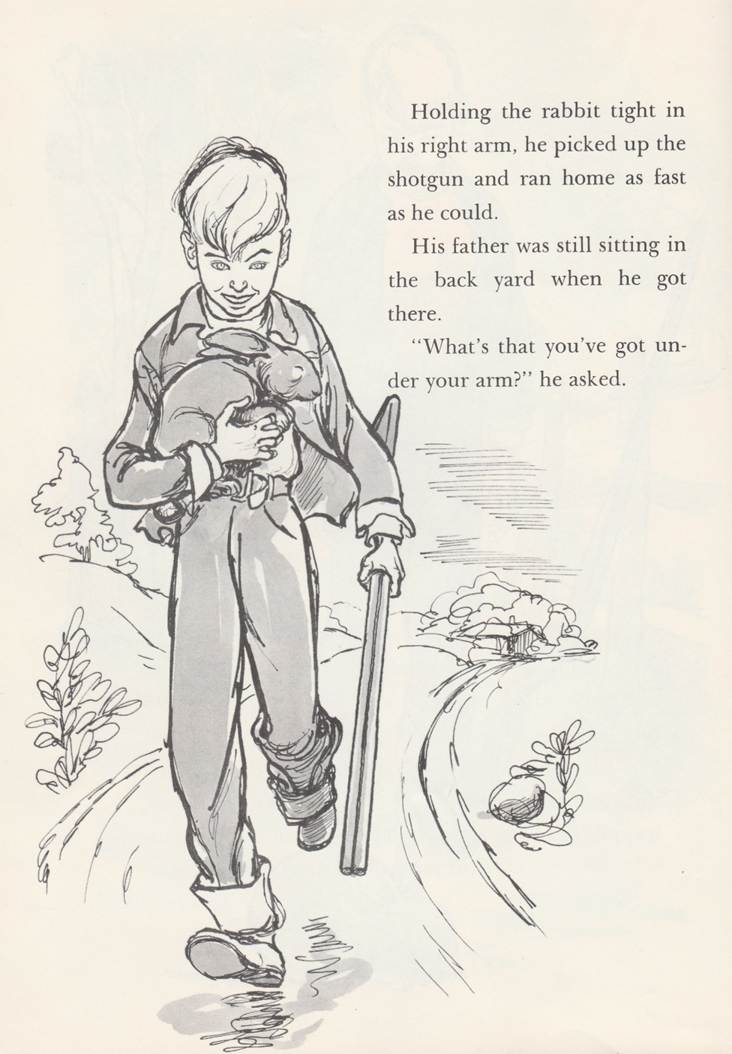
(Molly Cottontail 24)
In The Deer at Our House, a “message” is all the harder to pinpoint as the story has a simple poetry that is enhanced by the pen and ink illustrations of the natural environment. Caldwell once said that he never published any of his poetry, but that he had sent some to “a chap by the name of Louis Untermeyer.”
I had such admiration for him that I sent him some of my poems. He wrote to me and said that every young man is entitled to write poetry, but the sooner he gives it up, the better he’s going to be as a man. So I took his advice. […] And many years later when Untermeyer edited some children’s books, he asked me to submit a book for his series. “I know you’re out of poetry now,” he said, “so perhaps you can write a good child’s story.” […] I did. The Deer at Our House. (Pell and Hoag)
The story is grounded in the real, but has poetic elements. It is enriched with appeals to the senses: “There were some tall pine trees growing at the edge of our yard. There were some birch trees, too, and they looked very small growing so close to the green pine trees” (7), or “The next day Tommy and Mommie and I went to the market and got a basket of ripe peaches. The peaches were red and yellow and very juicy. They looked so good that we wanted to eat them right away” (18). Moreover, Caldwell presents the deer’s tender/stern rapport, similar to humans,’ as magical:
Just then the mother deer pushed the little fawn with her head until he turned around and looked at her. He pawed the ground as if he did not want to go home, but she put her head against him and pushed him some more. He took one more look at Mommie’s flowers, then kicked up his heels and ran up the hill as fast as he could. The mother deer walked slowly up the path behind him.
“Maybe deer can’t talk like us,” Tommy said, “but they know almost as much as we do.” (The Deer at Our House 28)
The simple story line centers on an “understanding” reached between the humans and the deer which is the most poetical aspect of the story, as communication with another species, taking one beyond one’s own boundaries, has something of the ineffable. It may seem beside the point to go looking for an ideological structure in such a text.
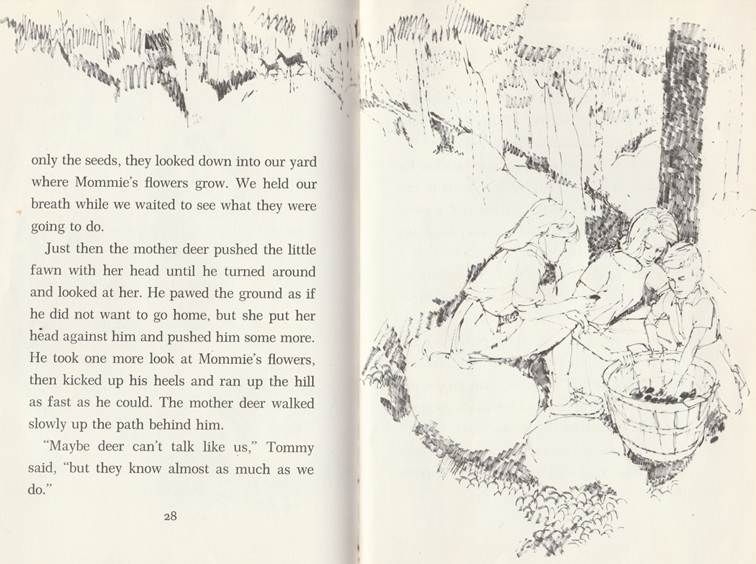
(The Deer at Our House 28-29)
The Minor, Experimentation and Indirection
When one does look for ideology in Caldwell’s children’s books, one finds that they are so structured as to render interpretation very difficult. But I find a consideration of texts on minor literature sheds light on the question of his world view.
Resistance to interpretation is one of the characteristics of “minor literature” as Gilles Deleuze and Felix Guattari defined it in their article “What Is a Minor Literature?” Deleuze and Guattari base the notion of minor literature on Kafka’s 1911 diary entry on “little literatures,” by which he meant Yiddish literature in Poland or Czech literature in Prague. Kafka’s view of “little literatures” was political (Gilman vi), and Deleuze and Guattari’s view of minor literature implies an ideological context, and to the latter “only the minor is great and revolutionary” (Deleuze and Guattari 26). For Deleuze and Guattari, the term applies to works in which there is a deterritorialization of the language, a connection of the individual and the political, and that have a collective value (16-17); it also applies to works of multiplicity that block attempts to interpret them. All resist what they call “territorialization” by an interpreter who is an agent of a dominant social code largely through experimentation, with “invention […] not only lexical” (27). Where Deleuze and Guattari admonished “Know to create a becoming minor” (27), Caroline Zekri, in her introduction to La notion de « mineur» entre littérature, arts et politique, suggests that what makes the minor work noteworthy and valuable is that it does not attempt or need to seem legitimate: the minor “does not garner recognition, but rather seeks a form of knowledge” (10, my translation). Again, it may seem puzzling to view Caldwell’s children’s books as seeking a form of knowledge regarding society, as they appear to be destined only to entertain. But my thesis is that when one delves beneath their surface charm, one will see that he twists the experimental interrogative so that it defeats attempts at ideological interpretation. And in this opposition to interpretation one may find Caldwell’s and the texts’ “becoming.”
On the one hand, Caldwell’s questioning of social practices in his children’s books recalls his work and social commitment of the thirties. On the other, the predominance of dominant ideological formations blurs his message.
In what follows, I use the distinctions recalled by Fredric Jameson, who holds that when one speaks of ideology it is necessary to view the cultural dominant as made up of distinct ideological formations, as does Raymond Williams. Jameson believes that a “cognitive mapping” of society ensuring a realistic and unified view of history can be envisaged if one takes into account “residual” ideological formations (ideologies belonging to the past but that still have a degree of currency), “emergent” ideological formations (new ideologies that are beginning to have currency), and “dominant” ideological formations (those ideologies supported by what Louis Althusser terms “ideological state apparatuses”) (Jameson 6). In considering Caldwell’s ideological message, one must note that progressive representations of society or points made in favor of emergent ideologies are set down within dominant ideological structures.
Caldwell told interviewers: “As I was growing up, I did resent the South. I resented its economy and sociology. I resented the lack of opportunity in general, and especially the fact that the black people there were not accorded the same opportunity as the white people” (Hoag 82). The system of beliefs by which he made sense of the world is inscribed in Georgia Boy, for he was both nostalgic for the Georgia of his youth and critical of it. In these stories, he uses experimental techniques that he had applied to his earlier work, notably what John Stephens calls the carnivalesque interrogative, recalling Mikhail Bakhtin’s exploration of the subversions of authority inherent in carnival in Rabelais and his World (Stephens 6 and ch.4). William’s bland acceptance of Morris’s unacceptable behaviour is destined to shock the reader. William considers it normal that his Pa should ill-treat his Ma, philander (“My Old Man and the Grass Widow”), steal money from his son (“The Time Handsome Ran Away”), deprive Handsome of his wages, banjo and holiday (“Handsome Brown’s Day Off,” “The Time Handsome Ran Away”), throw baseballs at Handsome’s head (“The Time Handsome Ran Away”) and routinely put him in the way of physical harm. And as with Caldwell’s work of the thirties, the effect of the stories depends on the reader wondering what happened to the virtuous self-sustaining rural men whom Jefferson felt were the backbone of the Republic. Caldwell uses a residual ideological formation, the agrarian myth, to legitimize emergent ideological formations like the acceptance of equal rights. As Ronald Wesley Hoag has shown, the abuse of Handsome is social satire directed against a South in which the stunted economic opportunity is made apparent (Hoag 79). For all its humorous exaggeration, Georgia Boy provided a picture of a South sans “magnolia blossoms” (Miller 165). The impoverished Morris Stroup, owner of a farm in the country (whence he brings his goats to their house in town, 41) is ineffective, unrealistic and abusive, showing the degradation of the Jeffersonian ideal in the South.
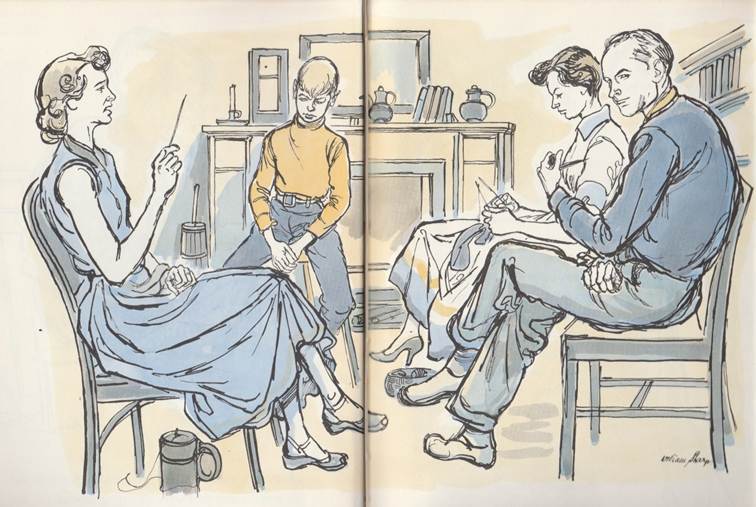
Molly Cottontail also questions the ideology of the South, and is “progressive” in this respect. The two-tone illustrations synthesize the conflict between the aunt who longs for gentility and the rest of the family: as she talks, heads are bowed, the father walks off head bent. They reinforce the contrast between the two gun-wielders, the patrician dream gentleman in his plus fours, and Johnny’s farm-bound father in roomy trousers, taking care not to hit the crows he wants to frighten (though both smoke a pipe). The genteel South is debunked by a Southern farmer; the crash course he gives Johnny after the child tries to shoot at a rabbit point blank shows that he knows the noblesse oblige of not abusing power, but prefers a democratic application: “A real sportsman always gives the game he is after a chance for its life” (my emphasis—27). But Caldwell is upholding the residual myth that has shaped American thought: having Molly in the barnyard means the victory of the Jeffersonian good farmer over aristocratic pretense; the rescued live rabbit, allowed to run free, elicits the aunt’s “disgust” (28). Whereas William and Handsome shoot rabbits in Georgia Boy (61) an emergent, anti-killing ideology is set down regarding hunting; but it works within the dominant ideology: the American right to bear arms is not qualified for children who might take it into their head to set off with a gun, only a vague rule for hunting is provided.
In The Deer at Our House, the seemingly perfect parents of the well-brought up Vivi and her petulant brother seem to think of nothing but the deer problem which many a gardener has solved by planting only ferns (feeding deer is prohibited today). The father who works in the city solves the problem like an independent Jeffersonian farmer, and repression is kept to a minimum. Thus the liberal ideology of feeding pests to indulge the children seems sanctified by tradition. One might see the story as a vehicle for other emergent ideologies, reading into the notion that it is preferable to sacrifice a portion of your possessions than to lose what you cherish justification for giving the needy benefits through taxation, for example, so they will not rob you. Social peace is surely manageable too, with a little common sense. This may seem in tune with the permissive sixties, but the ideology remains close to a more traditional, dominant culture: the parents are said to find sustainable solutions; moreover, they “make children behave.”
Thus ideological boundaries are blurred in Caldwell’s works. Emergent ideological formations such as liberal attitudes are given residual validity, and dominant ideologies limit them. Yet residual, emergent and dominant ideologies are a part of the cultural dominant. Identifiable messages in Caldwell’s children’s fiction are none of them revolutionary. The revolutionary is rather in Caldwell’s approach, where doubt is crucial. Althusser says that ideology finds an echo in the subject, producing an “Amen, ‘So be it’” (1971, 28). These works seem to try to make such a reaction impossible, to make the reader say “Wait a minute!” instead of “So be it!”
“Wait a minute!” Children’s Literature: Adults Teaching Children How to Be Children?
Jacqueline Rose deems that adults avoid acknowledging aspects of experience which they have repressed (notably, of sexuality), and that in books, children learn how to “know less […] exactly in order to suit […] adult wants and needs”, so that Rose speaks of their “colonization” in The Case of Peter Pan or The Impossibility of Children’s Fiction (qtd. in Nodelman 161-163). As one ideal of children’s literature is helping the child develop his full potential, she and other critics feel that “most texts for children […] work ambivalently both to make children more like adults and to keep them opposite to adults—both to move children past innocence and to encourage them to keep on being innocent” (Nodelman 167). Children’s innocence is central in Caldwell’s tales, yet doubt is cast on the adults, too. Adults’ inconsistencies make an “Amen, ‘So be it’” reaction impossible.
In Georgia Boy, William’s innocence is a comic device. He seems not to know what his father is getting up to with women; he is ordered about by his parents, and especially by his mother who tells him to “[s]hut up […]. Stop taking up for your pa…” (“My Old Man’s Baling Machine” 13) or to “[g]o inside the house and […] stay there until I call you” (“My Old Man and the Gypsy Queen” 113). So it is humorous when he sneaks out of the house (“My Old Man and the Grass Widow”), and meaningful when he sides with his father at the end and runs out after him (“My Old Man Hasn’t Been the Same Since”). Thus, Martha’s dominant position as a voice of reason is questioned. And the carnivalesque interrogative is used in Georgia Boy to highlight Morris Stroup’s excessiveness, as well as visiting adults’ like Uncle Ned’s. The latter’s remark about Handsome Brown can be seen through by the most inexpert reader: “All the work that shine’s ever done could be counted up and poured into a thimble. Ain’t that the truth, boy?” (214). No adult seems reliable.
Molly Cottontail may be seen as aiding the child to develop, introducing ethics (“fair” and “unfair” hunting) and teaching that what a child is embarrassed about, like failing to shoot a rabbit, can be socially acceptable, and that full instructions are needed before undertaking a project. But it makes adults’ ascendency clear from the women acting as if Johnny were not there, and Johnny’s silent knowledge that “his father would have taken up for him” (11). This ascendency is confirmed in his father’s suggestions and orders: “I wouldn’t put it in a box. […] Turn it loose and let’s see what it will do” (27). His father names the rabbit and tells Johnny to get it lettuce: “[H]is father knew a lot more about rabbits than he did” (27). The father’s near omniscience reinforces the message that “father knows best:” “Look here […]. You didn’t shoot that rabbit while it was sitting down, did you?” (26). The penultimate illustration shows Johnny thoughtful, the father smiling: “Anybody could see that he was beginning to like the rabbit a lot,” and the final illustration shows the father about to stroke what Caldwell calls “their” rabbit (32). Children cannot do anything themselves, or enjoy anything of their own.
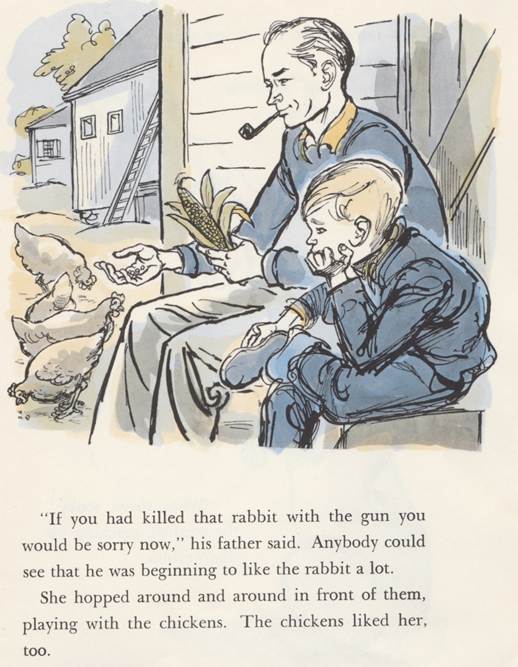
(Molly Cottontail 31)
But adults provide the child with erroneous concepts, and the authority of Johnny’s domineering father is made to appear suspicious. From his aunt, the boy gathers that a “Southern gentleman” means someone who spends “all his spare time away from home gunning for game,” like his uncle (8). That a gentleman should be a good sport, or that being a good sport is deemed gentlemanly behavior, is not made explicit. It would be difficult to construe such a basic concept from the dialogue with his father.
“A good sportsman never shoots at a rabbit when it is sitting down. A good sportsman never shoots at a bird until it flies. A real sportsman always gives the game he is after a chance for its life.”
“But Aunt Nellie said I had to kill something and she didn’t say not to kill things standing still.”
“You stop paying any attention to your Aunt Nellie. She doesn’t know what she’s talking about, anyway.” (Molly Cottontail 26-27)
The father’s blanket assertion about Johnny’s aunt calls out for qualifiers. She cannot always be wrong; he is not “giving the game a chance,” establishing the conditions for resolution and reconciliation that a child would prefer to the uncomfortable feud depicted, in which the father signals his distaste for her by not staying in the same room with her (7), and she makes no bones about her displeasure: “Aunt Nellie went into the house and slammed shut the door behind her” (28). Moreover, the father’s sportsman code is not to be found in any literature on hunting that I have come across. In nearly every case, including rabbit hunting, it is considered more humane to shoot a still prey, as a sure kill reduces its suffering.6
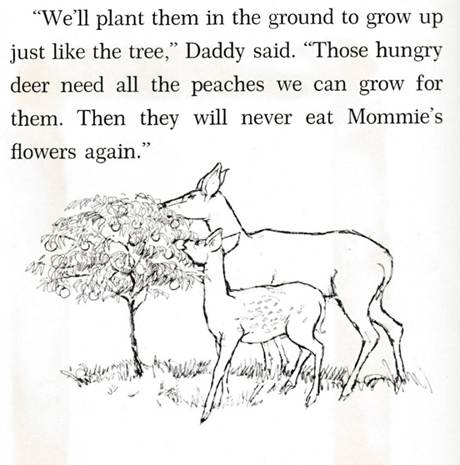
The Deer at Our House also helps children to grow in some respects. Discourse and story center on the questions of time and the need to plan ahead which children must take in. The book opens on the past perfect “We had lived in our house in the country for a whole year” (7); time’s passing is recorded: the family wait for the deer “nearly all day”, then “wait for Daddy to get home from the city” (21, 30); and sustainable measures are shown to be preferable over temporary ones. The other explicit ideological tenets in the book serve adults: youngsters must be made to behave, and parents are always right. The mother initially shoos the fawn away from her flowers, saying “A little deer should have good manners too” (i.e., just like children) (15). Even the mother deer scolds her fawn and “mak[es] him do just what she tells him” (25); she will not let him return to the yard after eating the peaches. Daddy gets credit for solving their problem: “That was Daddy’s idea. I was only thinking about how much I like to eat [peaches]” (26), says Tommy; and again at the end, it is the father who asserts a happy ever after, which the child reader takes for as good as done: “‘We’ll plant [the seed] in the ground to grow up just like the tree,’ Daddy said. ‘… Then [the deer] will never eat Mommie’s flowers again’” (32). However, questions arise though the father promises all will be well. Caldwell has stressed the importance of time but remains artistically vague as to the time it takes for a tree to grow to maturity—to say nothing of growing trees from seeds: “We’ll put the tree in the ground in the morning […] and very soon the peaches will be ripe enough for the deer to eat” (32). The final picture is of two deer eating peaches off a miniature tree. The only way out of the durable solution conundrum is that the parents who have humored their children throughout the book will now chase the deer away from the yard until the trees have grown. Thus, Caldwell saps adults’ authority. Children are shown to gain little knowledge or security from interaction with them. The consistent undermining of their dominance in his children’s books seems designed to make the reader say “Wait a minute!” It renders Caldwell’s worldview more complex, as does his treatment of other minorities.
“So be it”? The Interrogative, or a Questionable Ideology?
Caldwell either comically undermines the dominant when writing about minorities other than children—African Americans and women—or presents dominant ideological structures as if they were a matter of course. Racist behavior in the South is questioned by the carnivalesque interrogative in Georgia Boy. And perhaps in these books where defense is indirect, Caldwell’s women—all “females” to Morris Stroup (Georgia Boy 204), shown knitting and in dresses in illustrations—are also meant to raise questions. However, when Caldwell also uses the discourse of the dominant ideology, it is not clear whether the reader will say “Wait a minute!” or “So be it.”
(Molly Cottontail 6-7)
In Georgia Boy, Handsome is a sympathetic character. Caldwell shows him to be quick—his reaction in “My Old Man’s Baling Machine” when Martha discovers what has gone into Morris’s lucrative bales is humorous, because it indicates that he has understood before Morris that the game is up, and that he knows how irascible his mistress can be:
“Do you know what you’ve gone and done, Morris Stroup!” she said. “You’ve taken all my recipes and dress patterns I’ve been saving […]!”
“But it’s all so old it’s not worth anything,” Pa said.
Handsome started backing through the hall door. Ma looked around.
“Handsome, untie every one of those bales…” (13)
Caldwell’s humor generally makes the reader feel sympathy for Handsome. There is comedy in the opportune mention of Handsome’s pain in “Handsome Brown and the Goats,” and in its repeated discounting by the Stroups because it suits them to believe he is fit to get the goats off the roof where they don’t dare to go: “Handsome could not walk fast. He always said his arches hurt him when he tried to walk fast,” says the narrator (41). Handsome does not succeed in mollifying Morris: “‘If it’s all the same to you, Mr. Morris, I just don’t feel like going up [on the roof]. My arches has been hurting all day […].’ ‘Stop that talking back to me, Handsome,’ Pa said, ‘and go on up there like I told you. There’s nothing wrong with your arches today, or any day’” (42). Nor does he succeed with Martha: “‘Handsome Brown,’ Ma said, running out into the yard where we were, if you come down that ladder before getting those goats off the roof, I’ll never give you another bite to eat as long as I live […].’ ‘But, Mis’ Martha, my arches has started paining me again something awful.’ I’ve warned you, Handsome Brown…’” (43-44). Even when Handsome is presumed dead after being butted off the roof and falling into the well, no sympathy is given him: “‘Can you breathe all right, Handsome?’ Pa shouted down at him. ‘I can breathe all right, Mr. Morris,’ Handsome said, ‘but my arches pain me something terrible.’ ‘Fiddlesticks,’ Pa said. ‘There’s nothing wrong with your arches’” (50). There is a social critique both in the humor, which shatters Martha’s status as the more reasonable and feeling of the two (she is overly preoccupied by what the Ladies’ Circle will think of her if the goats are not got off the roof, and not at all by Handsome’s welfare), and in the technique of repetition, which Scott MacDonald sees as emphasizing “the basic immovability of the central characters” (331); these are the white masters he is at the mercy of, and they have no mercy. Handsome’s falling into the well is just one instance of the many torments he experiences at their hands. Natalie Wilson points out that Caldwell distorts the body for a “reconsideration of various debilitating social conditions in the South” (114). Despite the humor of these slapstick situations, I believe that their dehumanization and commodification of the black body aims at revealing social injustice, and that the reader is supposed to spot it.
But discourse redolent of social prejudice about African Americans is used for comic effect in Georgia Boy too. Handsome in the well is a minstrel-like figure:
“Are you down there, Handsome?” Pa shouted into the well.
There was no answer for a while. We leaned over as far as we could and looked down. At first there was not a thing to be seen, but slowly two big, round, white balls started shining down in the bottom. […] Pretty soon they got brighter and then they looked like two cat eyes on a black night when you turn a flashlight on them. (“Handsome Brown and the Goats” 50)
After dismissing the pain in Handsome’s arches once again, Morris asks, “Can you see all right?” The resulting exchange is more humorous if one shares in the belief that all black people are superstitious and slow-witted.
“I can’t see a thing,” Handsome said. “I’ve done gone and got as blind as a bat. I can’t see nothing at all.”
“That’s because you’re in the bottom of the well,” Pa told him. “Nobody could see down there.”
“Is that where I am?” Handsome asked. “Lordy me, Mr. Morris, is that why there’s all this water around me? I thought when I come to that I was in the bad place. I sure thought I had been knocked all the way down to there.” (“Handsome Brown and the Goats” 50-51)
Georgia Boy is the only book of the three with an African American character. In Molly Cottontail, the family depicted is Caucasian (only the rabbit’s name, referring back to the tales of Uncle Remus,7 serves as a reminder of a black presence in the South). In The Deer at Our House, it is striking that the whole family looks Aryan—cultural diversity is suggested only in the fruit seller’s dark hair.
As for the female figures in Caldwell’s children’s books, they generally seem secondary to the dominant male, but the reaction of an adult today is not “So be it.” In Georgia Boy, Martha stands for home and the realities of life and must circumscribe the excessive male whose many plans make him the creative force. The ending on her abandonment after she kills the fighting cock College Boy echoes society’s belief that no true son could stand by while a woman cuts off a man’s cock.8 But Martha’s being a more able breadwinner than Morris sheds light on what can make a woman threatening. In Molly Cottontail, questions may arise as to why the “correct” woman should be seen and not heard. The mother gives a congratulating glance, but doesn’t say a thing when Johnny brings in the rabbit. She speaks one line: “Johnny doesn’t like to kill things” (Molly 10). Both she and the assertive aunt, who gets things all wrong, make one uneasy because of their limitations—and the illustrator apparently deemed it unimportant to observe real people knitting, for they are holding their needles incorrectly in the drawing. In The Deer at Our House, it is even more striking that woman seems to deserve no recognition. Vivi’s only comment on her family is: “My brother Tommy is always very practical” (17). Women are not practical. The narrator’s name is mentioned once, when her brother complains about her “silly pretend games” and questions her seeing the fawn (she does not take offense) (10-11). Vivi “asks” Tommy, her younger brother, to explain things to her (21, 30), and when she attempts to compliment him, saying “You gave Daddy the idea about peaches,” he cuts her down: “That was Daddy’s idea” (26). Tommy tells Mommie (whose name’s unusual ie ending makes her doubly feminine, as does her preoccupation with “her” flowers) that their solution won’t hold, as “Peaches cost a lot of money at the market,” and all that she can say is “Well, […] that’s something we will have to ask Daddy about when he comes home” (30). She and Vivi are demure, while Tommy clambers behind the fruit seller in his dungarees. Vivi defers to her mother, but Tommy questions her authority: “Mommie, why did you do that? […] You scared [the little deer] away. Now he may never come back to our house again” (15). He keeps his mother in her place, as he keeps his sister in hers, pooh-poohing Vivi’s suggestions as to what the deer might like to eat (16). Are females so dense? Or is Caldwell having a bit of fun with the beginning reader books?
It is not clear whether he is propounding a WASP, patriarchal ideology, or reflecting the stultifying roles available to minorities in his time. Do the questions raised make a child think “Now wait a minute…?” instead of “So be it”? One thing is certain: juveniles reading these books do not absorb the basics of racial and ethnic diversity or the ABC’s of equality neat.
For an author supposedly reporting on the world, Caldwell’s children’s books do not reflect the increasing number of African Americans and women in positions of power and responsibility from the 1920s to the 1960s.9 Nor, apart from Martha Stroup, does his portrayal of these minorities who are not of the elite reflect their resentment at what they have to contend with. The uncertainty as to the serious or carnivalesque nature of these works makes Caldwell’s claim of mere reporting dubious. He is, rather, exaggerating the pecking order in society. His “ideological mapping” presents residual and dominant ideologies in greater force than emergent ones that might give minorities hope for change. Yet his works question the dominant authority that they uphold. As an example, in Georgia Boy, the dominant ideology is reinforced, yet challenged. Morris, a womanizing, brutalizing thief, is obviously reprehensible, and industriousness and decency, embodied by Martha, seem to win out at the end. But Caldwell questions the obvious adherence to reason: the symmetry has changed in the war between the two spouses, and the Georgia boys seem united in a fun-loving male understanding. But that would also be in line with the dominant ideology in which males have the last word over a bothersome female. Yet the story remains interrogative, as Caldwell has shown the Southern male to be neither carefree nor understanding.
The Line of Flight and Becoming
Illogic could be a critique in his children’s books, but it is not clear if it would make a child think “Now wait a minute…?” instead of “So be it.” Early critics, who implied “that Caldwell’s talent was conducive to ideological confusion” (Cook 99)10 had perceived its ambiguities. One explanation for Caldwell’s ambiguity will be found in Lucien Goldmann’s view of contradiction as intrinsic to any work of quality: in order to give life to characters whose views the writers condemn, they must also formulate the limits of the worldview that they wish to promote (553). Another explanation—one that I feel meshes with his refusal of political categorization over the years—is to view his indirection as a strategy which corresponds to the “line of flight” that Deleuze and Guattari see in minor literature, “an exit” from “the language of power” (27). It is as if Caldwell deliberately wished his participation in the Ideological State Apparatus to be as un-straightforward as possible. As the editor of “What Is a Minor Literature?” notes, “The desire to evade interpretation is not a desire to be against interpretation, to negate it. To do so, after all, would be to continue to exist in its terms. The desire is rather to affirm an alternative which is simultaneously uninterpretable” (13-14). Such a desire seems to inform Caldwell’s revolutionary, dissonant works of the 1930s and 1940s: Cook has shown that the writer undermined the naturalistic theories that he invoked, and wrought his fiction so that it “refused […] to accommodate itself to any comfortable category, either aesthetic or political” (284). The indirection that we find in his children’s books has something of the revolutionary as well.
For Georgia Boy, Molly Cottontail and The Deer at Our House show the line of flight available to a celebrated major writer. These works provide a mapping of dominant ideology, but undermine the authority and systems they seem to uphold. Caldwell’s resistance to interpretation and his use of experimentation, notably his interrogative technique, recall what is revolutionary in minor literature. His ideological quest can best be seen in the texts’ contradictions, not in any smooth face value. The contradictions make alternative thought necessary. Just as the vitality of the major writer’s achievement stemmed from his “flights” from the system, in the alternatives which his children’s books suggest are their—and the writer’s—“becoming.”
Caldwell encouraged readers to ask questions, and these books suggest that Caldwell remained free to ask questions of himself—at any rate, he does not seek to impose a system of answers. It is this rejection of a system that is revolutionary. And as regards the Cultural Ideological State Apparatus, they constitute a mapping of the dominant ideology with a line of flight that may yet wing in change. Black or female children today might be moved to fury by the depictions of downtrodden Handsome or Vivi, and resolve never to settle for less than just treatment. Or children may find in these books confirmation of chinks in others’— adults’—authority. Some of the questions posed by Caldwell’s children’s books will no doubt evade young readers. But perhaps one can never determine what effect individual works will produce on a child. Adults assess their value according to their own criteria, and are surprised at requests to repeat a passage or skip pages, or at being told another story altogether (Prince 148). Certainly, new questions will arise as new generations read Caldwell’s books.
(The Deer at Our House 32)
Notes
- 1See also Cook, chapters 3-5 on the later novels.
- 2Norman Macleod’s analysis of Caldwell’s ideological stance in July 1931 for the New Masses is one example. More recent studies on his social concerns include Sylvia Jenkins Cook’s Erskine Caldwell and the Fiction of Poverty: The Flesh and the Spirit (1991), and Wayne Mixon’s The People’s Writer: Erskine Calwell and the South (1995). Some essays centering on the relationship between Caldwell’s aesthetics and his politics are to be found in Robert L. MacDonald’s Reading Erskine Caldwell: New Essays (2006), notably those by Tom Jacobs, Natalie Wilson, Jonathan Dyen, and Christopher Metress; my article “Myth for the Masses: Erskine Caldwell’s ‘Daughter’” also focuses on Caldwell’s style and social purpose.
- 3There are two other changes, i.e., the insertion of “Johnny knew” (11) and the deletion of the explanatory clause after “I’d lots rather have her living than dead” (32): “suddenly realizing how much I liked her myself.”
- 4An attempt (an overt series of actions, carried out in the service of attaining a goal) causes or enables a consequence (an event, action, or endstate), making the attainment or non-attainment of the protagonist’s goal, which in turn causes a reaction (an internal response expressing the protagonist’s feelings about the outcome of his actions, or the occurrence of broader, general consequences resulting from the goal attainment or non-attainment of the protagonist).
- 5This is probably Morris’s version of the Southern greeting made popular by the Tales of Uncle Remus, “How’s your corporosity sagaciating?” (Liberman).
- 6The exception being birds, which may be setting—hence the expression “a sitting duck.”
- 7Miss Mollie Cottontail becomes Brer Rabbit’s wife. See “How Mr. Rabbit Succeeded in Raising a Dust” (Harris 93).
- 8“Ma… you shouldn’t—”, “You shouldn’t have done that, Martha…” (238). There seems to be a continuity with the castrating woman in Caldwell’s early work Poor Fool (1931).
- 9African Americans and women had been pressing for civil rights and equal rights since Caldwell started writing—through the NAACP or CORE and the NWP or NOW (founded 1966), for example—and were changing American society. In the Harlem Renaissance of the 1920s, many blacks gained recognition and influence, like W.E.B. Dubois, co-founder of the NAACP. In 1934 Arthur Mitchell of Illinois was the first African American elected to Congress. Singer Marian Anderson was the first black artist to perform in the White House, and her 1939 concert on the steps of the Lincoln Memorial was a milestone in the civil rights movement. Sports figures like Jackie Robinson spoke out publicly for black equality in the 1940s. Benjamin Davis became the first African American general in the American Army in 1940, Ralph Bunche the first American Nobel laureate in 1950—Martin Luther King was awarded his Nobel in 1965. In 1925, the first female U.S. Governor, Nellie Tayloe Ross, was sworn into office, and the World Expo of Women’s Progress, the world’s first women’s fair, was held in Chicago. In 1926 Amelia Earhart flew across the Atlantic. In 1933 Frances Perkins was the first woman in a Presidential Cabinet, as Secretary of Labor under F.D.R, and in 1934 Letty Pate Whitehead was the first American woman to serve as the director of a major corporation, the Coca-Cola Company. Margaret Chase Smith, of Maine, was the first woman nominated for President at the National Convention of San Francisco in 1964. Women were gaining visibility around the world: from 1960 onward Sirimavo Baudaranaike was Prime Minister of Ceylon then Sri Lanka, and from 1966 Indira Gandhi was Prime Minister of India.
- 10Among these, Cook cites Kenneth Burke in “Caldwell: Maker of Grotesques” and Otis Ferguson in “Caldwell’s Stories.”
Bibliography
- Althusser, Louis. “Ideology and Ideological State Apparatuses (Notes Towards an Investigation).” Lenin and Philosophy and Other Essays. Trans. Ben Brewster. New York: New Left Books, 1971. <https://www.marxists.org/reference/archive/althusser/1970/ideology.htm>.
- Bakhtin, Mikhail. Rabelais and his World. Trans. Helene Iswolsky. Cambridge: Massachusetts Institute of Technology, 1965.
- Broadwell, Elizabeth Pell and Ronald Wesley Hoag. “Erskine Caldwell. The Art of Fiction N°62.” The Paris Review 86 (Winter 1982). <https://www.theparisreview.org/interviews/3098/erskine-caldwell-the-art-of-fiction-no-62-erskine-caldwell>.
- Caldwell, Erskine. The Deer at Our House. Ill. Ben Wohlberg. New York: Collier-MacMillan, 1966.
- Caldwell, Erskine. Georgia Boy. (New York: Duell, Sloan and Pierce, 1943) Athens: U of Georgia P, 1995.
- Caldwell, Erskine. God’s Little Acre. New York: Viking, 1933.
- Caldwell, Erskine. A House in the Uplands. New York: Duell, Sloan and Pierce, 1946.
- Caldwell, Erskine. “Molly Cottontail.” American Earth. New York: Scribner’s, 1931. 37-46.
- Caldwell, Erskine. Molly Cottontail. Ill. William Sharp. Boston: Little, Brown and Co., 1958.
- Caldwell, Erskine. A Place Called Estherville. New York: Duell, Sloan and Pierce, 1949.
- Caldwell, Erskine. Poor Fool. New York: Rariora Press, 1930.
- Caldwell, Erskine. The Sure Hand of God. New York: Duell, Sloan and Pierce, 1947.
- Caldwell, Erskine. Tobacco Road. New York: Scribner’s, 1932.
- Caldwell, Erskine. With All My Might. Atlanta: Peachtree Publishers, 1987.
- Caldwell, Erskine. You Have Seen Their Faces. New York: Viking, 1937.
- Cook, Sylvia Jenkins. Erskine Caldwell and the Fiction of Poverty: The Flesh and the Spirit. Baton Rouge: Louisiana State UP, 1991.
- Deleuze, Gilles, and Felix Guattari. “What Is a Minor Literature?” Trans. Robert Brinkley. Mississippi Review 2.3 (Winter/Spring 1983): 13-33. <http://parenthetic.org/minorliterature.pdf>.
- Dyen, Jonathan. “‘Ripe for Revolution’: Ideological Struggle in God’s Little Acre.” Critical Essays on Erskine Caldwell. Ed. Scott MacDonald. Boston: G.K. Hall, 1981. 150-164.
- Gilman, Sander L. Preface. One Hundred Years of Masochism: Literary Texts, Social and Cultural Contexts. Eds. Michael C. Finke and Carl Niekerke. Amsterdam and Atlanta, GA: Rodopi, 2000.
- Goldmann, Lucien. « La Sociologie de la littérature: situation actuelle et problèmes de méthode », Revue internationale des sciences sociales, 19.4 (1967): 532-555.
- Gray, Richard. “The Comedy of Frustration.” The Critical Response to Erskine Caldwell. Ed. Robert L. McDonald. Westport, CT: Greenwood Press, 1997. 220-236.
- Harris, Joel Chandler. The Complete Tales of Uncle Remus. Ed. Richard Chase. Boston: Houghton Mifflin, 1995.
- Herman, Luc and Bart Vervaeck. “Ideology and Narrative Fiction.” The Living Handbook of Narratology. <http://www.lhn.uni-hamburg.de/article/ideology-and-narrative-fiction>.
- Hoag, Ronald Wesley. “Canonize Georgia Boy.” In Arnold, Erskine Caldwell Reconsidered. 73-85.
- Jacobs, Tom. “Poeticizing the Political Image: Caldwell, Bourke-White and the Recasting of Phototextual Expression.” Reading Erskine Caldwell: New Essays. Ed. Robert L. McDonald. Jefferson, NC and London: McFarland, 2006. 92-113.
- Jameson, Fredric. Postmodernism, or the Cultural Logic of Late Capitalism. Durham: Duke U P, 1991.
- Jefferson, Thomas. Notes on the State of Virginia, 1784. Web. University of North Carolina 2006. 29 Aug. 2017.
- Liberman, Mark. “How’s your copperosity sagaciating?” Language Log. 29 Nov. 2003. 28 July 2017.
- Lukacs, Georg. “The Ideology of Modernism.” The Critical Tradition. Classic Texts and Contemporary Trends. 3rd ed. Boston and New York: Bedford/St. Martin’s, 2007.
- MacDonald, Scott. “Repetition as Technique in the Short Stories of Erskine Caldwell.” Critical Essays on Erskine Caldwell. Ed. Scott MacDonald. Boston: G.K. Hall, 1981. 330-341.
- Macleod, Norman. “A Hardboiled Idealist” (July 1931). Critical Essays on Erskine Caldwell. Ed. Scott MacDonald. Boston: G.K. Hall, 1981. 6-7.
- Marx, Karl and Friedrich Engels. The German Ideology. ˂https://www.marxists.org/archive/marx/works/download/Marx_The_German_Ideology.pdf˃.
- McDonald, Robert L. Reading Erskine Caldwell: New Essays. Jefferson, NC and London: McFarland, 2006.
- McDowell, Edwin. “Erskine Caldwell, 83, Is Dead; Wrote Stark Novels of South.” The New York Times, April 13, 1987. <http://www.nytimes.com/1987/04/13/obituaries/erskine-caldwell-83-is-dead-wrote-stark-novels-of-south.html?pagewanted=all>.
- Metress, Christopher. “Repetition as Radical Critique in Erskine Caldwell’s God’s Little Acre.” Reading Erskine Caldwell: New Essays. Ed. Robert L. McDonald. Jefferson, NC and London: McFarland, 2006. 165-182.
- Miller, Dan B. Erskine Caldwell. The Journey from Tobacco Road. New York: Knopf, 1995.
- Moisy, Amélie. “Myth for the Masses: Erskine Caldwell’s ‘Daughter.’” The Journal of the Short Story in English, 67 (Autumn 2016): 83-95.
- Nodelman, Perry. The Hidden Adult: Defining Children’s Literature. Baltimore: The Johns Hopkins University Press, 2008.
- Prince, Nathalie. La littérature de jeunesse. Pour une théorie littéraire. Paris: Armand Colin, 2010.
- Rose, Jacqueline. The Case of Peter Pan or The Impossibility of Children’s Fiction. London: Macmillan, 1984.
- Smith, Harrison. “Comic Citizens of the South” (Sept. 10, 1949). Critical Essays on Erskine Caldwell. Ed. Scott MacDonald. Boston: G.K. Hall, 1981. 89-90.
- Stein, Nancy L. and Tom Trabasso. “What’s in a Story: Critical Issues in Comprehension and Instruction.” Advances in the Psychology of Instruction. Vol. 2. Ed. Robert Glaser. Hillsdale, NJ: Lawrence Erlbaum Associates, 1981. 213-267.
- Stephens, John. Language and Ideology in Children’s Fiction. London: Longman, 1992.
- Tinkle, Lon. “Crumbled Georgia Crackers” (Aug. 28, 1948). Critical Essays on Erskine Caldwell. Ed. Scott MacDonald. Boston: G.K. Hall, 1981. 87-88.
- Wilson, Natalie. “Social Injustice Embodied: Caldwell and the Grotesque.” Reading Erskine Caldwell: New Essays. Ed. Robert L. McDonald. Jefferson, NC and London: McFarland, 2006. 114-130.
- Zekri, Caroline and Béatrice Rodriguez, eds. La notion de « mineur » entre littérature, arts et politique. Paris: Michel Houdiard, 2012.
About the author(s)
Biographie : Amélie Moisy est Maître de Conférences à l’Université Paris Est Créteil (UPEC). Elle y est membre de l’équipe du laboratoire de recherches IMAGER sur la littérature anglophone, Text, Images and Sounds (TIES). Membre de la Thomas Wolfe Society, elle étudie chez cet écrivain, ses contemporains du Sud des États-Unis des années 30, ou des textes plus récents, les relations entre autobiographie, mythe et politique.
Biography: Amélie Moisy is a Senior Lecturer at the Université Paris Est Créteil (UPEC). She is a member of IMAGER, a research team on English language literature, Text, Images and Sounds (TIES). She is also a member of the Thomas Wolfe Society and her research focuses on that writer, his Southern contemporaries of the 30s, or on more recent texts, and on the relations between autobiography, myth and politics.