The Writing’s on the Stalls: Linguistic Practices in Latrinalia
Abstract: Public toilets, as intimate and anonymous spaces, provide a unique canvas for unfiltered self-expression. This article examines a corpus of 226 latrinalia (toilet graffiti) as a site for anonymous, naturalistic, and interactional communicative practice in the linguistic landscape. The data were collected over a seven-year period in Bordeaux and Toulouse (2018-2024); from university, public toilets, and bar facilities. The study conceptualises the toilet cubicle as an analogue chat room, applying frameworks? from linguistic landscape studies, retrospective lurking, and digital ethnography. Findings show that the presence of latrinalia transforms the toilet cubicle into a multilingual and polyphonic communicative space in which writers draw on a unitary semiotic repertoire, combining French, English, internet slang, and globalised lexical items. Overall, latrinalia remains an empirical resource for studying language contact, linguistic identity, and physical communicative interactions in an increasingly digital world.
Keywords: Graffiti, Latrinalia, Corpus, Linguistic hybridity
Résumé : Les toilettes publiques, en tant qu’espaces intimes et anonymes offrent un cadre unique pour l’expression sans filtre. Cet article examine un corpus de 226 inscriptions de latrinalia (les graffitis dans les toilettes) en tant que lieu de communication anonyme, naturaliste et interactionnelle dans le paysage linguistique. Les données ont été collectées sur une période de sept ans à Bordeaux et Toulouse (2018-2024), provenant d’universités, de toilettes publiques et de bars. L’étude conceptualise la cabine de toilettes comme un forum de discussion analogique en appliquant le cadre des études sur le paysage linguistique, la surveillance rétrospective et l’ethnographie numérique. Les résultats montrent que les latrinalia transforment les cabines des toilettes en un espace de communication multilingue et polyphonique dans lequel les auteurs appliquent un répertoire sémiotique unitaire, combinant le français, l’anglais, l’argot d’Internet et des éléments lexicaux mondialisés. Dans l’ensemble, le latrinalia reste une ressource empirique pour étudier le contact linguistique, l’identité linguistique et les interactions communicatives physiques dans un monde de plus en plus numérique.
Mots-clés : Graffiti, Latrinalia, Corpus, Hybridité linguistique
Acknowledgements
The author would like to thank the reviewer and the editor for their comments and
advice concerning this article. I would also like to thank Alison, Rachael, and Jeanette
for proof reading the article and Florian for his support during the writing process.
Digital language tools (including Gemini Pro version 2.5, Gemini Raisonnement, and
ChatGPT 4o) were used to support editing and revision; all analytical decisions remain
the author’s own.
Latrinalia : « Un jour, les philosophes, les politiques et les intellectuels s’apercevront que toutes les réponses étaient dans les toilettes de l’université. »1
Introduction
While digital communication increasingly dominates our daily interactions, the study of handwritten inscriptions in public places offers insight into unfiltered self-expression. Despite the contrasts between the digital and physical world, many parallels can be drawn between them. Graffiti, as a primary source for researchers, is particularly useful for anthropologists and sociolinguists as the inscriptions often cite and refer to current events (Menis). As the reactions are anonymous and unrestricted, it allows the researcher unprecedented access to the inner thoughts and emotions of the writers. This is supported by Bartholome and Snyder who suggest that toilet graffiti can be particularly useful to researchers giving them “an insight into the psyches of the authors and the society to which they belong” (86). In normal interactions or ethnographic research, the presence of other people or a researcher asking questions limits some interactions and encourages others. In the case of graffiti, and particularly latrinalia, the author’s psyche is voluntarily laid bare for others to see through the inscriptions that they write and scratch into the walls.
The online linguistic landscape is not defined by geographical boundaries, but by the communities shared lingua franca. The same can be said of graffiti, which can be a physical representation of the inhabitants of a certain area. Where in digital communication we can focus on one specific forum or online community, graffiti researchers can study a certain country, city, or facility. This study proposes the analysis of case study of toilet graffiti, in much the same way that a digital researcher might follow an online thread on a public website. In both cases the spaces are public and accessible, yet the groups passing through share either online interests or geographical locations. Graffiti, and latrinalia in particular, allows for passers-by and researchers to observe the interactions and corrections, any attempt to censor or “cancel” someone’s comments still leaves a physical marker even if the message is hidden. Once an online interaction is deleted it is only visible to the server host of administrative members.
The study of multilingual toilet graffiti, from here on referred to as latrinalia, contributes a niche view of the writing habits, styles, and multilingual linguistic hybridity being used on these physical canvases at the time of study. The toilet cubicle itself is a unique place of linguistic practice, it is one of the last remaining zones of anonymous, physical, and asynchronous communication within the digital age, whilst simultaneously bridging the gap between digital language and a physical space. The presence of a globalised linguistic repertoire, namely English words and expressions, and internet slang, within a hyper-local, semi-private space can be observed and recorded through the use of retrospective lurking. This study, therefore, intends to focus on the following research questions:
-
How does retrospective lurking reveal the interactional linguistic practices of the toilet cubicle?
-
How does multilingual linguistic hybridity function as a communicative resource?
-
How does linguistic swarming create polyphonic, spatial discourse?
In order to answer these questions, this paper analyses a corpus of latrinalia collected in toilets in southwestern France (n = 226). Rather than focusing on identity categories such as gender, the central aim is to examine latrinalia as a site of “natural” linguistic practice, where multilingual repertoires, linguistic hybridity, and polyphonic interactions become visible through anonymous written exchanges.
Latrinalia
The term latrinalia, first used by Dundes in 1966, will be used to denote graffiti found in toilet cubicles: namely on doors or walls, in sticker form and written with a pen or marker. Latrinalia provides a unique window into the thoughts and feelings of the graffiti writers as the confines of the cubicle grant writers “almost complete anonymity” (Trahan 2). Abel & Buckley observe that latrinalia, as opposed to other forms of graffiti, allows the writers to verbalise, albeit in written form, “their frustrations, hatreds, fantasies, desires, wit, wisdom, their innermost secrets, [and] things they would not normally reveal to their closest friends or loved ones” (3).
The anonymity of the toilet cubicle creates a false sense of privacy in which the writers feel they are able to express their most intimate thoughts. The false sense of privacy refers to the transformative nature of the public toilet: as its name suggests it is public and serves the many; yet, it becomes private and anonymous with a click of the lock. This phenomenon has been referred to as the “reverse panopticon effect” (Ahmed), and it has been also identified by researchers of online behaviour where an individual’s life is accessible online for inspection (Martin).
Latrinalia, being a sub-form of graffiti, can be studied for its artistic nature but also for its linguistic and multilingual content. Demska writes that “language makes cultural hybridity visible while also being an element of it” thus “linguistic hybridity should be treated as a part of cultural hybridity, rather than as a separate phenomenon” (2). Multilingual linguistic hybridity in this study is understood as an inscription containing words from more than one language, or a word created through the use of more than one language. Hybridity can be either implicit or explicit (Bakhtin); explicit hybridity can be conscious or unconscious, whilst implicit hybridity is mainly unconscious (Demska).
This study adopts the view that multilingual speakers, or writers, have a “unitary semiotic repertoire” (García and Kleifgen 2); they draw from their multiple linguistic resources without necessarily considering the “named language” like “French” or “English” which are eponymous with the countries from which they originate (Otheguy, Ricardo, García, and Reid 283). Generally, the focus of the multilingual speaker is the overall message conveyed, not the language used.
Swarming
A key feature of graffiti, and therefore of latrinalia, is its dialogic nature. A single inscription can provoke responses, in turn creating a conversation on the wall. This aligns with Bakhtin’s concept of polyphony which refers to the presence of multiple voices and consciousnesses within a text. In the context of latrinalia, polyphony is achieved through multiple writers on the same canvas, often discussing the same topic. Polyphony highlights the social and conversational aspects of the inscriptions, showing how writers interact through response, overlap, cross-outs, and modifications (Menis). The polyphony of voices present in the inscriptions allows for the analysis of the phrases individually as well as the asynchronous interactions between them.
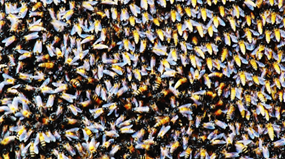
Additionally, if “graffiti attracts graffiti” (Macdonald 4), then latrinalia attracts latrinalia. To account for the accumulation, density, and interactional layering of inscriptions, this study adopts the concept of linguistic “swarming” (Peake 97), as an unbiased alternative to the Broken Window Theory (Kelling and Wilson) which suggests that the more dilapidated a building is, the more it will be vandalised. Swarming, however, is a sign of life, movement, and interaction: the more writers leave their mark in a particular cubicle, the more it will be added to. Swarming also refers to the multitude of inscriptions: just as a snapshot of a swarm of insects shows partial insects covered by others and movement captured in a freeze frame. In latrinalia, swarming often results in overlapping and illegibility, whereas conversational latrinalia tends to respect the space around phrases and can be read almost like a conversation. Conversational graffiti, and therefore conversational latrinalia, refers to inscriptions that seek a response from other writers (Sheivandi et al.) or are responding to previous inscriptions. The individual writers, in both swarming and conversational latrinalia, are often identifiable through the use of a new line or paragraph (Trahan).
The Globalised Vulgare
Latrinalia encapsulates multiple taboos, as it involves graffiti writing, a prohibited act of vandalism, in an intimate setting, often concerning taboo topics, whilst using taboo language (e.g. sex and swearing). The word taboo refers to “any indiscretion that ought to be avoided” (Hughes 151; 462). The privacy and anonymity of the toilet cubicle could be a contributing factor to the presence of taboo inscriptions, as the risk of being caught and/or identified is lower compared to writing on a school desktop or on a public wall. This secrecy might explain why latrinalia writers allow themselves to use swear words, write about taboo topics, or make references to race or sex “which one would not normally write [about … or] perhaps only express in the most intimate conversations with trusted partners” (Menis 45).
Swearing in graffiti is a means to express anger and frustration without resorting to violence (Abel and Buckley). Swearing in English, and in particular the word fuck, is “one of the most prominent modern and global curses” (Fjeld et al. 86). The increasing use of English swear words in countries where English is not an official language has been documented in other studies around the world (Beers Fägersten; Fjeld et al.; Rathje; Zenner, Ruette and Devriendt). Gorter writes that “due to globalization, a pure monolingual linguistic landscape is a rarity,” he cites “the spread of English in non-English-speaking countries” (191), a trend that is also observed in the present corpus.
The latrinalia inscriptions in this study were written in France, so English is presumed to be a second or third language for the majority of the writers; therefore, the use of swear words from a “foreign language […] adds another layer of complex interactions between sociobiographical, psychological and linguistic variables” (Dewaele 109). It has been suggested that the use of a foreign language can be a way to escape from the “confines of [the writer’s] own grammar and culture” (Kramsch 101), potentially heightening the cathartic function of multilingual latrinalia.
Besides swearing, there are other global terms from popular culture that are present in the unitary semiotic repertoire of LX English speakers (LX refers to all non-native speakers, Dewaele). Demska writes that the globalised linguistic landscape can actually be considered a hybrid linguistic landscape, one such example of a global hybrid word within the linguistic landscape is “Stan.” It refers to an Eminem song about one of his fans called Stan who became obsessed with him and ultimately killed himself and his pregnant wife after receiving no responses from the rapper. The name/noun Stan has undergone a functional shift to become a verb which means to love a certain celebrity, it connotes an intense worship (“Urban Dictionary.com”).
Methodology
In this section I will present the methodology and frameworks used. In the same way that a netnographer (digital ethnographer) can study online interactions from a distance, not engaging with internet users but collecting and analysing their public interactions, the latrinalia researcher can also observe, collect, and analyse asynchronous conversations and interactions without participating and influencing the exchanges. In order to do so, we rely on a mixed methods approach, as is commonplace in ethnographic research (Brewer).
Linguistic Landscape
Linguistic landscape is a data focused framework (Peake 2023), serving as a tool for providing information about the “sociolinguistic composition of the language groups inhabiting the territory” (Landry and Bourhis 26). The term was first coined by Landry and Bourhis in 1997 and traditionally focuses on public signage, but its principles can also be applied to informal texts such as graffiti inscriptions as well as the hyper-local context of toilet cubicles. The framework can be used to map written forms of language diversity and multilingualism in urban settings (Gorter, Ben-Said). Linguistic landscape studies are often associated with a quantitative approach: the researchers document every occurrence of language and use statistics to compare the percentages of texts in the target languages (Leeman and Modan).
The use of linguistic landscape in particular combines well with ethnographic studies, which according to Brewer, should be understood as fieldwork. The study of the linguistic landscape of toilet facilities required time being spent visiting and archiving the graffiti found in the communal, semi-private spaces.
Retrospective Lurking to Archivist
Many parallels can be drawn between graffiti research and digital research, in particular the methods used to conduct the research. By conceptualising latrinalia research as retrospective lurking, this study aligns its analysis with established methodologies present in digital ethnography (also called netnography) and equally draws upon archival research during the data harmonisation. Addeo et al. refer to this as “covert access or lurking: the researcher invisibly observes the community without informing people about the research and the researcher’s presence within the group with related ethical implications” (21). Graffiti inscriptions tend to be anonymous, making it impossible to identify the writer. In cases where a person’s name is used the researcher can avoid citing those examples to preserve anonymity.
The texts being studied were created voluntarily and independently from the study, therefore there is no interaction between the researcher and the participants, no bias or influence can occur. As Cox and Hassard write, “accuracy is paramount, and the task of both the research and reader is to maintain a critical stance so as not to be duped into receiving a less-than-objective view of the world” (480). In graffiti research, the critical stance is not focused on an objective world view, rather, the critical reflection is of the views, beliefs, and opinions within the subjective inscriptions of the writers. We do not enter into the debate of whether their views are objective or correct, we record what opinions are expressed and how. However, Cox and Hassard identify a possible limitation of retrospective research, in that the researcher is subjectively constituting the nature of the past reality from their own position. Therefore, in retrospective research there is no researcher bias in the data creation, but it could still remain in data collection and analysis.
However, the line between objectivity and subjectivity is fine for many researchers. For example, research based on self-reporting interviews is only as reliable as the participants, as there is the risk of faulty memories, oversimplications, subconscious decisions to change the story for self-esteem, or acceptance and so on (Cox and Hassard). The graffiti researcher, however, takes a photograph of the graffiti and that image contains the inscriptions, that have not been removed or covered, dating from the first to that moment without the prior knowledge of the graffiti writers.
Digital-Physical Blended Ethnography
As explained above, a blend of digital and physical research methods informs this study. The toilet cubicle can therefore be treated as an analogue chat room or thread and, applying concepts from internet ethnography to a physical, “naturally” occurring setting. Brewer writes that “ethnography is predisposed to naturalism: it concentrates on topics that lend themselves readily to the study of people’s views, beliefs and meanings” (100). Describing graffiti inscriptions as “naturally occurring” may be an exaggeration for some, but as they have not been created for the purposes of research they can be considered “naturally produced” by the writers (Peake 119). Addeo et al. would add that “lurking [can] offer a unique opportunity for collecting ‘natural’ data, as the members [or graffiti writers] are not aware of their informant status and do not modify their behaviour due to the researcher’s presence” (22). Authors including Addeo et al. and García et al., argue that lurking could be acceptable in certain contexts, particularly if that is how that community routinely participates and interacts with one another.
The study of latrinalia, and all graffiti, implies both embodied on-foot field work as well as archive creation and analysis. The latrinalia researcher must visit local visits and document the instances of graffiti, photographing with as much detail as possible. The researcher then becomes a librarian, and archives the photographs studying each one and turning the images into typed data that can be read and analysed more easily.
In addition to fieldwork and archiving, ethnographers can be seen as participating:
…overtly or covertly, in people’s daily lives for an extended period of time watching what happens, listening to what is said, asking questions–in fact, collecting whatever data are available to throw light on the issues that are the focus of the research.” (Hammersley and Atkinson, 1)
As stated above, ethnography often implies a case study over a long period of time which is possible, or even necessary, for both the digital and graffiti researcher. Within both digital and graffiti research one single online thread or bathroom wall can contain days, months, or years of interactions, like a timelapse photograph. In one visit, a researcher can access almost the whole conversation, minus the parts that have been deleted or cleaned. Addeo et al. give the following summary of advantages of netography, all of which can be applied to graffiti research through lurking:
Netnography allows documenting the explicit language of informants without the risk of obtrusiveness and disturbance. It is focused on the study of spontaneous and naturalistic conversations, publicly available on the internet and not contaminated by the needs of a social scientist. In doing Netnography, it is not necessary to initially compile the desired data, as these data already exist in the Internet. Due to their spontaneity, the collected data are free of systematic bias, since the researcher does not interrupt the conversation and can remain invisible. (Addeo et al. 24)
Corpus Collection
The study is built around the collection, categorisation, and analysis of a corpus of latrinalia inscriptions. There is an examination of key linguistic features identified in the corpus: the multilingual and hybrid lexical content, and polyphonic nature of the inscriptions. It has been argued that “a corpus is essential when exploring issues or questions related to language use” (Reppen 31). Tools and approaches from corpus linguistics were instrumental in organising and analysing the collected data. This study uses corpus analysis as a foundation for quantitative exploration, providing insight into the linguistic diversity and frequency of specific phrases in the latrinalia inscriptions. According to Reppen, “simply counting items or displaying their occurrences does not actually tell us anything in itself; it is the associated analysis, which may be both quantitative and qualitative, which provides the insights” (122). The sections containing the analysis and the discussions intend to provide such insights into this data set.
All of the inscriptions have been translated into English and appear in brackets following the original text, which are all verbatim, both the translations and the original inscriptions are in italics. Each inscription was transcribed, entered into a digital spreadsheet, and then categorised and organised. The spreadsheet allowed for a quantitative examination of granular details and patterns in the corpus and comparison with the American English 2006 (AmE06) reference corpus. This provides a broad overview of the prominent linguistic features of the present corpus. The following sections briefly present the corpus and its comparison to other studies of a similar nature.
Sample Size and Diversity
Due to the nature of latrinalia, the inscriptions in this corpus are often short. The type-token ratio can be used to determine the lexical diversity of a corpus regardless of its size (Templin). To calculate the lexical diversity, the total number of types is divided by the total number of tokens. The corpus used in this study has 776 types and 1160 tokens. Therefore, the lexical diversity in this corpus is 0.66, whereas the AmE06 corpus has a type-token ratio of 0.051. This corpus has a relatively high score for lexical diversity as the “ideal” score can be considered 1.00, whereby there is no repetition in the sample (Richards). However, this is in part due to the size of the corpus and the nature of graffiti writing, in which the writer repeats the same phrase in as many places as possible.
The overall size of the corpus could be considered a limitation of the study, however, studies on graffiti, and in latrinalia in particular, tend to rely on smaller corpora. Table 1 compares the corpora of six previously published studies on latrinalia.
|
Author(s) |
Olusoji 2013 |
Batholome and Snyder 2004 |
Trahan 2011 |
Islam 2011 |
Green 2003 |
This current study |
|
Corpus Size (number of inscriptions) |
152 |
269 |
323 |
338 |
723 |
226 |
Due to the size of this corpus, the use of a relative frequency was applied during analysis. To calculate the relative frequency, the number of occurrences of a selected token is divided by the total number of tokens, this is then multiplied by 10,000 to give the relative frequency per 10,000. In this study, the number of occurrences and relative frequency are indicated by (n = x) and (rf = x) respectively.
The phrases ranged from one word to 64 words in length, the mean average inscription containing 5.49 words and one-word inscriptions being the modal average (n = 47). In this study, words containing a contraction, such as I’m or c’est, have been counted as two words.
Data Harmonisation
Due to the latrinalia being written by hand, and sometimes (half) removed by maintenance or covered by other writers, all illegible words have been represented with a question mark in square brackets [?] (n = 21). In the case of inscriptions such as AHAH and BRAVO, which can be considered French or English, they have been classified as French rather than English as they are written in France.
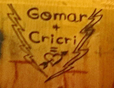
Symbols that are a part of a phrase or as an entire inscription have not been counted as a word unless they replace a word. For example, Image 1 contains two phrases hey, you’re beautiful ♡ From Zoé :) and Well, thank [?] ZOE ♡ . In these inscriptions the symbols are used as if they were punctuation rather than words and are therefore not counted as words. However, in Image 2, it can be inferred that the plus sign, the equals sign, and the heart symbol are used to replace the words plus, equals and love, completing the phrase: Gomar + Cricri = ♡.

Results
This section contains a quantitative overview of the data. The corpus in this present study contains 226 legible latrinalia inscriptions photographed by the author and volunteers over a seven-year period (2018-2024). The data were collected from public toilets in universities, bar toilets in Bordeaux, and public toilets in Toulouse, through field work using linguistic landscape as the framework (Landry and Bourhis). Although the corpus allows for descriptive comparison between locations, the uneven distribution of inscriptions across the three sites limits the reliability of statistical testing. Table 2 shows the distribution of the phrases with the majority collected within university facilities; the following analysis compares the differences between the two sub-corpora.
|
Location |
Number |
Percentage |
|
Public Toilet Bars2 |
23 17 |
10.1% 7.6% |
|
Universities (4 Campuses) |
186 |
82.3% |
The first difference between the three spaces is the size, both in number of inscriptions and number of words. The public facilities contain both French and English, whereas in the universities the three additional languages can be seen (to be discussed in more detail below). The dominant themes vary between the two data sets, references to politics are much more frequent in the university toilets compared to the public and bar toilets. For example, there is one instance of the acronym ACAB within the public toilet and the 5 remaining examples were found in the university cubicles. The university corpus also contained the names of several French politicians and stickers inciting other lavatory users to join protests. Additionally, the use of the imperative was greater in the university corpus: VOTEZ; STREAM; STOP [vote; stream; stop].3
The inscriptions in the public facilities function primarily as affective tagging, supporting Deiulio’s findings that graffiti is a means to express one’s existence. The university corpus, however, serves as a “safe” space for confrontation and confession.4 The writers in the university facilities give their opinions and reasons for their beliefs and explicitly challenge and censor the writers before them, whereas there is little to no interaction within the public toilet and bar facilities (n = 2).
Studying at university is sometimes described as a time or place for “finding oneself” and the inscriptions in the toilets would suggest that this extends beyond the classroom. The instances of existential and philosophical thought are all inscribed in university facilities.
Language Distribution
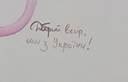
The corpus is multilingual. The most used language is French, followed by English, with a small number in Spanish, Japanese, and Ukrainian. Finally, there are 9 hybrid inscriptions which contain two languages. In total, the corpus contains 1,160 words (tokens).
|
Language |
Number |
Percentage |
|
French |
112 |
49.56% |
|
English |
86 |
38.05% |
|
Unclear |
12 |
5.31% |
|
Hybrid |
9 |
3.98% |
|
Spanish |
2 |
0.88% |
|
Japanese |
2 |
0.88% |
|
Symbols only |
2 |
0.88% |
|
Ukrainian |
1 |
0.44% |
The presence of non-French and hybrid inscriptions in French toilet cubicles are evidence of “the effects of globalisation and language contact on the languages themselves” (Huebner 32). Besnier finds that the use of English, as a second or additional language, in oral or written form, establishes the language user as both cosmopolitan and modern. However, this study focuses on anonymous inscriptions therefore the use of other languages to create a particular image appears to be redundant unless we consider that language choice is “personal and fundamental to that individual’s identity” (Carrere and Peake 44), despite being written anonymously.
|
Photographs |
 |
 |
 |
|
Possible Translations |
The Case Study of Vanita’s No talking! |
Tigger and Saint Mary |
Good evening, we are from Ukraine! |
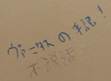
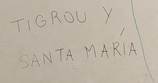
The first two latrinalia (image 3 and image 4) were found at the University Bordeaux Montaigne which houses a languages faculty. Therefore, the authors may have been students of these languages. The third inscription was found at the Université of Bordeaux which has a language centre but does not offer classes in Ukrainian. This, coupled with the text itself: we are from Ukraine, suggests that this was the work of one or more international or Erasmus students. The use of Ukrainian in France is noteworthy as it is not commonly used or taught in French schools compared to English and Spanish. The use of Ukrainian could be linked to the writer’s identity and willingness to express their identity and/or communicate with members of the Ukrainian community, a desire to share their language, or conversely, a wish to hide the meaning of their message in plain sight.
As expected, in a corpus sourced in France, French is the dominant language and accounts for 65% of the words and 49.56% of the inscriptions. This demonstrates that the latrinalia writers were more comfortable expressing themselves in French than in English. The most frequently written words include functional French words such as la, de, est, on and a [a, of, is, we and have]. One of the most frequent two-word combination, however, was the set phrase was here.
|
Word |
La |
De |
Est |
On; A |
Les; pas |
Et |
Je |
Tu; le |
Qui; Que |
Here to |
|
No. of occurrences |
22 |
21 |
20 |
15 |
14 |
11 |
10 |
9 |
8 |
7 |
|
Combinations |
De la; Was here |
Cest pas; I need; Tu es; Kilroy was here |
||||||||
|
No. of occurrences |
4 |
3 |
||||||||
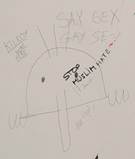
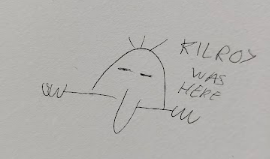
The use of the word here is significantly higher in the latrinalia corpus than in the AmE06 (rf = 56.5 and 6.5 respectively). This could be due to the desire of the writers to leave a trace of their presence. Graffiti has been associated with a desire to communicate to others: “I am here, I exist, I have something to say” (Deiulio 517). The phrase “Kilroy/X was here” has been documented worldwide in graffiti inscriptions, we employ the term “translocal marker” to describe a word or phrase (marker) that extends beyond (trans) its original locality (local). It has been posited that the inscription was first used by a shipyard worker named James J. Kilroy as proof of inspection and that the phrase was then rewritten by North American soldiers wherever they were stationed during World War II as a means to reassure one another (Dickson). The continued use of “Kilroy/X was here” in English inscriptions could be a desire on the part of the writer to use the original phrase instead of a translation, which we define as “language authenticity” (Peake 387). In comparison, the French translations ici and là are only used once each in the corpus. As illustrated in the two images below, the inscription “Kilroy was here” is always accompanied by a drawing in this corpus and appears to be the same writer or at least the same style of drawing in each inscription.
Translocal Markers
In addition to “Kilroy was here” the corpus also contained other translocal markers. Firstly, the use of ACAB (All Cops Are Bastards) (n = 6), an arguably internationally recognised and used acronym, could be a means to support and align the writers with the ACAB movement in the rest of the world and/or render their discontent with the police visible to passers-by that do not speak French. In this corpus, there are no instances of the French alternative to ACAB which uses the number 17 (the number to call to reach French police).5 Additionally, this corpus contains two variants of the acronym ACAB: All Clitoris Are Beautiful and AFAD all fascist are died. These are examples of constitutive intertextuality. Constitutive intertextuality refers to “the configuration of discourse conventions that implicitly contribute to the production of text” (Fairclough 105).
Another example of the latrinalia writers aligning themselves with a globalised community can be seen through their use of the verb stan (n = 5). The repeated use of the verb in the latrinalia serves as a means for writers to bond and align themselves with a globalised community through copying or mirroring their vocabulary choices, therefore fostering a sense of solidarity. In the corpus, the verb stan is mainly used in reference to Korean pop (K-Pop) music bands (Red Velvet, Stray Kids, Day Six, and Mamamoo), linking French popular culture to Korean popular culture, through English/internet slang. This specific use, alongside the close proximity of related inscriptions, further supports the analysis that the writers are consciously positioning themselves within a shared fan community, in this case, uniting around their K-Pop interests.
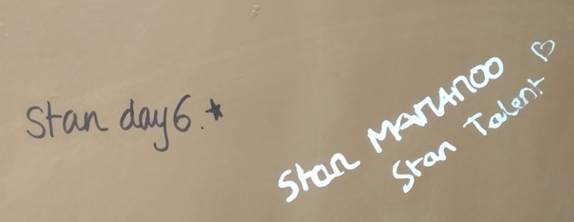
In image 8, it appears that one writer has expressed their love for one band and this has been copied by two more writers. We infer that there are three separate writers due to the differences in the handwritten letters. This is an example of the beginning of a potential swarm. One expression of fandom has led to two more, if we revisit the cubicle in question years later more writers could have added to this area, extending the interaction.
One internationally recognised and used English word that features in the corpus in hybrid phrases is the verb fuck. The word fuck appears in the corpus three times: FUCK MACRON, ♥ (FUCK SM though) and fuck la société [fuck society] (rf = 27, compared to 0.2 in the AmE06). Its appearance in the corpus supports the findings of previous studies on the international use of the swear word. Rather than viewing this lexical choice as code-switching, it is more accurate to see the use of the verb fuck as a borrowed and integrated lexical item in certain French registers. It could therefore be argued that the word fuck in particular, is no longer an example of linguistic hybridity but of globalised lexicon and is understood across more than one language.
Swarming and Conversing
Latrinalia, as opposed to the tagging seen in many urban graffiti inscriptions, tends to be longer and more conversational. Halsey and Young find that latrinalia has “a specific communicative tone (often involving a conversational format) and is ‘public’ only to the extent that it occurs on someone else’s property” (167). In this corpus, individual writers can be seen either distancing themselves from others or developing social bonds and affiliations as part of a social group (Yakushkina and Olson), which was demonstrated through comments of support: PREACH; oui [yes].
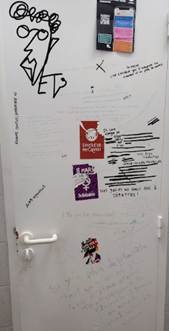
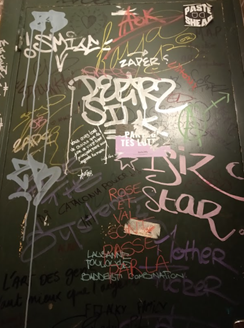
This study has identified instances of swarming, in which the entire door is covered in inscriptions to the point that many are no longer legible, as well as in-depth, asynchronous conversations between several writers. There are three photographs containing swarming in public toilets in bars and three in the university facilities.
|
Swarming in a university |
Swarming in a public toilet |
|
|
Photograph |
 |
 |
|
Nature Comparison6 |
 |
 |
In the first photograph, the swarming is pseudo-organised by theme and the conversations are somewhat easy to follow. We still identify this as swarming due to the number of inscriptions. The similarities between the two images can be seen in the photographs from insect swarms. In the first instance of swarming (graffiti and nature) there are elements of order and organisation with conversations and whole animals being identified and legible. The second instance of swarming, in the bar and by the ladybirds, has very little order or organisation. The inscriptions, like the beetles, are piled on top of one another rendering parts only partially visible and therefore illegible.
Whilst swarming is present in all three locations, public toilets, bar toilets, and university toilets, the 42 instances of conversational latrinalia all took place in university facilities, this corresponds to 22% of the inscriptions found in university toilets.
Image 10 contains 25 latrinalia legible inscriptions in one unisex toilet. There are very few instances of overlap and change of topic. The majority of the inscriptions respond to other writers or are independent topics. Nonetheless, at least one writer has decided to censor the discussion and appears to have blacked out the anti-abortion comments on the right as well as responding to the inscriptions and challenging the first author’s views around the original text. Trahan (5) describes this as “encircling,” positing that the placement of the following inscriptions could be intended to contain the original message.
|
Conversational Interaction |
Challenge |
Support |
Correction |
|
Number of occurrences |
24 |
10 |
10 |
A quantitative analysis of the interactions reveals that challenges are the most common response in this latrinalia corpus. As presented in Table 6, there are 24 occurrences of overt challenges to a previous latrinalia inscription (QU’EST-CE QUE TU CROIS TOI ?[What do you think?]), compared to 10 supportive comments (e.g. je t’aime aussi – [I love you too] and 10 grammatical/orthographical corrections (décission > décision[decision]). This highlights the rebellious and contentious nature of latrinalia where writers are more likely to criticise a previous comment rather than to agree.
![RECETTE POUR SAUVER LA PLANETE [recipe to save the planet] / WTF](https://revues.u-bordeaux-montaigne.fr/leaves/article/download/850/version/856/1072/4945/Leaves_n21_art16_Peake_image013.png)
In addition to criticising one another, latrinalia writers do not shy away from correcting one another. The corpus contains a further eight instances whereby the original phrase is altered by a second writer, this can be identified as a written repair mechanism (Peake; Sacks et al.). These modifications are often correcting the grammar and/or spelling in the first inscription. For example, in the inscription: RECETTE POUR SAUVE LA PLANETE[recipe to save the planet] a second writer added an illegible letter at the end of SAUVE and exclamation marks before crossing out the following sentences. A third writer corrected the grammar to make SAUVERand added WTF7 ? at the end of the crossed-out sentences to indicate their confusion or disagreement with the inscriptions.
These conversational interactions and censorships suggest that within the swarm of graffiti inscriptions there is regulation. Similarly to people shouting over each other in an argument and the loudest person winning, during arguments in a toilet cubicle it is the person with the darkest colour and/or largest nib that has the last word.
Discussion
This section contains a discussion of the findings and limitations of this study. These findings demonstrate that latrinalia functions as an interactional, multilingual, and polyphonic communicative space, thereby addressing the three research questions posed in this study.
Firstly, the results suggest that the latrinalia inscriptions are aligned with the global trend of borrowing English words and internet slang. The phrases present in latrinalia the “natural,” non-research intended, unitary semiotic repertoire of the writers. French is still the predominant language in the latrinalia as 65% of the words used and 49% of the monolingual inscriptions were in French. The English words are used as synonyms to French words, replacing p*tain with f*ck for example, or as means to connect with global issues, e.g. the repetitive use of ACAB. This is supported by the fact that of the 10 longest inscriptions, 64 to 17 words long, only two are in English and one is a quote from the internet. Furthermore, the mean average of a French inscriptions is 6.8 as opposed to 4.2 in English. French is reserved almost exclusively for the serious sociopolitical debates: “c’est le choix de la femme pour son corps” [it’s a woman’s choice for her body] whilst English is used in playful and harmless interjections: “***** will poop here again.”.
Conversely, one major difference between the physical latrinalia in the pseudo chat room as opposed to online interactions is the effort made to interact. When browsing online it is automatically possible to comment and post on the content if on a thread or chat room i.e. the device for viewing is also the device for writing. In a toilet cubicle our eyes read the inscriptions but in order to join the swarm, the writer must find or have a pen ready and physically step from lurking observer into active participant. Unlike an online chatroom there is no official administrator or moderator to decide what is removed and what is tolerated, there is no one validating posts before they are viewable by others. Censorship is regulated by other writers and requires the physical effort of crossing out another writer’s text (Image 12). Ultimately, this makes the cubicle canvas a more equitable canvas whereby each writer has an equal opportunity to write and be read.
Limitations
|
Gender |
Number |
Percentage |
|
Unisex |
179 |
79.2% |
|
Female |
42 |
18.6% |
|
Male |
5 |
2.2% |
The gender distribution immediately highlights a key limitation in this study: the very small sample from male toilets. This imbalance is due to both practical access to male toilets and an observed lower density of inscriptions in the male toilets. As a consequence, any statistical comparison between the three spaces would be unreliable. The analysis of the data therefore focuses on the corpus as a whole, cross-gender accumulation of data, identifying the location (male, female, unisex) as a qualitative descriptor where relevant.
Conclusions
This study contributes to our understanding of the linguistic practices in the latrinalia of French public toilets. The toilet stall is not just a canvas for random scribbling, but a place for multilingual and hybrid inscriptions, and polyphonic exchanges. Latrinalia offers insight into the everyday language of protest, identity, and community. Therefore, latrinalia remains a valuable primary data source for sociolinguists and anthropologists wishing to study human language interaction and language contact without interacting directly with the subjects.
These inscriptions reveal shared concerns and cultural references from multilingual language users. The writers draw upon their unitary semiotic repertoire to create their messages. The corpus contains examples of informal linguistic forms that might not surface elsewhere, including asynchronous interactions that demonstrates that latrinalia are read and that they provoke a reaction in certain people who are, or become, latrinalia writers themselves. The quantity of inscriptions within the same area, i.e. visible at the same time, leads to linguistic swarming. The swarm can be informally organised, legible, corrective, and even censor other writers, or it can be layers of inscriptions partially covering one another rendering certain areas illegible.
The findings from this study offer potential avenues for comparison with digital discourse or other informal or marginalised communication spaces. The author recommends future researchers prioritise a more balanced and larger gendered context in order to compare the linguistic styles between the gendered spaces. Ultimately, this research confirms that despite our hyper-digital age, the toilet stall remains a relevant site of human expression, linguistic creativity, and social interaction.
Notes
- 1“One day, philosophers, politicians and academics will discover that all of the answers were in university toilets.” Graffiti documented by the author at the Université Bordeaux Montaigne in May, 2020.
- 2We have chosen to combine the bars and the public toilet due to size and similarity. Both are predominantly used by the general public as opposed to students and staff within the universities.
- 3“Stream” is an example of a loanword from internet culture, and although “stop” was originally a loanword from English it is used in specific contexts, for example auto-stop means to hitchhike.
- 4We employ the term safe due to the anonymity and privacy of the cubicle as seen in the literature review (see Trahan).
- 5In a previous study by the same author, all of the inscriptions referring to the police were hybrid (English and French) and often followed the structure fuck le 17 (Peake). The use of the English swear word could be an example of borrowing or alignment with the global movement of distrust towards all policing bodies.
- 6Both nature images are taken from https://animalia-life.club/qa/pictures/swarm-of-insects
- 7WTF is the abbreviation for What the fuck.
Works Cited
- Abel, Ernest L., and Barbara E. Buckley. The Handwriting on the Wall: Toward a Sociology and Psychology of Graffiti. Greenwood Press, 1977.
- Addeo, Felice, Paoli, A. D., Esposito, M., & Bolcato, M. Y et al. “Doing Social Research on Online Communities: The Benefits of Netnography.” Athens Journal of Social Sciences, vol. 7, no. 1, 2019, pp. 9–38.
- Bakhtin, Mikhail M. Voprosy literatury i estetiki: Issledovaniia raznykh let. Khudozhestvennaia Literatura, 1975.
- Bartholome, Lynn, and Philip Snyder. “Is It Philosophy or Pornography? Graffiti at the Dinosaur Bar-B-Que.” Journal of American Culture, vol. 27, no. 1, 2004, pp. 86–90.
- Beers Fägersten, Kristy. “The Use of English Swear Words in Swedish Media.” Swearing in the Nordic Countries, edited by Kristy Beers Fägersten, Dansk Sprognævn, 2014, pp. 63–81.
- Ben-Said, Selim. “Data Triangulation as a Resource in Multilingual Research: Examples from the Linguistic Landscape.” Proceedings of the Conference on Doing Research in Applied Linguistics, King Mongkut’s University of Technology, 2011.
- Besnier, Niko. “Crossing Genders, Mixing Languages: The Linguistic Construction of Transgenderism in Tonga.” The Handbook of Language and Gender, edited by Janet Holmes and Miriam Meyerhoff, Wiley, 2003, pp. 278–301. DOI: 10.1002/9780470756942.ch12.
- Brewer, John D. “Ethnography.” The Sage Encyclopedia of Social Science Research Methods, edited by Robert L. Miller and John D. Brewer. Sage, 2003.
- Carrere, Anaïs, and Jeni Peake. “The Story Behind the Ink.” ESSE Messenger, vol. 29, no. 1, 2020, pp. 38-66.
- Cox, Julie Wolfram, and John Hassard. “Ties to the Past in Organization Research: A Comparative Analysis of Retrospective Methods.” Organization, vol. 14, no. 4, 2007, pp. 475–97.
- DeIulio, Anthony M. “Of Adolescent Cultures and Subcultures.” Educational Leadership, vol. 35, no. 7, 1978, pp. 517–20.
- Demska, Orysia. “Hybridity and the Linguistic Landscape.” Cognitive Studies | Études cognitives, no. 19, 2019, pp. 1–10.
- Dewaele, Jean-Marc. “Thirty Shades of Offensiveness: L1 and LX English Users’ Understanding, Perception and Self-Reported Use of Negative Emotion-Laden Words.” Journal of Pragmatics, vol. 94, 2016, pp. 112–27. DOI: 10.1016/j.pragma.2016.01.009.
- Dickson, Paul. War Slang: Fighting Words and Phrases of Americans from the Civil War through the Persian Gulf War. Pocket Books, 1994.
- Dundes, Alan. “Here I Sit: A Study of American Latrinalia.” Kroeber Anthropological Society Papers, no. 34, 1966, pp. 91–105.
- Fairclough, Norman. Discourse and Social Change. Wiley, 1993.
- Fjeld, Ruth E. Vatvedt, et al. “The Worldwide Use and Meaning of the F-Word.” Intercultural Pragmatics, vol. 16, no. 1, 2019, pp. 85–111. DOI: 10.1515/ip-2019-0004.
- García, Angela C., et al. “Ethnographic Approaches to the Internet and Computer-Mediated Communication.” Journal of Contemporary Ethnography, vol. 38, no. 1, 2009, pp. 52–84.
- García, Ofelia, and Joanne Kleifgen. “Translanguaging and Literacies.” Reading Research Quarterly, vol. 55, 2019. DOI: 10.1002/rrq.286.
- Gorter, Durk. “Linguistic Landscapes in a Multilingual World.” Annual Review of Applied Linguistics, vol. 33, 2013, pp. 190–212. DOI: 10.1017/S0267190513000020.
- Green, James A. “The Writing on the Stall: Gender and Graffiti.” Journal of Language and Social Psychology, vol. 22, no. 3, 2003, pp. 282–96. DOI: 10.1177/0261927X03255380.
- Halsey, Mark, and Alison Young. “The Meanings of Graffiti and Municipal Administration.” Australian and New Zealand Journal of Criminology, vol. 35, no. 2, 2002, pp. 165–86. DOI: 10.1375/acri.35.2.165.
- Hammersley, Martyn, and Paul Atkinson. Ethnography: Principles in Practice. 2nd ed., Psychology Press, 1995.
- Huebner, Thom. “Bangkok’s Linguistic Landscapes: Environmental Print, Codemixing and Language Change.” International Journal of Multilingualism, vol. 3, no. 1, 2006, pp. 31–51.
- Hughes, Geoffrey. An Encyclopedia of Swearing. M.E. Sharpe, 2006.
- Islam, Gazi. “Backstage Discourse and the Emergence of Organizational Voices: Exploring Graffiti and Organization.” Journal of Management Inquiry, vol. 19, no. 3, 2011, pp. 246–60. DOI: 10.1177/1056492609359417.
- Kelling, George L., and James Q. Wilson. “Broken Windows.” The Atlantic, March 1982, www.theatlantic.com/magazine/archive/1982/03/broken-windows/304465/. Accessed 7 Nov. 2024.
- Kramsch, Claire. “The Multilingual Subject.” International Journal of Applied Linguistics, vol. 16, no. 1, 2006, pp. 97–110. DOI: 10.1111/j.1473-4192.2006.00109.x.
- Landry, Rodrigue, and Richard Y. Bourhis. “Linguistic Landscape and Ethnolinguistic Vitality.” Journal of Language and Social Psychology, vol. 16, no. 1, 1997, pp. 23–49. DOI: 10.1177/0261927X970161002.
- Leeman, Jennifer, and Gabriella Modan. “Commodified Language in Chinatown.” Journal of Sociolinguistics, vol. 13, no. 3, 2009, pp. 332–62. DOI: 10.1111/j.1467-9841.2009.00409.x.
- Macdonald, Nancy. The Graffiti Subculture: Youth, Masculinity and Identity in London and New York. Palgrave Macmillan, 2001.
- Martin, C. Dianne. “The Internet as a Reverse Panopticon.” ACM Inroads, vol. 4, no. 1, 2013, pp. 8–9.
- Menis, Anne. “Towards an Understanding of Graffiti Discourse.” Monash University Linguistics Papers, vol. 2, no. 2, 2002, pp. 43–54.
- Olusoji, Olofin A. “Graffiti as a Tool of Students’ Communication.” International Review of Social Sciences and Humanities, vol. 5, no. 2, 2013, pp. 1–11.
- Otheguy, Ricardo, Ofelia García, and Wallis Reid. “Clarifying Translanguaging and Deconstructing Named Languages.” Applied Linguistics Review, vol. 6, no. 3, 2015, pp. 281–307. DOI: 10.1515/applirev-2015-0014.
- Peake, Jeni. Les inscriptions en anglais comme marques linguistiques du flux et de l’hybridité linguistique en France: Le cas des graffitis et des tatouages. PhD dissertation, Université Bordeaux Montaigne, 2023. HAL, https://theses.hal.science/tel-04634508. Accessed 7 Nov. 2024.
- Rathje, Marianne. “Attitudes to Danish Swearwords and Abusive Terms in Two Generations.” Swearing in the Nordic Countries, edited by Kristy Beers Fägersten, Dansk Sprognævn, 2014, pp. 37–61.
- Reppen, Randi. “Building a Corpus: What Are Key Considerations?” The Routledge Handbook of Corpus Linguistics, Routledge, 2022.
- Richards, Brian. “Type/Token Ratios: What Do They Really Tell Us?” Journal of Child Language, vol. 14, no. 2, 1987, pp. 201–209. DOI: 10.1017/S0305000900012885.
- Sacks, Harvey, et al. “A Simplest Systematics for the Organization of Turn-Taking for Conversation.” Language, vol. 50, no. 4, 1974, pp. 696–735. DOI: 10.2307/412243.
- Sheivandi, Laleh, et al. “On the Role of First Graffito in the Emergence of More Vandalism.” Journal of Applied Linguistics and Language Research, vol. 2, no. 7, 2015, pp. 105–122.
- Templin, Mildred C. Certain Language Skills in Children: Their Development and Interrelationships. University of Minnesota Press, 1957. JSTOR, www.jstor.org/stable/10.5749/j.ctttv2st. Accessed 4 May 2023.
- Trahan, Adam. “Identity and Ideology: The Dialogic Nature of Latrinalia.” Internet Journal of Criminology, 2011, www.ojp.gov/ncjrs/virtual-library/abstracts/identity-and-ideology-dialogic-nature-latrinalia. Accessed 1 Mar. 2023.
- Yakushkina, Maria, and Daniel J. Olson. “Language Use and Identity in the Cuban Community in Russia.” Journal of Multilingual and Multicultural Development, vol. 38, no. 1, 2017, pp. 50–64. DOI: 10.1080/01434632.2016.1159686.
- Zenner, Eline, et al. “The Borrowability of English Swearwords.” Advances in Swearing Research, edited by Kristy Beers Fägersten and Karyn Stapleton, John Benjamins, 2017, pp. 107–136. DOI: 10.1075/pbns.282.06zen.
- Sitology
- Urban Dictionary. “Stan.” Urban Dictionary, www.urbandictionary.com/define.php?term=Stan. Accessed 3 Nov. 2022.
- Ahmed, Mashiyat. “Latrinalia: More Than Just Writings on the Wall.” The Varsity, 31 Mar. 2025, thevarsity.ca/2025/03/31/latrinalia-more-than-just-writings-on-the-wall/
About the author(s)
Biographie : Jeni Peake est enseignante à l’Université de Bordeaux. Elle a soutenu son doctorat en études anglophones en 2023 au sein de l’Université Bordeaux Montaigne. Elle étudie l’hybridité linguistique en espaces publics, avec un regard particulier sur les graffitis et les tatouages. Elle a récemment étendu son champ de recherche pour inclure l’apprentissage informel guidé.
Biography: Jeni Peake is an English teacher at the University of Bordeaux. She obtained her PhD in English studies in 2023 at the University Bordeaux Montaigne. Her main areas of study are language hybridity in public spaces, with a particular focus on graffiti and tattoos. She has recently expanded her field of interest to include guided informal learning.