Reading Bukowski in the Mirror of his Psychococutaneous Acne Illness
Abstract: The severe acne Bukowski suffered from during his teenager years, resulting in a scarred face, profoundly influenced his life, together with the problematic relations with his parents, outlined in his autobiography and in numerous poems. Of particular interest is the rather positive influence his appearance had on his relation to women, as well as the impact on his social life.
Keywords: Charles Bukowski, Acne, Skin, Apperance, Scars
Résumé : L’acné sévère dont Bukowski a souffert durant son adolescence, qui a laissé des cicatrices permanentes sur son visage, a profondément influencé sa vie, tout comme sa relation problématique avec ses parents, évoquée dans son autobiographie et dans de nombreux poèmes. L’influence plutôt positive que son apparence a eue sur ses relations avec les femmes est particulièrement intéressante, ainsi que son impact sur sa vie sociale.
Mots-clés : Charles Bukowski, Acné, Cicatrices, Peau, Apparence
In our psychobiographic study, we try to understand the impact Charles Bukowski’s severe acne, his violent father and his submissive mother had on his life and his work.
From a dermatological and psychological point of view, Bukowski’s autobiography “Ham on Rye” is of particular interest, wherein he describes the first sixteen years of his life. (Bukowski Das Schlimmste, 1-349). This book, which he later would call his best work (Bukowski Schreie vom Balkon, 423), contains a detailed description of his physical suffering from acne, as well as the mental suffering at the hands of his brutal father, his passive mother and the empathy-less fellow human beings. It is not by chance that this book carries the dedication: “For All Fathers”.
In his introduction to the German edition of Ham on Rye, Carl Weissner hit the nail on the head when pointing out:
At the age of fourteen, [he] developed wild acne and boils all over his body: battered-child syndrome gave vent. … Teenagers run over by fate in this way later become beating family fathers, sociopaths in the city administration, misogynistic Boderliner, Berbers with compulsion to wash. This one became a letter sorter and a poet. (Weissner ii)
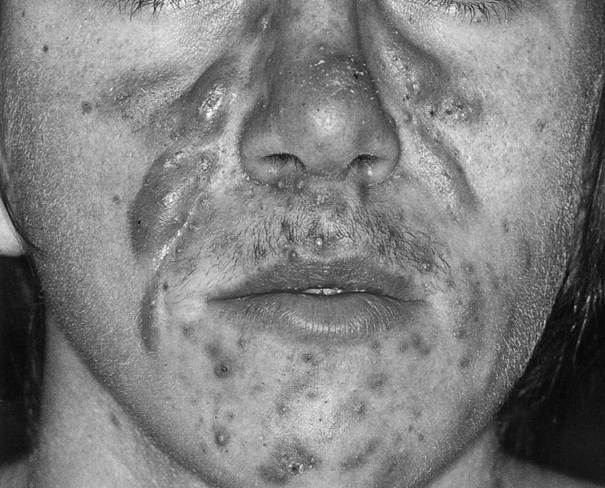
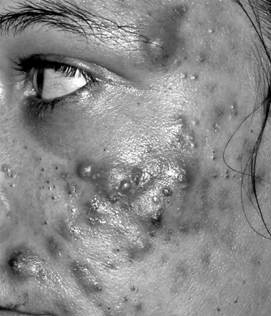
The acne Bukowski develops at the age of thirteen is by no means the common puberal acne consisting of “simple pimples” of the kind his peers had, but an extreme form with “pus bumps” on the face and back, some of them as large as “walnuts”. In the medical language, this type of acne is designated as cystic acne or acne conglobata (Fig. 1 and 2.), leaving severe, disfiguring scars upon healing (Fritsch, Schwarz 914-923).
For the pathogenesis of acne, a genetic disposition, changes of the metabolism of both the sexual hormone testosterone as well as lipid metabolism are responsible (Zouboulis et al.). The increased production of testosterone, mediated somewhat by stress, not only affects the sebaceous glands with the formation of acne, but also the psychological status. Studies show that antisocial, aggressive or criminal behaviour is often associated with increased testosterone levels (Giammanco et al). Bukowski indirectly confirms that testosterone is produced mainly in the testicles, when he noticed at a shower with classmates: “… I had the biggest balls of all” (Bukowski, Das Schlimmste 105). Since alcohol consumption and cigarette smoking are considered to contribute to the severity of acne (Zouboulis et al.), one could speculate whether these factors played a role for Bukowski’s acne, as he started early in life both with alcohol drinking and cigarette smoking.
In the 1930s, at the time Bukowski developed his acne, treatment consisted of peeling pastes, ultraviolet light radiation, and of opening the abscesses with the so-called “hot needle”, i.e. a needle heated by electric current, a time-consuming procedure. To save time, therapy was carried out without local anesthesia, an extremely painful procedure. Bukowski describes in detail his extreme suffering for several weeks, as newly appearing abscesses had to be opened, apparently leading to a kind of post-traumatic stress disorder.
An important aspect of his suffering is his experience with doctors and nurses. Among the medical staff, only one nurse shows empathy (Bukowski Das Schlimmste 158). Without exception, the doctors are distant and pitiless, only interested in commenting and demonstrating this extreme case of acne.
Bukowski feels humiliated; he wonders how some people have managed to become doctors. His statement “The doctors were kings, the patients trash” (Bukowski Stories 210) demonstrates his experience with doctors, somewhat akin to those of the Austrian writer Thomas Bernhard (1931 - 1989), who also had suffered from severe acne as a teenager (Bahmer 2005).
When Bukowski occasionally squeezes an abscess in front of the mirror, he not only feels disgust, but also fascination in a horrible way. Pus, perceived as a disgusting substance by almost all people, evokes a kind of pleasure in Bukowski. This sensation, described as “disgusting lust” (Krebs 1997), is a reminiscence of the polymorphic-perverse form of sexuality of early childhood and the accompanying joy to all bodily secretions (Freud 1972).
This feeling is a prominent feature in Charlotte Roches bestseller Wetlands (Bahmer and Bahmer 2005). Helen, her protagonist, describes in detail the pleasure of dealing with secretions and decay products not only of her own, but also the body of strangers. This disgusting lust might also be a component of itching in skin diseases such as psoriasis, outlined by the American writer John Updike (1932-2008). Suffering almost all of his life from itchy psoriasis, he sometimes felt this lust and a kind of furtive pleasure too, when scratching his skin lesions (Updike 1987). Bukowski describes the same pleasure, when his girlfriend Linda squeezed out his pimples in the glow of the bedside lamp, giving him an erection now and then. (Bukowski Liebesleben 44)
For Bukowski’s pathography, in addition to his acne, his violent and sadistic father is decisive. Once, Bukowski senior takes his son’s acne as an opportunity to torment him further, by forcing him to leave an aggressive, painful peeling paste on his skin for hours instead of only thirty minutes. Predictably, Bukowski junior develops a negative emotional relationship with this father whom he characterizes as a “brain-cracking, stupid monster” (Bukowski Roter Mercedes 22).
From the other family members, his paternal grandmother deserves mention. She, as a Polish Catholic, considers the acne of her grandson to be the devil in disguise. Bukowski describes in detail an highly amusing scene of exorcism, however fugitive. As far as is known, Bukowski, who never turned either to psychologists nor to psychiatrists, was convinced that they were only paid for their lies to guarantee the continued existence of social disorder (Das Schlimmste kommt noch). Why pay people like psychiatrists money to hear from them what to do, was his opinion (Western Avenue 11).
The torments young Bukowski has to endure evoke fantasies of patricide. He did not kill his father, yet he put his plan to defend himself into action. After a night-long drinking spree, the final break with his parents occurs. Bukowski writes: “In one fell swoop, at the age of 16 1/2, I knocked out my father, a violent, sweating bastard with bad breath” (Bukowski Flinke Killer 94).
It is common sense that acne stigmatizes and leads to social exclusion (Harth & Gieler, Psychosomatic 91). In Bukowski’s case, social isolation occurs well before his acne develops, when his father radically restricts social contacts with neighbouring children. In addition to the deprivation imposed externally, Bukowski himself notes withdrawal tendencies long before the onset of acne when reporting that he lost his “enthusiasm for the masses” at the age of four (Bukowski Nicht mit sechzig 235).
From a psychoanalytic point of view, this temporal assignment fits into the anal, active-forming, exploratory and also aggressively tinged phase of the development of sexual autonomy, peculiar to this age group (Freud). So, it is not surprising that Bukowski junior anxiously avoids going to the toilet in kindergarten. Ironically, he later writes that he had the feeling that there was something inside of him. Even if it is only “hardened shit”: it is more than what his peers had in them (Bukowski Das Schlimmste 35).
After his acne has healed, his face is marked by deep and disfiguring scars which make him feel like suffering from leprosy. He himself as well as his love affairs compare his appearance with animals like monkeys, alligators, dogs and hyenas. A person stigmatized by scars is, at least initially, unable to distance himself from the flaw. The disfigured skin impedes the much-desired intimacy and closeness.
Last but not least, this contact blockade decreases with age when Bukowski learns that his appearance does not stand in the way of his success with women. Amused, he notes the envy of a colleague who did not believe that he could attract so many women in 24 hours (Bukowski Letzte Meldungen 205). This success with women reconciles him somewhat with his appearance. He justifies his interest in women with the emotional deficits of his childhood: “No love, no nest warmth. … I have a lot of catching up to do” (Bukowski Liebesleben 299).
People with scarred faces are sometimes considered ugly or repulsive (Harth & Gieler, Psychosomatik 91), as did Bukowski quite often (Bahmer and Bahmer, 2015). However, equating scars with ugliness and smooth skin with beauty is superficial, since ugliness is not defined as the absence of beauty. Here, the flat but apt statement comes to mind that beauty is mainly created in the eye of the beholder. Deformities of the face, especially congenital malformations, and pronounced scars after plastic surgery, do have a negative effect on attractiveness (Rankin, Borah). However, this does not apply to male acne scars, which on the contrary tend to increase attractiveness, at least for those women who are more interested in a short-term relationship than a long-term one (Burris et al.). When Bukowski points out that other men did not whistle at his girlfriend or did not make ambiguous gestures, he alludes to the idea that a scarface is considered a sign of particular masculinity.
Bukowski turns his stigma and his unhappy childhood, which according to Hemingway is the best school for a writer (Hemingway, 49 Depeschen 194), into creativity. The concept of “epigenetic modeling” in recent neuroscientific research shows that a chaotic childhood can indeed be a source of particular creativity (Damasio). As a self-determined, unattached loner, Bukowski is a true “philobat”, that is a person who overcomes his inner tensions, his emotional fluctuations and strokes of fate as well as the horror of hopelessness by a particular activity (Raeithel). In Bukowski’s case, this creativity consists in writing, his vital tool to overcome his inner conflicts and to control the demons from the past. In his own words: “poetry is survival” (Bukowski, Schreie 144).
Bukowski’s literary productivity seems paradoxical in view of his lifestyle. Ironically, his extreme discipline is based on his father, the crucial figure for the formation of his superego (Freud). He realizes this at an older age when he writes: “… without knowing what he was doing, my father shaped what creative power I have within me.” (Bukowski Nicht mit Sechzig 280) His creative power with writing, expressed in the “magic of words”, surpasses everything else in importance: “no woman so beautiful, no wealth greater” (Bukowski Nicht mit Sechzig 280). Finally, he also addresses his outward resemblance to his father in a poem entitled “Twins” (Bukowski Flinke Killer 74).
Like many writers, Bukowski tries to make sense of his illness when he writes: “Man sometimes gets sick just to get out of the wheels of everyday life for a while” (Bukowski Schreie 483). However, his acne and his other illnesses (Bahmer 2017) do not seem have the same significance for writing as for writers with life-threatening illnesses (Dietrich von Engelhardt).
Bukowski’s work reflects the interactions of genetic, psychological, and social factors. The power of observation and the pitiless, almost dissecting precision with which he describes the American Way of Life of his time is striking. Unlike Jack Kerouac, Allen Ginsberg, William S. Burroughs and others, Bukowski does not belong to the writers of the Beat Generation describing attitudes of a Hippie-life. Bukowski’s work deals with human beings on the fringes of society: the whores, the alcoholics, and the disadvantaged by life. His work reminds us of George Orwell’s Down and Out in Paris and London, who some decades before had erected a monument to the same human beings.
In the mirror Bukowski holds up, his compatriots are unable to recognize their true selves and the society in which they live. This is one of the reasons why he is not only rejected by the vast majority of his contemporaries, but reviled as the true “Dirty Old Man”. Bukowski never allows himself to be co-opted, neither for a cause, nor for a party, nor for a movement. Throughout his life he is, like his alter ego Henry Chinaski, a poet and chronicler living in the urban jungle of Los Angeles, obsessed with writing, sex, alcohol, cigarettes, and horse betting.
Bibliography
- Bahmer, Friedrich, Bahmer, Judith. “Feuchtgebiete.” Charles Bukowski und Charlotte Roche über Hämorrhoiden. Hautarzt 61, 2010, pp. 719-722.
- Bahmer, Friedrich. “Thomas Bernhards Nase.” Aktuelle Dermatologie 31, vol. 1, 2005, pp. 52-55.
- Bahmer, Friedrich, Bahmer, Judith. „Die Schönheit des Schimpansen – Bukowskis Haut. “ Jahrbuch der Charles-Bukowski-Gesellschaft 2011/12/13, Maro Verlag, Augsburg, 2015, pp. 34-51
- Bahmer, Friedrich. „Patient Hank – Krankheit, Sterben und Tod in Bukowskis Werk. Jahrbuch der Charles-Bukowski- Gesellschaft 2015/16, Maro Verlag, Augsburg, 2017, pp. 78-93
- Bukowski, Charles. Bekenntnisse eines Menschen, der sich den Wahnsinn leistet, zwischen Raubtieren zu leben. Stories und Romane. Zweitausendeins, Frankfurt, 1977.
- Bukowski, Charles. Das Liebesleben der Hyäne. Kiepenheuer & Witsch, Frankfurt am Main, 2004, p. 44.
- Bukowski, Charles. Das Schlimmste kommt noch. Deutscher Taschenbuch Verlag, München, 1987, pp. 7-343.
- Bukowski, Charles. Flinke Killer. Deutscher Taschenbuch Verlag, München, 1983.
- Bukowski, Charles. Letzte Meldungen. Zweitausendeins, Frankfurt am Main, 2005.
- Bukowski, Charles. Nicht mit sechzig, Honey. Gedichte vom südlichen Ende der Couch. Deutscher Taschenbuch Verlag, München, 2000.
- Bukowski, Charles. Schreie vom Balkon. Briefe. Gingko Press, Hamburg, 2005, pp. 3-550.
- Bukowski, Charles. Roter Mercedes. Deutscher Taschenbuch Verlag, München, 1994, p. 22.
- Bukowski, Charles. Western Avenue. Gedichte. Deutscher Taschenbuch Verlag, München, 1992.
- Bukowski, Charles. Stories und Romane. Zweitausendeins, Frankfurt, 1977, p. 210.
- Burris RP, Rowland HM, Little AC. “Scarring enhances men’s attractiveness for short term relationships.” Personality and Individual Differences, vol. 46, no. 2, 2009, pp. 213-217.
- Damasio Antonio. Selbst ist der Mensch. Siedler Verlag, München, 2011.
- Engelhardt, Dietrich von. Medizin in der Literatur der Neuzeit. Matthes Verlag, Heidelberg, 2018
- Freud, Sigmund. Drei Abhandlungen zur Sexualtheorie. Studienausgabe. Bd. V., S. Fischer Verlag, Frankfurt, 1972.
- Freud, Sigmund. Das Ich und das Es. Studienausgabe, Bd. III, S. Fischer-Verlag, Frankfurt, 1972.
- Fritsch, Peter and Schwarz Thomas. Dermatologie Venerologie. 3. Auflage, Springer-Verlag, Berlin Heidelberg, 2018, pp. 914-923.
- Giammanco, Marco et al. “Testosterone and aggressiveness.” Med Sci Monit, vol. 11, no. 4, 2005, pp. 136-145.
- Harth, Wolfgang and Gieler, Uwe. Psychosomatische Dermatologie. Springer Medizin Verlag Heidelberg, 2006, pp. 91-96
- Hemingway, Ernest. 49 Depeschen. Rowohlt Taschenbuch Verlag, Reinbek bei Hamburg, 2003, p. 194
- Krebs, Julius. Ekellust. Kursbuch Ekel und Allergie, Rowohlt Verlag, Berlin, 1997, pp. 88-99.
- Orwell, George. Erledigt in Paris und London. Diogenes Verlag, Zürich, 1978.
- Raeithel Gert. “Philobatism and American Culture.” J Psychohist, vol. 6, no. 4, 1979, pp. 461-496.
- Rankin M, Borah GL Perceived functional impact of abnormal facial appearance. Plast Reconstr Surg, vol. 11, no. 7, 2003, pp. 2140-2146.
- Updike, John. Der Zentaur. Ex Libris Volk und Welt Verlag, Berlin, 1987.
- Zouboulis, Christos C et al. “What is the pathogenesis of acne?” Exp Dermatol vol. 14, 2005, pp. 143-152.
About the author(s)
Biographie : Friedrich A. Bahmer, MD Professeur de dermatologie et de vénérologie à l’université de Göttingen, membre honoraire de la Société mexicaine de dermatologie, ancien chef du département de dermatologie de l’hôpital central de Brême, Allemagne.
Biography: Professor for Dermatology and Venerology at University of Goettingen, Hon. Member Mexican Soc. of Dermatology, Former Head, Department of Dermatology, Central Hospital, Bremen, Germany.
Biographie : Judith A. Bahmer, Dr. phil. Docteure en psychologie de l’université d’Osnabrück, chargée de cours à l’Institut WILOB à Lenzburg, Suisse, cabinet privé de psychologie des profondeurs à Münster, Allemagne.
Biography: Diploma and Doctor degree in Psychology, University of Osnabrück, Lecturer WILOB-Institute, Lenzburg/Switzerland, Private Practice for Depth Psychology, Münster, Germany