Look Who’s Talking Bukowski: his person & his persona
Abstract: The author Charles Bukowski (1920-1994) is notoriously infamous for his blunt descriptions
of American lowlife on the edge of society, preferably told from the “I”-perspective of an alter ego named Henry Chinaski. The fashion of his writing is
deliberately set to indicate authentic autobiography rather than literary fiction.
Since this includes not only the happenings in his work, but also the character of
his protagonist, there appears to be some difficulty to separate the real person of
the author from his made-up persona. I am going to show that in Bukowski’s case a
strict distinction of the two would even mean an unsuitable assumption.
Scholarly research has revealed the close resemblance of Bukowski’s writing and living.
The same applies to his person and his persona.
Keywords: Charles Bukowski, Persona, Image, Autobiographical fiction
Résumé : L’écrivain Charles Bukowski (1920-1994) est connu pour sa description sans fard
de la vie marginale aux États-Unis, qu’il préfère raconter à travers son alter ego
Henry Chinaski. Son style d’écriture est délibérément pensé pour donner l’impression
qu’il écrit une autobiographie authentique plutôt que de la fiction. Comme cela inclut
non seulement les événements contés dans son œuvre, mais aussi le caractère même de
son protagoniste, il semble difficile de séparer la personne réelle qu’était l’écrivain
de son personnage fictif. Je démontre dans cet article que dans le cas de Charles
Bukowski, une distinction stricte entre les deux serait même une hypothèse inappropriée.
Des recherches universitaires ont révélé la grande similitude entre la vie et l’œuvre
de Bukowski. La même similitude s’applique à sa personne et sa persona.
Mots-clés : Charles Bukowski, Persona, Image, Fiction autobiographique
The writing of Charles Bukowski has often been attributed as “autobiographical fiction” due to the recognizable intermix of his own self as a person and his public image, which constitutes what can be called his persona.
This close connection may cause confusion about the true nature of his literary work in its relation to his real life. Comparing the two helps shine a light on this complex.
Let me start with a graphic example to introduce my subject:
You may already know that Bukowski was visiting France in 1978, where he attended the TV-Show Apostrophes hosted by Bernard Pivot. In the book on his trip to Europe, entitled Shakespeare Never Did This, he writes about the encounter, and what we read serves pretty well the typical infamous l’enfant-terrible-simulacrum all through. It goes like this:
On Friday night I was to appear on a well-known show, nationally televised. [..] The next morning [..] I turned to Linda Lee: “What happened baby? What did I do?” – “Well you grabbed the lady’s leg. Then you started drinking out of the bottle. Then the guy who ran the program wouldn’t let you speak. He put his hand over your mouth and said, ‘Shut up! Shut up!’ Anyhow, you finally ripped your translation earphone off, took a last hit of wine and walked off the program.” – “Yes, I get like that when I’m drinking …“ (Shakespeare, Chapter 6)
This sounds much like a made-up –or at least heavily exaggerated– exploitation of the abundantly spread Dirty-Old-Man-image, n’est-ce pas? Now, luckily we are in the convenient position to be able to compare this literary “fictionalisation” with the factual occurrences on the show, as it was taped1.
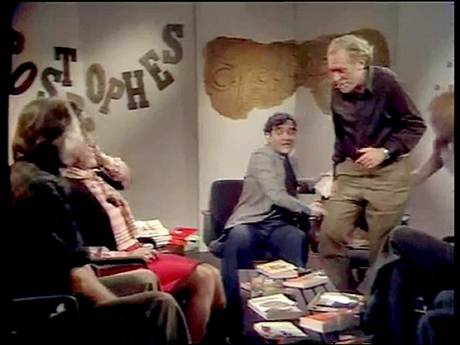
To our surprise, we see that the seemingly exaggerated description in Bukowski’s writing is quite accurate, which leads to the obvious question: how far does Bukowski’s literary production resemble his own actual life and character?
I’m quite aware that to some, this idea must sound like unprofessional naïveté. After all, first thing we were taught when we study literature was not to confuse the author with his work, most notably not to identify him with his main protagonist, not even when the work is written from the “I”-perspective. Undoubtedly, making this distinction is valid advice. Most of the time.
In Bukowski’s case, however, the situation is slightly more complicated, as one might have rightfully guessed. The findings in the text-video recording comparison are indeed only one pars pro toto for a pattern that we regularly encounter through his work and biography. Both go along, intertwined like Siamese twins.
Bukowski himself put it this way:
“I am 93% the person I present in my poems; the other 7% is where art improves upon life.” (1985)
This quote is taken from an interview he gave to The New York Quarterly in 1985. We see similar statements quite frequently throughout his career. Of course, an author’s statements alone cannot prove much. In particular, one tends toward disbelief, when facing such graphic samples of an extreme lifestyle as within Bukowski’s writing.
What happened, really?
That’s where scholarly research comes in to check for the facts. And this has been done intensely during the past 20 years. To sum up the results: even against some likeliness we find that for the most parts, events presented in Bukowski’s books correspond to real-life happenings. At the core, that is.
Evidence of it is given through sources such as official documents, personal letters (by him and others), documenting ephemera like photos, tickets, tape-recordings or film, not to forget the numerous memoirs and recollections by friends, ex-friends, ex-lovers and so on2.
To exemplify this intimate relation of his work and life, I pick the delicate subject of the ex-lovers for some deeper insight.
You may have wondered sometimes about the quite unbelievably high rate of sexual affairs that Bukowski’s alter-ego protagonist Henry Chinaski claims to have had, particularly notorious in his novel Women (1978) which covers our author’s lifetime from 1970 to 1976. In this fiction, we count no less than 31 women getting intimate with Hank Chinaski at some point.
It will come as little surprise that research has managed to identify all the significant female characters in the novel (and then some), verifying their existence in real life.
In Women, Lydia is Linda King; Dee Dee Bronson is Liza Williams; Tammie is Pamela Miller – now Pamela Woods; the two young German groupie-girls, waiting on his front-porch for him to come home, are documented live in the filmed material of Thomas Schmitt; Tanya is Amber O’Neill; Sara is Linda Lee Beighle, the later Mrs. Bukowski; these are the most striking individuals on the list.
The next revelation concerning the occurrences, isn’t that surprising either, after what you have read by now: knowing the real women behind the figures gives us the privilege to ask for firsthand-information, thus providing direct comparisons between Bukowski’s literary production and what might actually have happened. We realize that the expectedly invented is not so fictional at all.
A few ex-lovers have released memoirs recollecting these times, mainly to tell their side of the story.3 Done in an attempt to set things straight and so-to-say “correct” the picture drawn of them in Women, one might expect these memoirs to vastly contradict his storytelling.
Remarkably, this is not the case. While their mappings of the emotional impact often differ from Bukowski’s versions, naturally so, due to different perspectives (and the need to amend some unflattering attributions), their accounts of the pure happenings as such usually tell the same tale as his, even in the details.
No different from these written testimonials is what you get from conversations with these women, which I was fortunate to enjoy a couple of times, partly through email-correspondence, partly by meeting in person. Again they regularly support the narrative from the novel Women or some equally relevant stories like “This is What Killed Dylan Thomas” from South of No North (1973), and books of poetry such as Love is a Dog from Hell (1977) or Scarlet (1976).
An example as means of illustration: When I first met Linda King in 2003, she frankly confessed that in fact, she did once try to run right into Bukowski with her car [sic!] in furious jealousy, which is exactly what we read in Women, where it might not be received as possibly being literally true. According to Linda King, it is.
Similarly so, when one night October 2010, Bukowski’s mid-70s-muse Pam Woods (aka “cupcakes” or “Scarlet”) and I gathered in East Hollywood to hit the infamous Frolic Room for a talk and a drink (or maybe two), she also confirmed the accuracy in Bukowski’s reports.
For the moment, this glimpse into our findings via comparative exploration of the literary production and biographical reality must do, for the subject itself would easily make a voluminous book and this is not the place. However, I’m positive these few samples offered some valid insight into the vivid interaction and intermixing of Bukowski’s fictional existence with his actual life, of his protagonist’s character and his own, the persona and the person.
Now finally, to complete my short inquiry, I’ll briefly deliver a psychological view of the matter.
The psychological function of the persona
There’s a common understanding that sensitive souls often try to cover their vulnerability by putting a mask on. (The word “persona” originally meant “mask” in ancient Greek.) Some psychological laymen may consider the “mask” to implicate untruthfulness. While this attribution may occasionally be applicable, it usually is not. The phenomenon bears more complexity.
It is perfectly justifiable to state that a persona is only seldom built as the opposite of one’s “true self”, but rather a modification. This goes for both, consciously crafted “alter egos” and subconscious, intuitive “facade” as well.
Of course, my point to that specification is that in Bukowski, his persona is exactly this sort of modified self, by which I mean they are not different entities opposing each other but genuinely related; in fact they are inseparable or – to resume a picture I have used earlier, then connecting his work to his biography – Bukowski’s person and his persona are intertwined like Siamese twins.
Why is that of interest? Because accepting this helps prevent hideous misconception. For all too often we observe that readers tend to draw false conclusions after they realize that their dedicated hero, as they have experienced him through Henry Chinaski or in videos of poetry-readings, is not identical to the author and human being Charles Bukowski. It occurs to them that Bukowski must have lied, pretending to be someone he is not. This invariably includes dismissing him for being a fraud and his writing for being fake.
Obviously, such simplification does Charles Bukowski no justice. I argue that it sure is possible to unite both a public image, a deliberate construction, an invented persona on the one hand – and at the same time an authentic depiction of one’s true character. I also state that it can be deduced from our collected material that in Bukowski we have a perfect specimen of such unification.
Having said this, we must admit that it cannot be overseen or denied that he frequently lost control over his own creation. Things used to get out of hand at moments when he dismissed the expectations of others to live up to his image. It also occurred when he himself embraced the image a bit too much. That is when he became a victim of his Golem, and he knew it well.
Studying these mechanisms will certainly be worth the effort as it could be a major key to Bukowski’s otherwise incomprehensible behavior at times. Maybe at another occasion I’ll come up with a deeper look into that abyss. Yet for today, we’re through.
Notes
- 1A short video (2:21 min) edited to present smithereens of exactly the occurrences that are described in the cited Bukowski-text from Shakespeare Never Did This can be viewed or downloaded here: https://www.bukowski-gesellschaft.de/BX/buk_apostrophe_1978.mp4
- 2The Bukowski.net website offers much of the sources stated above.
- 3Some highly enlightening examples are: Loving and Hating Charles Bukowski (2012) by Linda King; Charles Bukowski’s Scarlet (2010) by Pamela Woods and Blowing my Hero (1995) by Amber O’Neill.
Bibliography
- Bukowski, Charles. South of No North : Stories of the Buried Life. Los Angeles: Black Sparrow Press, 1973.
- Bukowski, Charles. Scarlet. Santa Barbara: Black Sparrow Press, 1976.
- Bukowski, Charles. Love is a Dog from Hell. Santa Barbara: Black Sparrow Press, 1977.
- Bukowski, Charles. Shakespeare Never Did This. San Francisco: City Lights Books, 1979.
- Bukowski, Charles. “Craft Interview with Charles Bukowski”. New York Quarterly, no. 27, Summer 1985, pp. 19-25.
- O’Neil, Amber. Blowing My Hero. Berkeley: Selfpublished, 1995.
- Wood, Pamela. Charles Bukowski’s Scarlet. Northville: Sun Dog Press, 2010.
- King, Linda. Loving and Hating Charles Bukowski. San Francisco: Kiss Kill Press, 2012.
- Bukowski-Forum & Database, https://bukowskiforum.com/database/
About the author(s)
Biographie : Roni (1970-) est le président de la Charles-Bukowski-Society (depuis 2008) et éditeur
de ses albums de fin d’année (depuis 2003). Il a organisé (et donné) des conférences,
des expositions et publié de nombreux articles sur Charles Bukowski. Il aime boire
du pastis dans son café favori tout en lançant des remarques existentialistes à ses
compagnons.
CHARLES-BUKOWSKI-SOCIETY
℅ Roni
Urbanstr. 7
D - 96047 Bamberg
Biography: Roni (1970-) is the chairman of the Charles-Bukowski-Society (since 2008) and editor
of their yearbooks (since 2003). He has organized symposia, curated exhibitions, published
numerous articles, and given talks on Bukowski. He likes to drink pastis in his favorite
café while shoving existentialist remarks at his companions.
CHARLES-BUKOWSKI-SOCIETY
℅ Roni
Urbanstr. 7
D - 96047 Bamberg