Charles Bukowski and European Art
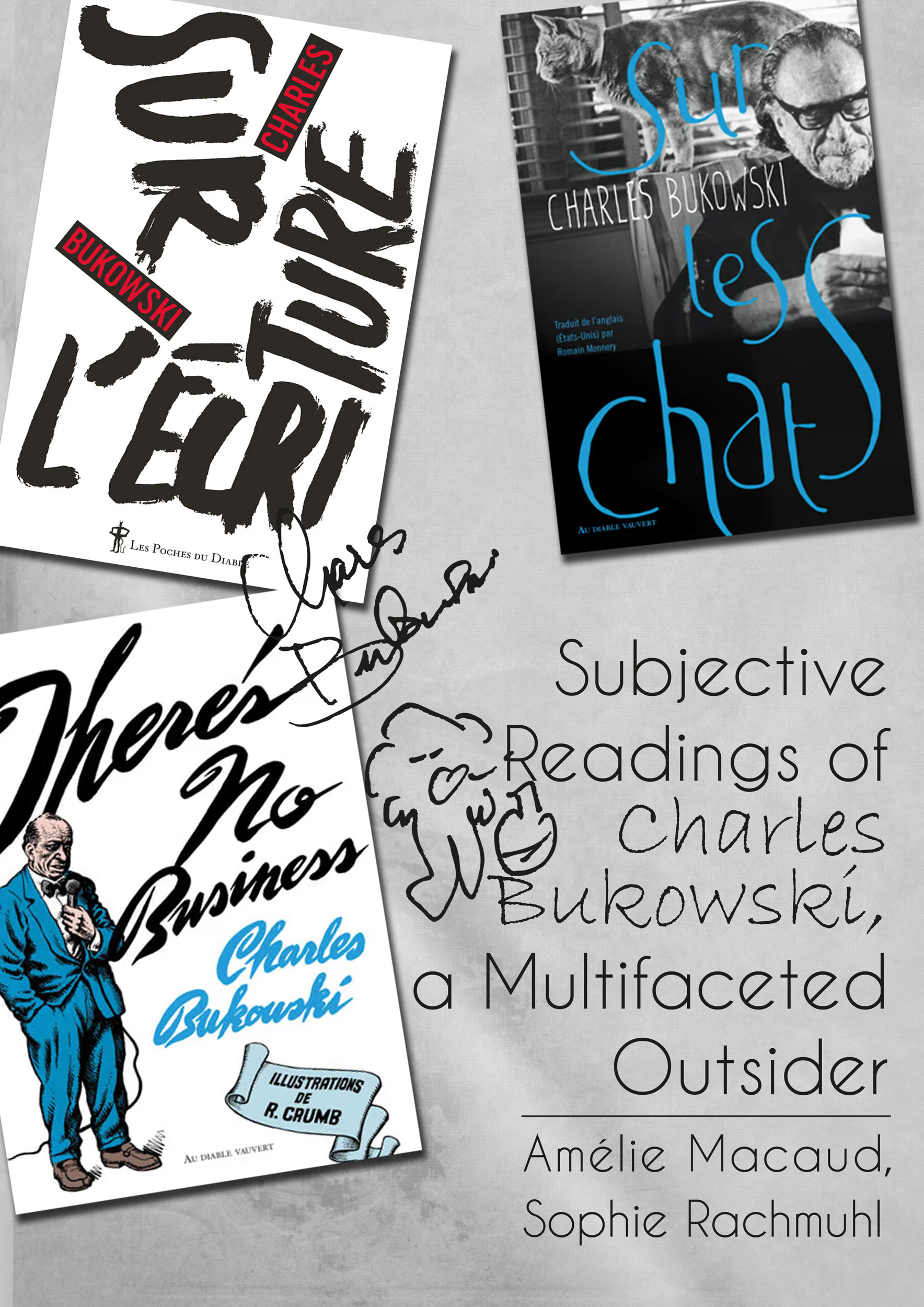
Abstract: Charles Bukowski’s drawing and painting deserve greater attention. He was well-versed in European art, showing the influence of Matisse, Toulouse-Lautrec, and Degas, not only in his subjects but also the style of his own work. His aphorism of “painting like a canary swallowed by a cat” explains how he disciplines topics with style.
Keywords: Charles Bukowski, Los Angeles, Art, Painting, European art, Line art, Henri Matisse, Jose Clemente Orozco
Résumé : Le dessin et la peinture de Charles Bukowski méritent une plus grande attention. L’écrivain californien connaissait bien l’art européen, et on note l’influence de Matisse, Toulouse-Lautrec, et Degas non seulement dans ses sujets mais aussi dans son style artistique. Son aphorisme « painting like a canary swallowed by a cat » (« peindre comme un canarie avalé par un chat ») évoque la manière dont il discipline les sujets avec style.
Mots-clés : Charles Bukowski, Los Angeles, Art, Peinture, Jose Clemente Orozco, Toulouse-Lautrec, Art européen, Dessin au trait, Henri Matisse
Introduction
The idea that Charles Bukowski was influenced by European painting may seem strange. Most readers identify him with drinking, fighting, and fornicating in Los Angeles. Biographies and reportage attest to it, and even his drawings seem to depict only a vie de bohème. But a close examination of his life and the prodigious production of drawings and the art in his books, articles, and letters, reveals that Bukowski (a devotee of Handel, Shostakovich, Mozart, Brahms, Mahler) was more influenced by the Old World than the New when it came to art.
There is little sign of this in extant scholarship. Barry Miles’ admirable biography is largely anecdotal, but does reveal how, when he and Linda attended art classes, “the teacher warned him… we don’t tolerate prima donnas around here… Hank continued to paint at home, but the paint got on his hands and on his cigars as he drank…” (9-10). More information on art influences enters Miles’ biography around the edges: “In the course of their letters [Harold] Norse attempted to interest Bukowski in the cut-up technique, being developed at the Beat Hotel by Brion Gysin and William Burroughs […] in which texts were sliced up and recombined, then examined to see if any unusual or extraordinary phrases or meanings emerged” (170). Norse was an important stylistic influence in Bukowski’s drawing.
Howard Sounes, in his biography, uses Bukowski’s drawings as thematically appropriate chapter headings, but he doesn’t comment on them. He does, however, have sections on classical music, reinforcing the other overlooked European influence on Bukowski. And he develops the connection to Robert Crumb, who like Norse affected Bukowski’s cartooning style.
Neither of these biographers even mentions Vincent Van Gogh, the inspiration for one of the writer’s most famous poems. Bibliographer Abel Debritto does not take up the topic, but the European connection is treated in passing in Shakespeare Never Did This, the Michael Montfort photo documentary of the author’s 1978 trip to France and Germany. And it is touched on in Glen Esterly’s chapter for The Shooting, by Abe Frajndlich (37-65), and also in Bob Flanagan’s “On Bukowski & His Paintings” as well as in Adam Kirsch’s 2005 article in the New Yorker.1 But his art and its origins are always an after-thought.
The approach that I use here owes to Marguerite Johnson’s “Radical Brothers-in-Arms: Gaius and Hank at the Racetrack” (2018). Treating Beat writers in relation to the Classical Tradition, as Johnson does, suggests that a similar optic might illuminate Bukowski’s drawing and paintings.
But first let us review the practices of art criticism. The critic should describe the visual elements and subject matter of the artwork (#1). In this case that has been done elsewhere and is not pertinent. But (#2) one asks how the work is “designed”: which is to ask how the artist’s choices contribute to the elements s/he uses (#3). Interpretation asks about the artist’s intent (if known), cultural context, and the viewer’s personal experience of the art. Finally (#4), an evaluation asks if the artwork is effective, based on established criteria such as intention, beauty, and impact. Criteria #2 and #3 are the foci of this paper.2
In Bukowski’s case, the Los Angeles setting demands attention first. When he was living there, Los Angeles was the scene of an important art avant-garde, but Bukowski wasn’t part of it. Judy Chicago, Ed Ruscha, and Ed Kienholz, the Watts Towers, the tabloid art of the LA Express–these were all around him. Bukowski and his work were deeply influenced by Los Angeles life, but there are few traces of the “L.A. Scene” in his artwork. This is very strange. For example, Ed Kienholz would seem like the perfect accompaniment to Bukowski’s life. In his famous “Back Seat Dodge ‘38” installation, Kienholz featured a couple making out in a wrecked vintage sedan, beer bottles strewn about them in a vaguely apocalyptic fugue of sex and hard metal. And where in Bukowski’s work is Ed Ruscha, whose stark geometric panels were ironically over-written with “Bliss Bucket” or “Quit”? Ruscha also photographed L.A, with a deadpan gaze. His Thirty-four Parking Lots, Twenty-six Gasoline Stations, and Every Building on the Sunset Strip, published in a 1966 photo-book, offered a movie-like, yet autistic and static road trip. Add in Judy Chicago, whose “Dinner Party” broke feminist ground, and Simon Rodia, who built “The Watts Towers” and you have a contemporary art world that reflects Bukowski’s topics. Bukowski might have heard of them, but he didn’t pay attention; they did not influence his own drawing or painting. They don’t appear in any biographical materials.
As Judith Delfine has documented, the L.A. scene was truly radical. However, the academic view of California art in this period has long had a Northern California bias: up around San Francisco were the photo-realists, typified by Wayne Thiebaud, and the abstract expressionists, typified by Richard Diebenkorn. San Francisco was “the center” (Delfiner 2015). As Ruscha himself said about Los Angeles, “It wasn’t just a matter of piling paint on a canvas, as much as just living the life out here in LA. The movies were out here, the beach, the freeways, the desert. It had an accelerated pace to it; it was a fast city, but it didn’t have the cultural depth that New York had” (in Patterson 2009). The unspoken assertion was that it didn’t have the cultural depth of Northern California either.
Bukowski, growing up and writing in this radical art culture of L.A., never acted as though it was special. He was paying attention to art though, just of a more traditional sort. He read voluminously at the L.A. library (though we don’t know what) and he wrote his first stories and poems there. He took an art class for 4 or 5 months with his girlfriend Barbara Frye. She perceived some artistic talent in him and undertook to groom it; she thought he might become a graphic artist and started taking him to galleries; then they enrolled in an art class at L.A. City College (Sounes 19-20).
Bukowski hated the class, he said. In one session he was asked to paint a bowl of flowers, but rushed through it so he could go outside for coffee and a cigarette. When he returned, he found the instructor praising his hasty work and wanting more, for an art show. Another assignment was to create a Christmas advertisement for Texaco, the oil company. Bukowski worked the Texaco star into a Christmas tree, but the instructor humiliated him, saying it was passé (Sounes 39-40). According to Sounes, the design was used by Texaco the following Christmas and noticed by Bukowski as he walked around town (40). It could be a myth, but Bukowski also wrote that when the same instructor told the class “I want you to draw like Mondrian,” he growled to Barbara: “I want to draw like a sparrow eaten by a cat” (Sounes 39).
An overview of Bukowski’s drawing and painting suggests that he was heavily influenced by European sources. Passing to Interpretation (#3), we can see that Bukowski modifies his sources or content in four ways: 1) they are simplified, 2) they always prize the outsider, 3) their mode is anti-thesis, and 4) they are gestural, chiefly in the mode of “Line Art.”3
Let’s note the Americans linked to such tendencies before passing to the European sources. We first see a Bukowski sketch in his 1946 letter to Caresse Crosby, to whom he had submitted a manuscript (On Writing 4-5).
The sketch is a narrative expansion of his emotions, which is what he usually used the mode of Line Art for. It’s only fair to note that those Northern California painters, such as Diebenkorn, were often admirers of Henri Matisse, whose use, later in his life, of pure line and a flattened perspective became influential. In fact, if we count R. Crumb and Norse, “Line Art” is a link between the L.A. Scene and Bukowski’s European influences. It was around him, but he did not go to the source.
Like Matisse, Diebenkorn painted women, almost always seated and quasi-ornamental, sometimes in Line Art. They are passive subjects. There was a simplicity and lack of action in such work that didn’t appeal to Bukowski. In L.A., however, Bukowski met the poet/artist Harold Norse, who used Line Art broadly. Norse had earlier lived at the Beat Hotel in Paris with Allen Ginsberg, painted explosive Abstract Expressionist pieces, and explored the “cut-up” method. Norse may have given Bukowski Line Art, for the poet would later draw Norse in that style. Another California influence was Henry Miller, whose art, mostly watercolors, Bukowski knew about and liked. But Miller was closer to the Northern California group. His most radical work was The Waters Regliterized, published in 1950, but there’s no Miller influence to be discerned on Bukowski’s drawing or painting. In addition to these two California influences, Bukowski’s ideas of Line Art were probably influenced by the nation-wide popularity of cartoons by James Thurber.
To see clearly how Bukowski used European painting, there is no better example than his poem “His Wife, The Painter” (1969). The poem, apparently first drafted when he was married to Barbara Frye (who disliked the mild acclaim his art had received in that college class), begins in a domestic setting rich in classic art:
There are sketches on the walls of men and women and ducks,
and outside a large green bus swerves through traffic like
insanity sprung from a waving line; Turgenev, Turgenev,
says the radio, and Jane Austin, Jane Austin, too.
“I am going to do her portrait on the 28th, while you are
at work.”
The introduction of the radio questions both the art on the walls and the quoted speaker. Who is important here? What is “work”? The poem then passes to authorial self-deprecation: the poet calls himself a fat slob, who “feels hatred and discard of the world.” In boldface (in the original) is the first classical frame: the words “Daumier” and “Rue Transnonain.”
In this Daumier etching, three men are dead on the floor, the middle one sprawled atop a child. It’s an unblinking view of French soldiers killing striking workers in 1834. But a naive viewer could interpret the scene as a condemnation of alcoholism. The poet continues the conversation between Bukowski and his wife, but profits by this bitter ambiguity introduced by the reference to the painting:
“She has a face unlike that of any woman I have ever known.”
“What is it? A love affair?”
“Silly. I can’t love a woman. Besides, she’s pregnant.”
I can paint- a flower eaten by a snake; that sunlight is a
lie; and that market smell of shoes and naked boys clothed…
The speaker undermines whatever Barbara is off to do, and turns to some minutiae of personal angst; then a second frame painting is invoked: “Corot, Souvenir de Montefontaine.” In Bukowski’s reading, a woman and two children gather flowers in a sylvan setting that is overhung by inimitable Corot-like trees. Art historians say this painting is a bridge between realism and impressionism, retaining the muted palette of the former. Thematically it is an idyll. But neither of these modes take hold for Bukowski, who shifts to a pastoral tone.
She made a little hat and he fastened two snaps under one
arm, reaching up from the bed like a long feeler from the
snail, and she went to church, and he thought now I have
time and the dog.
About church: the trouble with a mask is it
never changes.
So rude the flowers that grow and do not grow beautiful.
Bukowski’s unsatisfied speaker is now apparently lying in bed; he says he is “searching for some / segment in the air.”
He finds it in a third painting: Jose Clemente Oroszco’s “Christ Destroying the Cross” (1949). The Mexican muralist had done a series at Dartmouth College in a comic book/cubist style. He portrayed Christ rejecting his sacrificial destiny, instead chopping down his cross. This comic book mode exemplifies what Johnson had identified in “Gaius and Hank at the Racetrack”: Bukowski invokes classic art to imbue contemporary culture with flashes of bitter frisson. This does not necessarily result in profound insight. After invoking three masterpieces, Bukowski concludes ambiguously: “He burned away in his sleep.” Either he or Oroszco could be the author of the thought, but the poem has achieved a tone that is the point.
Commentators have described this poem as “fragmented” and “complex,” with the ending “ambiguous.” But it’s not: this is the “flower eaten by a sparrow, the sparrow eaten by a cat.” It’s the inevitable despair that classical knowledge causes to well up under the prettified, pastoral vision of life. This is the tone that we need to remember. Bukowski’s drawings and paintings work to invoke older European sources as substrates of meaning.
Let’s transfer that insight to painting. If Oroszco personifies the “cat,” the colorful carnivore, the “sparrow” is the lighter touch of Line Art, exemplified by Corot in the poem. Orozco may be burning, but Corot is… not exactly “sleeping” but putting events in a cooler, classic perspective, like Matisse did. Color and Line Art were opposites for Bukowski.
Henri Matisse
During and after the turbulence of World War 2 Matisse had gained renown for his use of line. He developed an aesthetic based on heavy, dark lines that defined mass and subjects simply, using the minimum in number. Some of his line drawings of heads involve no more than six or seven continuous lines. Never lifting the pen became a challenge, but not a law. “La Grande Tête de Katja” is one of the best-known of these drawings. “I’ve been forty years discovering that the queen of all colors is black” wrote Matisse4. This is the period in which Bukowski became aware of the styles of drawing, and that they could correspond to, or even define, his emotional needs.
Let’s look at Matisse’s Line Art. His heavy dark line, unlike cross-hatching or shading, defines masses. It is unambiguous. It makes simplicity a virtue, a yes-or-no. A space is defined as simply as possible. But even as the line does this, it calls attention to itself, because its course, its swerve, and its thickness are all suggestive of an aesthetic. The aesthetic of the line is not either/or but rather flow, and flow’s course. The bold line invites the eye to retrace the flow, not just on each viewing, but repeatedly in a single viewing. In so doing, the bold line achieves the paradox of being a simple and seemingly definitive technique, which is endlessly dynamic. To return to the cat/sparrow anecdote, the line has suppressed emotion, be it anger, passion, or fear. The color of the line is black. Black + simplicity is the frisson.
Compositionally, Bukowski’s use of Line is unlike Matisse’s. He “contains” his subject(s), as discussed below, in a proleptic limitation of the narrative. Matisse doesn’t bother with that. Bukowski repeats objects in his line drawings, such as the smoke, the bottle, the plant or leaf, and the animalitos, probably cats that, as he grew older, he increasingly liked.5 These objects signal a familiar scene. The subject (usually the author) is seated or prone, and he or she is frequently connected by line to furniture or floor. The twigs and birds and small animals, not to mention cigarettes, create an implied narrative, a familiar universe for the viewer. Once these are seen, viewers know they are in Bukowski-land.
Bukowski frequently places his subject at the left edge of the drawing, facing right, a suggestion of narrative progress across the drawing. The persona, indicated by a large nose, a large ear (or two), and a domed head, is usually implied to be Buk himself. He frequently has, if not a cigarette, then trailing smoke or a line suggesting these. Also ubiquitous are the U or square shapes suggesting beer cans. These two visual abbreviations create, or complete, the Buk “character.”
This quixotic persona is now ready for narrative context. Sometimes he exists unto itself, with a dilemma or comment underneath evoking the situation. At other times there is a second character and the narrative becomes more complex. In “All the assholes in the World and Mine,”6 which concerns a colonoscopy, the unity of the scene is created by rows above and below: lights overhead the operating table and medical feet (one pair female) below it. These contain and balance the masked doctors and the middle row, the prone Bukowski.
Other drawings share this composition. “Right or Wrong in 18 Seconds” has these three bands, with a bird and the sun creating an upper boundary. Differently from other works, the action goes from right to left, which is not what happens at an American racetrack, unless one stands in the in-field. Similarly, “Like to Watch Television with a Girl” is “stacked” or banded: at the top by the headboard of a bed (or backboard of a sofa) and at the bottom by a caption, while in the middle are the subjects. There is a balance of bottles and animals left and right.7
Interestingly, Bukowski ignores such boundaries in sexual drawings. The female interest is usually more detailed than the male subject. In almost every drawing of this genre, the woman is on the left. If she is on the right, the scene is implicitly domestic.8
Painting
Let’s return to Matisse, this time his painting, by way of introducing Bukowski’s interest in Van Gogh and brilliant color.9 Rising to prominence in the Fauve period, Matisse was introduced to the work of Van Gogh at age 26. He said that “Purer colors […] have in themselves, independently of the objects they serve to express, a significant action on the feelings of those who look at them. The use of expressive colors is felt to be one of the basic elements of the modern mentality, an historical necessity, beyond choice” (Matisse 41; 177). This comment anticipates the later Bukowski paintings and poetry.
So does Van Gogh. He has a major place in Bukowski’s imaginary as well as in his art. In a 1962 letter to Jon Webb, Bukowski wrote, “I know how Van Gogh felt / I wonder if he carried shit and blood in his pants / and painted on elephant ears?” (On Writing 55) Then he proceeded to harangue the health movement, concluding “how can they make it, how can they make it / standing outside the fire?” (55) The transition from Van Gogh to the health movement seems strange, until we realize that it’s the cat eating the sparrow once again: the European substrate boiling up to the surface.
Bukowski’s most famous poem on Van Gogh is “Working Out,” written on December 31, 198410. It concerns one of the painter’s famous paintings:
Van Gogh cut off his ear
gave it to a
prostitute
who flung it away in
extreme
disgust.
[…]
These line breaks isolate nouns from verb phrases, mostly to emphasize a material demi-monde that Bukowski feels knowledgeable about. The cat eats the ear, so to speak, and the poet says that he knew it would. The poem seems to be intentionally devoid of color—how can one write about Van Gogh without a mention of color? That’s striking because Bukowski “often used colors to describe his subjects in his writings,” writes a dedicated sleuth named Black Swan on the website Bukowski.net: “This is what I discovered when I did a search in 37 of his books. He used red 6,396 times, blue 816, yellow 460 times, white 1,088, black 1,050, pink 202, orange 218, purple 162, brown 274 times and green 662 times”11. Other times, Bukowski declared that yellow was his favorite color. And it is the dominant color in “Self Portrait with a Bandaged Ear.” The biographic appeal of Van Gogh is at least as strong for Bukowski as the European art. Why is there no color? The answer is: to emphasize the monetary details.
However, Bukowski’s was no partial embrace of Van Gogh. In his more strongly colored paintings, Van Gogh used a dominant line. An excess of impasto paint loses definition; it needs line to define. Thus, Line Art can become an extension of Fauve tendencies, for both Van Gogh and Bukowski. The former’s strong lines, repeated details, and color masses arranged in a signature way resemble Bukowski’s use of them in his color painting, especially echoing Van Gogh’s heavy paint-laden impasto strokes. In Bukowski’s painting we also notice the Line Art combined with almost pure colors. But most of his color work depicts tortured faces, a clear if limited thematic connection to Van Gogh’s self-portraits.12
Toulouse-Lautrec and Degas
The theme of the sexually available, working-class woman that Bukowski pulled from classic European painting went beyond Van Gogh. He wrote about Henry Toulouse-Lautrec in terms similar to those he used about Van Gogh in “The Drunk with the Little Legs” (1982 107). This poem/performance piece resembles Bukowski’s treatment of Van Gogh in its focus on a physical deficiency and prostitutes, not to mention a bitter, dismissive tone. Not mentioned by name, Toulouse-Lautrec “fell down a stairway as a child,” became disabled, and sketched the dancers in music halls. And drank. “Strange that most of those who create have some malady,” writes Bukowski. After the painter “gets in all down,” he falls down stairs and dies. Toulouse-Lautrec gets sharper treatment than Degas, but in this painter’s sketches and paintings of washerwomen in the Paris area we can see again the European substrate that is present in Bukowski’s art work.
Working in monotypes from 1877 onward, Degas depicted tired women at work, as in “Reyer and the Washer Woman.” The first efforts he reworked with a black crayon, producing only two copies, apparently not thinking them salable.
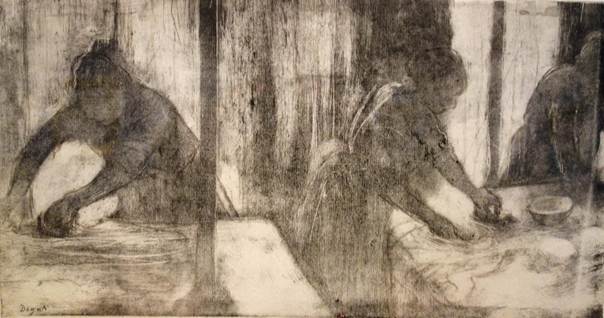
But he progressed to “Repasseuses” (The Laundresses, 1884-6), in which his subjects are split left and right, engaged in dynamic actions that tend off the page, not centered. They are also bent over, and two strong horizontal columns split the work almost into panels. This unconventional mise-en-scène is characteristic of Bukowski’s drawings as well.
In “Repasseuses,” Degas adds a bottle, and a yawn, motifs the American author liked to insert in his own artwork as well. But for Degas they underline fatiguing work, not boredom. He left sections of the canvas above and right of the laundresses unpainted–bare canvas–apparently to get the color and texture of raw canvas peeking through. But the antiquity is noteworthy.
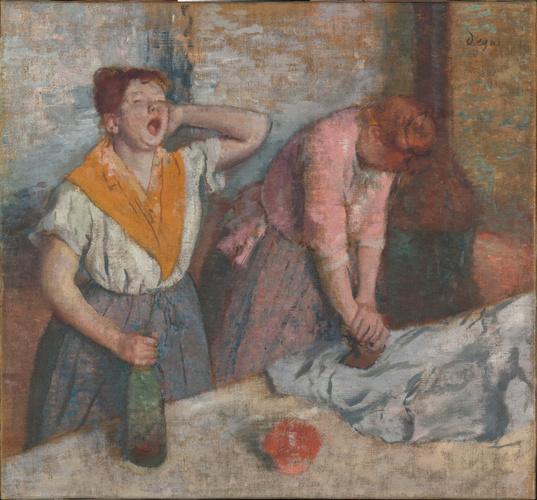
© RMN-Grand Palais (Musée d’Orsay) / Hervé Lewandowski
Degas actually stepped into an already known topos with the washerwomen and sexuality. Paul Gavarni, one of his favorite graphic artists, painted this theme more pointedly in the 1870s. And in Degas’ own era, there was Theophile Steinlen, whose 1867 cover for a musical review advanced the theme of washerwomen and their availability.
Conclusion
The main use that Bukowski makes of European color painting is self-portraiture, as seen best in his appropriation of Van Gogh. In terms of form and media, color is Bukowski’s medium of anguish and self-doubt, but almost never of sexuality or humor. For him, color emphasized an affective experience that he couldn’t quite express by Line Art, his attenuated inheritance from Matisse. With color, Bukowski could crowd the canvas and diminish the need for narrative efficiency, showing that his instinct to keep the two modes separate was, in fact, wise. The subject, of course, is always Bukowski’s personal anguish. It was in his ubiquitous Line Art that he found a flexible tool, a daily cathartic, more appropriate to his sense of pathos and of humor, of the cat eating the sparrow.
Notes
- 1Kirsch of The New Yorker wrote, “the secret of Bukowski’s appeal … [is that] he combines the confessional poet’s promise of intimacy with larger-than-life aplomb of a pulp-fiction hero.” (2005)
- 2These criteria are widely published, not only in most introductory art texts but on Wikipedia: “Description: This initial step focuses on objectively listing the visual elements and subject matter of the artwork. It involves noticing what the artwork looks like, including its subject, medium, size, and composition. #1 Analysis: Analysis delves into how the elements of art are used and how they relate to the principles of design. This step examines the artist’s choices and how they contribute to the overall effect of the artwork. #2 Interpretation: Interpretation explores the meaning and significance of the artwork, drawing on the artist’s intent, cultural context, and the viewer’s personal experience. It involves proposing possible interpretations of the artwork’s message or theme. #3 Evaluation: The final step involves judging the artwork’s effectiveness based on established criteria, such as its beauty, emotional impact, or ability to communicate a specific idea. This step considers how well the artwork succeeds in its intended purpose. #4 Evaluation: The final step involves judging the artwork’s effectiveness based on established criteria, such as its beauty, emotional impact, or ability to communicate a specific idea. This step considers how well the artwork succeeds in its intended purpose. By following these four steps, art criticism provides a comprehensive framework for analyzing and understanding works of art.” For more information, see https://www.britannica.com/art/art-criticism.
- 3Line Art is “an illustration technique that employs clear, straight, or curved lines in a single color, usually black, to create an image.” https://artcorvibes.com/what-is-line-art/
- 4Matisse quoted at https://independent-photo.com/news/20-inspirational-black-and-white-photography-quotes/
- 5Poem “My Cats” in the book On Cats by Charles Bukowski, published by Ecco Press in 2015.
- 6The image can be found via the following website : https://thebukshop.com/products/all-the-assholes-in-the-world-and-mine-all-the-assholes-in-the-world-and-mine-with-book-announcement-1966?srsltid=AfmBOopqG-zbq9kin5hSfjqkN9AwPATNHvCVLquRe5Ro9hvAnuzi1kUl
- 7The drawings discussed here can be found on this link http://www.booktryst.com/2013/02/bukowski-lost-original-drawings-of.html
- 8For example: “I Fixed the Clock” at http://www.booktryst.com/2013/02/bukowski-lost-original-drawings-of.html, or “Like to Watch Television with a Girl” at https://www.openculture.com/2013/08/notes-from-a-dirty-old-man-charles-bukowskis-lost-cartoons-from-the-60s-and-70s.html .
- 9Edwards, Angela. “From Van Gogh to Matisse: the Roots and Rise of Fauvism.” Angelaedwards.com, June 24, 2023. https://www.angelaedwards.co.uk/from-van-gogh-to-matisse-the-roots-and-rise-of-fauvism/
- 10Poem available here: https://bukowskiforum.com/database/manuscripts/working-out-526/
- 11Find the quote (message #12) in the following forum thread : https://bukowskiforum.com/threads/bukowski-as-a-painter.11850/
- 12An example can be found on the following website: https://zombieresearchsociety.com/archives/1506
- 13An early study by Degas, shows several of the techniques that Bukowski used in his drawings, such as vertical divisions and action tending out of the frame.
Works Cited
- “Art Criticism”, Britannica. https://www.britannica.com/art/art-criticism
- “Art Criticism.” Wikipedia. https://en.wikipedia.org/wiki/Art_criticism
- Bukowski Forum. https://bukowskiforum.com/threads/bukowski-as-a-painter.11850/
- Bukowski, Charles. “His Wife, the Painter.” in Hearse Broadside No. 1, Santa Rosa, Calif.: Black Sparrow Press, 1969.
- Bukowski, Charles. “Manuscript: working out (December 1984).” Bukowski Database. https://bukowskiforum.com/database/manuscripts/working-out-526
- Bukowski, Charles. All the Assholes in the World and Mine. Bensenville, IL: Open Skull Press, 1966. https://www.burnsiderarebooks.com/pages/books/140946440/charles-bukowski/all-the-assholes-in-the-world-and-mine
- Bukowski, Charles. “Three Uncollected Poems (Four Total) by Charles Bukowski.” Wormwood Review, vol. 87, no. 409/700, 1982, pp.105-108.” TheBukShop.https://thebukshop.com/products/wormwood-review-87-409-700-three-uncollected-poems-four-total-by-charles-bukowski-1982?srsltid=AfmBOopK0vgBEMJnuL6CNx2rue-W6kS4W_9LW5EI8o9bWBmmrh2naTlb
- Bukowski, Charles. On Writing. Edinburgh: Canongate. 2015
- Bukowski, Charles. “My Cats.” On Cats. ECCO. 2015, p.109.
- Bukowski, Charles. You Get So Alone At Times That It Just Makes Sense. Black Sparrow Press, 1986.
- Bukowski, Charles. Notes of a Dirty Old Man. San Francisco: City Lights, 1969.
- Bukowski, Charles. All the Assholes in the World and Mine, in The Buk Shop.com: https://thebukshop.com/products/all-the-assholes-in-the-world-and-mine-all-the-assholes-in-the-world-and-mine-with-book-announcement-1966?srsltid=AfmBOopqG-zbq9kin5hSfjqkN9AwPATNHvCVLquRe5Ro9hvAnuzi1kUl
- Delfiner Judith. “The art of California counter-culture in the 1950s.” Perspective [Online], vol. 2, 2015. DOI: https://doi.org/10.4000/perspective.5976
- Edwards, Angela. “From Van Gogh to Matisse: the Roots and Rise of Fauvism.” Angelaedwards.com, June 24, 2023. https://www.angelaedwards.co.uk/from-van-gogh-to-matisse-the-roots-and-rise-of-fauvism/
- Esterly, Glen, “The Pock-Marked Poetry of Charles Bukowski,” (36-65) in Abe Frajndlich. The Shooting – Bukowski. Hirmer Verlag: Munich, 2020.
- Flannagan, Bob. “On Bukowski & His Paintings.” Sure: The Charles Bukowski Newsletter, no. 4 (1992), Ojai, CA.
- Gerts, Stephen J. “Bukowski: Lost Original Drawings of a Dirty Old Man are Found.” Booktryst, February 13, 2013. http://www.booktryst.com/2013/02/bukowski-lost-original-drawings-of.html
- Johnson, Marguerite. “Radical Brothers-in-Arms: GAIUS AND HANK AT THE RACETRACK.” Hip Sublime: Beat Writers and the Classical Tradition. Ed. Sheila Murnaghan and Ralph M. Rosen. https://www.academia.edu/37508110/Radical_Brothers_in_Arms_GAIUS_AND_HANK_AT_THE_RACETRACK.
- Kirsch, Adam. “The Transgressive Thrills of Charles Bukowski”, The New Yorker, March 6, 2005. https://www.newyorker.com/magazine/2005/03/14/smashed?currentPage=all
- Matisse, Henri. Matisse on Art. Edited and translated by Jack D. Flam, University of California Press, 1995.
- Miles, Barry. Charles Bukowski. London: Virgin Books Ltd, 2005.
- Patterson, John. “California dreamers: The story of art in the 1950s and 60s.” The Guardian, October 8, 2009. https://www.theguardian.com/artanddesign/2009/oct/08/california-1960s-art
- Rörden, Felix. “What is Line Art? A Guide to Understanding This Artform in 2025.” Artcorvibes [Online], March 29, 2025. https://artcorvibes.com/what-is-line-art/
- Sounes, Howard. Charles Bukowski: Locked in the Arms of a Crazy Life. Grove Press, 1998
- Torres, Rosie. “20 Inspirational Black and White Photography Quotes”, The Independent Photographer, January 6, 2025. https://independent-photo.com/news/20-inspirational-black-and-white-photography-quotes/
- ZRS Staff. “Zombie Portrait by Charles Bukowski.” Zombie Research Society, July 15, 2009. https://zombieresearchsociety.com/archives/1506
About the author(s)
Biographie : William Marling enseigne la littérature américaine, les littératures du monde et le cinéma à la Case Western Reserve University à Cleveland, dans l’Ohio, aux États-Unis. Il a écrit sept ouvrages universitaires, trois livres d’intérêt général, et plus de quatre-vingts chapitres et articles sur des sujets variés comme l’anarchisme, la globalisation, Edgar Allan Poe, Nathaniel Hawthorne, F. Scott Fitzgerald, Marcel Duchamp, William Carlos Williams, et l’utilisation des téléphones portables dans les films. Professeur Fulbright à deux reprises, en Espagne en 1983 et en Autriche en 1994, il fut nommé Edward Said Chair à l’université Américaine de Beyrouth (2008), Bryant Drake Chair au Kobe College (2000) et professeur à l’université d’Avignon en 1998.
Biography: William Marling teaches American Literature, World Literature, and Film at Case Western Reserve University in Cleveland, Ohio, USA. He has written seven scholarly books, three general interest books, and over eighty chapters and articles on subjects such as anarchism, globalization, Edgar Allan Poe, Nathaniel Hawthorne, F. Scott Fitzgerald, Marcel Duchamp, William Carlos Williams, and cell phones in film. Twice a Fulbright Professor (Spain 1983, Austria 1994), he was the Edward Said Chair at American University of Beirut (2008), the Bryant Drake Chair at Kobe College (2000), and the French Ministry of Education Professor at Université d’Avignon, 1998.