The Geography of Bukowski: Mapping Everyday Los Angeles
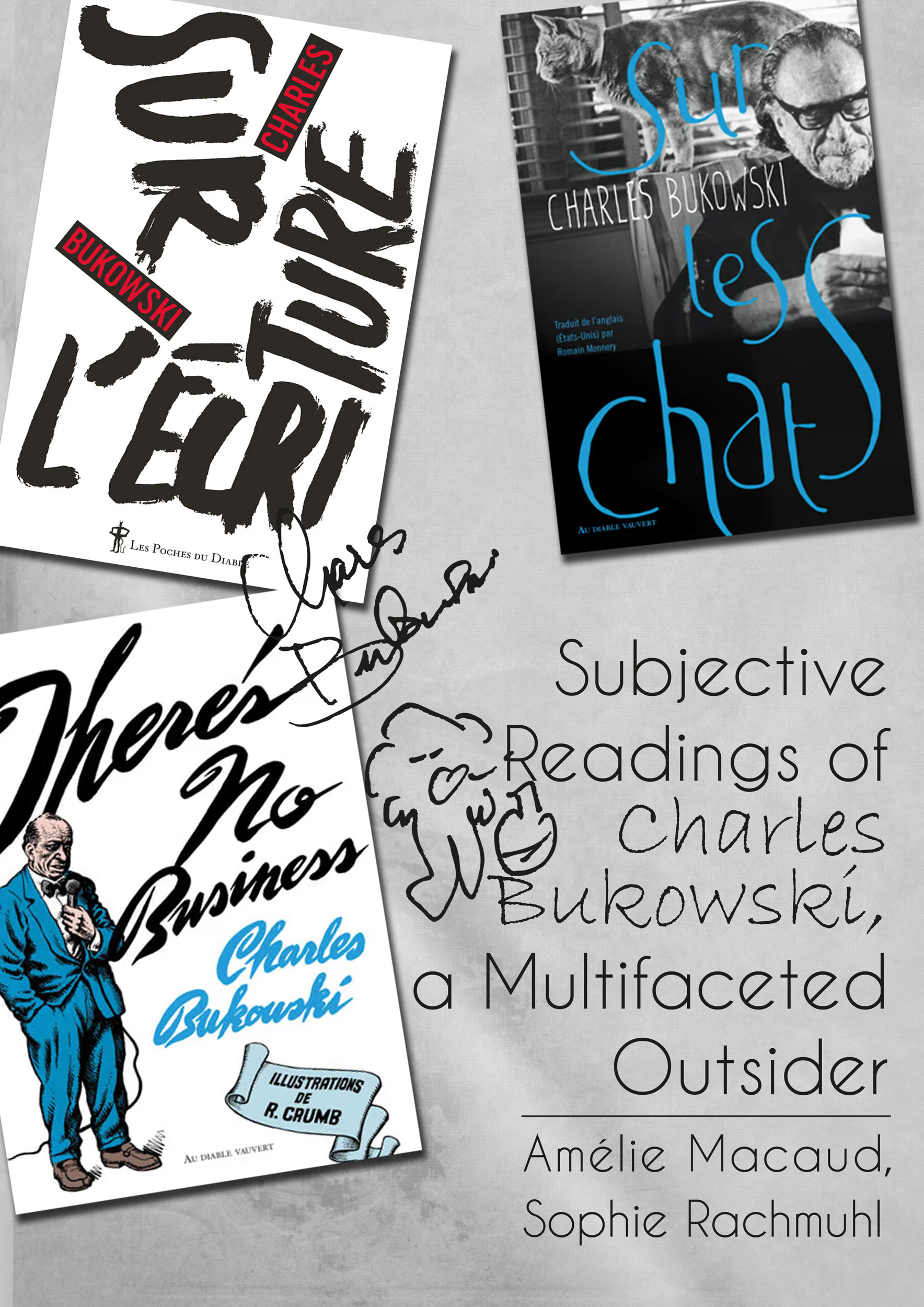
Abstract: Charles Bukowski’s prolific oeuvre of poems, short stories, columns and novels celebrate Los Angeles. His writings reference dozens of specific LA streets and the everyday minutiae of the landscape he inhabited. His Los Angeles was the city’s mundane, everyday reality, not glamorous Beverly Hills or the sunny, shiny beaches.
Keywords: Los Angeles, Vernacular landscape, Geography, Noir, Poetry, Black Sparrow Press, Dive bars
Résumé : L’œuvre prolifique de Charles Bukowski, composée de poèmes, de nouvelles, d’éditoriaux et de romans, célèbre Los Angeles. Ses écrits font référence avec minutie à des douzaines de rues de Los Angeles et au paysage quotidien qu’il habitait. Son Los Angeles était celui de la réalité banale et quotidienne, et non du glamour de Beverly Hills ou des plages ensoleillées.
Mots-clés : Los Angeles, Paysage vernaculaire, Géographie, Noir, Poésie, Black Sparrow Press, Bars miteux
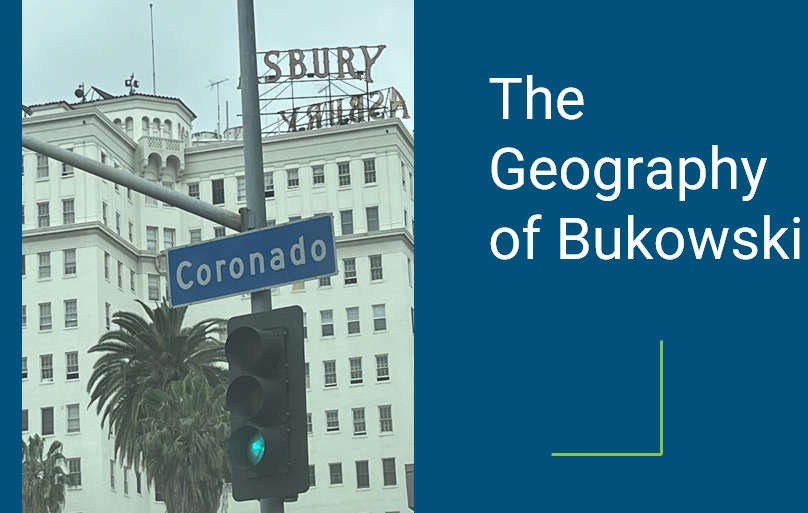
“A poem is a city filled with streets and sewers/filled with saints, heroes, beggars, madmen,” writes Charles Bukowski (1920-1994) in “A Poem is a City.” Bukowski’s prolific oeuvre of poems, short stories, columns, and novels celebrate the city streets and sewers along with the saints and madmen. His writings reference dozens of existing Los Angeles streets and the everyday minutiae of the landscape he inhabited. His Los Angeles was the city’s mundane, everyday reality, not glamorous Beverly Hills, or the sunny, shiny beaches.
As a third-generation Angeleno who loved geography from birth, Bukowski’s site-specific poetics resonated with me when I first read him in 1993. Witnessing how his work mapped Los Angeles significantly impacted my evolution as a writer and scholar.
Numerous Bukowski poems and short stories cite precise streets, places, and neighborhoods. Most of the pieces mentioning a street or place are more about his life than explicitly about the specific site mentioned. Still, the mere mention sets a context grounding the piece in the everyday Los Angeles he so wholeheartedly inhabited. In some cases, though, like his poems “Philippe’s 1950” or “Downtown,” they are directly about these locations.
Everyday Beauty
Reading his work as an undergraduate at UCLA was a revelation. I wrote essays and poems while studying local history, geography, poetry, and selected fiction, especially writing connected to Los Angeles. I didn’t discover Bukowski in class; it was from word of mouth in the poetry scene. Bukowski showed me that you could write about anything and that you could celebrate everyday beauty that might otherwise seem ordinary. He accomplished this in countless poems like “On going out to get the mail,” and “the trash men.”
I was also reading Mike Davis during college. His books City of Quartz and Ecology of Fear taught me how to see L.A. through the wider lens with his Sunshine and Noir archetypes and the big ideas in his work like “fortress architecture,” “fire ecologies,” and “the garden city.” Still, it was Bukowski that got me noticing the little things in my own daily life while giving me permission to name the places I was inhabiting. Moreover, Bukowski embodied the noir aesthetic as an outsider writing unflinchingly about his travels, whether it be betting on horses, fist fights in a back alley, or breaking up with his on-again, off-again girl. Regardless of whether he was writing about California sunshine or losing at the track, Bukowski showed me that it all mattered.
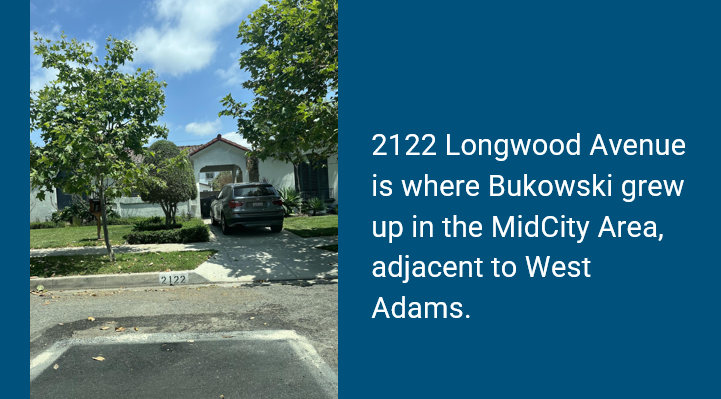
Bukowski’s poems and stories mention many Los Angeles streets he lived on, like Longwood, Mariposa, Delongpre, Carlton, Coronado, Westlake, Oxford, Edgewater Terrace, neighborhoods like the Rampart and East Hollywood and locations like the Sears on Olympic, the Terminal Annex Post Office, Union Station, County Hospital, the Olympic Auditorium, Hollywood Park, Phillipe’s, Santa Anita, and the Central Library. Though Bukowski is primarily a poet and novelist, his countless pieces referencing various Los Angeles sites provide an evocative portrait of a specific 20th-century Los Angeles history and geography.
Bukowski’s biographer, an accomplished poet and his longtime friend, Neeli Cherkovski, wrote about Bukowski’s relationship with LA, “Whereas many poets yearn for the literary cafes and cosmopolitan culture, their absence is precisely what Bukowski liked about it. Playing himself off against the slow, gentle decay of East Hollywood, he brought fresh images into American poetry” (157-58). Cherkovski calls Bukowski’s geography “his spiritual topography” (158).
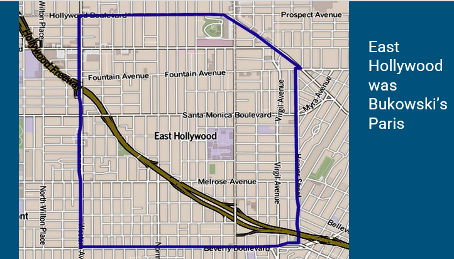
There is a widely quoted passage from Bukowski himself that expresses his love for Los Angeles. “You live in a town all your life, and you get to know every street-corner,” he writes. “You’ve got the layout of the whole land. You have a picture of where you are. […] Since I was raised in L.A., I’ve always had the geographical and spiritual feeling of being here. I’ve had time to learn this city. I can’t see any other place than L.A.”1 This is true for me as well; I have lived my entire life in Los Angeles County.
The Burning of a Dream
One of the first Bukowski poems I loved was “The Burning of a Dream,” which describes the 1986 fire almost destroying Los Angeles’s Central Library.
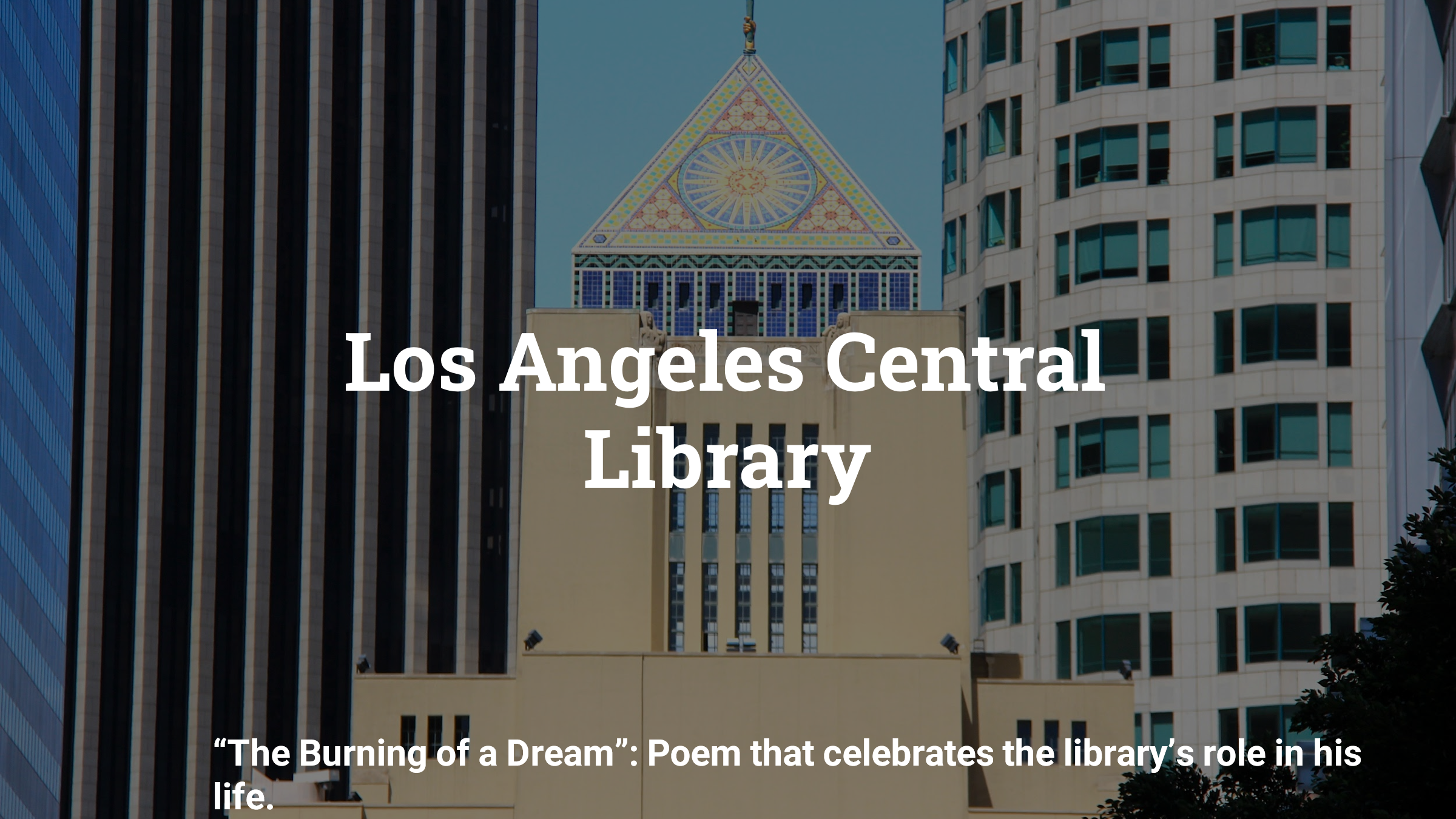
Beyond just breaking down the fire, it evokes his rite of passage and the library’s critical part in his development. At 9 pages, it is one of his longest but it doesn’t let go from the beginning to its conclusion. The opening sets the tone: “the old L.A. Public Library burned / down / that library downtown / and with it went / a large part of my / youth.” We get the scoop on his early reading habits: “going from room to / room: literature, philosophy, / religion, even medicine / and geology.”
“While other young men chased the / ladies / I chased the old / books,” he confesses. The piece names Fante, Li Po, Dos Passos, Sinclair, Steinbeck, and Hemingway among other authors while beautifully capturing how the library shaped him. I read this poem shortly after discovering Bukowski. I was 20 in my sophomore year, going through my rite of passage at UCLA. I’d been to the Central Library a few times, but after reading this one, I began regular pilgrimages downtown to the library whenever school and L.A.’s Westside weighed me down.
Central Library for Bukowski was a refuge: “that wondrous place / the L.A. Public Library / it was a home for the person who had had / a / home of / hell.” It provided a place where he could find something to hold onto, especially considering his family history. While reading dozens of books at the library, he found the grounding to become the writer he gradually became. I’ve heard the Los Angeles Poet Laureate Luis J. Rodriguez share a similar sentiment about the Central Library’s alchemical qualities and how it transformed him when he was homeless in the 1970s. He, too, like Bukowski, found his calling and a home at the Central Library.
Reading “The Burning of the Dream” in my early 20s not only kept me reading and visiting the library but also gave me a template to follow. In the middle of the poem, Bukowski states that he discovered “that it would take decades of / living and writing / before I [he] would be able to / put down / a sentence that was / anywhere near / where I wanted it to / be.”
Another favorite Bukowski poem for me is “Phillipe’s 1950.” The one-page piece is direct and not overly complicated, but its matter-of-fact register perfectly illustrates Bukowski’s every day poetics. “Phillipe’s is an old time / cafe off Alameda Street / just a little north and east of / the main post office. / Phillipe’s opens at 5am / and serves a cup of coffee / with cream and sugar / for a nickel.” Phillipe’s opened in 1908 and is sometimes credited with being the birthplace of the French Dip. Located in Chinatown, just below Dodger Stadium, it’s a popular dining destination before Dodger games. I’ve eaten there with my dad for years, and we recently took my 10-year-old son, who discovered he loved their pastrami.
In the poem’s final lines Bukowski encourages us to “come down there some / early morning. / for a nickel / you can see the most beautiful faces / in town.” Though you can no longer get anything for a nickel, Phillipe’s still holds some of L.A.’s most beautiful faces, even in 2024. This piece is one of a handful that shows Bukowski seeing beauty in everyday Los Angeles in places that many take for granted. He reminds us to slow down and cherish experiences. There’s beauty everywhere if you look. In this way, Bukowski sometimes resembles the French poet Charles Baudelaire and his flaneur concept “as an observer of modern life.”
A Bit of Music
In “If We Take,” Bukowski lists several things that “show life swinging on a rotten axis,” like “the crowded jails,” and “clowns in love with dollar bills,” but he also mentions “a bit of music” like “a small volume of poems by Rimbaud” or “a streetcar turning the corner on time.”
From time to time, he lets readers know about this other side of himself, like in his poem “Bluebird,” where he states: “There’s a bluebird in my heart that / wants to get out / but i’m too tough for him, / I say, / stay down, do you want to mess / me up? / you want to screw up the / works? / you want to blow my book sales in / Europe?” He usually keeps the bluebird tucked away in his heart, but he’s never let it die. The bluebird in his heart emerges singing, he says, “when everybody’s asleep.”
Though Bukowski lived almost all his life in Los Angeles, there was a period during World War Two in his early 20s, when he traveled around America on buses to Philadelphia, New Orleans, New York, Miami, St. Louis, Atlanta, and the Bay Area working odd jobs and gaining life experience. He writes about this period extensively in his novel Factotum.
The movie he wrote, Barfly, conflated this period with his decade or so in the Westlake District near MacArthur Park. He’s said in interviews that Barfly’s spirit combined a bar from Philadelphia with those in which he drank in the 1940s and 50s along Alvarado in Westlake.
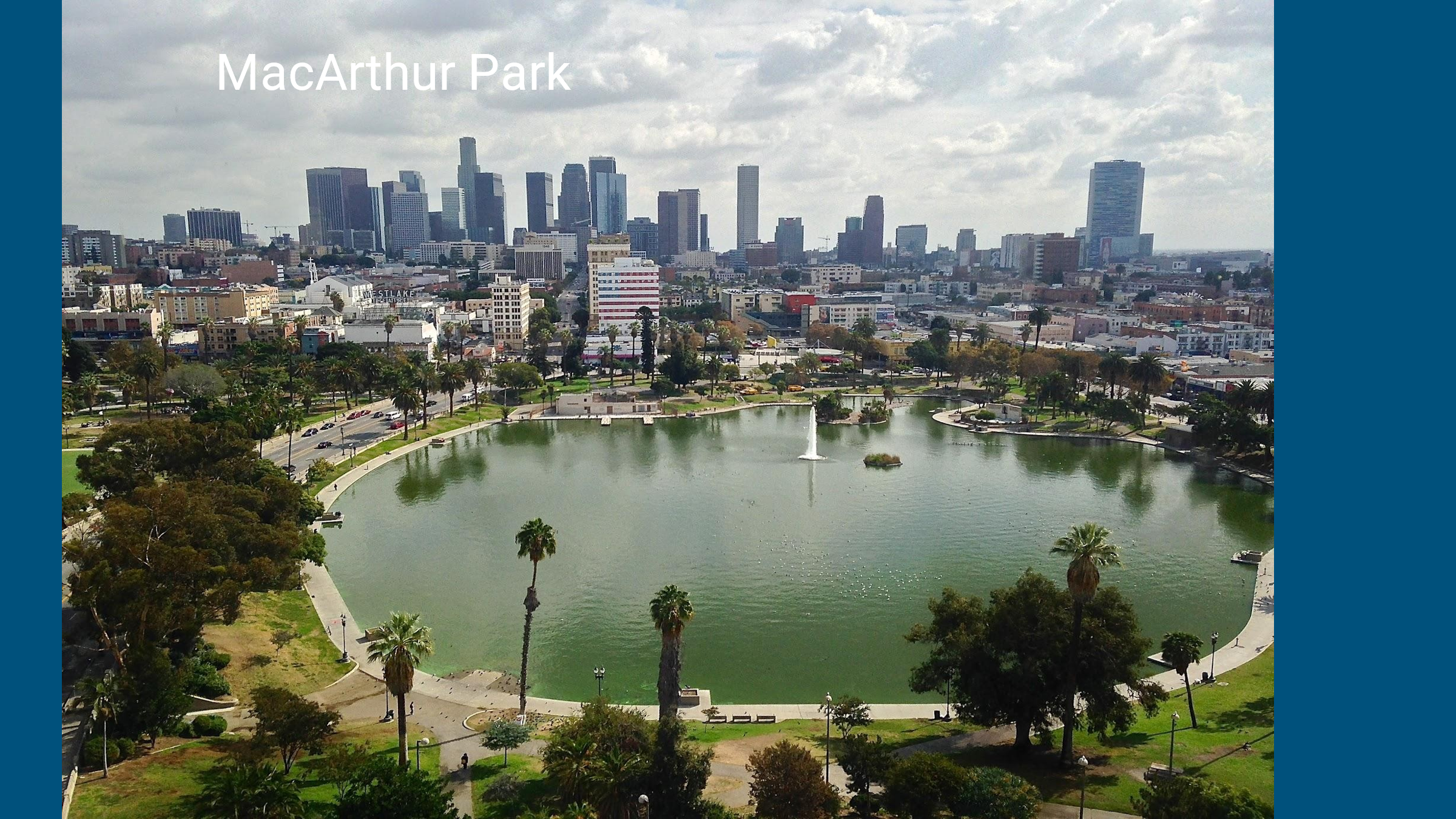
Photo: Bahniuk, November 2013
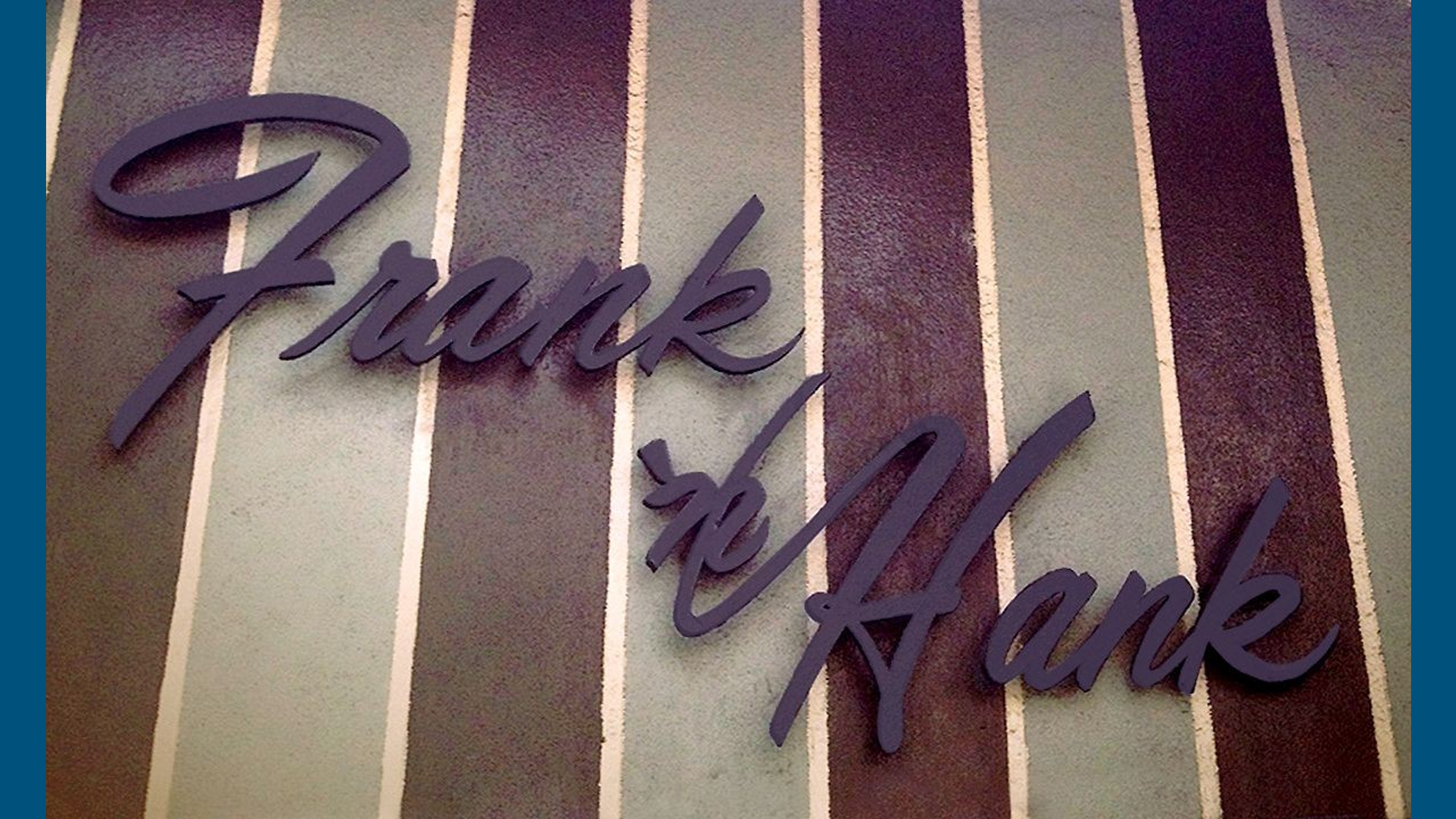
Near the end of college in 1997 my friends and I began hitting L.A. dive bars. There was always word at various watering holes that Bukowski once drank there. I’d heard this at the Golden Gopher downtown, the Smog Cutter on Virgil, the Frolic Room on Hollywood Boulevard, Crabby Joe’s on Main, and Frank ’n Hank’s on Western, among several others I can no longer recall. As my friends and I began reciting our poems around town, we’d hit these bars after readings, especially Frank ’n Hank’s. Sometimes, we’d address the crowd mimicking Mickey Rourke as Bukowski in Barfly exuberantly exclaiming: “To all my friends!!”
After learning that Bukowski had lived for a while around the block on Oxford, I thought Frank’n Hank’s may very well have been one of the dives he did drink in. It’s been there since 1933 and remains open today. I befriended the Frank ’n Hanks owner after writing an essay about it. She started giving us free drinks, and we hosted a few readings there. We even used to see the actor Vince Vaughn there after the popularity of his Los Angeles nightlife flick, Swingers. I no longer frequent these bars, but it was a big part of my early days as a poet. We were channeling Bukowski.
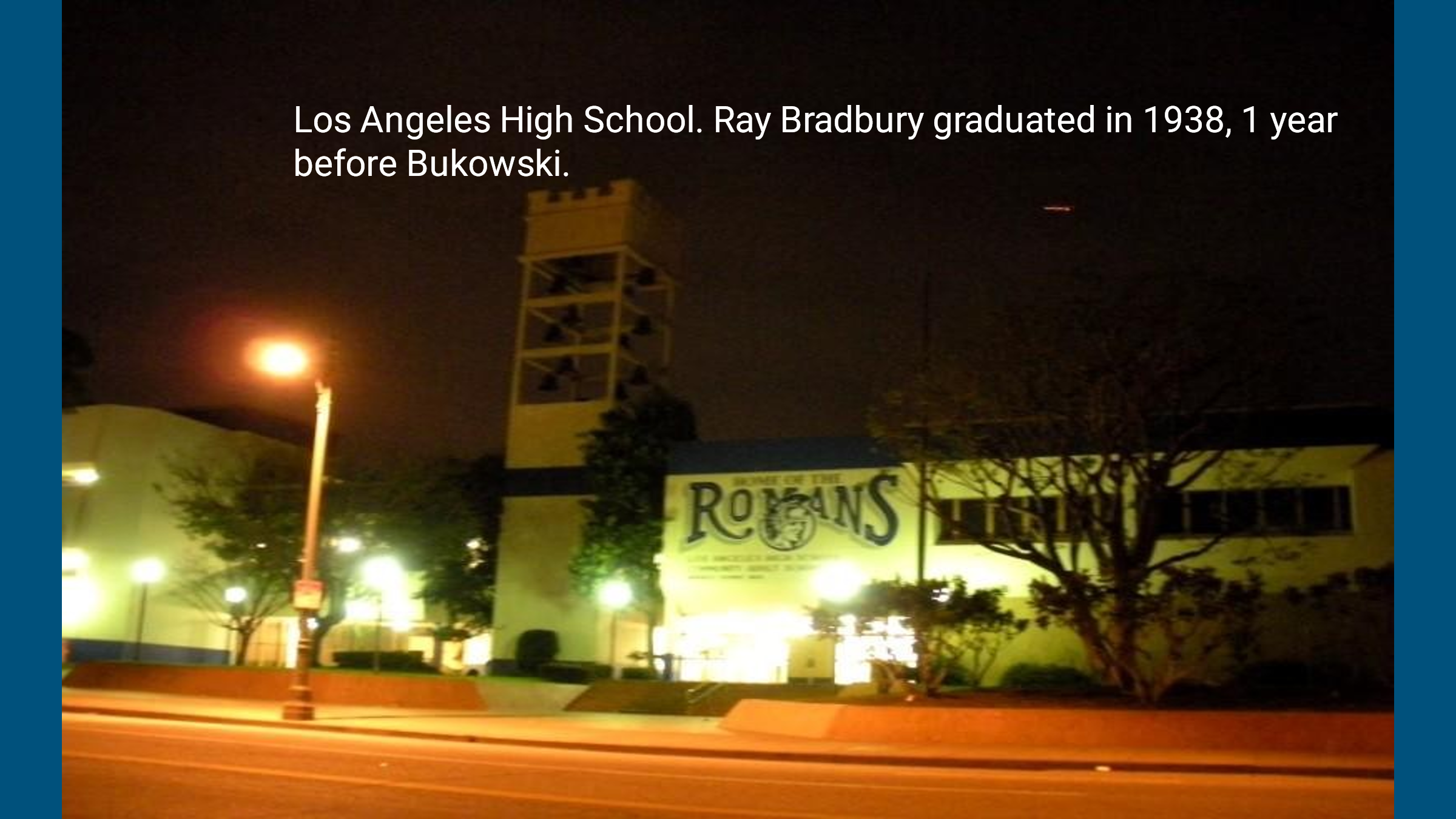
In his 1982 novel Ham on Rye, Bukowski talks about the neighborhood he grew up in on Longwood, his early schooling, attending Los Angeles City College (LACC), and riding the streetcar down Vermont and Washington. When he discusses Los Angeles High School, he doesn’t call it that; instead, it’s called Chelsey High. Nonetheless it’s a well-known fact Bukowski went to Los Angeles High, graduating in 1939, the year after another accomplished Los Angeles writer, Ray Bradbury. Ham on Rye also covers his first job at the Sears Roebuck on Olympic, but he refers to it as Mears-Starbuck.
There are countless other references to Los Angeles throughout Bukowski’s work. Especially considering that he published over 1,000 poems and almost 70 books (and counting), with a few more posthumous collections appearing every few years. And as popular as Bukowski’s work is internationally, some have questioned his legacy like the literary critic Laurence Goldstein in his book Poetry Los Angeles in a chapter titled “How Good, or Bad, Is Charles Bukowski’s Poetry?”
Goldstein analyzes three lesser-known Bukowski poems, extolling some of the flaws in his perspective while offering a larger point of view on Bukowski’s entire oeuvre, stating: “He wastes our time, if we read him in bulk, but he composed some poems—how many? A dozen? Two or three dozen?—that readers of well-wrought poetry are fortunate to possess. They add their light to the city, and we should be grateful they exist.”
A Poem is a World
I believe that Bukowski has more than a few dozen well-wrought poems, but Goldstein is not entirely wrong that reading Bukowski in bulk is time-consuming. Still, I am grateful for his extensive body of work; he captured multiple chapters of 20th Century Los Angeles, providing a template for later poets to follow, like his fellow Black Sparrow Press scribe Wanda Coleman and legions of others after her. He also showed later bards like me how to poetically map and why it matters. Returning to the first poem quoted in this piece, “a poem is a city, a poem is a nation, / a poem is the world…” Bukowski wrote about his Los Angeles bringing the world into his world.
Consequently, with his prolific output and sheer honesty Bukowski made himself undeniable despite what the academy or any critics say. I wholeheartedly agree with Jim Harrison, who wrote in a 2007 New York Times Book Review essay about Bukowski’s Selected Poems, The Pleasures of the Damned that: “It is ironical that those who man the gates of the canon will rarely if ever make it inside themselves. Bukowski came in a secret back door.” A poem is indeed a city, a nation, a world, and Bukowski built worlds with his words.
Notes
- 1https://thevintageproject.blogspot.com/2013/07/kind-of-obsessed-with-charles-bukowski_13.html
- 2More pictures of the library can be found following the link: https://www.lapl.org/branches/central-library/art-architecture
- 3https://onthegrid.city/los-angeles/koreatown/frank-n-hank
Works Cited
- Bukowski, Charles. Barfly Screenplay. Internet Archives, [1986] 2021. https://archive.org/details/barfly-screenplay-charles-bukowski
- Bukowski, Charles. “Bluebird.” Purr, 1, 1975.
- Bukowski, Charles. “The Burning of the Dream.” In Septuagenarian Stew. [1986] 1990, 42.
- Bukowski, Charles. “If We Take.” Poeticous. https://www.poeticous.com/charles-bukowski/if-we-take-
- Bukowski, Charles. “Phillipe’s 1950.” In What Matters Most Is How Well You Walk Through the Fire, 1999, 78.
- Bukowski, Charles. “A Poem is a City.” In Essential Bukowski: Poetry, Abel Debritto (Ed.) New York, Ecco, 2016.
- Cherkovski, Neeli. Charles Bukowski: A Life. Westminster, MD, Steerforth Press, 1997.
- Djemant, Melinda. “Kind of Obsessed with Charles Bukowski?” The Vintage Project, July 2013. https://thevintageproject.blogspot.com/2013/07/kind-of-obsessed-with-charles-bukowski_13.html
- Goldstein, Laurence. Poetry Los Angeles: Reading the Essential Poems of the City. Ann Arbor, U. of Michigan P., 2014.
- Harrison, Jim. “King of Pain.” The New York Times, November 25, 2007.
- “Los Angeles Central Library”. https://www.lapl.org/branches/central-library/art-architecture
About the author(s)
Biographie : Angeleno de troisième génération, Mike Sonksen, aussi connu sous le nom de Mike the PoeT, est un poète, enseignant, journaliste, historien et guide touristique dont les textes ont été publiés dans des revues comme Academy of American Poets, Alta, PBS So Cal, Poetry Foundation et Westways. Sonksen a donné des lectures de poésie dans plus de 100 institutions académiques, est passé à la radio et à la télévision et a organisé des événements au Getty Center. Son livre, Letters To My City (1919), est publié par Writ Large Press.
Biography: 3rd-generation Angeleno Mike Sonksen, aka Mike the PoeT, is a poet, professor, journalist, historian and tour guide whose work has appeared in publications including the Academy of American Poets, Alta, PBS So Cal, Poetry Foundation and Westways. Sonksen’s read poetry at over 100 academic institutions, appeared on radio and television and hosted events at the Getty Center. His book, Letters To My City (1919) is published by Writ Large Press.