Of Nieces and Uncles:the Gendered Evolution of Suspicion in Shadow of a Doubt (Alfred Hitchcock, 1943) and Stoker (Park Chan-wook, 2013)
Abstract: In Shadow of a Doubt (Alfred Hitchcock, 1943), young Charlie’s initial faith in her Uncle Charlie gradually dissolves, and leads her to a bitter realization of life’s baseness. Seventy years later, using Hitchcock’s film as a reference, director Park Chan-wook totally transforms the relationship between his own Uncle Charlie and Charlie’s niece, India, in Stoker (Park Chan-wook, 2013). The complex connection between the two characters is first characterized by India’s suspicious mind, but her trouble with Charlie enables the niece to outdo her kin in evil deeds, thereby giving Park Chan-wook’s film a gendered twist in which the woman is no longer the hunted, but the stalker. Using Paul Ricœur’s ideas on the benefits of suspicion, this article first analyzes how suspicion is used in both films not only to question and dissolve family links, but also to propose a social structure in which the main female character is happy to fit. However, the dynamics of suspicion is different, even opposed, in the two films. While Shadow of a doubt seems to foreground a belief in patriarchy, Stoker highlights a radical and death-dealing subversion of patriarchal rules.
Keywords: Suspicion, Double, Patriarchy, Return of the repressed, Gothic heroine, Female empowerment.
Résumé : Dans Shadow of a Doubt (Alfred Hitchcock, 1943), la confiance qu’éprouve la jeune Charlie envers son oncle Charlie se dissipe progressivement, ce qui amène l’héroïne à une prise de conscience amère des turpitudes de la vie. Soixante-dix années plus tard, Park Chan-wook reprend le film de Hitchcock dans Stoker (Park Chan-wook, 2013) mais transforme radicalement la relation entre l’oncle Charlie et sa nièce, India. Cette relation complexe, mélange de méfiance et d’émoi, va finalement amener la jeune femme à commettre des actes répréhensibles, qui n’ont rien à envier à ceux de son oncle. Park Chan-wook donne ainsi à son film une structure genrée où la femme n’est plus proie mais prédatrice. À partir de l’idée de Paul Ricœur selon laquelle le soupçon est bénéfique, cet article montre, d’une part, que le soupçon remet en question et discrédite les liens familiaux, d’autre part, qu’il permet d’établir une structure sociale où le personnage féminin principal trouve sa place. La dynamique créatrice liée au soupçon est donc radicalement différente dans les deux films. Alors que Shadow of a Doubt semble se conclure sur la réaffirmation des bienfaits du patriarcat, Stoker met en évidence la subversion radicale et mortifère du pouvoir patriarcal.
Mots-clés : Soupçon, Double, Patriarchie, Retour du refoulé, Héroïne gothique, Émancipation féminine.
Suspicion has always been a key concept in Alfred Hitchcock’s filmography. Suspicion (1941) is obviously a case in point, but Shadow of a Doubt (1943) is also relevant as one takes Paul Ricœur’s thoughts on suspicion in Freud and Philosophy as the cornerstone of the present analysis. Besides, the choice of that film makes it possible to see how some elements of Hitchcock’s plot have been used as the source of Park Chan-wook’s Stoker (2013), a film also heavily relying on suspicion.
Shadow of a Doubt belongs to the first series of films that Hitchcock made in the United States during World War II. Just like Rebecca (1940), Suspicion, and even Notorious (1946), Shadow of a Doubt is part of a subgenre that developed specifically in the 1940s and mainly targeted a female audience. These films merged elements of gothic melodramas with what would later be referred to as film noir so as to create “uniquely feminine cine-dramas of suspicion and distrust” (Pratt 184).1 In those films, the tension results from the doubts that the heroine feels regarding her husband’s unclear intentions, and in Shadow of a Doubt the wife is replaced by a niece, and the husband by an uncle (Pratt 184). This mixing of genres is also to be found in Park Chan-wook’s film.2Stoker has thus already been described as “a stylish fusion of family drama, gothic horror and Hitchcockian thriller” (Lambie, Internet), and one could even add an element of the (dark) fairy tale. The explicit reference to Hitchcock here goes without saying, the director having repeatedly declared that Vertigo (1958) was the film that made him feel like becoming a director (Kim 140). A brief summary of the two films only makes the link that unites them even more blatant.
In Shadow of a Doubt, Charlie Newton is initially bored with life, but she is thrilled when her uncle, Uncle Charlie, comes to see her and her family in Santa Rosa, a quiet little town. The two characters are very close, but Charlie will gradually find out that her dearest Uncle Charlie is the notorious “merry widow murderer,” and she will be forced to kill him when he tries to murder her. In Stoker, young India Stoker is bored with life and bereaved since her father, Richard Stoker, has just died in some mysterious car crash. But then, her uncle (Uncle Charlie too) arrives with a smile on his face that is more enigmatic than friendly. Quite rapidly, a very strange atmosphere suffuses the Stokers’ house as Uncle Charlie, India, and her mother Evie get entangled in a relationship founded on suspicion, fascination, and incestuous feelings. Likewise, Uncle Charlie happens to be a cold-blooded killer (and the murderer of his own brother). After thinking of eloping with him, India finally kills him, but she does so in cold blood and leaves the house alone, killing the sheriff (still in cold blood) before heading for New York City. The plots have therefore many similarities, but Stoker is more than just a remake of Shadow of a Doubt.
In both films, the directors deal with the shadowy part of the human soul and the uncertainty it triggers. Suspicion is experienced by different characters, but one will essentially focus on the two nieces’ suspicious feelings, since both stories are principally based on their coming of age, which occurs while the suspicion they both experience throws them onto the path of maturity. Suspicion, therefore, is far from being a negative concept only. If one follows some of Paul Ricœur’s ideas, suspicion is a necessary stage if one wants to avoid some sort of absolutist delusion. For the philosopher, certainty can lead to “metaphysical absolutism” (Scott-Baumann 176), which is obviously negative as it involves narrow-mindedness. Suspicion first destroys illusory certainties, and in the best of cases, this should then lead to some better understanding of the Self, to what Ricœur would consider the recovery of one’s true Self (Soi-même 394).
Hence, I will initially highlight the different ways through which suspicion ends up dissolving family ties in both films. Subsequently, I will observe separately the reconstructive dynamics at work, since the outcome of the process differs in the two films: in Shadow of a Doubt, suspicion eventually reinstates patriarchy, whereas it leads to the replacement of patriarchal codes by some female agency at the end of Stoker.
I. Dissolving family ties: Paul Ricœur’s view on suspicion in Shadow of a Doubt and Stoker
The dynamics of suspicion tend to cast doubt on any belief. Boris Groys has analyzed this phenomenon in the media, and he has shown that our awareness of a submedial space (hidden beneath the image in the media) always creates the discrepancy that triggers suspicion (175).3 This constant questioning is part and parcel of what Ricœur calls the “hermeneutics of suspicion,” and it is a trend of thought that he finds in Freud, Marx, and Nietzsche, those he calls the “masters of suspicion” (Conflit 149). Ricœur acknowledges the necessity of these dynamics, but he also thinks that this spiraling process can potentially be never-ending, and therefore may lead to utter skepticism and even nihilism. As he desires no such thing, the French philosopher then insists on hope and posits a second stage in which things can be recovered and reconstructed (Scott-Baumann 77).
This positive view of suspicion is shared in literature, notably by the proponents of the Nouveau Roman; Nathalie Sarraute, for instance, exemplifies how rich the “age of suspicion” is, forcing the reader to keep his mind open. It is, however, to be noticed that Sarraute believes this fundamentally positive process mainly applies to literature, and she describes cinema as an effortless way to create and consume classical and therefore worn-out characters and stories (73). For Sarraute, cinema remains a form of easy relaxation, except in the few cases where some films become writerly in the hands of “advanced directors” (73) who resort to literary narrators thanks to the use of a voice-over. Thus, ironically enough, Sarraute blames classical writers and critics for their narrow-mindedness when dealing with the Nouveau Roman, but she seems equally prejudiced when it comes to cinema, for cinema has far more ways to keep the audience alert than the methods used by Alain Robbe-Grillet, for instance.
In the two films under scrutiny, for example, the dynamics of suspicion is definitely at work from the very beginning. In fact, that dynamics is already at work as the opening credits start, and this is due to the reputation of both directors who are famous for their films based on suspenseful murder stories. This is especially true of Hitchcock, but it also applies to Park Chan-wook, who is known for his gripping revenge trilogy and his vampire film Thirst (2009).4 Thus, from the start, the audience is invited to play the part of the detective, looking for clues and some “reasonable suspicion” that might prove characters guilty of committing a crime. Following the US judicial terminology, that “reasonable suspicion” might become more substantiated and prompt the audience to think that some characters act illegally “beyond a reasonable doubt.”
A) Shadow of a Doubt
Much has already been discussed about Shadow of a Doubt. The introduction of the film shows us Uncle Charlie, well dressed and lying corpse-like in his dark room, with money on the floor, a cigar and some whiskey close at hand, a cold look in his eyes [02:05]. This somber presentation immediately links him to the underworld and film noir. The rest of the film, however, shows a brighter picture of the character as he can also be a very warm and friendly with his family, his sister and niece especially. This paradox is obviously the main element that triggers our suspicion, but soon enough, suspicion also spreads in the mind of his beloved niece, Young Charlie. Darkness then enfolds the Newton family, as can be felt when comparing the two dinner scenes. The first is cheerful and bright [20:10], the second only appears to be so, and encapsulates Uncle Charlie’s ominous speech on widows: “these horrible, faded, fat, greedy women” [1:05:25]. Then, as he speaks, the camera slowly zooms in on his merciless face and light seems to gradually fade until Uncle Charlie directly looks at the camera and breaks the fourth wall, which leaves little doubt about how tormented the man is.
![Fig. 1: Uncle Charlie breaking the fourth wall [1:05:30]](https://revues.u-bordeaux-montaigne.fr/leaves/article/download/436/version/438/910/3537/Leaves_n17_art06_Chambost_image001.jpg)
Even though Emma (the mother) is disturbed by the dark nature of the speech, it is Young Charlie who is the most upset. But this is no surprise as, from the beginning of the film, the special connection between uncle and niece has been heavily underlined: they have got the same name, are introduced in the same way, both being first seen lying down on their beds with tormenting thoughts. The parallels are numerous, and the vampiric nature of the link that connects them has already been noted (Knee 52). Like a vampire, Uncle Charlie disappears when followed by two policemen, and he reappears on top of a building with a wire that looks like a spider web in the background [06:05]. Like a vampire, he is let in by his niece, who invites him to Santa Rosa [12:30].5 Uncle Charlie also mentions they have the same blood [1:13:35], and the whole film is based on a series of doubles meant to insist on that pairing. This closeness, however, implies that everything is not that bright in the apparently well-polished world of Santa Rosa in general, and in Young Charlie’s mind in particular. After all, Young Charlie is first presented as a girl dissatisfied with life, as she keeps complaining, lying on her bed [09:30]. She also reveals her own inner darkness, when she threatens to kill Uncle Charlie if he does not leave, and as she says those words, her usually bright face is then engulfed in the darkness of the night [1:29:00].
Doubts may be felt indeed regarding Young Charlie’s capacity to believe and fit in that typical American little town. Throughout the first part of the film, she keeps being at odds with the people who represent the pillars of American society. In a light and comic scene, Charlie first faces Mrs. Henderson’s disapproving look, as the telegraphist misunderstands the young girl’s reference to telepathy [15:05]. Charlie is also reprimanded both by Mrs. Corcoran, the librarian, who is surprised at her inconsiderately not respecting the library’s closing time [57:10],6 and by Mr. Norton, the policeman, who blames her for crossing the street when it is not allowed [56:10]. What is more, Young Charlie vehemently opposes detective Jack Graham when the latter tells her that Uncle Charlie may be a criminal [50:55]. All this tends to prove that there might be something wrong in the Newton family, but also in Santa Rosa, where disreputable bars like the “Till Two” can be found if one strips away the shiny veneer of that sunny town [1:08:50].
Two specific objects reveal the ambiguous nature of family links in Shadow of a Doubt: the ring and the paper house made out of Mr. Newton’s newspaper. Both objects are initially meant to symbolize something warm and reassuring, but they are in fact endowed with cold murderous characteristics that go against the grain in this idealized family. The ring that Uncle Charlie gives Young Charlie is central to the plot [23:45]. For Slavoj Žižek, it is a “circulating object of exchange” (8), which should unite and strengthen family links, and yet it is the object which triggers Charlie’s suspicion (as a murdered widow’s initials are engraved on the inside of the ring). Mladen Dolar also considers the ring essential since it creates the suspicion leading to “the moment of recognition” that takes place in the nightclub called “Till Two”.7Then, the ring is given back, and “the dual relationship is disrupted by the very object that constitutes its bond” (Dolar 35).
Likewise, the house that Uncle Charlie makes with a sheet of newspaper is apparently meant to entertain little Ann (Charlie’s younger sister) [29:30]. It could also symbolize the unity of the family. However, the house that Charlie builds is a flimsy house indeed, and a deadly one to boot, as Uncle Charlie uses the one page in the newspaper in which his murders are related, which is obviously a device to hide his deeds. That house is also responsible for the first crack in the façade of the apparently united household since Charlie guesses that there is something hidden on that page, and as she tries to reach out for it, Uncle Charlie grabs her wrists in the most brutal way [31:30]. This newspaper page can be seen as a sort of Poesque “purloined letter” for it is given another shape so as to hide the sad truth about Uncle Charlie, and it stays under everybody’s gaze but cannot be deciphered. Nevertheless, even if the reading is postponed, it does take place (at night, in the public library), and Charlie’s suspicions about her uncle are proven true; the shock of this epiphanic moment is conveyed by a majestic crane shot that isolates Charlie in the public library.
![Fig. 2: Young Charlie alone in the public library [59:00]](https://revues.u-bordeaux-montaigne.fr/leaves/article/download/436/version/438/910/3538/Leaves_n17_art06_Chambost_image002.jpg)
The high-angle long shot shows how crushed by the news Young Charlie is, and the feeling is even emphasized by the dissolve effect that follows and makes her body disappear as it is gradually replaced by couples dancing to the tune of the Merry Widow Waltz. In the end, the paper house can be seen as a miniature of the Newton’s house and family, and more generally of any average family’s house concealing a crime within its walls (McLaughlin 145).8
As can be seen with these two examples, things that first appear to be proof of strong family ties happen to be undermined by crime. By going beneath the surface of things, by reading the article inside the paper house, by noticing the initials engraved inside the ring, Young Charlie and the audience question the validity of the belief in the sacredness of the American family. Family is indeed under attack in Shadow of a Doubt, and even the good-natured and positive-minded Emma finally admits, while crying, that her life as a housewife is far from being fulfilling: “… And then I got married, and you know how it is… you sort of forget you’re you: you’re your husband’s wife” [1:38:40]. Thus, the suspicion that initially concerned Uncle Charlie only, has spread to the whole family, and even more widely all over the self-righteous community of Santa Rosa. As Robin Wood rightly notes: “What is in jeopardy in the film is above all the family—but, given the central ideological significance of the family, once that is in jeopardy, everything is” (297). Paula Marantz Cohen agrees with such a statement, and she adds that it is not that frequent to have thrillers whose suspense is based on what is happening within a family. For Cohen, plots in which families play a central part are usually either dramas or comedies (135-6). In Shadow of a Doubt, suspicion prevails and this is certainly the case in the even more restrained and dysfunctional family at the center of Stoker.
B) Stoker
Stoker is based on the same dynamics of suspicion as Shadow of a Doubt. The plot is based on the same triangle of suspicion, desire, and murder, with desire being here more openly incestuous. Both women are fascinated by Uncle Charlie, which obviously intensifies the tense relationship between mother and daughter, which differs from Shadow of a Doubt. Another difference from Hitchcock’s film is that India’s doubts about her uncle are immediate. India only learns about her uncle’s existence on the day of her father’s funeral. And the uncle’s arrival is all the more disquieting as it appears quasi-supernatural. India is the only one who can hear him softly call her name during the funeral ceremony, as he stands in the distance on top of a grave, as if he came back from the dead [04:05]. The supernatural connection between the two characters is emphasized since both are gifted with synesthetic hypersensitivity, notably rendered by a minute attention to the slightest aural perceptions. We can thus distinctly hear the breaking of an eggshell or the noises made by crystal and cutlery at dinner time. India can even hear the slight patting noise of a spider’s legs on the floor [04:35]. This sensory over-acuteness and the ambivalent feelings of suspicion and fascination that underlie these family relationships also connect the film to the notion of vampirism. The title is a direct allusion to it,9 but so are some scenes: India kisses a boy and bites his lip, making him bleed [50:55]. In the final scene, India kills the sheriff using pruning shears to cut his carotid artery [1:29:25], as the female vampire does in director Park’s Thirst. In some of his letters to his niece, India’s uncle even mentions they share the same blood, just like Hitchcock’s Uncle Charlie.
![Fig. 3: India and Charlie linked by blood and ink [1:03:50]](https://revues.u-bordeaux-montaigne.fr/leaves/article/download/436/version/438/910/3539/Leaves_n17_art06_Chambost_image003.jpg)
India’s closeness to her uncle, however, is also coupled with a strong sense of distrust, which is felt in the intensity of her gaze as she keeps observing unfathomable Uncle Charlie. This is cleverly shown at the end of a family dinner: Evie has left the table, and Uncle Charlie and India stare at each other with very few words being exchanged. Just as India gulps down wine and is shown in a close-up shot, we can already hear the beginning of the dialogue from the next scene. This careful “J-cut editing” (also known as “audio advance”) makes it then possible to hear the voice of a man (who will turn out to be India’s arts teacher in school) who explains: “It takes time to observe attentively. Wait for the moment that our eyes fully penetrate the inside of the subject” [25:45].10 The message is clear: India calmly waits and observes her uncle, just as she did when she hunted birds with her father (we are told many times how skilled she is at hunting).
What makes the film so tense is that Evie, the mother, is also actively involved in the game of suspicion and desire. Evie seems easily charmed by her handsome stepbrother, and the mother/daughter conflict is also fraught with jealousy, even rivalry. The daughter accuses her mother of not mourning as she should and as Victorian people would do [15:35], while the mother blames her daughter for always being very close to her father, when she is supposed to love her too [1:21:50]. This triangulation of desire echoes René Girard’s ideas in Deceit, Desire, and the Novel, and, following the French thinker’s ideas, the fascination that India feels for her uncle might well be caused by the attraction that Evie feels for him in the first place. For Scott-Baumann, Paul Ricœur also links suspicion to desire when he implies that enlightenment might result from suspicion, which may help us understand what we desire (48). India’s suspicion about her uncle’s intentions is, therefore, gradually combined with incestuous desire, and this can be seen symbolically, first, with the insert shots of the spider that are shown at intervals in the film: the spider first creeps in the direction of India’s leg, then climbs onto her ankle, and finally heads towards her crotch [44:25]. The spider echoes the myth of vampiric possession—since it is one of the “creatures of the night” vampires are associated with—but it is also coupled here with the idea of incest, since the spider happens to be a “harvestman,” also known as “daddy longlegs,” which ties in with the twisted family relationships. The incestuous desire becomes even more explicit when uncle and niece play an emotionally intense piano duet [42:50]. Then, we can hear India panting and see her very pale cheeks coloring for the first time as Uncle Charlie embraces her and plays footsie while still playing. Finally, in this crescendo of paradoxical feelings, the two characters are united in a disturbing scene in which India has an orgasm as she touches herself while remembering how her uncle broke the neck of the man who was trying to rape her [56:40]. Death and desire—or rather death and sex—are then totally blended, and India’s suspicious feelings are compounded by sexual attraction.
However, this desire does not stop India from having doubts about the reason for her uncle’s return. And just as the ring that was supposed to prove Uncle Charlie’s love for Young Charlie actually revealed his murderous activity in Shadow of a Doubt, here, in Stoker, India reaches her dark epiphany when Uncle Charlie makes sure she gets the key allowing her to open a drawer and read the love letters he wrote to her for 18 years. In this pivotal scene, a succession of shots dissolving into one another show Charlie’s handwriting and India’s face, while we can hear both protagonists reading bits of those letters in turn, their voices often overlapping [1:02:55]. On the screen, the succession of sentences written by Charlie gradually darken the image, and out of the ink from these love sentences India’s face emerges seemingly drawn in ink until it becomes flesh again.
![Fig 4: India appearing through Charlie’s words [1:03:35]](https://revues.u-bordeaux-montaigne.fr/leaves/article/download/436/version/438/910/3540/Leaves_n17_art06_Chambost_image004.jpg)
The scene ends with both their voices merging on meaningful bits, like “Please know I am with you as we share the same blood,” and finally “All my love. Charlie” [1:03:55].11 However, as the inside of the ring revealed the dark side of Uncle Charlie in Hitchcock’s film, here the flip sides of all the envelopes betray Charlie’s madness for after that moment of intimacy, India realizes that all these letters bear the stamp of the mental asylum where Charlie was locked for years for killing his younger brother Jonathan [1:04:50]. With these letters, the past comes back into India’s life, and Uncle Charlie then represents a literal embodiment of the Freudian return of the repressed, since he is back home, after years of confinement for some unspeakable reason.
This return of repressed murderous tendencies is visually staged even before the spectators are aware of it. However, when the flashback about Jonathan’s murder is shown near the end of the film, the attentive spectator may perceive the eerie connection between uncle and niece. In this flashback, indeed, Charlie is shown burying his baby brother alive and flapping his arms and legs on the sand where the toddler is, as if to create a snow angel. The scene is filmed in a bird’s-eye shot [1:11:45], and, interestingly, a similar bird-like gesture was earlier performed by India on her bed as she followed the rhythm of a metronome soon after Charlie’s return—the scene being also shown in a high angle shot [16:50].
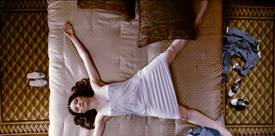

This filmic echo is proof of the special connection between the two members of the Stoker family. The initial suspicion felt by India toward her uncle Charlie comes from the fact that she can feel the man’s dark soul without initially realizing that she has also inherited these homicidal characteristics. As the film nears its end, it becomes increasingly evident that the urge to kill is a monstrous trait defining the Stokers. Thus, the apparently affectionate statement that India’s grandmother wrote on the back of a picture showing her three sons (Richard, Charlie, and Jonathan) and which says “My three little monsters” happens to contain a ghastly truth: this monstrous streak does run in the family [1:01:25]. India eventually understands it when she admits that her father encouraged her to hunt; she then grasps he made her do bad things (killing birds) in order to stop her from doing worse things (killing people) [59:40]. Until the return of the repressed uncle, she had not realized that hunting was her father’s way of assuaging her murderous instincts.
The film Stoker has already been compared to The Stepfather (Joseph Ruben, 1987), in which the main character is a serial killer who appears as a family man until he kills his family and then starts a new one (Murphy 183). However, this comparison appears far too limiting: Park Chan-wook’s film does not limit the source of evil to one man only, as is the case in The Stepfather, which can be seen as an efficient by-product of the then fashionable trend of psycho-killer films. In Stoker, the whole family is characterized by murderous impulses. Even Evie, coldly and hatefully, tells her own daughter: “Personally speaking, I can’t wait to watch life tear you apart” [1:21:20].
There are definitely common dark characteristics between the families of Shadow of a Doubt and Stoker. However, the younger generation of the Stokers has far darker features than the Newtons. Another difference between the two films would be that, as mentioned earlier, Hitchcock’s film insists on the fact that the Newtons live in Santa Rosa, a typical American little town, whereas the plot of Stoker has no geographical locale.12 It is limited to the evil things that occur within one murderous household. The house, which is quite luxurious, eventually appears to be a modern-day Gothic mansion, a deadly golden cage, enclosing and destroying failing psyches. Yet India will eventually manage to survive and fly away from this stifling place in which suspicion and murderous thoughts prevail.
Suspicion may paradoxically make it possible for some characters to recover from their original predicament, and this is what occurs in both films. However, the solutions that are then provided are radically opposed: while one film shows the reinstatement of patriarchy, the other displays the drastic subversion of patriarchal codes.
The reconstructive dynamics of suspicion
A) A funeral and a wedding, or how suspicion eventually reinstates patriarchy in Shadow of a Doubt
As already mentioned, Ricœur wants to make something positive out of suspicion. This is what Alison Scott-Baumann shows as she contrasts Ricœur’s ideas 13with the skepticism and destructive jealousy that can emanate from suspicion (175). Ricœur’s hermeneutics of reconstruction turns suspicion into some “condition of possibility” that enables us to go under the surface and see what is wrong in others and in ourselves (Scott-Baumann 73). The final stage of the dynamics propounded by Ricœur is to recover and improve ourselves.14
Jean Douchet’s thoughts about Hitchcock’s filmography reproduce the same pattern, albeit without using the concepts of suspicion and recovery, as the critic speaks of darkness and light (54). For Douchet, Hitchcock’s films regularly show darkness engulfing the main protagonists who must then fight hard to find light again. Analyzing Shadow of a Doubt, the critic insists on Young Charlie’s initial disillusion and upon her attempts at regaining some positive view of life as a full member of Santa Rosa’s world (55-6). By refusing the ring and the sort of partnership that her uncle murderer offers her in the noir universe of the nightclub, Young Charlie declines the role of rebellious femme fatale, and she realizes that Uncle Charlie’s contemptuous words that she is “an ordinary little girl living ordinary little days in an ordinary little town” are not that bad after all [1:12:25]. Casting doubts on her family’s way of life in the first part of the film enables her to think and go beyond what she had then considered as flaws: she is now willing to recover her position within the typical American family. To prove this point, the film shows her sadness when she returns home from the bar. Standing on the dark porch, she witnesses a homely scene inside, in which her father acts as good fathers should. Joseph Newton is then shown in a loving and responsible way as he takes little Ann to her bedroom, carrying her on his back while she keeps laughing [1:15:15]. This short scene is quite important, because this new way of representing the patriarch contrasts with all that we had seen of that man before.15 And this new perception of him reflects Young Charlie’s new opinion on family life: in that moment, she wishes she were back in the warm light of the loving home, where fathers take care of their daughters. To insist on the benefits of a loving family, the film also counts on the comic aspect by joyously recalling cacophonous family scenes. In these moments, the film tends towards Frank Capra’s description of the zany Sycamore-Vanderof family in You can’t Take it with You (1938). The human warmth of the scenes makes Young Charlie’s feeling of loneliness all the more obvious for the audience.
Before returning to the fold, Charlie has to fight back the man who kills rich widows, who are free to act as they like in a male-dominated society. For a brief while, Charlie has literally the upper hand over her uncle, as she holds the banister and walks down the stairs, ostentatiously showing the ring that she has recovered from him, and that is clear evidence against him [1:37:25].16 With the ring on her finger, she is the one who becomes powerful in the series of gazes she and Uncle Charlie exchange. With much difficulty, however, she will manage to get rid of this harmful male presence, only to join Jack and his beliefs in patriarchy in the film’s epilogue.
Thus, Young Charlie has eventually killed her uncle and may have found a forceful husband, able to prevent her from straying again on the path patriarchy would forbid. By marrying Jack, she will accept his idea that “average families are the best” [46:25]. Jack is indeed patriarchy’s prime ambassador in the film, a man for whom a typical American woman must stay at home to bake cakes.17 And no matter how reluctant Charlie is at first to admit this point of view, by marrying the police officer, she may well accept the uneventful family life she criticized before. The epilogue in front of the church, therefore, hardly comes as a surprise, all the more so as we had previously witnessed inspectors Jack Graham and Fred Saunders walking Charlie back from the church to the family house, each detective being on one side of Charlie, as they would do if she were a prisoner [1:18:10].
The second part of the film thus reinstates the initially dubious patriarchal values. The foundations of society might have been shaken for a while, but order is back in town, and the last extreme long shot of Santa Rosa echoes one in the beginning, with Mr. Norton, the policeman, directing traffic [1:41:45].18 The last figure of the Law to be seen, however, remains Jack Graham, in front of the church conversing with Young Charlie about Uncle Charlie. While the minister’s eulogy of Uncle Charlie can be heard off-screen, spectators listen to the soon-to-be couple analyze Uncle Charlie’s madness. The policeman reassures the young woman by stating that the world is not entirely bad but that it needs a lot of watching [1:42:45], a statement that she seems to endorse as she has just accepted his hand [1:41:55].
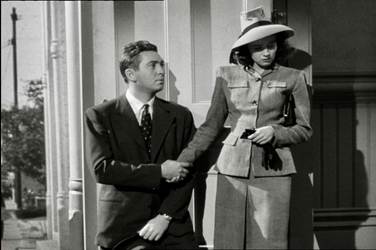
Darkness, therefore, seems hidden even right in the center of a little town like Santa Rosa.19 Reliable and yet average family men like Jack Graham seem to be strong enough to have the law enforced, and let the sun shine and the birds sing in Saintly little town.20
Some critics and scholars deem this ending very conservative. James McLaughlin, for instance, assimilates the notion of wedlock to some deadlock, since the final wooing scene takes place during the funeral (149). But even before, the garage door slamming shut on the two lovebirds also suggests that family life is a trap [1:24:20], and Emma indirectly confirms this impression when she declares that they do not own the house, but that the house owns them [42:50]. Emma unwittingly goes even further in her debunking of married life when she admits that once she got her husband, she forgot who she was and became her husband’s wife [1:38:40]. Home can therefore be seen as the burying ground of women’s aspirations to freedom. In the film, it clearly appears that female freedom must be checked and tamed, if not by the strangulation of rich, independent widows, at least by the bonds of wedlock. This must be the idea that leaves a “bitter taste” lingering after watching the film, according to Robin Wood (293).
Critics favoring a gender perspective in their analyses have regularly stressed the misogyny that can be felt in Hitchcock’s films in general. Without being as harsh as Laura Mulvey,21 Tania Modleski remarks that one of Hitchcock’s favorite themes is “the suspicious-haunted relations between the sexes” (171, my italics). Shadow of a Doubt doesn’t deviate from that rule, the scholar adding that the film focuses on the “pathological and often violent underside of marriage and family” (171).22 Rather than simply implying that Hitchcock’s films convey misogynous ideas, Modleski insists on the fact that the film reveals that patriarchy is in crisis, and that women may well be the main victims of it, although she nonetheless concludes that patriarchy is reinstated in the end (179).
If we follow Ricœur’s trend of thought, suspicion in Shadow of a Doubt is used to eliminate some nefarious ideas—whether they be murderous thoughts or female emancipation—so as to recover a safer, and more stable patriarchal society. It is, therefore, tempting to see the ending of the film as a controversial version of the recovery advocated by Ricœur, as doubt eventually leads to the taming of independent women initially resistant to patriarchal codes.
B) A funeral and a “rebirth-day,” or how suspicion leads to the subversion of patriarchy in Stoker
As seen before, Stoker is also based on the dynamics of suspicion, and like Shadow of a Doubt, the recovery it proposes is quite controversial… but for a radically different reason. Stoker is a coming-of-age story of the most radical form. On her eighteenth birthday, India’s father dies in mysterious circumstances, and the following doubts she experiences eventually trigger some major changes in the teenager’s life. In the two films analyzed herein, the dynamics of suspicion enables both girls to evolve and adopt a new way of life. Yet, it is the process itself that is different. While Charlie first trusts then suspects her uncle so as to finally hark back to the patriarchal values she initially despised, India first suspects her Uncle Charlie, then gets closer to him, before untying all her family links so as to assert radical new values.
India’s father’s violent death is obviously a shock to the girl who was very close to him, as her mother admits. This partly explains her withdrawn attitude, with a tendency to keep to herself. However, that behavior typified her even before her father’s death, or so we are told. Her constantly sullen expression—at home and in some rare scenes in high school—could well be the physical expression of the uneasiness and rage felt by female adolescents when the female body is perceived as “other” (Creed 75). When she is finally a little more confident and starts to flirt with another pupil, she asks him: “Have you ever seen a photograph of yourself taken when you didn’t know you’re being photographed, from an angle you don’t get to see when you look in the mirror? And you think: that’s me… That’s also me… Do you? Do you know what I’m talking about? Well, that’s how I feel tonight” [49:15]. These questions India asks herself about herself, associated with the unexpected death of the role model that her father was, create some mental upheaval which is only emphasized by the brand-new psychic connection she can feel for this unknown uncle who comes out of nowhere.
As said before, the fascination and eerie closeness she feels for Charlie turns out to be destructive, and some people will pay the heavy price because of their evil partnership. However, Uncle Charlie merely happens to be a means to an end for India, as she eventually frees herself from his influence to start a new life in a new environment. An outstanding hunter, India has become an accomplished murderer thanks to the return of the uncle, and eventually the pupil surpasses the master, as she calmly aims at Charlie’s throat and shoots him in cold blood [1:26:40]. One may think that by killing him India only wants to save her mother—who is then being strangled by Charlie—but the girl’s collectedness and her lack of concern for Evie once Charlie is dead tends to imply that she did it for herself more than anything else. By killing Charlie, she opts out of any patriarchal structure. The epilogue then shows India truly smiling at long last, as she has just killed the sheriff who had intercepted her racing car [1:29:45]. The message seems clear: India no longer needs any patriarchal figure. The sheriff is another expression of the “Law of the Father,” and as such, he must be eliminated for India to enjoy her own narcissistic world, a world in which she can blossom just like the flowers that have been sprayed with the sheriff’s blood [1:30:45].23 India thus belongs to the gothic heroines described by Victoria Nelson for whom: “the [modern gothic] heroine meets the monster, mates with the monster, and finally becomes the monster herself—but often with redeeming qualities” (141). We may however think that the coda added by the critic does not really apply to the monstrous creature that India turns out to be. As a matter of fact, India’s monstrosity was there from the beginning, but it remained tamed and hidden thanks to the hunting sessions organized by her father. It only resurfaces with Charlie’s return, and then it is even more ruthless than her uncle’s, as Charlie sometimes shows some empathy with his victims.24 Conversely, India shows no emotion in the act of killing her uncle; she even contentedly smiles when she executes the sheriff.
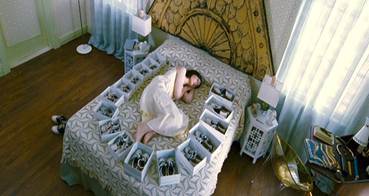
India’s dramatic coming of age is also conveyed in the film thanks to two series of symbolic motifs: the shoe and the egg. These references can be assimilated to literary extended metaphors. The shoe imagery starts the film, with India puncturing a blister caused by her saddle shoes, as if these shoes typical of little girls were no longer fit for a 17-year-old adolescent verging on 18 [02:25]. Thanks to a series of beautiful dissolve shots, we later understand that Uncle Charlie secretly sent her the same pair of saddle shoes for each of her 17 birthdays—the size of the shoes corresponding to the age of the girl [08:25]. Her 18th birthday shows a great change, since for the first time Charlie personally gifts her another pair of shoes, and these are no longer saddle shoes but crocodile high-heel shoes: those a femme fatale would wear [1:14:30]. India is definitely “of age.”25 Later, a scene depicts India lying on her bed, surrounded by the 17 boxes of saddle shoes that make an ovoid shape [08:50], and the end of the film shows us the empty bed with the egg-like shape of boxes broken, the 17th pair of shoes being abandoned on the threshold of the house, next to some trace of blood left by Charlie’s corpse that India has taken outside to bury: it is as if the baby bird had hatched from its egg and spread its wings [1:28:40].
Likewise, during the funeral reception, an artful dissolve shows the egg of a stuffed wading bird merging with India’s eye in the next shot [09:20]. The superimposition is both elegant and meaningful: India is literally extracting herself from the egg, from the house, and from the swing which does look like a nest hanging from a tree in the garden [29:20]. The TV program broadcast on the night of auntie Gin’s killing leaves little doubt as to the species of bird India might be. As the unfolding of the murderous plot appears in parallel editing, one can see excerpts from a wildlife show in which an eaglet gets rid of another baby bird, the presenter commenting on the growth of the animal with statements like: “Even family ties have no meaning when food is scarce,” or “while this sibling rivalry may seem cruel, in the end it is for the best,” then “each day in the hunt brings the eagle closer to maturity,” and finally: “wings are freedom” [30:50]. All this information obviously symbolizes India’s growth. She is the young girl who becomes a full-fledged woman and who breaks loose from the family nest… And the “deviled” eggs she prepares at the beginning also imply that this chick is quite a bad egg indeed!26
In Stoker, therefore, India manages to extract herself from the painful stage of adolescence and to find her real Self. Through her father’s death, her uncle’s arrival, and the changes all this implies, she is able to assert who she is. She may keep some features of her background as part of herself, but this does not stand in the way of her own blossoming and construction of her own personality. As the opening flash-forward allows us a glimpse of the final scene, we can hear India’s concluding thoughts about her coming of age in voice-over: “Just as the skirt needs to billow, I’m not formed by things that are of myself alone. I wear my father’s belt tied around my mother’s blouse. And shoes which are from my uncle. This is me. Just as a flower does not choose its color, we are not responsible for what we have come to be. Only once you realize this do you become free. And to become adult is to become free” [01:15].Thus, the dynamics of suspicion at work in the film helps her uncover things about her family and herself, and by getting rid of all that is not necessary, and keeping what is truly part of herself, she manages to be an emancipated adult, an empowered (and deadly) New Woman.
In Stoker, as in Shadow of a Doubt, suspicion plays an important part in the shaping of the female protagonist. In both cases, suspicion targets family and its role in the creation of identity. Gertrude Stein tersely gave her opinion on identity and family. She declared: “I had a family. They can be a nuisance in identity but there is no doubt no shadow of a doubt that that identity the family identitywe can do without” (148, my italics). If we consider the two films here studied, we may say that they both tend to prove the opposite of Gertrude Stein’s quote. In both cases, though differently, the doubts emanating from the questioning of family links lead the protagonists to decisions that will be influential for the rest of their lives. Charlie returns to the patriarchal structure she saw as a nuisance at first. India eventually fully assumes what it means to be a Stoker, and she gladly embraces her new freedom outside the heteronormative society.
In this regard, India fully belongs to the group of Park Chan-wook’s female heroines who manage to extract themselves from patriarchy, in the latest part of the director’s filmography. Lady Vengeance (2005), Thirst (2009), and The Handmaiden (2016) all have female protagonists who are also involved in a dynamic of suspicion and aim at emancipation by opposing patriarchal rules.27 These films are based on plots that give pride of place to suspicion and to some women’s reclamation of independence and of their selves. This is most obvious in The Handmaiden in which the two female protagonists play the part of victims only to become the victimizers of unsuspecting men. The “sly civility” (Bhabha 142) they use in the patriarchal SouthKorean and Japanese societies is a way for them to resist while pretending to comply.28 This strategy of “wise passiveness” (Hoeveler XV) can also be found in Stoker and in Lady Vengeance, and it enables these women to gain empowerment without openly rebelling against patriarchy.29
Victimization is not the only paradoxical way for India to reach female agency. By reproducing patriarchal codes on an excessive mode, she implicitly shows her opposition and thus subverts patriarchal order. This behavior happens twice in a row at dinner, when she first refuses both Uncle Charlie’s offer, then her mother’s request [23:20]. Each time, she does say “No, thank you” but with a smile on her lips that is exaggerated, and so, far more defiant than polite.30 In the first part of the film, India thus pushes the cliché of the obeying daughter/perfect A-student to its limits, to the point that it may even look like some travesty or simulacrum. Then, she finally imposes her will by killing Uncle Charlie, leaving her mother, and disposing of the law and its enforcement officer. Such an attitude calls to mind what Luce Irigaray wrote about mimesis and mimicry. For Irigaray, mimesis is just a way to submit by reproducing codes, but this “mimetic submission becomes some destabilizing mimicry” when the reproduction is excessive and therefore subversive (Diamond 369).31 Through this excess, women can create something new that no longer obeys the phallocentric order. India’s attitude reproduces this challenging stance.
Moreover, as is the case in his revenge trilogy, director Park’s story and his way of filming sometimes go against Mulvey’s idea that films often reproduce the male gaze, female characters being then defined by their “to-be-looked-at-ness” (11).32 Handsome Charlie is, indeed, observed not only by suspicious India and flirtatious Evie, but also by all the teenage girls at India’s high school. More importantly, by the end of the film, India seems to have learnt how to play with the objectification of the female body by the male gaze, and she uses her skills when she gives a beguiling smile to the sheriff in order to charm him and take him off guard while she stabs him in the neck [1:29:25]. As her killer high-heels imply, she is now a true femme fatale, free to go wherever she wants. The skirt billowing in the wind may be a sign of her now fully embraced femininity, and the extreme close-up shot on her smile, a real one this time, also insists on the euphoric moment she experiences as a New Woman who blossoms and welcomes the colors she shied away from at the beginning—the colored blouse she now wears contrasts with the deliberately dull color palette used in relation to her in most of the film. The song lyrics on the ending credits echo both this visual stress on colors and India’s words in voice-over about inheriting from one’s family, and yet becoming one’s self.33 As the film reaches its end, India has gained empowerment and a better knowledge of herself thanks to suspicion and its paradoxically restorative dynamics.
![Fig.9: India’s final look of contentment [1:29:40]](https://revues.u-bordeaux-montaigne.fr/leaves/article/download/436/version/438/910/3545/Leaves_n17_art06_Chambost_image009.jpg)
The fact that this empowerment results from some deadly acting out is obviously questionable, and some critics like Lisa Coulthard have already noted the ambiguity of female violence as an alleged means to reach female empowerment. When analyzing Quentin Tarantino’s Kill Bill, for instance, Coulthard even argues that female violence “does not upset but endorses the [patriarchal] status quo” (173). For Coulthard, even in those films, what finally prevails is the male gaze and its objectification of women.34
While murder as a way of recovering one’s self is obviously debatable, what Kill Bill was blamed for does not actually apply to Stoker where violence is hardly graphic, and India’s body hardly objectified—except in the epilogue with the sheriff. Nevertheless, the kind of female empowerment enacted in Stoker remains problematic, for India’s lack of social emotions and empathy are typical characteristics of women killers with “damaged personalit[ies]” (Seal 50)—which casts discredit on the soundness of the female agency then portrayed. We may therefore wonder if the suspicious dynamics leading India from an introspective mood to the blooming of a murderous self is some radical claim for female empowerment, or if it tends to justify detective Jack Graham’s final statement in Shadow of a Doubt that “the world needs a lot of watching” for “it seems to go crazy every now and then” [1:42:45]. Although unable to stop Uncle Charlie’s killings, Jack Graham’s intervention brings Young Charlie back to reason, and makes the perpetuation of patriarchy possible thereby limiting the scope of the pessimistic views of the merry widow’s killer. Conversely, there is nothing mitigating the violence of the assertion that is proposed in Stoker. The dreadful paradox of Park Chan-wook’s film is that it vehemently asserts female agency, while the consequences of this agency bring death: a positive assertion thus only leads to a deadly conclusion. This baffling situation reproduces what can be experienced in the Korean director’s filmography as many of his characters are crushed by the intensity of feelings they can hardly control—desire in Thirst, for instance, and revenge in Lady Vengeance. India’s newly gained empowerment can thus be likened to some sort of ontological dead-end with destruction as the final stage. Then, the dynamics of suspicion is bitterly ironical for, after the initial destruction of belief meant to bring about some recovery and the construction of meaning, this newly reached meaning happens to imply even more radical destruction. Stoker is quite a subversive film, therefore, and its complexity leaves the audience full of doubts, hardly knowing whether India’s blossoming is a thing to rejoice at or to fear.
![Fig. 10: India’s deadly empowerment [1:30:15]](https://revues.u-bordeaux-montaigne.fr/leaves/article/download/436/version/438/910/3546/Leaves_n17_art06_Chambost_image010.jpg)
Notes
- 1Ray Pratt takes that phrase from Andrea Walsh’s article in “The Women’s Film” (493). We may also refer to Jay McRoy as he analyzes both Shadow of a Doubt and Stoker in his article “Film Noir and the Gothic.”
- 2More generally, this tendency to merge elements from different genres in one film is a recurring characteristic of South Korean cinema.
- 3Something equivalent could be said when dealing with the disjunction between the signifier and the signified in some Lacanian analyses s.
- 4Sympathy for Mr. Vengeance (2002), Old Boy (2003), and Lady Vengeance (2005).
- 5It is as if the two Charlies could communicate through telepathy.
- 6We may also note the disapproving glances of the passers-by as she bangs on the library door.
- 7The name of the bar is one of the numerous elements stressing the dual relationship which structures the film.
- 8This is certainly what Stoker expresses in a much more explicit way.
- 9Dracula being written by Bram Stoker.
- 10And only then can we see the high school and India carefully painting.
- 11We may note that Park Chan-wook reproduced a similar technique in his TV series The Little Drummer Girl (2018), but this time to stress the notion of terror instead of love. Then, a terrorist reads a letter whose words can be seen on the screen, and as he pronounces the word “terror,” a superimposed scene shows the spectators a car crashing against a guard rail, which is located on the screen right where the written word “terror” appears (episode 3, [54:15]).
- 12If we really pay attention, we are told that the story takes place in Middlebend, Pennsylvania, but this is hardly mentioned, and with no consequence on the plot.
- 13To prove her point, Scott-Baumann then resorts to Stanley Cavell’s analysis of Othello’s behavior (143-4).
- 14This thought process then leads people to look for love and justice, which makes it possible for the philosopher to deal with religion. Such dynamics might be felt in Shadow of a Doubt, as the last scene takes place on the porch of a church. However, Ricœur’s faith in religion is totally absent in Stoker.
- 15Joseph Newton is initially portrayed as a man unable to embody the patriarchal codes in his own house.
- 16Hitchcock then uses an elegant zoom-in shot which ends in an extreme close-up on the ring.
- 17This opinion seems to be shared by all the other characters in the film, except, perhaps, for Ann, who does not seem keen on becoming a perfect housewife. For instance, she is reluctant to answer the phone as a housekeeper should [07:30].
- 18He is lastly seen letting the hearse go towards the church while the crowd attend Uncle Charlie’s funeral.
- 19After all, the shady nightclub “Till Two” is located downtown.
- 20Such a structure can be seen as proleptic of what David Lynch will do with Lumbertown, the apparently quiet town of Blue Velvet (1986).
- 21Laura Mulvey is especially harsh when she analyzes Hitchcock’s films and she criticizes “the male gaze” particularly in her study of Rear Window (6-18).
- 22Tania Modleski then quotes Christina Lane (113).
- 23The film ends with the close-up shot on the blood-bespattered flowers.
- 24 This is notably the case in the flashback in which he kills India’s father [1:11:50].
- 25Besides, the high heels are given at the top of the spiral staircase, which can suggest the accomplishment of some sort of growing process for India—who was seated at the foot of the staircase at the beginning of the film.
- 26Such a structure may also be reminiscent of Mervyn LeRoy’s The Bad Seed (1956).
- 27One may also add to that list the director’s TV series The Little Drummer Girl (2018), which was adapted from John Le Carré’s novel.
- 28Suk Koo Rhee uses Homi Bhabha’s phrase in his article on The Handmaiden (117).
- 29Diane Long Hoeveler assimilates this “masquerade of docility” to some “professional femininity” (XV).
- 30Ironically, later in the film both India and Evie use the same fake and defiant “No, thank you” when Charlie asks them to play the piano, after another dinner [32:15].
- 31Elin Diamond uses Luce Irigaray’s thoughts in “Plato’s Hystera” in Speculum of the Other Woman (241-365).
- 32For more on Mulvey’s thoughts in Park Chan-wook’s revenge trilogy, see Kelly Y. Jeong’s article.
- 33The song was especially made for the film. It is entitled “Becomes the Color.” It is sung by Emily Wells.
- 34Such criticism has recently occurred in France with the release of Titane (Julia Ducournau, 2022).
Bibliography
- Bhabha, Homi. The Location of Culture. Routledge, 1994.
- Cavell, Stanley. Disowning Knowledge in Seven Plays of Shakespeare. Cambridge University Press, 2003.
- Cohen, Paula Marantz. “Conceptual Suspense in Hitchcock’s Films.” A Companion to Alfred Hitchcock, edited by Thomas Leitch and Leland Poague, Wiley-Blackwell, 2011, pp. 126-38.
- Coulthard, Lisa. “Killing Bill: Rethinking Feminism and Film Violence.” Interrogating Post-Feminism, Gender, and the Politics of Popular Culture, edited by Yvonne Tasker and Diane Negra, Duke University Press, 2007, pp. 153-75.
- Creed, Barbara. The Monstrous-Feminine: Film, Feminism, Psychoanalysis. Routledge, 1993.
- Diamond, Elin. “Mimesis, Mimicry, and the ‘True-Real’.” Acting Out: Feminist Performances, edited by Lynda Hart and Peggy Phelan, University of Michigan Press, 1993, pp. 364-82.
- Dolar, Mladen. “Hitchcock’s Objects.” Everything You Always Wanted to Know about Lacan (But Were Afraid to Ask Hitchcock), edited by Slavoj Zizek, Verso, 1992, pp. 31-46.
- Douchet, Jean. Alfred Hitchcock, L’Herne cinéma. Editions de l’Herne, 1967.
- Groys, Boris. Under Suspicion: A Phenomenology of the Media. Columbia University, 2000.
- Girard, René. Deceit, Desire, and the Novel. Translated by Yvonne Freccero, The Johns Hopkins University Press, 1966.
- Hoeveler, Diane Long. Gothic Feminism: The Professionalization of Gender from Charlotte Smith to the Brontës. The Pennsylvania University Press, 1998.
- Irigaray, Luce. Speculum of the Other Woman. Translated by Gillian C. Gill, Cornell University Press, 1985.
- Jeong, Kelly Y. “Toward Humanity and Redemption: The World of Park Chan-wook’s Revenge Film trilogy.” Journal of Japanese and Korean Cinema, vol. 4, no. 2, 2012, pp. 169-83.
- Kim, Young-jin. Park Chan-wook. Seoul Selection, 2007.
- Knee, Adam. “Shadows of Shadow of a Doubt.” After Hitchcock: Influence, Imitation, and Intertextuality, edited by David Boyd and R. Barton Palmer, University of Texas, 2006, pp. 48-64.
- Lambie, Ryan. “Park Chan-wook Interview: Stoker, Oldboy and Wallpaper.” Den of Geek February 25, 2013. Accessed 2 March 2022. https://www.denofgeek.com/movies/park-chan-wook-interview-stoker-oldboy-and-wallpaper/.
- Lane, Christina. “Stepping Out from Behind the Grand Silhouette: Joan Harrison’s Films of the 1940s.” Authorship and Film, edited by David A. Gerstner and Janet Staiger, Routledge, 2003, pp. 97-116.
- McLaughlin, James. “All in the Family.” A Hitchcock’s Reader, edited by Marshall Deutelbaum and Leland Poague, Iowa State University Press, 1986, pp. 141-52.
- McRoy, Jay. “Film Noir and the Gothic.” Gothic Film, An Edinburgh Companion, edited by Richard J. Hand and Jay McRoy, Edinburgh University Press, 2020, pp. 37-57.
- Modleski, Tania. “Suspicion: Collusion and Resistance in the Work of Hitchcock’s Female Collaborators.” A Companion to Alfred Hitchcock, edited by Thomas Leitch and Leland Poague, Wiley-Blackwell, 2011, pp. 162-80.
- Mulvey, Laura. “Visual Pleasure and Narrative Cinema.” Screen, vol. 16, Issue 3, Autumn 1975, pp. 6-18.
- Murphy, Bernice M. “Girl Anachronism: We Have Always Lived in the Castle and the Depiction of Adolescent Psychosis in Excision (2012) and Stoker (2013).” Shirley Jackson: Influence and Confluence, edited by Melanie R. Anderson and Lisa Kröger, Routledge, 2016, pp. 183-200.
- Nelson, Victoria. “Daughters of Darkness.” Gothic: The Dark Heart of Film, edited by James Bell, BFI Compendium, 2013.
- Pratt, Ray. Projecting Paranoia: Conspiratorial Visions in American Film. University Press of Kansas, 2001.
- Rhee, Suk-Koo. “The Erotic-Grotesque Versus Female Agency in Colonial Korea in Park Chan-Wook’s The Handmaiden.” Canadian Journal of Film Studies, vol. 29, no. 2, Fall 2020, pp. 115-38.
- Ricœur, Paul. Soi-même comme un autre. Seuil, 1990.
- Ricœur, Paul. Freud and Philosophy: an Essay on Interpretation. Denis Savage transl. New Haven and London, Yale University Press, 1970.
- Ricœur, Paul. Le Conflit des interprétations. Seuil, 1969.
- Sarraute, Nathalie. The Age of Suspicion. Translated by Maria Jolas, George Braziller, 1963.
- Scott-Baumann, Alison. Ricœur and the Hermeneutics of Suspicion. Continuum International Publishing Group, 2009.
- Seal, Lizzie. Women, Murder, and Femininity: Gender Representations of Women who Kill. Palgrave Macmillan, 2010.
- Stein, Gertrude. The Geographical History of America: Or the Relation of Human Nature to the Human Mind. Random House, 2013.
- Walsh, Andrea. “The Women’s Film.” A Political Companion to American Film, edited by Gary Crowdus, Cineaste/Lake Press Review, 1994.
- Wood, Robin. Hitchcock’s Films Revisited. Columbia University Press, 1989.
- Zizek, Slavoj. Everything You Always Wanted to Know about Lacan (But Were Afraid to Ask Hitchcock). Verso, 1992.
About the author(s)
Biographie : Christophe Chambost est Maître de Conférences à l’Université Bordeaux Montaigne. Spécialiste de littérature américaine du XIXe siècle (thèse sur la cruauté dans les nouvelles d’Ambrose Bierce, articles sur Poe, Hawthorne, Melville…) et du cinéma d’horreur américain. Sa recherche porte actuellement sur le cinéma fantastique (Carpenter, Romero, Hooper, Roeg, Del Toro, Claire Denis…) mais aussi sur la représentation cinématographique de l’histoire des États-Unis et du journalisme (Eastwood, Peckinpah, Scorsese, P. T. Anderson, Orson Welles…).
Biography: Christophe Chambost is Associate Professor at Bordeaux Montaigne University. He wrote and published a PhD dissertation on the notion of cruelty in Ambrose Bierce’s short stories. He wrote articles on 19th century American authors (Hawthorne, Melville, Poe). He also published articles on horror films (Crimson Peak, Byzantium, Don’t Look Now, Full Circle, The Season of the Witch, In the Mouth of Madness, Trouble Everyday…), on Westerns (The Outlaw Josey Wales, The Wild Bunch, Deadwood), and the filmic representations of American history and journalism (There Will be Blood, Gangs of New Work,Citizen Kane, In Cold Blood, Midnight in the Garden of Good and Evil, Wag the Dog…).