Building by burning? Ephemeral art and permanent community at Burning Man
Abstract: The Burning Man festival started in 1986 with a spontaneous moment of “shared togetherness”
sparked by the burning of an eight-foot wooden man on Baker Beach. First set against
the countercultural backdrop of San Francisco, the event now gathers 70,000 inhabitants
for one week at an ephemeral city in the Nevada desert for “an annual experiment in
temporary community dedicated to radical self-expression and radical self-reliance”
(Burning Man Project, “The Event”).
Black Rock City is impermanent: much of its art is burnt to the ground, its 70,000
inhabitants disperse back to their homes around the globe after the burn, and the
city leaves no trace. Yet community, with its emphasis on stability, permanence, and
strong ties, is one of its structuring principles. How can transience and community
work together?
This paper will explore how community is imagined, structured and fostered in this
temporary city. It will examine what forms of “art” are present in the city, and interrogate
the role of temporary art and artistic encounters in the construction of a community.
It will focus on the roles of participatory experience and maker culture, and suggest
that the building of the city by all the participants, this “making together” is perhaps
the most valuable form of art created at Burning Man – the art of living together
which binds people together and creates a community. It will conclude by looking at
how this community-oriented event has turned into a global non-profit organization
which supports over a hundred regional events worldwide, and which encourages the
development of local communities through that of the “imagined community” of Burners.
Keywords: Burning Man, Art, Temporary city, Transience, Permanence, Community
Résumé : Un jour d’été de 1986, quelques amis décidèrent de brûler un grand mannequin de
bois sur la plage de Baker Beach – cet événement déclencha un moment spontané « d’unité
partagée » parmi les participants et spectateurs présents qui marqua le début du festival
désormais connu sous le nom de « Burning Man ». Né au cœur de la contre-culture de
San Francisco, cet événement annuel rassemble désormais plus de 70.000 habitants dans
une ville bâtie dans le désert de Black Rock au Nevada pour une semaine seulement.
Ses organisateurs décrivent Burning Man comme « une expérience annuelle temporaire
communautaire dédiée à l’expression personnelle et à l’autonomie » (Burning Man Project,
“The Event”).
Black Rock City est une ville éphémère : un grand nombre de ses œuvres d’art sont
brûlées dans des feux rituels, ses habitants se dispersent aux quatre coins du monde
à l’issue du festival, et la ville ne laisse aucune trace à la surface du lac asséché
sur laquelle elle est érigée. Pourtant, le concept de communauté, caractérisée par
sa stabilité, sa permanence et ses liens forts, est l’un de ses principes structurants.
Comment le caractère éphémère de Burning Man peut-il s’articuler avec le concept de
communauté ?
Dans cet article, nous nous proposons d’étudier la façon dont la communauté est imaginée,
structurée et construite par les habitants de cette ville temporaire. Nous examinerons
également les formes d’art présentes dans la ville, et interrogerons le rôle de l’art
et des rencontres artistiques dans le processus de construction d’une communauté.
Nous nous pencherons plus particulièrement sur la culture « maker » et participative
de Burning Man, et suggèrerons que la construction de la ville par tous ses participants,
cette culture du « faire ensemble » est la forme d’art la plus valorisée à Burning
Man – et ce qui soude réellement cette communauté. En conclusion, nous nous tournerons
vers l’évolution internationale de Burning Man, devenue organisation à but non lucratif soutenant
plus d’une centaine de « Burns » à travers le monde, et encourageant le développement
de communautés locales en s’appuyant sur celui de la « communauté imaginaire » des
Burners.
Mots clés : Burning Man, Art, Ville éphémère, Permanence, Communauté
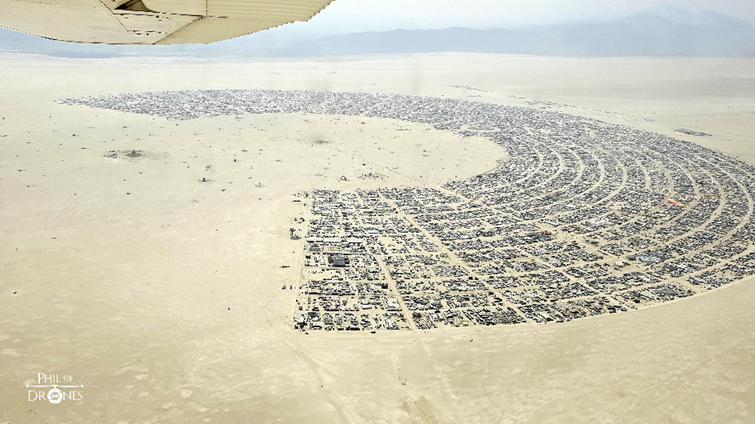
Burning Man is an annual countercultural artistic event which takes place in Black Rock City—a city erected for just a week on a prehistoric lakebed in Black Rock desert in Nevada. It is guided by ten principles, including “radical inclusion,” “participation,” and “community effort.” It is officially described as “an annual experiment in temporary community dedicated to radical self-expression and radical self-reliance” (Burning Man Project, “The Event”). Its 70,000 inhabitants or “Burners” live together for a week, creating and participating in activities, building or performing art, and watching many of its art pieces, including a giant wooden figure, “The Man,” burn to the ground.
First set against the countercultural backdrop of San Francisco, the original Burning Man event took place on Baker Beach in 1986 to mark the summer solstice, when Larry Harvey and his friend Jerry James decided to build an eight-foot-tall man and set him on fire on a beach:
One day in 1986 I called a friend and said, let’s build a man and burn him on the beach. I did this on impulse. There was really nothing on my mind. […] We built our man from scraps of wood, then called some friends and took it to the beach. We saturated it with gasoline and put a match to it, and within minutes our numbers doubled. That’s actually when Burning Man began as an institution, you know. We were so moved by that we knew we had to do it again.
If we’d done it as a private and personal thing, I’m sure we wouldn’t have repeated it. And I remember holding my son in my arms, and I looked at each fact illuminated in the firelight. They had formed a semi-circle about it, and I thought—no, I didn’t think it, but I felt it, I was so moved—We Are. They’d all come to see this gift. (Harvey 2002)
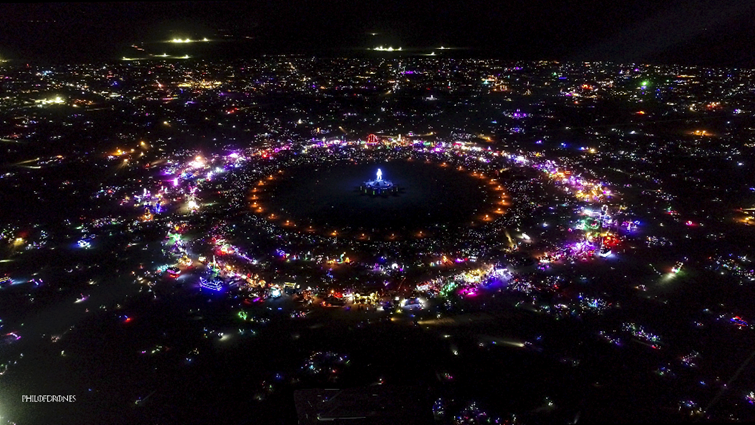
In a way, this original moment on Baker Beach has become a synecdoche of the history of the festival. The semi-circle that was formed around the bonfire on that summer night became a blueprint for the geography of Black Rock City: the city plan is formed by a series of concentric and radial streets which form an open circle around “the man.” But what Harvey’s description most strikingly highlights is that this spontaneous moment of communion between makers and spectators planted the seed of what has become the largest countercultural community on the planet. Harvey describes this seminal moment as a passage from an “I-sense” to a “we sense,” or from monads to community.
However, experiencing a moment of communion created by the consumption of art is not quite enough to create a community. Mainstream media routinely describe Burning Man as the world’s biggest, “wildest party on earth” (Vulliamy 8) and focus on the elements of hedonism and consumerism that seem to characterize it. Parallels have often been drawn with Mikhail Bakhtin’s concept of carnival, the festival only providing a temporary countercultural escape from capitalist society (Clupper and McCaffrey). Black Rock City is a carnivalesque space where “hierarchical precedence” is suspended and where people are “so to speak, reborn for new, purely human relations” (Bakhtin 10). It is also a space where eccentric behavior, dressing up, parody and laughter are encouraged, and where the rules of capitalist society are suspended—no exchange of money is tolerated during the festival (except to buy ice and coffee), and decommodification is one of its ten principles. If the rules of capitalism seem to be suspended for the duration of the event, however, for many critics the event ultimately only reinforces the system it is trying to escape. As Terry Eagleton points out, “carnival, after all, is a licensed affair in every sense, a permissible rupture of hegemony, a contained popular blow-off” (Eagleton 148). If Burning man is only a short-lived carnival, there seems to be a contradiction between the transient nature of Burning Man and its emphasis on “community,” which is more traditionally associated with stability, permanence, and strong ties.
This article will explore how community is imagined, structured, and fostered in this temporary city. It will start by giving a brief overview of the countercultural background in which Burning Man was born and look at the different communities which participated in the construction of the event. It will examine what forms of “art” are present in the city, and interrogate the role of temporary art and artistic encounters in the construction of a community. It will also focus on the roles of participatory experience and maker culture, and suggest that the building of the city by all the participants, this “making together,” is perhaps the most valuable form of art created at Burning Man—the art of living together which binds people and creates a community. It will conclude by looking at how this community-oriented event has turned into a global non-profit organization which supports over a hundred regional events worldwide, and which encourages the development of local communities through that of the “imagined community” of Burners.
The Burner Community
Before going any further, it may be useful to go over the rich history of the word “community” to understand what Burners mean when they use the term. A quick look at the list of entries of the four-volume Encyclopedia of Community: From the Village to the Virtual World gives one an idea of the immense scope of the term. Ferdinand Tonnies’s 1887 work Gemeinschaft und Gesellschaft was instrumental in defining the notions of Community and Society. Tonnies made the distinction between the idea of the traditional, small-scale, familial, rural community driven by emotions and personal ties and the modern, large-scale, contractual, individualistic urban society directed by rationality and efficiency which emerged during the industrial revolution. This definition of community as characterized by strong affective bonds influenced Max Weber and many sociologists after him. In 1978, Thomas Bender still defined community as “a network of social relations marked by mutuality and emotional bonds” (Bender 145), and indeed, emotional ties and friendships are at the heart of the way Burners envisage community.
However, the definition of community also evolved alongside new technological innovation throughout the nineteenth and twentieth centuries. The rise of mass media as well as the improvement of transport and communication networks (international commerce, railroads, telegraphs, telephones) modified our perception of community, which became understood as a feeling of shared identity which was no longer restricted by geography and the sense of place. As Benedict Anderson points out, “all communities larger than primordial villages of face-to-face contact (and perhaps even these) are imagined” (Anderson 6). He links the rise of “Imagined Communities” to that of “print capitalism, which made it possible for rapidly growing numbers of people to think about themselves, and to relate themselves to others, in profoundly new ways” (Anderson 36). In the twenty-first century, the notion of community continues to widen as the Internet and social networks grow and enable the creation of geographically dispersed online communities. As we will see, the Burner community is reinforced by its year-round online presence and activity.
However, despite the fluidity of the term, sociologists usually commonly identify at least three core components of community:
The first and most important element of community is […] consciousness of kind […], the intrinsic connection that members feel toward one another, and the collective sense of difference from others not in the community. […] The second indicator of community is the presence of shared rituals and traditions. Rituals and traditions perpetuate the community’s shared history, culture, and consciousness. […] The third marker of community is a sense of moral responsibility, which is a felt sense of duty or obligation to the community as a whole, and to its individual members. This sense of moral responsibility is what produces, in times of threat to the community, collective action. (Muniz & O’Guinn 413)
Burners often refer to their “community” and exhibit a strong sense of identity. They share multiple rituals, big and small: there is the ritual burning of the Man, the moving last burn of the week, that of the Temple, the dust angels which first-time burners make on the playa,1 the ritual attribution of playa names to new Burners… Perhaps most importantly, Burners have a very strong sense of civic engagement in their temporary city. As Kozinets points out, “Burning Man easily passes the threshold for the ‘three core components or markers of community’ laid out by Muniz and O’Guinn” (Kozinets 20).
Origins, cultures, communities
As was mentioned in the introduction, the motley group of friends who first burned “the man” on Baker Beach belonged to various subgroups of the San Francisco counterculture. The OED defines counterculture as “a radical culture, esp. amongst the young, that rejects established social values and practices; a mode of life opposed to the conventional or dominant.” The term counterculture, then, may encompass many different groups and subgroups. In The Conquest of Cool, Thomas Frank explains that the hippie movement started as a rejection of capitalism, but that its countercultural imagery was eventually recuperated by the dominant capitalist culture, or, one might say, reabsorbed by Empire. It seems that Larry Harvey observed the co-optation and commodification of countercultural values which took place in the 1960s and 1970s and saw it as a warning. The Burning Man organization is keen on avoiding being turned into a mass-marketed brand, and since 2004, “decommodification” has been one of the organization’s ten principles: “In order to preserve the spirit of gifting, our community seeks to create social environments that are unmediated by commercial sponsorships, transactions, or advertising. We stand ready to protect our culture from such exploitation. We resist the substitution of consumption for participatory experience” (Harvey, “10 Principles”).
Burning Man emerged out of the vibrant San Francisco counterculture whose vitality came from the fact that it was made up of not one, but many subcultures which rejected the excess of capitalism. In a 2006 interview, Harvey underlined the links between Burning Man and the city’s specific culture: “San Francisco has always been a place apart, and a center of eccentric and independent thinkers. And what we started here, I don’t think could have grown up anywhere else. […] You can create a social context in which culture can be created, but you can’t directly create the culture” (qtd. in Jones 16). In the 1950s, San Francisco became one of the headquarters of the Beat generation, whose attitude of non-conformism, freedom and possibility left its imprint on the city (Peters). It then became the international centre of the hippie movement:
A small psychedelic city-state was taking place, and those who inhabited it adhered to a set of laws and rhythms completely different from the nine-to-five routine that governed straight society. More than anything else the Haight was a unique state of mind, an arena of exploration and celebration. The new hipsters cast aside the syndrome of alienation and despair that saddled many of their Beat forebears. The accent shifted from solitude to communion, from the individual to the interpersonal. (Lee 72)
The hippie movement picked up on the rejection of economic materialism and of conventions developed by the Beat generation but placed more emphasis on community than them—and Burning Man clearly finds its roots in those cultures. The Burning Man founders were also famously influenced by French Situationists (Wachs ch. 1), who denounced the passivity created by the Western world’s capitalist “Society of Spectacle” (Debord). Situationists advocated direct action through performance in the urban space, strategies such as dérive and détournement, or the use of irony or parody to counter the cycle of spectacle which alienated people from their surroundings. The parodying of brands and advertising is a regular feature on the streets of Black Rock City. In the 1970s another movement arrived and left a strong subcultural imprint on San Francisco—the Punk movement. With its ethos of “mutual aid,” “not selling out,” “DIY,” and “anti-consumerism” (Beer chap. 2), the Punk movement also became well-implanted in the city with collectives such as Circus Redickuless or The Suicide Club. Members of these collectives then went on to found the Cacophony society, taking with them the Punks’ principles of “never sell out” and “DIY.” The Cacophony Society has been described as “a Bay Area network of ‘culture jammers’ and pranksters, leftovers from the posthippie, prepunk bohemia of the 70s, though with a touch of both” (Pinchback 176). In its newsletters, the Cacophony Society described itself as follows:
Meet the SF Cacophony Society, a randomly gathered network of free spirits. They are united in the pursuit of experiences beyond what they see as the pale of mainstream society. They are the Merry Pranksters of the 1990s. They travel through the social landscape, dispensing a variety of mind challenging activities to everyone. You may already be a member […]. (Evans et al. 40)
They would organize events like “sewer walks, giant salmon attacks, Santa Rampages, Zone Trips, theatre, pranks, kidnappings, and surprises of every stripe” (Evans et al. 38), as well as Poetry Breakfasts, Urban games, or, on one occasion, a distribution of cake to the homeless on Bastille Day called “Let them Eat Cake” (Evans et al. xi). Although comprising many artists, Cacophony did not think of itself as an art movement, but as a group which championed creativity and play, “with a basis in unorthodox ideas and direct engagement with the world and people in it” (Evans et al. xi). Some events were carefully planned and prepared: the Billboard Liberation Front, for instance, which playfully subverted advertising messages. Others were spontaneous when friends gathered with nothing specific in mind. Most of the Burning Man founders were members of the Cacophony society. The overlap with Burning Man philosophy here is clear: at the core of the event is this mix of spontaneity and careful preparation aimed at playfully engaging people with their surroundings and at making them fully present.
This brief overview of the San Francisco countercultural scene shows that the founders were well-versed in the art of community-making. However, what is interesting about the Burner community is that it does not only stem from this countercultural scene. Burning Man’s ethos is also rooted in American Libertarianism and individualism, which also attracts different subgroups. One of the sentences one hears a lot on the playa is “you do you,” and the diversity of the cultures in Black Rock City is quite striking: the culture of pranks and Cacophony coexists with camps of new-age spirituality, Christian, Jewish or Muslim camps, steampunk camps, even camps with elaborate high-tech art projects built by engineers working in Silicon Valley. It also attracts quite a few back-to-the-landers and preppers, as well as many inhabitants of Gerlach (the closest town to Black Rock City), for whom attendance is free to encourage harmonious links with the local community.
These politically and ideologically diverse cultures all identify themselves as members of the same community of Burners: the next section of this article will explore why this should be the case.
From communities to the Burner community
For Larry Harvey, communities can only form around what genuinely comes from within individuals:
This process begins with radical self-expression: the feeling that your inmost vital self is real and that you can project a vision of this sense of your own being onto the surrounding world. I mean all these ads say be all that you can be, buy this car and you’ll be free, but they’re just substitutes. You’re not going to be unless you can project a spiritual reality out onto the world. But most people just don’t have the confidence anymore because they’re too isolated; they’re too passive. So it starts with this, and I’ll call it “I Am.” And it proceeds, as in a theme camp, to a feeling that you are united with others, that you are linked in a bonded circle and that together you can share the same experience through an act of giving, because the value of a gift is in its flow—not as you consume it, but as it consumes. And I’ll call this, “We Are.” Finally there is the feeling that somewhere outside this circle there exists some greater gift that everyone is joined together by as they give to it, and I’ll call this “It Is.” And I have come to believe that whenever these feeling states can be strung together like pearls on a string, as if they were parts of one spontaneous gesture, you will then generate an ethos, a culture, that leads, in Jefferie’s words, to a “boundless shower of good things forever descending”. […] I’ve spoken of an I am, a We are, and an It is. But if you look at all previous ages of human culture, the order of this continuum was different. It started with It is, with gods and myths of supernatural origin, progressed in long-sustained traditions among people who struggled to survive in a challenging world, We are, and it ended somewhat tenuously with the experience of the individual. Today this sequence works and must work in reverse. It must necessarily begin with I am, at the level, radically fathomed, of each individual’s experience. (Harvey, “Viva Las Xmas”)
Harvey’s speech combines American individualist and libertarian values with a countercultural discourse going against the excesses of capitalism, which has led to isolating forms of individualism. Used rightly, individualism should lead people to building more resilient, better communities. He also underlines that this countercultural dream, like all countercultures, breaks new ground, stating that the Burner movement reverses the traditional order of things: instead of having institutions create and organise communities, and ascribe roles to individuals, individuals create the communities that suit them, which creates a more harmonious culture. This discourse favouring a bottom-up approach to community building over a top-down one is at the heart of many community-building endeavours, and is not specific to Burning Man. However, what is perhaps more specific to the Burner culture is the emphasis on “making” and “creating” as the cement of the community.
Artists and artisans: Burning Man as “do-ocracy” and “scenius”
Black Rock City extends over seven square miles on the Black Rock Playa, one of the largest, flattest surfaces on Earth. The playa has often been compared to a blank canvas on which Burners can create any artwork, monument, or community they have dreamt up. The official website states that “the playa is a tabula rasa, a blank canvas upon which many a fantastic vision has been realized. All participants are welcome to create—or be—art at Burning Man” (Burning Man Project, “Art and Performance”). Unlike many other festivals where people may receive the prescribed entertainment, the organizers do not decide who they should invite, the participants imagine and build the city and everything that happens in it. The organization stresses that “the people who make up Black Rock City are not simply ‘attendees,’ but rather active participants in every sense of the word: they create the city, the interaction, the art, the performance and ultimately the experience that is Burning Man. […] the only limits (other than basic public safety) are the bounds of your imagination” (Burning Man Project, “Art and Performance”). “Participation” is one of its ten principles, and participants are given all the scope they could wish for to execute their vision. Artists can apply for art grants from the Black Rock City Honoraria Program for big-scale art works, but the great majority of the art and theme camps that make up the city are imagined, funded and built by the Burners themselves, who may spend between several months and several years planning, fundraising, and working on their vision.
Benjamin Wachs, a long-time writer of the Burning Man Journal better known as Caveat Magister, is a member of Burning Man’s Project’s Philosophical Center and the author of a book on “what Burning Man philosophy can teach us about building better communities.” He explains that when people have an opportunity to be themselves, communities will naturally form around their passions and centers of interest:
When [people] are in an environment where they can actually choose what kind of communities to belong to and how they work, they give a lot of thought to the kinds of cultural spaces they want to create. […] Burning Man ends up being the “permission engine” people need to create the kinds of communities they want to live in, whether in Burning Man or (even better) outside of it. And so when “Burning Man” spaces get large enough, they are not singular cultural entities or one community, but a stunningly diverse and inspiringly bizarre assemblage of many different communities and cultures living next to one another, giving gifts to one another, welcoming strangers. (ch. 19)
What emerges most clearly in Burners’ discourse is that people’s sense of creative agency is paramount in making them truly feel part of the community. Burning Man is designed to empower people and to give them a maximum amount of agency over the gifts, art projects, and communities they create. And communities of interest, or theme camps, form around the most varied passions: story-telling (“1001 Nights”), healing (“Pachamama Burning Man”), board games (“Playasophy”), French Cabaret, bread-making (“Lovin’ Oven”), food (“Midnight Poutine”2), drinking (“7 Deadly Gins”), massage (“HeeBeeGeeBee Healers”), black humour (“Barbie Death Village”, “Bureau of Needless Bureaucracy”), academic interest (“Burning Nerds”), circus arts, bluegrass, electronic dance music, yoga, bike repair services, sex, perfume-making, Joyce’s Finnegans Wake, welding, costumes, fire-breathing, dragon-shaped art cars, dancing, flattery, fresh fruit distribution, drone-based art-projects, hugs, tattoos, saunas, tea, jewellery, spas, film, children’s playgrounds, arts and craft, fortune-telling…
New communities are brought to Black Rock City every year with new participants. Only being a spectator is actively discouraged, as the words “no spectating,” written outside the press center, remind Burners. People who come to Burning Man as passive consumers of experiences, and who express little sense of commitment to the community are jokingly known as “Yahoos” after Jonathan’s Swift’s description of these “brute[s] in human form” in Gulliver’s Travels.3 Burners can either join communities they find inspiring and help build them, or create their own. On a small scale, people are brought together to live and work together for a week in a theme camp of their choice that will often have year-round activities to plan for (or build) their “gift” to the city. On a larger scale, Burners’ sense of community is fostered by this “making” and “gifting” culture. Theme camps are the bare bones, the skeleton of the festival. People get together to survive together in a hostile environment and to build the thing they have imagined. This “making together” is perhaps the most valuable form of art created at Burning Man—the art of living together which creates a community. In a video produced by the Burning Man Project entitled “Social Creativity: MacGyvering Community in the Desert: Burning Man,” the producers interviewed Burners about the reason why they come to Burning Man, and most Burners agree that they keep returning for the theme camps, and the community they find there: “To me, theme camps really bring this whole city together, they are the communities that everyone gets to stop to, they bring interaction, and they bring a lot of culture, whether it’s a theme camp that does massages, or yoga, or martinis or loud music” (“Social Creativity” 1’42). “Theme camps are the society out here, the art is the entertainment, so this is the foundation” (“Social Creativity” 2’13).
We don’t want tourists, we want to take the Burning Man principles, we want people to participate, and everybody in the camp gets to have that experience of being part of the gift culture, and everybody in this camp gets to make somebody else participate. We’re all artists, okay? Artists aren’t just two people with paintbrushes, artists may be the person with the wrench, artists may be the person who knows how to tell a joke on a runway, artists may be the ones who designed the frontage or come up with the theme, and we do this all year. (“Social Creativity” 4’12)
As can be seen in the example above, Burners often conflate the word “artist” with the word “participant”. In a way, burners do not see themselves as artists so much as artisans or craftspeople. The structure of theme-camps is reminiscent of the way artists organized themselves in the Middle Ages. Their power was not based on their individual capacities, but rather, on their willingness to join together and act as a collective, either within the structure of a workshop or within that of a guild. As individuals, craftsmen had little power, but as a group they had astounding powers. Theme camps are very similarly structured: it is easier to organize collectively for food, water, shelter, and first-aid to survive one week in a harsh desert environment. Similarly, it is easier to build a giant wooden phoenix or organize pancake distribution, pantomime shows, jewellery-making, bad pun declamations, or concerts and light shows with a team of people with various skills focusing on different tasks.
In his chapter entitled “Action Is the Basic Unit of Meaning,” Wachs describes Burning Man as a “Do-ocracy”; further on, he says that “Burning Man is not a noun, it’s a verb, because really all culture is a set of verbs; so we do not get to stop; we keep going, improving, making things better, recognizing there will be imperfections and trade-offs and still working, with no end point in sight or mind, to practice being the people and communities we want to be” (ch. 42).
Moreover, the Burning Man community is particularly resilient because the city, along with all its communities, has to be rebuilt from scratch every year, which leaves a lot of room for experimentation and improvement. This idea of constant trying is also important to Wachs:
Burning Man is a very early prototype […] demonstrating that better forms of organization, better kinds of communities, are possible. It works as well as it does largely because it has abandoned the notion of utopia and has instead focused on other aspects of the human experience. Not “how do we make life fair and perfect?” but “how do we give people opportunities to be authentic, and connected, and expressive (among other things)?” (ch. 1)
At Burning Man, communities of artists and artisans will form organically around individual passions and activities practiced for their own sake. These week-long communities often solidify into year-round communities as Burners meet, have parties, fundraise, and spend time together as friends planning their vision. This year-round “making together,” “trying together”—and failing together, sometimes—is the foundation of the Burner ethos: it teaches Burners the art of living together and fosters a permanent sense of community which far outlives the week-long festival.
Seen in this context, Burning Man seems to embody what Brian Eno has described as “scenius,” or “communal genius” (Kelly). According to Eno, the West has tended to idealise a few individuals or “geniuses” such as Mozart, Darwin or Einstein. However, looking at any of their lives, these individuals seem to have been drawing on a huge network of ideas coming from other people—or “scenius.” In Eno’s words, “scenius stands for the intelligence and the intuition of a whole cultural scene. It is the communal form of the concept of the genius. Individuals immersed in a productive scenius will blossom and produce their best work. When buoyed by scenius, you act like genius” (qtd. in Kelly). According to Eno, the history of art and science is replete with episodes of scenius. The participatory / artisan / artistic culture of Burning Man constitutes such scenius, and expands our traditional definition of community: such community, or scenius, is nurtured by several factors: “mutual appreciation… rapid exchange of tools and techniques… network effects of success… local tolerance for novelties” (Kelly), all of which are integral parts of the Burner ethos.
Building Black Rock City, “One of the most public-spirited places on Earth”
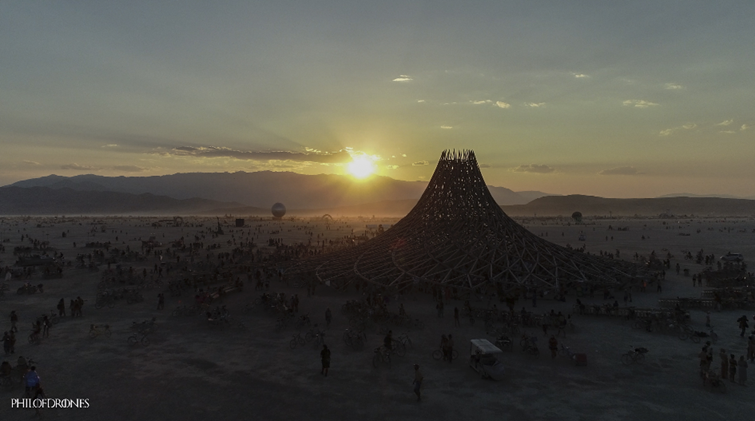
Burning Man carries this process of collective experimenting, failing, learning and improving in its principal activity: the building of Black Rock City. If Burners create the content of the festival, the Burning Man organization creates the container for the execution of Burners’ projects. Creating both the cultural and physical container for those ideas necessitates thousands of volunteers who offer their skills and talents to make sure the operations run smoothly. In his 2002 speech, Larry Harvey said:
Black Rock City is one of the most public-spirited places on Earth. We have, for instance, an incredible rate of volunteerism. We did a poll on the Internet recently. It was a 10% sampling, so it’s pretty indicative, and the results were even more astonishing than we anticipated: 84.7% of our citizens contribute some form of volunteer service to our city. (“Viva Las Xmas”)
Burning Man now has 200 year-round employees and about 800 seasonal employees, but over 10,000 volunteers doing every conceivable kind of task before, during and after the festival. They can volunteer as Greeters, Earth Guardians, Lamplighters, Temple Guardians, Black Rock Rangers, barista, or to work at the San Francisco office, at Arctica (the Ice Sales camps), the Box Office, the Playa Info Services, the Recycle Camp, at the BRC radio station, as part of the Census team or the Cleanup and Restoration team, to name but a few.
Founding member Michael Mikel insists on the fact that Burning Man’s culture and infrastructure as it exists now did not exist at the start, and have been built and slowly improved over the years: “That’s one thing about Burning Man: we learn in the process of creating and releasing in the desert. We learn from our mistakes and make changes and adjustments. I think the Burning Man philosophy embraces that concept of evolving over time” (qtd. in Wachs ch. 24). He has also pointed out that the experience of learning together is more valuable to the community than that of creating an efficient, business-like organization: “by accepting some inefficiency and ineffectiveness, organizers avoided creating a bureaucracy that overlooked members’ interest” (Chen 53). For many Burners, there is something compelling about having direct input, and having the chance to improve the structure and the culture of the city every year, and that sense of agency over the structure and culture of the city reinforces the sense of community. Wachs has observed that “one of the key reasons why Burning Man’s culture was so widely accepted and internalized by the people participating is that it was still changing, still in flux, so if they engaged in it, it would belong to them” (ch. 24).
Burners also often spontaneously volunteer for Black Rock City as a civic entity on top of their theme camp duties because the culture fosters that public spirit. For Harvey, what naturally encourages so many Burners to volunteer is the gift-giving culture, which produces the “social capital” that has disintegrated in capitalist societies: “social capital represents the sum of human connection that holds a society together, and it is fostered by networks of personal relationship. It is social capital that a culture is made of” (“Viva Las Xmas”). Later in the same speech, he quotes Lewis Hyde’s The Gift: “When gifts circulate within a group, their commerce leaves a series of interconnected relationships in its wake, and a kind of decentralized cohesiveness emerges” (Hyde xvii). The whole fabric of Black Rock City is a vast web of sharing, giving and gifting: people freely share food and water, art, performances, and public service roles:
That city is created out of gifts, and we’ve actually created much of our civic infrastructure out of gifts. We have people who volunteer to greet every person who comes into our city. The policing of the environment, the work of the Black Rock Rangers, is done by volunteers. The lighting of the lamps that illuminate Black Rock City, another public utility: that’s a gift that is donated to our city. (“Viva Las Xmas”)
The gifting economy fosters Black Rock City’s sense of community, and volunteering comes naturally to people who are invested in their communities. Burners are also deeply involved in their community’s cultural and physical infrastructure because they actively participate in its construction and have a chance to improve on this collective vision every year as they rebuild the city from the ground up. In that sense, during the week of the festival, the literal, physical “city” constitutes community, but as we will see, the Burner community exists and extends far beyond the spatial and temporal boundaries of the festival.
“The 10 Principles”
It may then seem somewhat strange for this grassroots community-led event to have ten principles which, on the surface, are strikingly reminiscent of the Ten Commandments, God’s top-down injunctions to Moses. It seems quite unlike Burning Man to have rules at all. However, the mounting success of the event rendered them necessary after a few years. Burners became so passionate about the Burn that they started wanting to create their own regional events. For a long time, Burning Man did not find it necessary to define itself at all. The ten principles emerged in 2004 as a response to a question by enthusiastic members of the community rather than a mission. Larry Harvey wrote them down after observing what was working well within the Burner community to help Burners to create local events in different parts of the world. The full list is: Radical Inclusion, Gifting, Decommodification, Radical Self-Reliance, Radical Self-expression, Communal Effort, Civic Responsibility, Leaving No Trace, Participation, and Immediacy. Each principle is assorted with one or two brief explanatory sentences. To illustrate what Communal Effort is, Harvey writes: “Our community values creative cooperation and collaboration. We strive to produce, promote and protect social networks, public spaces, works of art, and methods of communication that support such interaction” (“The 10 Principles”). The whole text is under 400 words, and the sentences are descriptive, rather than prescriptive. In that sense, the Principles really are more bottom-up guidelines than top-down rules imposed by the Burning Man Organization. For Wachs, one of the reasons why they are descriptive is to make Burners engage with them: “in order to really address Burning Man culture, to really participate in it, you have to interpret the 10 Principles for yourself. Not just through beliefs but through your actions—and thereby co-create the culture you’re joining” (ch. 1). The Burning Man culture belongs to those who participate in it, and the 10 Principles are there to help Burners—and non-Burners—to create their own community.
Local communities, Regional Burns and Burners without Borders
In his 2002 study of Burning Man, Kozinets coined the term “‘hypercommunity’ to distinguish these from other communal phenomena of a well-organized, short-lived but caring and sharing community whose explicit attraction to participants is its promise of an intense but temporary community experience” (Kozinets 35). The term “hypercommunity” does apply to the community of Burners that lives in Black Rock City for a week. However, as stated before, many Burners form year-round communities where they live to work on a project together, imagine a local Burning Man event, or join a non-related association in their own community. This temporary “hypercommunity” fosters Burners’ desire to join or create permanent local communities in their hometowns, be they Burner-related or not.
The 2018 Black Rock City Census indicates that experiencing Burning Man inspired volunteerism in more than 50% of the participants after the event (Burning Man Project, “BRC Census”). The Census has detailed questions about the kind of volunteerism people go on to offer in their lives: self-initiated good deeds, community groups/clubs, arts projects, animals/environment, Black Rock City schools/universities, Burning Man Regional Network, political campaigns/voter registration, or Burners without Borders. The organization is clearly interested in encouraging people to engage with their local communities, be they related to Burning Man or not.
Moreover, the Burner culture is spreading rapidly: there are now hundreds of Regional Burns around the world. “Afrikaburn” in South Africa has over 12,000 participants every year. The “Midburn” in Israel is growing fast, and there is even a small French one, called “crème brûlée.” The spread of the culture and its connectedness has no doubt been accelerated by the online presence of the Burner community. “The Burning Man Regional Network” is a part of the organization which helps foster those local Burner communities. Its website describes it as “the year-round embodiment of the Burning Man experience, supporting it as a global cultural movement. In cities around the world, the Burning Man Project has established Regional Contacts whose role is to help local Burners connect with each other, while bringing Burning Man principles and culture into their local communities.”4 The future growth of Burning Man seems to lie in those multiple local events, as there is a limit on how much the Nevada desert ecosystem can bear, and as this is in line with the organization’s greening efforts.
Another particularly active group is Burners without Borders (BWB), a community-led group which helps disaster relief efforts in local communities around the globe:
[It] is a grassroots, volunteer-driven, community leadership organization whose goal is to unlock the creativity of local communities to solve problems that bring about meaningful change. Supporting volunteers from around the world in innovative disaster relief solutions & community resiliency projects, BWB is known for the unbridled creativity they bring to every civic project they do. (BWB website)
The BWB movement started in 2005: when word made its way that a category five hurricane had hit New Orleans and the Mississippi region on August 29, several Burners spontaneously headed south after the burn to help rebuild the structures and communities which had been devastated after Hurricane Katrina. They contacted the organization to find other Burners in the area and built a camp where they implemented the ten principles to bring disaster relief: they first focused their efforts on rebuilding a Vietnamese temple in Biloxi, Mississippi. “After several months, that job done, they moved to another needy Mississippi community, Pearlington, to continue to work hard—gifting their time—to help those in need. Over the course of eight months, BWB volunteers gifted over one million dollars’ worth of reconstruction and debris removal to the residents of Mississippi” (BWB website). BWB also participated in the disaster relief efforts after the 2007 Peru earthquake and the 2011 Fukushima disaster, Hurricane Sandy in 2012, the 2015 California wildfires, and Hurricane Maria which devastated Puerto Rico in 2017, to name but a few. They were also particularly quick to respond in the early days of the Covid-19 pandemic, supporting the collection and distribution of personal protective equipment in different locations when they were in short supply.
BWB also focuses on bringing community resiliency projects to those in need. For instance, after raising and distributing money to local community leaders to help the disaster relief efforts in Puerto Rico, Puerto-Rican artist and Burner El NiNo decided to rebuild an artwork he had built on the Playa for his home community. He built the giant owl MÚCARO (a sacred Puerto Rican screech owl) to honor his country of origin as well as his teachers and educators. Rebuilding the owl in Puerto Rico is an educational tool “to draw together local artists, teachers, youth and other community members, giving them the opportunity to learn creative and collaborative thinking. […] El NiNo hopes to develop a volunteer system to maintain the upkeep of the pavilion and further encourage a sense of ownership and pride in the piece” (Alesbury).
BWB, this grassroots, community-led movement grew over the years and became a non-profit NGO and part of the Burning Man Project in 2015. As can be seen from these few examples, Burning Man is not only a week-long “hypercommunity,” but a network of increasingly connected, action-oriented communities which often also try to invest in their local communities.
Conclusion
The Burning Man community seems to be particularly resilient for several reasons: it has its roots in American libertarianism and individualism as well as in many experimental countercultural movements which had—and still have—worldwide appeal, be it that of the Beats, the Hippies, or the punks. From the start, the Burning Man ethos was action-oriented and community-oriented, and the focus on “making together” is precisely why it has been growing in popularity. Another particular feature of the Burner community is its supportive, innovative and participatory framework which makes it an example of scenius, an inclusive space which provides fertile ground for creativity in all sorts of areas. Another key aspect of the festival is that all the citizens of Black Rock City have an opportunity to contribute to improving the city they build from scratch every year, meaning that the building of the city itself provides a powerful experience in community-building. This “making together” is what binds people together and creates this “hypercommunity” which comes together for a week every year. However, this “making together” also fosters the creation of more permanent, year-round communities which are disseminated around the world: so much so, that there are now hundreds of regional burns or Burner associations all around the globe. The Burning Man culture’s rapid growth has also been greatly aided by the rise of the internet, which has made the “imagined community” of Burners one of worldwide appeal. However, it seems that Burning Man’s future will come from the growth and multiplication of those smaller, well-connected, networked and distributed communities around the world. Interestingly, this brings us full circle and back to Ferdinand Tonnies’s 1887 definition of harmonious, small-scale, familial, local communities driven by emotions and personal ties, the difference being that these twenty-first-century Burner communities are a networked mesh of communities connected through multiple ties, technology and a uniquely adaptable culture.
Notes
- 1The Spanish word for beach, also used to describe dry lake beds in the American west such as the Black Rock Desert, which has consequently become an endearing nickname for the site.
- 2Poutine is a traditional Québecois comfort food made from french fries and cheese curds often eaten after a night of drinking.
- 3Part IV, chapter II.
- 4https://regionals.burningman.org/
Works Cited
- Alesbury, Lucy. “Sacred Owl to Rise from Puerto Rico’s Rubble.” Burning Man Journal, 6 February 2019, journal.burningman.org/2019/02/burning-man-arts/global-art/sacred-owl-to-rise-from-puerto-ricos-rubble/. Accessed 6 Jan. 2020.
- Anon., The San Francisco Cacophony Society Archives, www.zpub.com/caco/caco1.html. Accessed 15 Dec. 2019.
- Anderson, Benedict. Imagined Communities.Reflections on the Origin and Spread of Nationalism. 1983. Rev. ed., Verso, 2006.
- Bakhtin, Mikhail. Rabelais and His World. Translated by Helene Iswolsky, Indiana UP, 1984.
- Beer, David. Punk Sociology. Palgrave Pivot, 2014.
- Bender, Thomas. Community and Social Change in America. Rutgers UP, 1978.
- Burners without Borders. www.burnerswithoutborders.org/mission. Accessed 5 Jan. 2020.
- Burning Man Project. “Art and Performance.” burningman.org/event/art-performance/. Accessed 5 January 2020.
- Burning Man Project. “BRC Census Population Analysis, 2013-2019.” brccensus.2018.popanalysis.s3-website-us-west-1.amazonaws.com/index.html. Accessed 5 Jan. 2020.
- Burning Man Project. “Social Creativity: MacGyvering Community in the Desert: Burning Man.” 7 May 2017, www.youtube.com/watch?v=XKkc1LMFAT8. Accessed 5 Jan. 2020.
- Burning Man Project. “The Burning Man Regional Network.” regionals.burningman.org/. Accessed 5 Jan. 2020.
- Burning Man Project. “The Event”. burningman.org/event/preparation/faq/. Accessed 5 Jan. 2020.
- Chen, Katherine K. Enabling Creative Chaos: The Organization Behind the Burning Man Event. University of Chicago Press, 2009.
- Christensen, Karen and David Levinson. Encyclopedia of Community: From the Village to the Virtual World. Sage Publications, 2003. 4 vols.
- Clupper, Wendy Ann. The Performance Culture of Burning Man. 2007. University of Maryland, PhD dissertation. drum.lib.umd.edu/bitstream/handle/1903/7405/umi-umd-4825.pdf;jsessionid=A9A06742C8CACB625B16CFC313DBDF93?sequence=1. Accessed 5 Jan. 2020.
- Eagleton, Terry. Walter Benjamin or Towards a Revolutionary Criticism. NLB/Verso Editions, 1981.
- Evans, Kevin, et al., editors. Tales of the San Francisco Cacophony Society. Last Gasp Publishing, 2013.
- Frank, Thomas. The Conquest of Cool: Business Culture, Counterculture and the Rise of Hip Consumerism. University of Chicago Press, 1998.
- Goffman, Ken and Dan Joy. Counterculture Through the Ages: From Abraham to Acid House. Villard Books, 2004.
- Harvey, Larry. “The 10 Principles of Burning Man.” 2004. burningman.org/culture/philosophical-center/10-principles/. Accessed 5 Jan. 2020.
- Harvey, Larry. “Viva Las Xmas, 2002”. Speech at the Cooper Union in New York City, April 25, 2002. burningman.org/culture/philosophical-center/founders-voices/larry-harvey/viva/. Accessed 5 Jan. 2020.
- Hyde, Lewis. The Gift: How the Creative Spirit Transforms the World. 1979. Random House, 2007.
- Jones, Steven T. “Epilogue as prologue: Has Burning Man finally returned from the desert? And can San Francisco help share it with the world?” SF Bay Guardian, Oct. 4, 2005.
- Kelly, Kevin. “Scenius, or Communal Genius.” kk.org/thetechnium/scenius-or-comm/. Accessed 27 Feb. 2022.
- Kozinets, Robert. “Can Consumers Escape the Market? Emancipatory Illuminations from Burning Man.” Journal of Consumer Research, vol. 29, no. 1, 2002, pp. 6-33.
- Lee, Martin and Bruce Schlain. Acid Dreams: The CIA, LSD and the Sixties Rebellion. Grove Press, 1985.
- McCaffrey, Jessica. Burning Man: Transformation Community through Countercultural Ritual Process.,2012. Centre for Sensory Studies, Concordia Univeersity. Master’s dissertation. centreforsensorystudies.org/burning-man-transforming-community-through-countercultural-ritual-process/. Accessed 5 Jan. 2020.
- Muniz, Albert, Jr. and Thomas C. O’Guinn. “Brand Community.” Journal of Consumer Research, vol. 27, no. 4, 2001, pp. 412-432.
- Peters, Nancy. “The Beat Generation and San Francisco’s Culture of Dissent.” Reclaiming San Francisco: History, Politics, Culture, edited by Chris Carlsson, City Lights Books, 1997, pp. 199-217.
- Pinchback, Daniel. “Heat of the Moment: the art and culture of Burning Man.” Art Forum International, vol. 42, no. 3, 2003, pp. 174-179.
- Vulliamy, Ed. “Anarchy Rules at Wildest Party on Earth: Ed Vulliamy in Black Rock Desert, Nevada, Joins the Pyro-Fetishists, Cybergeeks and Guy Just nuts about Guns at the Burning Man Festival.” The Observer, Sept. 6, 1998, p. 8.
- Wachs, Benjamin. The Scene that Became Cities: What Burning Man Philosophy Can Teach Us about Building Better Communities. E-book, North Atlantic Books, 2019.
About the author(s)
Biographie : Estelle Murail est maître de conférences en littératures et cultures anglophones à l’Institut Catholique de Paris (EA 7403), et chercheuse associée à l’Université de Paris (LARCA, CNRS, UMR 8225). Elle a obtenu un doctorat en co-tutelle de l’Université Paris Diderot et de King’s College London en 2013. Sa thèse examine la figure du flâneur à Paris et à Londres au dix-neuvième siècle. Elle a publié plusieurs articles sur la marche urbaine et la ville, et a coédité l’ouvrage Dickens and the Virtual City (Palgrave, 2017). Ses recherches actuelles portent sur le roman du dix-neuvième siècle et ses réécritures, la ville, les croisements, les réseaux, et la notion de persistance.
Biography: Dr. Estelle Murail a Senior Lecturer in English Literature and Culture at the Catholic University of Paris (EA 7403) and an associate researcher and lecturer at the University of Paris (LARCA, CNRS, UMR 8225). She obtained a jointly supervised PhD in English Literature from the University of Paris and King’s College London in 2013. Her thesis examined the figure of the urban stroller in London and Paris in the nineteenth century. She has published several articles on the flaneur and cities, and co-edited a book entitled Dickens and the Virtual City (Palgrave, 2017). Her current research focuses on the nineteenth-century novel, urban spaces, crossings and networks, and the notion of persistence.