The Corrupt (Re)generation of the Californian Desert in The Octopus by Frank Norris.
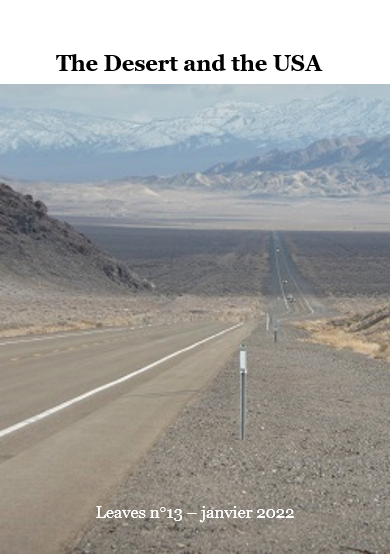
Abstract: Critics have often explored The Octopus as a muckraking novel which exposed the hypocrisy and greed of American society at the turn of the twentieth century. While it does pit the ranchers against the railroad company as a political backdrop, the novel mainly investigates the power of nature to renew itself, as an alternative motif that allows for regeneration. The desert in which the story unfolds provides a tabula rasa, but also alludes to the instability of nature which follows its own whims. Throughout the novel, the Californian space is ambiguously depicted both as a barren land and as a promising desert thanks to its irrepressible wheat crops compared to a womb. This former desert only offers a tainted regeneration. The breaks and breaches in the desert partake in the ambiguous comment on corruption as they allow it to seep into the ranches and precipitate their own downfall; but these breaks are also lines of flight in the midst of a deterministic structure and repetitive formulations which seem to entrap the characters. The instability and geological fault on which this corrupted desert lies also opens up the genealogical fault that disrupts the ranchers’ lineage as they are directly affected by the contaminating effect of the corruption which befalls them. These geological and genealogical faults which permeate the Californian desert allude to language’s own failure at keeping control over the characters’ fates. By exploring these faults, the novel’s language also participates in the creative renewal of nature and writing.
Keywords: Norris, Corruption, Regeneration, Desert, Space, Fault
Résumé : Les critiques ont beaucoup considéré et exploré La Pieuvre comme un roman de muckraker, qui levait le voile sur l’hypocrisie et l’avarice de la société américaine au tournant du vingtième siècle. Si le roman met en scène le conflit entre la population habitant les ranches et l’entreprise de chemins de fer comme toile de fond politique, il examine avant tout le pouvoir de régénération de la nature, qui s’impose alors comme thème alternatif à la lecture socio-économique du roman. L’espace du désert du roman propose une tabula rasa mais fait également allusion à l’instabilité de la nature qui suit ses propres envies. Tout au long du roman, l’espace californien est représenté avec ambiguïté, tantôt comme une terre infertile ou comme un désert plein de promesses grâce à la culture du blé qui est comparée à une gestation. Cet espace, un désert originel, ne permet qu’une régénération corrompue. Les ruptures et brèches du désert alimentent l’ambiguïté de la corruption ; tandis qu’elles permettent à cette dernière de s’immiscer dans les ranches et de provoquer l’éclatement des familles, elles sont aussi des lignes de fuite au milieu d’une structure déterministe et de formules répétitives qui semblent enfermer les personnages. En effet, l’instabilité et la faille géologique sur lesquelles repose ce désert corrompu participent à l’éruption d’une faille généalogique, tandis que les enfants se retrouvent directement affectés par l’effet contaminant de la corruption. Ces ruptures et brèches géologiques et généalogiques du désert californien renvoient ainsi aux failles d’un langage qui ne peut tout contrôler, mais qui, en explorant ces lignes de fuite, participe à la fonction et création régénératrice de la nature et de l’écriture.
Mots-clés : Norris, Corruption, Régénération, Désert, Espace, Faille
Frank Norris’s naturalistic themes have often monopolized critics’ attention at the expense of other approaches which resist incorporation into the pattern of the purely naturalistic meanings traditionally associated with his work. Despite the many stylistic flaws, Norris’s last two novels, which are part of a trilogy which will never be whole, are also his most accomplished. Far from being only a muckraking novel aiming to expose the capitalistic greed of political institutions, The Octopus relies on hybrid strategies and techniques which show that its main concern is the vulnerability of the self. In fact, the Darwinistic and evolutionary theism1 which permeates the novel’s writing not only serves as a backdrop epitomizing the concerns of the turn of the century but also helps ridicule the characters’ attempt at gaining and keeping control over their lives. In his book The Novels of Frank Norris, Donald Pizer considers that “[The Octopus] is more a novel about man’s relationship to nature than a story of man as a social being” (Novels 121). Because it entails human intervention but also relies on natural elements, Norris’s romanticized wheat is this “hybrid entity... that is neither nature nor culture” (Dolan 295). The desert in which the story unfolds and in which wheat is planted epitomizes man’s doomed attempts at dominating the environment.
The narrative at the core of The Octopus by Frank Norris revolves around the economic troubles of wheat ranchers in California. Throughout the novel, the Californian space is depicted as a flat and rotten landscape, yet promising desert full of regenerative possibilities. Norris’s works are representative of the industrialization of agriculture and its evolution at the turn of the twentieth century when working the land no longer is a concrete experience and a close bond with earth, but a business activity that may help make fortunes: “[The ranchers] want land–which they work with tenants and hired men–for their own speculative purposes to secure their ‘fortunes’” (211, and see Conlogue 44).
Norris’s novel offers a multi-faceted portrayal of the American desert whose polymorphism hinges upon his merging the contradictory mythopoetic images associated with the Californian desert.
The etymology of the term “desert” summons up the barren and abandoned state of a land devoid of human presence. In his study Wilderness and the American Mind, Roderick Frazier Nash draws attention to the closeness of the terms “desert” and “wilderness” which harks back to the fourteenth-century biblical reads:
[John Wycliffe] used wilderness to designate the uninhabited, arid land of the Near East in which so much of the action of the Testaments occurred... Through this Biblical usage the concept of a treeless wasteland became so closely associated with wilderness that Samuel Johnson defined it in 1755 in his Dictionary of the English Language as “a desert; a track of solitude and savageness.” Johnson’s definition remained standard for many years in America as well as in England. (2-3)
Considered as the expression of a perfect void or “vide parfait” (Baudrillard 68), the Californian desert is used as mythical projection, a form of tabula rasa for a people bereft of origins. The particularly flat and homogeneous aspect that Norris bestows on the desert is contrasted with the rising wheat that springs forth and also puts forward the regenerative power of the desert.
This article aims at bringing out the narrative and stylistic strategies put in place to portray California as a former barren space that allows for a tainted (re)generation. I would like to focus on Norris’s The Octopus, and offer a reading that puts forward a reflection on language and the creative power of fakery and corruption.
Catching the Californian myth: a literary quest doomed to failure
The difficulties the wheat ranchers come across are mainly seen through the internal focalization of the poet Presley, who is believed by many critics to be Norris’s alter ego. Presley’s literary failure to write the “Epic of the West” by the end of the novel underscores the fruitless promises of the West, but also alludes to the author’s own desire to write his epic trilogy of the West: “I think a big Epic trilogy could be made out of such a subject, that at the same time would be modern and distinctly American” (Starr viii).
Yet, instead of dwelling on the Californian past and what it represented for all, Presley attempts to put in writing his own experience of the West, “his West”:
It was his West that passed, unrolling there before the eye of his mind: the open, heat-scourged round of desert; the mesa, like a vast altar, shimmering purple in the royal sunset; the still, gigantic mountains, heaving into the sky from out the canyons; the strenuous, fierce life of isolated towns, lost and forgotten, down there, far off, below the horizon. Abruptly his great poem, his Song of the West, leaped up again in his imagination. (16)
Picturing the Californian space, Presley struggles to put into words the mythical power that he feels lies in these landscapes. “The desert, the mountains, all wild, primordial, untamed” (16) that he sees in his mind’s eye can only linger there, in his imagination. Presley’s attempt at capturing the essence of the desert is bound to fail as he realizes the limits of language to grasp the reality in front of him. It also highlights the very impossibility to “tame,” to try to claim ownership of the desert through words. This also underscores Presley’s own limitations as a character.
Similarly, if the talks between the ranchers and the red tape add a varnished touch to this American society of the frontier, the events often uncloak the underlying blood and thunder at the core, which often escalates during dances or confrontations that spiral out of control. If the deterministic structure of the novel hinges upon the echoes and parallels between the behemoths and the ranchers, nature also plays an important role. By running its course no matter what, it emphasizes man’s foolish attempts at trying to manipulate it and, in a broader sense, to establish philosophical or scientific certainty.
With the transformation of the Californian desert into wheat fields, the land is no longer to be seized and no longer represents a frontier to cross. According to Mogen et al.:
The concept of the “frontier”... is not merely a physical line defined by Bureau of the Census population-density data in different historical eras. Rather, it consists as well of a group of images, ideas, and expectations that came into focus during the European Renaissance and found its most dramatic expression in the development of American civilization. It begins with a sense of wonder at the infinite possibilities in the expanding world of the Renaissance explorers, for the frontier as the margin of the known opened the possibility of wonders in the unknown. The frontier as the limit of the settled and developed offered the possibility of new land, new resources, seemingly inexhaustible, yet to be gained. The frontier as the limit of existing society demarcated the line beyond which beckoned freedom from existing social and political restraints. (5-6)
It seems to be Presley’s main preoccupation to try and find a way to endow the Californian space with a new story, one that would not be tied to its past frontier: “Epic, yes, that’s it. It is the epic I’m searching for. And HOW I search for it. You don’t know. It is sometimes almost an agony. Often and often I can feel it right there, there at my finger-tips, but I never quite catch it. It always eludes me” (16). In the end, it is the Californian past or original myth that Presley is trying so hard to find. But because it offers only horizontality to the eye, the desert also symbolizes this otherness and this place that one can never fully comprehend and reach. It is never seen as a whole and remains forever out of grasp, which allows it to be full of literary possibilities. It can thus signal new perspectives, whether they be new beginnings or ends as Maurice Blanchot indicates: “Il n’est jamais en vue, le désert est encore moins sûr que le monde, il n’est jamais que l’approche du désert et, dans cette terre de l’erreur, on n’est jamais ‘ici,’ mais toujours ‘loin d’ici’” (Blanchot 91-92). The Californian desert bears the traces of the past and signals its own vanishing act but it can also offer a surface to start anew.
The literature pertaining to California itself is still to be written at the time as no literary reference comes to his mind, no intertextuality on which he can rely to start his own narrative. Because of the difficulty to put the Californian space into words, it prevails by its ever-elusive and ineffable nature in the text. The impossibility to define it properly in the novel is hinted at through the repetition of the sentence “The silence was profound,” which emphasizes the mystical aspect of the land and blends the monotonous visual and aural experiences of the territory: “The brown earth, smooth, unbroken, was as a limitless, mud-coloured ocean. The silence was profound” (Norris 57). One may think of Jean Baudrillard’s comment in Amérique: “Le silence du désert est aussi visuel. Il est fait de l’étendue du regard qui ne trouve nulle part où se réfléchir” (Baudrillard 11). The semantic potential of the desert is heightened by the horizontal infinity it offers, the desert being an infinite surface which Baudrillard compares to a space for fiction (97), hence the inability to find something tangible, an obstacle on which to build a narrative: “There was not so much as a twig to obstruct the view” (Norris 21). The natural cycles at stake in the novel also tinge the text with this impression of a never-ending nature which reasserts itself through a process of constant regeneration, which is tied to the fertility and the lineage of the ranchers.
The novel’s allusions to (re)generation or lack thereof are channeled through the multiple meanings of “barren” (Norris 114) which are reminiscent of the former nature of the desert as “infertile” in California. In a chapter focusing on Annixter, the character is riding back to his ranch and notices the “apparent barrenness” of the wheat land. A few pages later, Annixter has an epiphany, fostered by his love for Hilma, which is compared to a seed which, “long since planted, gathering strength quietly, had at last germinated” (Norris 116). At the same time, Annixter realizes the wheat has sprung from the earth and, like the metaphorical seed, the land has also germinated. Only Annixster’s cry breaks the silence (Norris 117) which precedes the depiction of the land’s new growth: “the land was no longer barren” (Norris 117). The germination of the wheat hints at Annixter’s decision to marry Hilma and build a family. But his future hope to be a father and have descendants is undermined soon after by his own death and Hilma’s miscarriage. If her miscarriage is due to her distress, the analogy between the land and a womb thus ties the land grabbing by the railroad company to the loss of the child.
Through Annixter’s internal focalization, the Los Muertos ranch is, as its name suggests, doomed from the start:
On the other side of the track he could see the infinite extension of the brown, bare land of Los Muertos, turning now into a soft, moist welter of fertility under the insistent caressing of the rain. The hard, sun-baked clods were decomposing, the crevices between drinking the wet with an eager, sucking noise. But the prospect was dreary; the distant horizons were blotted under drifting mists of rain; the eternal monotony of the earth lay open to the somber low sky without a single adornment, without a single variation from its melancholy flatness. (Norris 32)
In the flatness of both the landscape depicted and the romantic undertones, the word “prospect” stands out for its polysemy. It hints at the extensive vista of the landscape but also at the opportunities for wealth and the likelihood of some future event happening. In the quote aforementioned, the term already foreshadows the downfall of the Derrick family, but also alludes to Magnus Derrick’s past as a gold-miner and prospector and to the gold-mining era which generated the mystical frenzy for this land, which was a symbol of wealth and opportunity. Yet, Man remains only a cog in a machine, a machine which takes the shape of a train and whose regular and violent apparition in the text illustrates a never-ending cycle, which remains out of Man’s control. The first passage of the train in the novel is an ominous one, the “massacre of innocents” (Norris 19), the slaughter of the sheep, is personified thanks to the phrase “human distress” and the text is replete with symbolism to pinpoint the doomed fate of the protagonists. Even the owners of the railroad company seem to be devoid of any responsibility when it comes to the ranchers’ economic ruin or tragic deaths. As is emphasized by the President of the railroad company Shelgrim: “Can anyone stop the Wheat? Well, then, no more can I stop the Road” (Norris 183). The parallel is telling because both the Wheat and the Railroad are overwhelming forces which disregard human fates. Yet, I would argue that wheat is also a restorative counterforce which unhinges the omnipotent capitalistic power of the railroad company and whose corrective potential lies in its own rising economic power at the turn of the twentieth century: “In Norris’s novels, human characters attempt to exploit this relationship with wheat to make great wealth” (Dolan 299).
This impossibility to name a tangible culprit that would have a human form bespeaks the impossibility to assign origins to this territory. Despite its being exploited by ranchers, the Californian space is a literal no man’s land, belonging to no one at the end of the novel, since the ranchers have been dispossessed of their lands and the owner, Behrman, ironically ends up suffocated under tons of wheat on board a ship bound for India, which signals the role of wheat as “natural corrective,” according to Kathryn C. Dolan (301).
A sense of obliteration permeates the protagonists’ descriptions when set against the Californian space as in this depiction of Vanamee who is described as “a solitary speck lost in the immensity of the horizons” (Norris 48). This process of erasure of the individual sheds light on the failure to claim original ownership upon the land whose original state as a desert negates the very idea of possession.
The text draws parallels between this land devoid of origins and the uprooting of a lineage forsaken by a land which Baudrillard describes as “sans origine, sans authenticité” (Baudrillard 76).
Breaking through the fence and disrupting lineage
The repetitive descriptions of the landscape stand for this contamination in the language of the novel as they generate a sense of saturation which highlights the failure to trace back the origins of this territory. Echoes between this land devoid of origins and the uprooting of a lineage forsaken by a land “sans origine” help foster the idea that the germination of wheat and procreation are tainted by the lies and bribery that prevail in the politics surrounding the ownership of the ranches, on both sides of the feud. A lack of authenticity permeates the novel with its references to the symbolic “Fake” written with a capital letter, notably when the men go to clubs in San Francisco. The city is likened to a Midway Plaisance by an artist. “San Francisco! It is not a city–it is a Midway Plaisance.2 California likes to be fooled” (Norris 96). A few pages later, the narrative voice comments:
It was the Fake, the eternal, irrepressible Sham; glib, nimble, ubiquitous, tricked out in all the paraphernalia of imposture, an endless defile of charlatans that passed interminably before the gaze of the city, marshalled by “lady presidents,” exploited by clubs of women, by literary societies, reading circles and culture organizations. The attention the Fake received, the time devoted to it, the money which it absorbed, were incredible. (Norris 100)
Playing on the polysemy of “defile”3 which alludes to the geographical term but also the verb “to defile,” this passage illustrates the corrupt yet authoritative scheme at the core of this gathering. Not unlike this metonymic hint at the elite, the sentence is endowed with disguises and seems to be this endless, interminable enumeration of words, also parading to show language’s own difficulty to break free from the prevalent urge to be part of this sham and to entertain, since books are “exploited by” intellectual and reading circles. This saturation of the textual space helps create a sense of excess which alludes to the excess of the era whose financial and economic prosperity also generated a lot of corruption. As Steven Frye points out in “Presley’s Pretense: Irony and Epic Convention in Frank Norris’ The Octopus,” Presley, the aspiring poet of the novel, also partakes in the sham and fiction as a whole can be considered as part and parcel of this fakery. Mrs. Cedarquist, who is hosting the event “is portrayed in satirical terms as a grand madame of the parlor who is drawn to all things artistic, yet lacks the perception, intelligence, and perhaps emotional depth to distinguish the genuine from the false... This is Mrs. Cedarquist’s world. But in a more specific sense it is Presley’s as well” (Frye 217-218). As William Conlogue also highlights, Presley’s ambition is solely to be read by the elite. When he writes his poem “The Toilers,” he hopes he will be published in monthly periodicals, where the rich will be able to read his work (54).
The narrator’s voice underscores the fakery which surfaces along with the capitalistic and greedy ventures emerging in California after the gold-rush, infiltrating even “a force of nature” in the novel, the wheat (Dolan 297). However, Stephanie Sarver notes that: “The wheat does not emerge spontaneously from the soil; it grows in the San Joaquin Valley through a complex relationship between human activity and the ‘force’ of nonhuman nature” (84).
Norris’s writing constantly conflates the wheat with the capitalistic machine at play in the whole narrative. Because it also constantly intertwines the individual story with the wheat crop and the environment depicted, Norris’s novel puts forward human activity as a source of corruption of nature. The corrupting influence of industrialized farming on the valley shows through the presence of peripatetic signs and cracks or breaks in the narrative and language of the novel. For instance, the ranchers’ presence in the city implies their being as corrupt as the greedy railroad company. Magnus Derrick is considered a “briber” (126) and his resorting to corrupt means to face the railroad company’s scheme is exposed and deprecated by the other members of the Ranchers’ association, the League. The cracks in the mirror lay bare his responsibility in this “sham” (177) and allude to his impending ruin: “And seated in the one chair of the room, Magnus Derrick remained a long time, looking at his face in the cracked mirror that for so many years had reflected the painted faces of soubrettes, in this atmosphere of stale perfume and mouldy rice powder” (177). The narrative voice satirically outlines Derrick as a figure of the past, and depicts him as an actor who can take on different shapes and roles, using the same means he used to forcefully excoriate.
Because of this conflation between the wheat (and the ranchers) and the railroad company (and its representative, Behrman) which imbues the novel, corruption has crept into the ranches through the metaphorical cracks and breaks hinted at throughout the novel.
The root of the word “corrupt” alludes to a “break” and that of corruption suggests contamination. The repetition of the same phrases echoing throughout the novel serves to fuel the deterministic ethos of the novel but also to foster a contaminating effect that affects the characters’ destinies. In fact, the whole regenerative process at stake in the novel–through the growing of the wheat–also seems to fuel the corruption that creeps in and shatters the ranchers’ families. As in Annixter’s case, the depiction of the lands is directly tied to the fates of the families whose patriarchal figures end up getting killed by the railroad company. Because of this analogy, both the germination of wheat and the ranchers’ families are tainted by the corruption that prevails in the politics surrounding the ownership of the ranches. The corruption that seeps in is alluded to by the “breach in the wire fence” (Norris 19) that allows for the massacre of the sheep at the beginning of the novel. The corruption within the ranchers’ organization pinpoints the fault that may be at the core of their ruin. One could also suggest that the many references to breaches in the fence that need mending on the ranches are signs that the railroad company is gaining ground but also ominous hints of the ranchers’ own moral fault. In the end, they are all perpetrators who, for the sake of fighting against corruption, start using the same strategies that they condemned in the first place, thus highlighting the scheme they are trapped in.
At the end of the novel, the Californian desert remains out of reach for the ranchers whose chance to grow roots and build a legacy in this space is sabotaged by forces which are all befouled by corruption and which tear apart their families by exodus and death. In the last chapters of the novel, the remaining female characters end up forsaken by the capitalist system and the male characters that all end up representing this system. Mrs. Hooven has no choice but to go to the city with her daughters to try to find work. After losing sight of Hilda, mother and daughter roam the streets of the city and are subjected to the pedestrians’ indifference. The mother dies in the streets of San Francisco, and her daughters Hilda and Minna become orphans, the latter resorting to prostitution to survive. The paragraphs dealing with their situation are in sharp contrast with the alternating paragraphs relating Presley’s dinner with the elite, which consumes expensive and abundant food. As Conlogue underlines in his study, Presley’s failure to evolve is hinted at through his failure to address the place of the individual in his writing. Contrary to Annixter who undergoes an inner transformation, Presley’s first-hand experience has very little impact on his view and he still remains unable to write from another perspective. His comments still verge on the sublime vision of wheat and nature, brushing aside the horrific events he has witnessed:
Presley’s aesthetic distance remains unchanged after all he experiences in horrific detail. Just as in the beginning he fancies himself “[a]s from a point high above the world, [where] he seemed to dominate a universe, a whole order of things” (39), in the end his perspective has hardly changed. Looking back to the San Joaquin from the Swanhilda’s deck, he dismisses the novel’s violence and greed by lamely declaring that men are “motes in the sunshine” (457). Sobered but not changed by the chaos around him, he simply leaves the country, finding refuge in an ordered universe commanded by a “larger view” that reasserts the irrelevance of detail and excuses maliciousness: “Greed, cruelty, selfishness, and inhumanity are short-lived; the individual suffers but the race goes on… all things surely, inevitably, resistlessly work together for good” (458). (Conlogue 55)
When Presley is having a good time at Mrs. Cedarquist’s, he ponders on the power of wheat and the meaning of all this “drama,” and his disregard for the Hooven family underscores his own partial vision, as Vanamee warns a few pages before: “Never judge of the whole round of life by the mere segment you can see” (Norris 202). While one paragraph emphasizes the self-indulgence of the upper-class, another dwells on the Hooven women, starving in the city’s streets. The spatial closeness of the paragraphs heightens the tragedy and melodrama of the ending, but also sheds a satirical light on Presley’s optimistic last comments, which insist on the wheat cycle as standing for a form of balance between good and evil by observing that the wheat remains “undefiled” (Norris 206) and that “[f]alseness dies” (Norris 207).
The offspring in The Octopus are affected by the corrupt machine at work. The ranchers’ children have to pay the price for their fathers’ mistake. They are uprooted from their native home and end up fatherless and/or motherless. These orphans of the desert are forsaken by a corrupt society which leads their parents to fight with the same corrupt strategies. The corruption seeping into the political as well the economic dealings, whether it be the railroad company’s or the ranchers’, seems to stem from the same etymological and geological root as the fakery and superficiality which monopolize the elite’s attention.
While the corrupting tension creeps in and contaminates the ranchers’ lineage, it also hints at the difficulty to achieve any sense of certainty, despite the novel’s deterministic assertions throughout. Embracing the idea that there is no certainty and that language itself is unstable and artificial also allows imagination to provide multiple lines of flight and partakes in the (re)generative process of the novel.
Corruption as a source of constant imaginative creativity
I would like to suggest that fakery and corruption are part of the same narrative and stylistic strategies put in place to draw a parallel between the characters’ evolution and the wheat’s natural cycle in the novel.
With the development of farming practices, wheat cultivation is shown as profitable but also as corrupt as any business entreprise and the ranchers who attempt to counter the railroad company’s scheme end up resorting to the same illicit and violent means to keep their lands.
The multiple faults and breaks–which are emblematic of this pervasive corruption–stem from the same etymological root as the artificial and fake world in which the elite and Presley ultimately indulge. As Georges Didi-Huberman notes:
Une faille est une étoffe de soie noire à gros grains, généralement fabriquée en Flandre. L’étymologie de ce mot apparu au XIIIe siècle est obscure. Pierre Guiraud y voit le même mot que le wallon faille, déverbal de faillir, c’est-à-dire « manquer » ou, mieux, « laisser un manque. » Il le rapproche aussi du provençal falho, « filet, » et de faio, « endroit d’un tissu moins serré que le reste. » Les failles désigneraient donc les mailles, les trous, les ouvertures d’une étoffe. Quand il désigne–en géologie, par exemple–une rupture, une fente, un pli ou un repli de terrain, une veine de minerai interrompue, le mot faille se réfère au latin fallere, tromper, induire en erreur, décevoir, faire défaut. Littéralement, la faille d’une substance est le lieu où elle faut, c’est-à-dire où elle fait défaut, où elle marque un manque. (Didi-Huberman 88)
The breaks that the corruption entails lead to the uprooting of the ranchers’ children who end up losing a parent and their land to the railroad company. The resulting absence of the parent can be seen as this metaphorical lack or gulf mentioned by Didi-Huberman.
If the seed of corruption disrupts the lineage of the ranchers, it can also partake in a regenerative and creative process as suggested by Gilles Deleuze’s subtitle of his book L’Image-Temps, “les pouvoirs du faux.” In his work, Deleuze shows how fakery is at the core of the American tradition by showing its ability to foster a metamorphosis process inscribed in a becoming-other process and which generates multiple readings.
One telling example of metamorphosis involves Vanamee, who remains unaffected by the capitalistic corruption which shatters the ranchers’ lives but whose experience of corruption—through his ex-lover’s tragic fate—eventually enables him to come to terms with nature’s own regenerative process and its creative power. His storyline diverges from the rest of the characters and the downfall that afflicts them. He hardly mingles with them with the exception of Presley with whom he shares some traits such as the propensity to self-reflection and solitude. Vanamee’s plot revolves around his consuming despair after the death of Angèle Varian, with whom he had an “untainted” love affair and who used to live on the Seed Ranch, another reference here to regeneration. His forlorn state is due to his incapacity to let go of the past as he remains deeply afflicted by Angèle’s rape by an “unseen face” (Norris 122) in the old Mission garden and her subsequent death while giving birth to her child. The encounter with the child is depicted with colors alluding to the possibility of regeneration out of corruption, her scarlet gown contrasting with the whiteness of the lilies. She is endowed with “the same beauty of untainted innocence he had known in his youth” and she emerges “from out the memory of corruption” (Norris 123). The paragraph portraying her also alludes to “a white forehead [with] no smudge, no trace of an earthly pollution–no mark of terrestrial dishonor” (Norris 123) which, when coupled with the mention of the scarlet gown and the first letter of her name could be a partial reference to Hawthorne’s novel TheScarlet Letter. At the end of the novel, Vanamee’s experience of the world and his meeting with Angèle’s daughter, help him create a new narrative and come to a conclusion that seems to praise corruption as part and parcel of a regenerative process: “The seed dying, rotting and corrupting in the earth; rising again in life unconquerable, and in immaculate purity... The wheat called forth from out the darkness, from out the grip of the earth, of the grave, from out corruption, rose triumphant into light and life. So Angèle, so life, so also the resurrection of the dead. It is sown in corruption” (Norris 124). This extract shows that wheat cultivation is not spared from corruption. In fact, it even partakes in spreading the corruption at play in the novel while spurring corruption’s imaginative power. Sarver’s perspective on this passage may help flesh out Vanamee’s importance in allowing corruption to become a source of creation, praising the power of imagination. Indeed, Stephanie Sarver argues that “[the Seed ranch] is not an actual place but one of the imagination–a place where one can see color in darkness, where roses and carnations, flowers that bloom in summer, are in full blossom with the hyacinths and lilies that bloom in early spring” (101).
Vanamee convinces himself that the figure he sees in this imaginary place is none other than Angèle while the narrator states that the girl is in fact Angèle’s child. Yet, the fanciful vision enables him to cope with his despair even if that means not putting it into words, for fear of having it vanish. As a vision, the child represents life and hope, even if only for Vanamee’s sake. This male character provides a different perspective on the desert, which, like a mirage or “terre de l’erreur” mentioned by Blanchot, is “half-fancied, half-real” (69) and can trick the eye and become an imaginative space. This space is available to Vanamee who deciphers the signs thanks to his ability to see the flowers of the Seed Ranch with “the eyes of the imagination” (121). His colorful vision offers a contrasting depiction of the arid land: “Under the moonlight, Vanamee saw them expanding, delicate pink, faint blue, tenderest variations of lavender and yellow, white shimmering with reflections of gold, all subdued and pallid in the moonlight” (121). Despite his “unseeing eyes” (51), he is the only one who attempts to read the signs of nature and see that “[d]istant objects, until now hidden, came into view” (122). While the vision had “come and gone in an instant” (122), the narrative voice portrays the vision as a “spectacle of incomparable beauty” (122). Yet, the essence of the vision hinges upon the gaze of an audience, as the term “spectacle” suggests. The etymology could also hint at its being arranged–probably by Vanamee’s eye here–but its potentially deceptive nature does not downplay the power of the vision.
As Conlogue notes (56): “Satisfied with what amounts to a figment of his imagination, the ‘half-inspired shepherd-prophet of Hebraic legends’ will not discuss with Presley why he is so happy (446): ‘Do not ask me any further. To put this story, this idyll, into words, would, for me, be a profanation. This must suffice you. Angèle has returned to me, and I am happy. Adios’ (447).” Although Vanamee refuses to consider his dead lover as being spiritually reborn, Donald Pizer stresses that “[w]ith the appearance of Angèle’s daughter, however, he at last recognizes the great truth that life is eternal, whether its continuity be expressed in a new crop of wheat or in a child” (“Concept of Nature” 78). However misleading or telepathic his vision may be, Vanamee’s refusal to put into words what he has seen hints at his wish to remain in the imaginary place whose reassuring permanence is its very strength and which hinges upon its conflation with the cyclical and regenerative permanence of nature.
Despite the corruption permeating the geological and metaphorical genealogical faults of the Californian desert, a new form of creation and regeneration is thus possible, and is in fact generated by the corrupt forces of the novel.
In her study on Norris’s works, Barbara Hochman suggests that while attempting to create a feeling of order and control is one of Norris’s recurrent motifs, storytelling also partakes in this “need to renounce the very impulse toward definite knowledge and control” (Hochman 13) by being both “a constructive and a destructive factor in the process of assimilating experience into a self that is resilient enough to bear the unstable conditions of existence” (Hochman 19). Norris’s early sketch The Puppets and the Puppy parodies the notion of certainty and foreshadows this willingness to embrace instability and syncretism in his fiction (Hochman 11). This failure to control one’s environment ties in with the difficulty for language to fully express the self and the complexity of nature. As writing emerges as a form of control, Presley’s failure to write the “Epic of the West” turns out to reveal the absurdity that derives from the wish to attain a form of supreme scientific or philosophical knowledge about either the human self or nature.
Thanks to its repetitive motifs and words, The Octopus is an illustration of this propensity to try to control one’s fate through words but it also reflects on language’s own impossibility to attain this “larger view” (Norris 206) that Presley would like to depict. Wheat works as this metaphorical cycle of life and death in which each is intertwined with the other. By allowing both a repetitive structure and lines of flight in this novel, the author sheds light on language’s own instability and artificiality. The metaphorical breaks in the narrative enable corruption to spread throughout the novel’s writing and the society portrayed. Underscoring the ability of the fake and corruption to create a space of imagination, Norris dives into the complexity of the individual and provides lines of flight within a seemingly unifying and deterministic framework. The writer embraces the creative dynamic of fakery and corruption, which provides the reader with multiple readings or “multitudinous ramifications” (109) that “challeng[e] the eye” (122). The lineage that springs forth from this corrupted world are the descendants of a systemic fault or break, which I used metaphorically to discuss corruption. In its capacity both to undermine the American lineage and to foster creativity, corruption is also the driving force of the text or a “spectral pulsating source of endlessly renewed creativity” (Larson 3).
Notes
- 1In “The Concept of Nature in Frank Norris’ The Octopus,” Pizer argues that “the guiding system of ideas in the novel is an evolutionary theism which attributes to nature the powers and qualities usually assigned to a personal, supernatural deity” (73).
- 2The Midway Plaisance is a reference to a Chicago park which hosted the World’s Columbian Exposition in 1893. The fair celebrated the 400th anniversary of Columbus’ voyage to America.
- 3A defile is a narrow pass between two mountains. It used to have a military sense and alluded to “a narrow passage down which troops can march only in single file” (Etymonline.com).
Works Cited
- Baudrillard, Jean. Amérique. Le Livre de Poche, 1988.
- Blanchot, Maurice. L’espace littéraire. Gallimard, 1988.
- Conlogue, William. Working the Garden : American Writers and the Industrialization of Agriculture. The University of North Carolina Press, 2002.
- Deleuze, Gilles. Cinéma 2 : L’image-temps. Éditions de minuit, 1985.
- Didi-Huberman, Georges. L’Étoilement. Éditions de minuit, 1998.
- Dolan, Kathryn Cornell. “A ‘Mighty World-Force’: Wheat as Natural Corrective in Norris.” Interdisciplinary Studies in Literature and Environment, vol. 19, no. 2, 2012, pp. 295-316, www.jstor.org/stable/44087101, accessed 12 Dec. 2020.
- Frye, Steven. “Presley’s Pretense: Irony and Epic Convention in Frank Norris’ ‘The Octopus.’” American Literary Realism, vol. 39, no. 3, 2007, pp. 213-221. JSTOR, www.jstor.org/stable/27747259, accessed 9 Dec. 2020.
- Hochman, Barbara. The Art of Frank Norris, Storyteller. University of Missouri Press, 1988.
- Larson, Anthony. “Introduction.” Revue française d’études américaines, vol. 150, 2017, pp. 3-8. Cairn, https://www.cairn.info/revue-francaise-d-etudes-americaines-2017-1-page-3.htm
- Mogen, David, et al. The Frontier Experience and the American Dream, Essays on American Literature. Texas A&M UP, 1989.
- Nash, Roderick Frazier. Wilderness and the American Mind. Yale UP, 2014.
- Norris, Frank. The Octopus: A Story of California. Astounding Stories, 2015.
- Pizer, Donald. “The Concept of Nature in Frank Norris’ ‘The Octopus.’” American Quarterly, vol. 14, no. 1, 1962, pp. 73-80. JSTOR, www.jstor.org/stable/2710228, accessed 8 Dec. 2020.
- Pizer, Donald. The Novels of Frank Norris. Indiana UP, 1966.
- Sarver, Stephanie. Uneven Land: Nature and Agriculture in American Writing. University of Nebraska Press, 1999.
- Starr, Kevin. Introduction. The Octopus: A Story of California, by Frank Norris. 1986. Penguin Classics, 2006, pp. vii-xxxi.
About the author(s)
Biographie : Pauline Boisgerault est doctorante en littérature nord-américaine à l’université Rennes 2. Sa recherche se concentre sur l’espace et le lieu dans les œuvres de Frank Norris, Gary Snyder et William Giraldi. Elle enseigne en tant que PRAG au département de Langues Étrangères Appliquées de l’université Rennes 2.
Biography: Pauline Boisgerault is a PhD student in American literature at the University of Rennes 2. Her research focuses on space and place in the works of Frank Norris, Gary Snyder and William Giraldi. A holder of the agrégation, she teaches English in the Applied Foreign Languages department at the University of Rennes 2.