Meeting the Meat Demand: How German Pork Butchers Filled a Gap in the Meat Supply of Britain’s 19th-century Industrial Society
Abstract: The Industrial Revolution brought far-reaching changes in food production and culture. This aspect especially pertains to 19th century Great Britain. It was German immigrants who highly influenced the available variety of food and the food supply in big cities and industrial areas as pork butchers. Recent research revealed that these immigrants mostly came from a small agricultural area in Southwest Germany, called Hohenlohe. There they had butcher’s shops that also served as country inns where they offered hot and wholesome meals. Both this marketing concept and their huge variety of pork products were new in England. Thus, the Hohenlohe pork butchers supplied the industrial workforce—men and women alike—with full meals that needed little additional preparation and could be taken to the factory for lunch in a basin and also for consumption at home with the family in the evenings. This way the first take-aways with cheap German delicacies and convenient food were created. The new tastes were delightedly accepted as the new forms of food supply exactly met the workers’ needs. The butcher immigrants became innovators in food provision and they fashioned new eating and food consumption habits in the highly industrialised parts of the country. With the outbreak of World War I, however, the atmosphere suddenly changed. Overnight the formerly respected and innocent immigrants were considered public enemies and unexpectedly found themselves confronted with hatred and rejection.
Keywords: Great Britain, 19th century immigration, German pork butchers, Food processing and supply, Integration, First World War
Résumé : La Révolution industrielle a provoqué des changements très conséquents dans le domaine de la production et de la culture alimentaire, dont les effets ont été particulièrement visibles dans la Grande-Bretagne du XIXème siècle. Ce sont les immigrants allemands, bouchers spécialisés dans la viande de porc, qui ont eu une influence déterminante en termes de variété mais aussi d’approvisionnement en nourriture dans les grandes villes et les zones industrielles. La recherche récente a établi que ces immigrants étaient pour la plupart originaires d’une petite région agricole du Sud-Ouest de l’Allemagne, le Hohenlohe. Ils y étaient bouchers et leurs officines faisaient également office d’auberges où ils servaient des repas chauds et roboratifs. Ce concept de vente, qu’ils importèrent en Angleterre en même temps qu’une variété impressionnante de produits à base de porc, était nouveau dans leur pays d’accueil. Ainsi, les bouchers originaires d’Hohenlohe fournirent toute une main d’œuvre industrielle, hommes et femmes, en repas complets qui ne nécessitaient que peu de préparation supplémentaire et pouvaient servir soit de déjeuner froid à emporter sur le lieu de travail soit de repas à la maison pour la famille, le soir venu. C’est ainsi que furent créés les premiers repas à emporter, constitués de spécialités allemandes abordables et faciles à consommer. Ces produits et leurs goûts nouveaux n’eurent pas de mal à se faire accepter en raison du besoin qu’ils permettaient de satisfaire. Ainsi les immigrants allemands réussirent-ils à innover mais également à façonner de nouvelles habitudes alimentaires dans les régions fortement industrialisées du pays. En revanche, l’éclatement de la première guerre mondiale transforma les sympathiques bouchers en ennemis numéro un et l’attitude des Britanniques changea si radicalement à leur égard que leurs établissements s’en trouvèrent fortement menacés.
Mots-clés : Grande-Bretagne, Immigration au XIXème siècle, Bouchers allemands, Production et distribution alimentaires, Intégration, Première Guerre mondiale
Introductory remarks on emigration from Germany
This article deals with a micro-historical aspect of migration that so far has not been the focus of the general German migration research. Yet, the people involved, German pork butchers and their female staff, initiated some far-reaching changes in eating habits accompanied by an increasing availability of provisions, as they offered a great variety of tasty pork products. Additionally, recent research revealed that these pork butchers, who in Great Britain were recognised as just being of German origin, in fact came from a small agricultural area in the Northeast of what is today Baden-Württemberg. This region is called Hohenlohe which measures not more than 45 miles or about 70 kilometres in diameter (Wüstner 2014, 85). This was confirmed by the English researcher Richard Ford who writes “[I]t is interesting to note that the German pork butchers of England were almost exclusively from the Hohenlohe area of Württemberg which focussed around Künzelsau.” (9) and another German researcher reinforces the described state of research by saying: “[T]he overwhelming majority of German pork butchers came from Hohenlohe, a rather poor agricultural region in the south west of Germany” (Schulte Beerbühl 101).
Throughout the nineteenth century the majority of European migrants sought new spheres of life in America (Baines 1995, 2-3; Wegge 415). At home, especially in rural areas, people had to challenge a threatening lack of occupational opportunities as there were “[P]ersistent economic crises since the early 1830s [that] led to a continuous increase in emigration” (Rößler 148). These insights are reflected in the numbers, as well as in the time-dependent waves of emigration from the small Hohenlohe village of Hohebach on the River Jagst in southern Germany. The graph below1 indicates how times of economic depression, hunger, inadequate personal opportunities and unemployment worked as push-factors for emigration. The more precarious the situation was for the inhabitants, the more often they decided to leave (the absolute numbers of emigrants per decade are taken from Eyth 308-9).
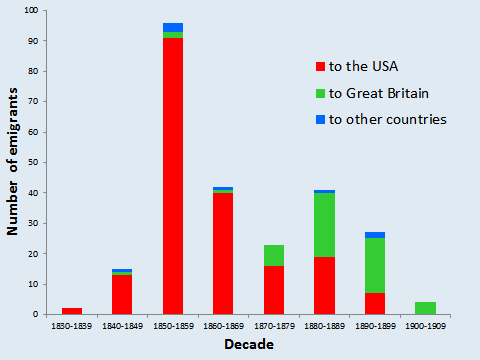
Like most Germans, the emigrants who left this village considered North America as their country of opportunity. Fewer emigrants chose other destinations but, among these, Great Britain was popular, specifically from the 1870s onwards.
It has been noted that, “[B]ecause of the predominance of the transatlantic and eastern European emigrations, we are far less informed about German emigrations into western European countries like England and France. There are great gaps in this area of research that still need to be filled” (Moch 132). The Hohenlohe pork butcher emigration to Great Britain may have been small in numbers compared to the overall figures of 19th-century migration but with all that we know now, it can add to and extend our understanding.
Research Methodology
In the nineteenth century emigration from the Hohenlohe villages was accepted. The families had many children, often reduced by high child mortality rates, but those who reached adulthood often had difficulties in earning their living and they were most vulnerable in times of depression. Migration was a way of seeking a better life. Thus, leaving home was a normal part of the life cycle for a sizeable proportion of young people. “Young apprentices and serving girls flocked to towns and cities” (Moch 126). This is especially true for the Hohenlohe butcher migrants and their female companions who went to Great Britain. However, there are few records left in the local archives about those who moved away. Once the emigrants had left their home country, there was no longer any reason for the administrative authorities in the district and the villages they left to conduct targeted research into their subsequent lives. It is only possible to track down certain persons, if you find them by name in their chosen destination and if their place of origin is recorded. The more you find, the better it is to make a general statement about the lives of emigrants, their development, their progress, success, or failure. Based on individual cases, it may ultimately be possible to gain an overriding impression of the entire migration movement of the German pork butchers in Great Britain and its historical classification.
In addition to the secondary sources listed in the bibliography, I have been able to consult, in Germany, letters home from the emigrants which have been preserved by succeeding generations of the original families; entries in the church archives and registry offices of many small towns and villages in Hohenlohe; as well as entries on migration in the Württemberg state archive in Ludwigsburg. Using an approach often applied in oral history, I also had access to a number of interviews with and reports of family descendants in both countries. On the British side, I have also looked at the literature dealing with migration from Germany to Britain: this is, logically, dominated by British sources, due to the long-standing presence of the immigrants in Britain. This was further supplemented by the ten-yearly British Census Returns (1841-1911), consultation of contemporary newspaper reports, information provided by the Anglo-German Family History Society in Great Britain and many photographs handed over to me by the migrants’ descendants and sometimes received – either online or as folders containing complete family histories, even printed as a book – the migrants’ written family chronicles. Finally, I have made use of entries in chat forums on the Internet, such as RootsChat where descendants of the German immigrants communicate with each other to exchange their genealogies and give each other advice on how to explore their roots.
As we now know these German pork butchers mostly came from the small area of Hohenlohe in southwest Germany. A few questions remain unanswered such as the existence of a special migration pattern or the roles played by their religion or their dialect. The paramount topic of the food itself will also be shown here as particularly relevant. The adaptation to the British taste that they were able to understand as crucial to their business will also be investigated. Those immigrants’ integration into British society will be questioned here as well as the strategies they used to convince people to buy their products.
German Immigrants in Britain
Until the end of the nineteenth century “Germans constituted the largest single continental immigrant group” in Britain (Panayi 1991, 11). This view is supported by a number of publications that analyse the country’s immigration figures during the aforesaid time period. They list several occupations that were especially taken up by German immigrants. According to them, the immigrants of the eighteenth and nineteenth centuries were mostly noted for having been wool merchants (Duxbury-Neumann 26-48) as well as specialists in commerce. Others earned their money in academia and education as teachers and governesses (Schulte Beerbühl 101). However, occupations were very diverse and they also turned to the food production and sales sector: “Although merchants and entrepreneurs constituted the most important occupational group in terms of numbers and influence, many German immigrants moved into the food and catering trades, often as butchers, sugar-bakers, waiters, hoteliers, and delicatessen owners” (Waddington 1022). Schulte Beerbühl enters into more precise details and qualifies what type of butchers they were: “Among the immigrants in the food processing industries the German pork butchers were one of the largest groups until World War I” (Schulte Beerbühl 101).
Early Butcher Migrants and the Aspect of Family Networks
It is not possible to determine exactly when the migration of German butchers to England began, especially since journeyman’s migration in the Early Modern Age was a typical part of the life of an aspiring craftsman. The organised guilds obliged journeymen to travel for several years. The main purpose of these travels was to provide further training in the profession and to establish useful contacts. London was also among the destinations of journeymen. The city archive of Schwäbisch Hall has several records from the end of the eighteenth century. One of them mentions the baker Johann Georg Druckenmüller of Übrigshausen, who decided to settle in London and left Hohenlohe in 1789 (City Archive Schwäbisch Hall 4/4421). Another document tells us of the potter Johann Lorenz Sieber from Schwäbisch Hall. A letter from him in 1793 to his sister in Schwäbisch Hall indicates that he had lived in London for several years and was a member of a financing company together with other Germans, including Hohenlohe citizens (City Archive Schwäbisch Hall 14/4191). German butchers have considered Great Britain a worthwhile destination since the third quarter of the 18th century. Margrit Schulte Beerbühl mentions the names Schweikhert and Seyzinger, who settled in London (Schulte Beerbühl 102). During this period, a larger migration stream from Hohenlohe occurred. In the Schwäbisch Hall archive we find the master butcher Jakob Ulrich Frank who left the city for England in 1773 (City Archive Schwäbisch Hall 14/4240). A noticeable number of early Hohenlohe butcher migrants came from Niederstetten. Four Schumm brothers from Niederstetten settled in Bath (British National Archive in Kew, HO 44/41/52, 133-140). Just as early, two other Schumm brothers from the same place opened butchers’ shops in London. Still in the first quarter of the 19th century, the butchers Dill, Glock and Guttropf followed the Schumm brothers to Bath; and four Schumm brothers from a succeeding Niederstetten generation chose London as their destination (Civil Registry Niederstetten, Family Register I, 530). At the same time, four Glock brothers had opened shops in different parts of the capital and had married British wives (UK Select Marriages and Banns). Thus, it can be concluded that positive reports from England encouraged other inhabitants of this village to leave for England, as well, and establish butchers’ shops there. Since the Schumm, Glock and Dill families were closely related at home through marriages in the parent generations (Protestant Niederstetten Church Register, Marriages) aspects of network building in the destination country will be considered more closely. Stefan Manz, for example, points out that “[I]t is not the actual employment and wage conditions in the receiving country, but the quality and scope of the information available about them in the country of origin that is decisive for migration patterns” (Manz 153). The contacts between migrants and the maintenance of personal links with families and their vicinity in the home country are therefore crucial factors that also lead to migration: “Such social relationships usually become a powerful and independent impulse that stimulates further migration” (Ayim 2). In the context of chain migration, the emigrant then remains embedded in a network of helpful and caring social connections. This becomes just as clear with the families Hachtel and Ebert from Kirchberg on the River Jagst and its surrounding areas and also with the Ebert brothers from Künzelsau. The migration to England from Hohenlohe involves two forms of migration, which are interwoven and influence each other. One is chain migration, which tends to be fed by the pull factors in the host country, and the other is reflected by the more recent network theory, which works on the basis of the exchange of reliable information. If these approaches are applied to the destination countries, we can state that the emigration from Hohenlohe to America is solely characterized by chain migration. The migrants from the rural area strove to establish their own farms and settled far from each other in the endless expanses of fertile prairie. Success reported back home attracted other migrants, who in turn settled on land in other areas of North America. They often practised subsistence farming. In Britain the situation was completely different. The immigrant butchers sought towns and larger villages where there was a sufficient density of population to support the sale of their goods. If they were successful, they recruited their staff from siblings, relatives and former neighbours at home. They were specialised in crafts, their processes had to work quickly and well, and communication in their own dialect helped them to do so. Besides they could make use of shorter distances for sending and receiving letters as well as of shorter travel times to their advantage. This encouraged the formation of family and business-related networks. London as the capital city had probably taken in most of the early migrants from Hohenlohe, while later immigrants who were becoming more and more numerous, spread out to other developing cities, which had gained importance through the industrial revolution.
The Meat Demand and the Business Niche
With the growing industrialisation new work and business sectors were created. A large number of jobs emerged. The cities steadily expanded due to the influx of labour from the surrounding rural areas. The good prospects for work and income, as well as the promising opportunities to lead a self-determined life, also attracted the German immigrants. Sue Gibbons confirms that at the time Britain was “the fastest growing industrial nation with plenty of opportunities for the young, strong and ambitious” (Gibbons 11). Britain also had an advanced, more liberal social and economic structure with better opportunities to start one’s own business. With regard to the Hohenlohe butchers, William Schuster, a German pastor in England gives two reasons that might additionally have functioned as pull-factors. He explains that “the wages and the income together with the possibilities to become self-employed were much better in England than in Württemberg, especially in the butcher trade” (Schuster 192).
The questions arise why the German immigrant butchers specialised in slaughtering pigs and processing pork and also why pork was needed and what comparative advantages the pork butchers had in this special field of the business. As a matter of fact, pigs were kept in rural areas of Great Britain for centuries. They were animals that anyone could raise and were excellent sources of meat. In addition, they were low cost animals to rear as they could be fed on scraps and leftovers. As a result, pork became an important part of the rural economy (Cocking). The rapidly advancing industrialisation led to rural dwellers seeking work in the expanding towns and cities. Concentrations of workers in northern cities and industrial centres, including many women in textile production, led to a greater demand for food products. George Steele, a German pork butcher descendant, refers to the disappearance of the ‘cottar’s pig’ resulting in a gap in the supply of pork in the industrial areas. He points out that “the mainstay of the rural economy could not be transported to the industrial housing in the overcrowded mill towns” (Steele 2). And he also points to the following circumstances in one of the most industrialised areas.
All the pig products […] were familiar to the hand-loom weavers who had moved from the Lancashire countryside to work in the new factories. Moreover, the female weavers were wage earners in their own right – but a small wage for long hours, so there was little time to prepare food. Many items of food and the fuel to cook meat were an additional expense. (Steele 2)
Sue Gibbons, another German pork butcher descendant writes that there was “a population with a great appetite for meat, but many industrial and city workers did not have the income to afford it” (Gibbons 11). Conclusions can be drawn from the above comments that the combination of city growth, the need for nourishing meat, missing pork and the requirement of wholesome, but cheap and quick to prepare food in the industrial areas were essential factors for the settlement of the German pork butcher immigrants. They even imported a successful market strategy. It was their family background that had prepared them to start such businesses with promising chances for success. The early butcher migrants’ families at home not only possessed butchers’ shops, in addition they were involved in dealing in livestock and commonly they were also innkeepers or ran a small country hotel. There they, or more precisely their wives, served meals based on all kinds of meat. In Künzelsau, butchers’ sons were often married to daughters of bakers. The butchering and baking skills and the experience in serving customers brought by all of these people also made them skilled entrepreneurs in Great Britain (Wüstner 2013, 9-10). Thus, the German pork butchers created the first take-away shops in the country in which they sold pre-cooked meats and hot dishes, either served on the premises or to be taken home in a basin or dinner pail (Gibbons 11). Their business concept turned out to be an outstanding advantage which distinguished them from their British counterparts. George Steele refers to the situation as follows: “[B]y all accounts, a pork butcher would have had a ready market, serving convenient and hot food to factory workers – to be taken home at the end of a working day in a basin for the family’s evening meal” (Steele 2). Robert Roberts adds: “[M]any working women […] took advantage of the basin meal; engaged as they were all day in the weaving, spinning and dyeing trades they had little time to cook […]. They had often not even learned how to cook, […] since their mothers before them had been similarly occupied in the mills” (Roberts 309). But not only working women, also school children profited from the ready cooked meals as Phyllis Lloyd, the daughter of a Hohenlohe pork butcher in Boston, Lincolnshire, reports. She explains that every Friday her father made faggots2. The children from the school nearby “would call in the shop on their way to school and leave a basin with a note in it as to how many faggots they wanted with the money for them. They were a penny each” (Lloyd 3). Robert Roberts explicitly points out that the German newcomers “saw at once that the kind and variety of pork products they could make for sale far exceeded anything on show in the conservative English shops” (309) and he goes on to say that each one “versed in Continental culinary skills, introduced a range of new tastes in cooked meats to the British working class and incidentally established the image of the ‘typical German’ for the next several generations” (309).
With this remark Roberts recites some public opinion that links German characteristics and virtues to the foodstuffs the pork butchers were selling in their shops. Of course, the Germans were especially noted for their sausages. However, they also impressed their customers with a whole range of other products.
The Main Products of the German Pork Butchers
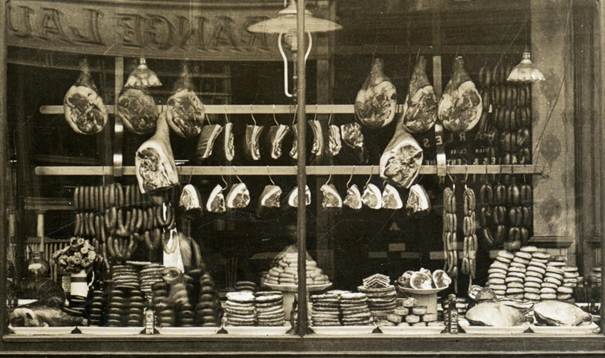
To contribute to this research, there were many descendant families who searched their photo albums and provided more than seventy photos of the butchers’ shops, their predecessors had established. The butchers not only presented quite a variety of their products in the shop windows but often promoted their specialities and delicacies in words or phrases on posters or along the bottom end of the window. Not infrequently they placed advertisements in the local newspapers and in trade directories. Some of these were written in the form of poems.
These advertisements are an indication of which products were important to the inhabitants of the area and which were important to the advertising butcher, and to which he gave special emphasis. Analysis of forty window displays and advertisements afforded an indication of the relative importance of the different products. The frequency with which a product was mentioned by different butchers, either in a window display or in an advertisement was recorded. The name of the product and the number of mentions are shown in the ‘product’ and ‘frequency’ columns. As some (but not all) butchers also made qualifying remarks on either their products and/or the reputation of their business and specialty products, these were noted and entered in the third column together with the number of times mentioned. The results in the table below are indicative of the preferences expressed in the 40 advertisements and window displays.
| Rank | Product | Frequency | Specialties | Qualities |
| 1. | Sausages | 27 |
black puddings 5 liver sausage and white pudding 3 delicious pork sausages 2 Cambridge sausages 2 Oxford sausages 1 German sausages 2 celebrated sausages 1 excellent in quality 1 |
delightful in flavour 1 economical in use 1 famous sausages 1 cooked sausages 1 fresh every day 1 fresh and daily 2 noted sausage shop1 sausage meat for turkeys 1 |
| plus Poloneys (Polony, Polonies) | 14 |
Yorkshire poloney 2 souse poloney 1 |
prime poloney 1 best quality 2 |
|
| 2. | Pork Pies | 20 |
celebrated pork pies 3 noted pork pies 2 famous pork pies1 |
home-made 1 raised pie 1 |
| 3. | Ham & Bacon | 18 each |
home cured hams 3 prime country fed 1 fine hams 1 Yorkshire hams 1 |
home cured 4 breakfast bacon 1 Yorkshire bacon 1 Rashers 1 [in Dublin] |
| 4. |
Pork Pork joints |
14 1 |
prime country fed 2 direct from the farms 1 prime home fed 1 prime dairy fed 1 |
fresh 1 celebrated pork established pork shop 2 noted pork shop 1 |
| 5. | Lard | 8 |
home-made lard 1 home rendered lard 3 |
pure lard 2 |
| 6. | Meats | 7 |
high class meat products 1 potted meat 1 cooked meats for a light and dainty meal 1 |
cooked meats a speciality 4 |
| 7. | Brawn | 7 | fresh daily 1 | |
Sausage has the greatest number of mentions. As specified previously, in Great Britain sausage is typically associated with German cuisine and culture, as is cabbage (‘Kraut’). In his studies Keir Waddington states that “German butchers became particularly prominent in the sausage trade. They introduced a variety of sausages into Britain as part of a culinary transfer, ensuring that the German sausage became the most visible German influence on British diets” (1022). He confirms that sausages “became an important component in the provision of meats” (1022). Of the many different types of sausages, the German pork butchers promoted one special type: poloney or, as it is also spelled, polony. The first impression suggests that this type of sausage was invented in Poland, but in fact the name is derived from a kind of Italian sausage from the city of Bologna. It is a thick, savoury type of sausage that features a red colour and is made from lean pork. Two butchers in the list used the distinctive German origin of their sausages as a sales argument while others were flexible enough to adapt some of their products to British tastes and expectations by offering Cambridge sausage, Oxford sausage and Yorkshire poloney.
(Photo by courtesy of Iain McNeil, Bunbury)
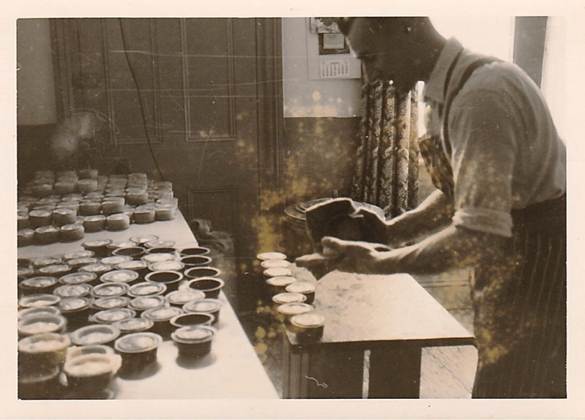
Pork pies are the second most advertised product. Pork pies are not a German invention, but a traditional British food eaten in British houses long before German butchers arrived. The German butchers modified the original recipes producing a tastier pork pie. Especially in Yorkshire, where very many German pork butchers had settled, there is still today a much-valued regional version that is described by Lauren Cocking. “Yorkshire variations are slightly smaller and molded, but still bear that traditional crimped lid; made from cured instead of raw pork, their meaty core is rather more disconcertingly pink and lends the pie a ‘hammier’ flavour” (Seriouseats.com). The Hofmann butchers in Wakefield preserved the art of making excellent and succulent pork pies until the present day. These butchers regularly received and still receive high awards for their pies and other products. Charles (Karl) Hofmann, the first butcher who founded the business in 1896 came from Hörlebach in Hohenlohe (Civil registry Wolpertshausen, family register I, 11). Lauren Cocking points to the fact that working-class people seldom possessed an oven which made the baking of pies almost impossible, and they were thus logically attracted to the German pork butchers’ offer. The latter had supplies of pork, the necessary equipment, and trained personnel so they were able to produce quantities of fresh, tasty pies at cheap prices the working class could afford.
(Photo by courtesy of Patricia Richardson of Church Fenton, Yorkshire)
Ham and bacon were the third most advertised products. These two items are regularly promoted together. Ham is made from the upper parts of a pig’s leg. This meat is cured with salt and cooked. Bacon comes from a pig’s belly. It is also cured and subsequently smoked in a long process in special smoking ovens. The smoked pieces of meat are cut into thin slices for consumption and can be fried in a pan so that most of the fat is removed. The smoking process gives it a distinctive, aromatic and delicious taste as well as a crispy touch when it is eaten. In Germany the process of curing and smoking meat has had a long tradition in rural farming areas. It was a useful method of preserving meat for longer periods. We can safely assume that ham was not originally part of the workers’ daily diet and that the urban population in the industrial centres was not familiar with the taste of smoked pork. Thus the Hohenlohe pork butchers again offered substantial and delicious products to a wider clientele at low costs.
Fourth in rank is the sale of pork. Emphasis is placed on the shop noted for supplying slaughtered pigs raised on farms with good animal husbandry. Others, as in Rank 6, focus more on the range of cooked meats and the use of different methods of processing. Additional pork products such as lard and brawn are advertised by 8 and 7 advertisers, respectively. Lard was needed by housewives for cooking and frying at home, and it is possible that it was also used as a cheap fat in large kitchens, e.g. in hospitals or nursing homes. It could also be taken as a spread on a slice of bread and with a little salt on it, it could be enjoyed as a good and satisfying snack. Brawn had to be eaten cold. Together with fried potatoes it made a quick and substantial, hearty meal. From other sources, also insights can be gained into the product range of German butchers. George Frederick Ziegler from Ruppertshofen, a very industrious and successful butcher in Wakefield owned a whole range of shops. Their tasks were split into those that were selling only and others that were also producing.
The manufacturing shops would make their own sausages; polonies, which were big red sausages of lean pork and were peculiar to Yorkshire; black puddings; hazlets which were a savoury meatloaf, a mixture of beef and pork; chitterlings, which were the innards of pigs; pig bags, which were the stomach of a pig; boiled hams; roast pork; roast pig cheeks, roast shanks; a range of pork pies […]; sausage rolls; Cornish pasties and meat and potato pies. The pies had to be hot, even if the customer was taking them home. (ASDA History 36)
Louis Schonhut, a descendant of a butcher immigrant from Oberhof near Künzelsau names the same products when he tells us of “polony, black and white puddings, haslet, jellied brawn, pork pies, chitterlings and all kinds of cooked meats now scarcely known to the present generation” and he says that “these were made in their hundreds each week” (Chapter 1).
Captivating all the Senses
From the above discussion it can be concluded that the sale of wholesome, hot meals, as well as the possibility of being able to take pre-cooked food home, played a significant role in the success of the business. On the other hand, it was essential to get customers acquainted with a range of new products introduced by the German pork butchers. Marketing their tasty products to the local population, gaining customer loyalty and convincing them to try other delicacies, was important to their success. For this purpose, the Hohenlohe butchers worked with a variety of measures that captivated all the senses, besides taste, smell and vision, also touch and texture were of importance. Essential was the presentation of goods in shop windows which were mainly arranged symmetrically. “The display was considered vitally important and became almost an art-form” (ASDA History 35). One of the above-mentioned photos shows that George William Schneider, a Hohenlohe pork butcher in Manchester had put a very impressive farewell scene on show in his shop window: framed by pigs’ carcasses, pork knuckles and sausages, two upright positioned piglets faced each other. Both wore a white shirt, a tailcoat and trousers. One carried a basket and was marked with a flag as British, the other had a suitcase in the claw and, as could be seen from the second flag, it was about to travel to the United States.
An even more fascinating display was given by a German pork butcher who owned a large shop in East London:
In the window, eight tiny pigs were represented sitting round a small table thoroughly engrossed in an exciting game of ‘nap’. Pipes were in their mouths, whilst glasses of wine stood handy to sip when the game began to get dry. This device, seemingly so very simple, was the means of attracting quite a large concourse of people round the shop, and a policeman had to be especially told off to keep the crowd on the move.” (qtd. in Gibbons 30-31)
How creative the butcher-businessmen were is shown once again by the Ziegler butcheries. “The shops were astute in their marketing and would keep ham water boiling to give off an appetising smell. This smell would drift out into the street helped by the fans used for ventilation […] To complete the picture there would be 15 to 20 sides of pork hung up in the shops” (ASDA History 36). These methods were especially aimed at people who were passing by, pedestrians on the street who did not yet belong to the regular customers. At Ziegler’s they experienced a convincing attraction. “Delicious smells used to waft up the street as shanks and pork chaps complete with full set of teeth were roasted in the ovens […]” (ASDA History 31).
Meat was generally treated with properly matured brines so that pork got a nice, soft touch and colour. The experienced butchers prepared black puddings in a way that they featured “the alluring sparkle of a black diamond to impress the customers” (qtd. in Gibbons 83).
Acknowledgement and integration
For about a century the pork butchers were welcome as they provided the population in their vicinity with good quality and cheap food. They enabled the working population to concentrate on their work and on how they could earn their living. By selling pre-cooked or ready-made meals they relieved families and working women from some of their kitchen tasks. As we have seen, school children also drew some benefit from the offers of their German fellow citizens. With their products the butcher immigrants gained high reputations. This factor not only increased their self-conception in connection with their profession but also strengthened their position in the foreign land. Furthermore, they were admired for their German virtues of discipline and hard work and so became respected citizens. This gave the Hohenlohe butchers a good opportunity to assimilate quickly into their communities. However, a fundamental integration by the first arrivals was greatly hampered by the lack of English language abilities. So the first immigrants were only structurally integrated. The German butchers displayed a feature of every diaspora group: they kept together in smaller communities and they were closely tied by intermarriage. They treasured their traditions, their songs and their stories (Winton 2, 5). In bigger cities like Newcastle, Bradford, Hull, Manchester, Liverpool and of course London there existed German churches. The Hohenlohe immigrants were mostly Protestant, only few were Catholics. Their religion depended on the area they came from and who their sovereigns were before mediatisation. Most of the Hohenlohe principalities were Protestant, but a few were Catholic. All these migrants, however, were strongly bound to their Christian belief and its values. The churches in their parishes with their community centres played an important role and provided a place where the butchers and their families could meet, converse and celebrate their German feast days. Religious meetings also offered possibilities to get to know sons and daughters of other German butcher families, so marriages occurred. The internal solidarity of the Hohenlohe immigrant group was shaped by the common origin, the common dialect and the same profession. It might even be that the German butchers consciously used their specific knowledge in pork butchering as a discernible element of distinction. By keeping their German names, which were often hard to pronounce for British people, and flaunting them in big letters over their shop windows, they possibly showed their customers that it was they who were the dominant ones in this thriving trade. When they sold their German sausage, they probably utilised its distinctive origin as a trademark.
However, they knew full well that they had to integrate into the British community as most of their customers were British. For this the wise and enterprising businessman made considerable efforts. For instance, he joined a sports club, a music club, or became active in the church (Schonhut Chapter 1).
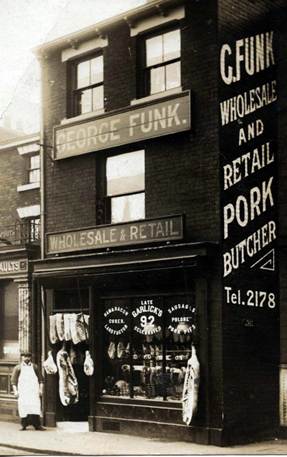
(By courtesy of Richard Ford of Huddersfield Netherton)
For example, a member of the Schonhut family was elected to Rotherham Borough Council in 1898 and became an alderman later on. Another member of the family became a choral conductor and a headmaster in the town (Schonhut chapter 4). Others like Frederick Schuch of Eichswiesen earned some merits for his commitment in the Meat Trades’ Union in London, whereas also in London Mr. C. Kirch was Chairman of a Butchers’ Charitable Institution (Gibbons 35-37). It is noteworthy that most of the immigrant pork butchers had found their centre of life in Great Britain. They started families and their businesses were promisingly established. Nevertheless, it did not seem important to them to obtain British citizenship. Naturalisation was a complex and expensive process and they harboured a fear of being called up for military service. This did not fit in with their ambitions to establish a business, permanently.
War times and riots
After the outbreak of the First World War the situation for the Hohenlohe pork butchers changed radically for the worse. Anti-German hysteria gripped the country and mobs vented their rage on the German pork butchers, who were regarded as the epitome of German culture and influence (Panayi 2008, 114). The British also feared the Germans as spies living in their midst. As a result, the indigenous population exhibited severe animosity towards all German people, particularly after the torpedoing of the Lusitania in May 1915 (Rosenkranz 210). Shop owners, as most of the German pork butchers were, became victims of widespread riots that began in Liverpool. Subsequently they covered the whole country and reached the Northeast coast a week later. A newspaper report about the dramatic situation in South Shields mentions seven German butchers who were severely affected (qtd. in Gibbons 57). Among them was John Frederick Fisher’s Butcher shop, pictured before, that suffered from extensive damage.
The butchers’ premises were attacked, their shop windows smashed and the pork products stolen from their shops. Panikos Panayi confirms the miserable situation for the shop owners: “[T]he Germanophobic hysteria that [had] gripped the country vented its fervour on German butchers and bakers […]” (2008, 114). He also gives a reason why the rioters focused on the shops. He points out that “German food came to symbolize German influence in the country and its rejection in riots reflected the turn against Germany” (114). So, the German shop owners sadly suffered from the intolerance and violence, even at the hands of their previous customers. Destruction was immense not only to property but to peaceful coexistence too. Those men who had not become naturalised British subjects were interned in prison camps, their wives and children sent to Germany for repatriation. The largest internment camp for civilian internees was at Knockaloe on the Isle of Man. Originally, it was built to accommodate 5,000 prisoners. However, during the war it was extended several times and at the end of the war in 1918 there were more than 23,000 men held captive in the camp (Cresswell 14). Experiencing such treatment, many of the pork butchers returned to Germany after the war, others were forcibly deported to their home country by the British government. After the First World War the pork butcher business never recovered and the rich history of Hohenlohe butchers in Britain that had lasted for over a century was practically at an end. The Second World War, with its reemerging animosities against Germans and the reintroduction of internment was the final death knell for the once thriving pork butcher business that had been dominated by the Hohenlohe butchers.
Conclusion
Emigration from Germany to Britain took place throughout the nineteenth century. At first, numbers were small, but grew steadily and reached their peak during the last two decades. As a result of the industrial revolution Britain was regarded as a land of opportunity. Many young, ambitious men and women took the chance and went into the pork butcher business. We have learned that most of these came from Hohenlohe, a small area in Württemberg, Germany. These people’s skills and qualifications came to the fore not only in slaughtering but in making appetising sausages and other tasty pork delicacies. They introduced customary specialities from Germany and adapted their products to local preferences, refining familiar foods such as pork pies. With their cost-effective and tasty food products, they met the industrial society’s basic needs for meat. In addition, they cultivated a sales concept that was previously unknown in the UK. They not only sold sausages and meat, but also offered hot meals, already prepared for consumption either in the butcher’s shop or to take away. At a time when factory canteens did not yet exist in their present form, the immigrant butchers filled a gap in the market for supplying the working population. Thus, they played a leading role in establishing the first take-away shops in the United Kingdom. Many of these butchers of German origin prospered, with some even holding office as leading members of butchers’ unions and meat trading associations. Because of their success the butchers summoned more personnel from home, which led to an extensive chain migration and the formation of a strong business migration network with close-knit connections among the families. The opportunity for assimilation was immensely hampered by the two wars between the two countries. A decline of the German pork butcher business followed. Moreover, the descendants of the immigrants soon went into a wide range of different professions. Only a few, like for example the Haffners in Burnley, the Hofmanns in Wakefield, the Gronbachs in Cowdenbeath in Scotland and the Herterichs in Galway in Ireland stayed in the business until the present day.
Notes
- 1The graph was drawn up by the author of the present article.
- 2Faggots consist of minced pork, breadcrumbs and seasonings like parsley, thyme and sage which are formed to a small kind of loaf and roasted.
Works cited
- ASDA History. Unpublished Manuscript on the Corporate History of ASDA, today’s second largest supermarket chain in Great Britain. Leeds: 1960s.3
- Ayim, May. “Acht Thesen zur Migration zwischen Mexiko und den USA.” Info Blatt 51. Ökumenisches Büro für Frieden und Gerechtigkeit e.V., April 2001.
- Baines, Dudley. Emigration from Europe, 1815-1930. Cambridge UP, 1995.
- Cocking, Lauren. “How the Humble Pork Pie Charmed the English.” www.seriouseats.com/2018/07/how-the-humble-pork-pie-charmed-the-english.html. Accessed 05 July 2020.
- Cresswell, Yvonne M., editor. Living with the wire. Civilian Internment in the Isle of Man during the two World Wars. Manx National Heritage. The Manx Museum, 2010.
- Duxbury-Neumann, Susan. Little Germany. A History of Bradford’s Germans. Amberley, 2015.
- Eyth, Ludwig. Chronik des fränkischen Dorfes Hohebach an der Jagst. Stuttgart 1904, photomechanical reprint. Bissinger, 1979.
- Ford, Richard. “From Belsenberg to Britain. A Case Study.” Huddersfield-Netherton: Unpublished family chronicle, 2010.
- Gibbons, Sue. German Pork Butchers in Britain. Anglo-German Family History Publications, 2001.
- Koerner, Roy. “The Chain of Migration. Short History of the Koerner Family.” Unpublished family document. Wylam, Northumberland, 2008.
- Lloyd, Phyllis. M. “My Childhood Memories.” Unpublished family document. Droitwich Spa: 1986.
- Manz, Stefan. Migranten und Internierte. Deutsche in Glasgow, 1864-1918. Franz Steiner Verlag, 2003.
- Moch, Leslie Page. “Moving Europeans: Historical Migration Practices in Western Europe”. The Cambridge Survey of World Migration, edited by Robert Cohen, Cambridge UP, 1995, pp. 126-29.
- Panayi, Panikos. The Enemy in our Midst. Germans in Britain during the First World War. Berg Publishers, 1991.
- Panayi, Panikos. Spicing up Britain. The Multicultural History of British Food. Reaktion Books, 2008.
- Roberts, Robert. “The classic slum. Salford life in the first quarter of the century (1971).” Poverty, inequality and health in Britain 1800-2000, edited by George Dowey Smith, Daniel Dorling, Mary Shaw, Bristol UP, 2001.
- Rößler, Horst. “Massenexodus: die Neue Welt des 19. Jahrhunderts”. Deutsche im Ausland. Fremde in Deutschland. Migration in Geschichte und Gegenwart, edited by Bade, Klaus J. Beck, 1992.
- Rößler, Horst and Margrit Schulte Beerbühl. “Kaufleute und Zuckerbäcker. Zum Verhältnis von Migrations-und Familienforschung am Beispiel der deutschen Englandwanderung des 18. und 19. Jahrhunderts”. Gesellschaft für Familienforschung e.V. (editor). Die Maus. Über Bremen in die Welt. Bremen, 2002, pp. 107-19.
- Rosenkranz, Albert Eduard. Geschichte der deutschen evangelischen Kirche zu Liverpool. Ausland und Heimat Verlags-Aktiengesellschaft, 1921.
- Schonhut, Louis. “And then the sun shone.” A family chronicle in possession of the Schonhut families in England. Unpublished and not paginated family chronicle, 1981.
- Schulte Beerbühl, Margrit. “Migration, Transfer and Appropriation: German Pork Butchers in Britain”. Transfers: Interdisciplinary Journal of Mobility Studies, n°2, 2012, pp. 97-119.
- Schuster, Wilhelm. “Unsere Schwaben in England”. Deutsch-Evangelisch im Ausland, n°7, 1908, pp. 191-212.
- Steele, George. “Living over the shop”. Draft of an Open University Dissertation, 1997.
- Waddington, Keir. “We Don’t Want Any German Sausages Here! Food, Fear, and the German Nation in Victorian and Edwardian Britain.” Journal of British Studies, n° 5, 2013, pp. 1017-1042.
- Wegge, Simone Alberta. “Different Profiles, Different Choices: Mid-Nineteenth Century Hessians Who Emigrated to the Southern Hemisphere”. Social Science History, vol. 41, n° 3, 2017, pp. 415-44.
- Winton, Rosemary. “A personal record of memories and family anecdotes.” Tranent, Scotland: Unpublished document, 2006.
- Wüstner, Karl-Heinz. “Sausages, Bacon and Pork Pies. German Immigrants’ Path to Success. A History of German Pork Butchers in 19th Century Great Britain.” Conference Presentation read at the Halsted Trust Conference: Exodus – Movement of the People. The Story of British Migration 1600-2000, 6th – 8th September 2013, Hinckley, Leicestershire, 2013.
- Wüstner, Karl-Heinz. “Deutsche Metzger in Großbritannien. Ihr Beitrag zur Ernährung der industriellen Gesellschaft im 19. Jahrhundert.” Über den Tellerrand geschaut. Migration und Ernährung in historischer Perspektive (18. bis 20. Jahrhundert), edited by Mathias Beer, Klartext Verlag, 2014, pp. 85-103.
About the author(s)
Biographie : Karl-Heinz Wüstner est un enseignant à la retraite qui a exercé à Ilshofen, en Allemagne. Il enseignait l’anglais, les arts, la géographie et les sciences sociales. Il a surtout étudié l’histoire des migrations et effectué d’importantes recherches sur le commerce et l’artisanat dans la région de Hohenlohe en Baden Württemberg. Il est membre du comité de la Société d’Histoire de Württemberg-Franconia et directeur d’un musée local qui expose du mobilier peint. Il écrit ouvrages et articles tout en participant régulièrement à des conférences nationales et internationales.
Biography: Karl-Heinz Wüstner is a retired high school teacher from Ilshofen, Germany. He taught English, Arts, Geography and Social Sciences. As a local historian he has fundamentally studied labour migration and done fundamental research on trade and craftsmanship in the Hohenlohe region of Baden Württemberg in German for many years y. He is a committee member of the Historical Society for Württemberg-Franconia and chairman of a local museum that exhibits painted furniture. He writes books and articles, and has given talks at numerous conferences and seminars, both nationally and internationally.