Frankenstein as a superhero? Frankenstein in the generic system of comic books
Abstract: Comic books became a mass media in the United States in the late 1930s, a period during which Universal was producing its popular series of Frankenstein movies. The dual intermedial figure–the scientist and the creature–became a source of inspiration for the superhero stories which dominated this new media, through quotations, borrowings or more sustained engagements, as in the case of Dick Briefer’s Frankenstein. Though the 1954 Comics Code ostensibly prohibited its use in comic books, Frankenstein has constantly interacted with the superhero genre since that period. This article uses a chronological approach to examine this generic compatibility, which never becomes a full assimilation, and the evolving functions of these intermedial exchanges.
Keywords: Comics, Adaptation, Intermediality, Horror, Superhero, Frankenstein
Résumé : Les comic books deviennent un média de masse aux États-Unis à la fin des années 30, période qui coïncide avec le populaire cycle des films Universal consacrés à Frankenstein. La double figure intermédiale de la créature et de son créateur devient alors une source d’inspiration pour les récits de super-héros qui occupent ce nouveau média, au travers d’emprunts ponctuels ou de dialogues plus soutenus, comme dans le Frankenstein de Dick Briefer. Bien qu’ostensiblement bannie des comic books par l’adoption du Comics Code en 1954, la double figure de Frankenstein n’a cessé depuis d’interagir avec celle du super-héros. Dans une approche chronologique, cet article examine cette compatibilité générique, qui ne devient pourtant jamais tout à fait une assimilation, ainsi que l’évolution des fonctions de ces échanges intermédiatiques récurrents.
Mots-clés : Bande dessinée, Adaptation, Intermédialité, Horreur, Super-héros, Frankenstein
In this article, I will seek to examine the way Frankenstein as a serial assemblage (the character, its creature, Mary Shelley’s novel and the deterritorialized myth it has spawned) functions in the economic and narrative context of superhero comic books in the United States. Through a chronological approach, I will seek to understand how Frankenstein is transformed by this generic displacement, and in turn, how the genre accommodates this multifaceted inclusion.
Alternative text
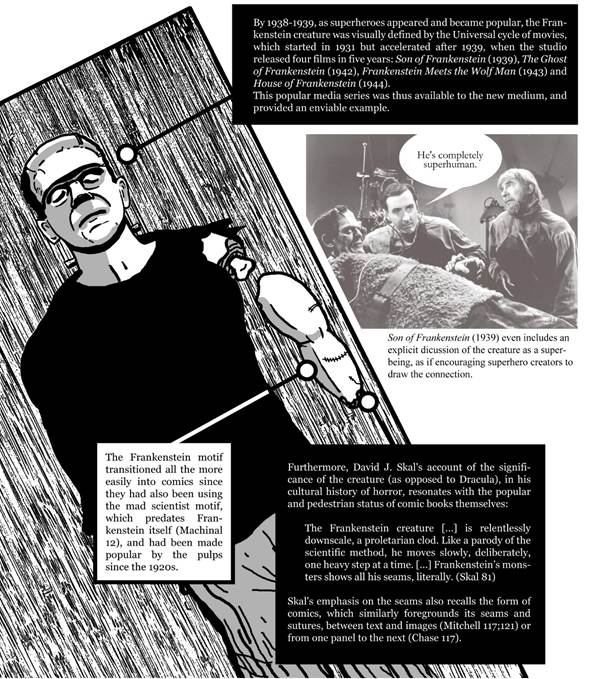
By 1938-1939, as superheroes appeared and became popular, the Frankenstein creature was visually defined by the Universal cycle of movies, which started in 1931 but accelerated after 1939, when the studio released four films in five years: Son of Frankenstein (1939), The Ghost of Frankenstein (1942), Frankenstein Meets the Wolf Man (1943) and House of Frankenstein (1944).
This popular media series was thus available to the new medium, and provided an enviable example.
“He’s completely superhuman.”
Son of Frankenstein (1939) even includes an explicit dicussion of the creature as a super-being, as if encouraging superhero creators to draw the connection.
The Frankenstein motif transitioned all the more easily into comics since they had also been using the mad scientist motif, which predates Frankenstein itself (Machinal 12), and had been made popular by the pulps since the 1920s.
Furthermore, David J. Skal’s account of the significance of the creature (as opposed to Dracula), in his cultural history of horror, resonates with the popular and pedestrian status of comic books themselves:
“The Frankenstein creature […] is relentlessly downscale, a proletarian clod. Like a parody of the scientific method, he moves slowly, deliberately, one heavy step at a time. […] Frankenstein’s monsters shows all his seams, literally.” (Skal 81)
Skal’s emphasis on the seams also recalls the form of comics, which similarly foregrounds its seams and sutures, between text and images (Mitchell 117;121) or from one panel to the next (Chase 117).
This context explains why so many early superheroes—The Moth, Bozo the Robot, Chic Carter, but also Batman & Robin and the Submariner—encountered avatars or copycats of Dr. Frankenstein and his creature between 1940 and 1945. The Promethean scientist is after all one of the canonical ways to create a superhero, as illustrated by the origin story of the Human Torch (“Even I fear the monstrosity which I have created,” says his creator on the first page of that story, in true Frankensteinian fashion [Marvel Comics #1, October 1939]) or Captain America in 1941 (“It is working! There’s power surging through those growing muscles” [Captain America Comics #1, December 1940]). Michael Chabon, in his novel TheExtraordinary Adventures of Kavalier and Klay, has also convincingly argued that the early superheroes were connected to the myth of the Jewish golem. While this resemblance remains elusive—despite the best efforts of a few scholars to consolidate the hypothesis (Kaplan; Weinstein)—it suggests that superhero narratives share salient thematic concerns with the Frankenstein mythos.
However, Frankenstein and his creation mostly appeared as antagonists in these early comic books, if only because in these serial narratives a new villain was needed for each episode, which mechanically led them to outnumber the heroes. As indicated above, most of these narratives do not feature Frankenstein himself but serial variations of the character: other life-creating scientists, Frankenstein copycats, or even Frankenstein relatives: for instance, Captain America meets the professor’s daughter in “Curse of Frankenstein” (USA Comics #13, July 1944), a story which adopts the Universal movies’ strategy of refusing to assign a precise date to the original narrative. By choosing a grave-robbing mad scientist as an antagonist to Kid Eternity, a character whose power consists in summoning fictional heroes to help him, Sheldon Modoff offers one of the striking variations on this idea of producing secondary Frankensteins: in “A Tale of a Door, a Doctor, and a Dreaded Cat” (Hit Comics #26, February 1943) a Frankenstein copycat is vanquished by Robin Hood and Achilles. The monster was also used at least twice as a special effect or a disposable make-up (“Ebony Meets Frankenstein” The Spirit, November 10, 1942; “The Mammoth Man!”, Flash Comics #43, July 1943), in a self-referential mode which testifies to the familiarity comic book readers were expected to have with the character.1
In these early 1940s superhero stories, Frankenstein was thus used as a known reference (from the movies, with occasional nods to the novel), which provided the ground for variations, sequels or reversals. This echoed the narrative and commercial choices at work in the Universal Movies, which turned into crossovers in 1943, and later foregrounded their self-awareness even more clearly with the Abbot and Costello parodies after 1948. In comics and in films, these options did not exclude horror—most of these scientists and monsters were depicted as evil and terrifying—but they added a distinct referential frisson, which was part of the characters’ appeal.
While the Frankenstein story offered a ready-made narrative for super-heroes and their foes (one which was firmly in the public domain), in all the aforementioned cases, they served only as punctual additions to the series they appeared in. The one exception is to be found in Dick Briefer’s use of the character, between 1940 and 1953, in a series published in various comic books, which explore most of the possible permutations and uses of the intertextual motif.
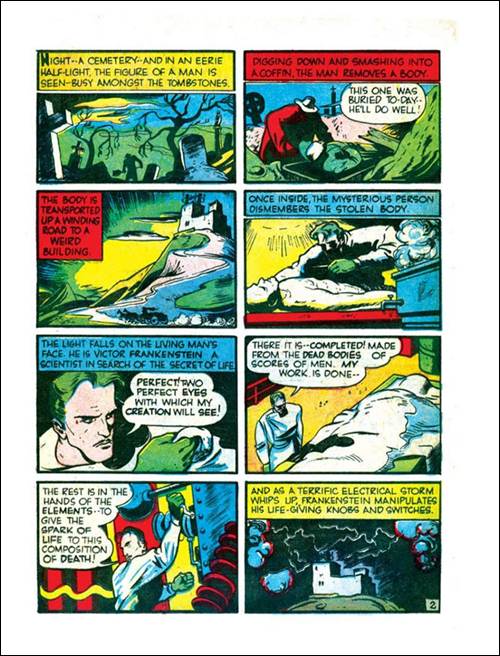
Briefer’s “Frankenstein” debuted in Prize Comics #7, in late 1940 where it was published in serialized fashion, in monthly 8-page installments, for nearly five years. The series ostensibly starts as an adaptation of the novel (“suggested by the classic of Mary W. Shelley”), and in fact as a transposition of the Universal films, as evidenced by the gothic castle, the frightening machinery, the resemblance between the monster’s appearance and Karloff’s, down to the regular grid evoking a juxtaposition of lobby photographs (see Ill. 1). The bright primary colors and Briefer’s graphic rendition, however, establish a distance between the two representations. After retelling the familiar origin story in a mere 2 pages, Briefer turns the creature into an increasingly intelligent wandering monster, which aligns him with the grotesque supervillains found in superhero comics. In #9-12, the creature has taken over a gang, imitates the Joker’s modus operandi by sending playing cards to his victims and even receives its own deformed servant, who calls him “master.” The force of attraction of the superhero genre, or at the very least of the narrative conventions which also informed the superhero genre, is thus perceptible early in the series. This attraction gets even stronger in #11 (June 1941), when a ten-year ellipsis between two panels in the middle of a page allows Briefer to turn Denny Dugan, Dr. Frankenstein’s ward, into the creature’s antagonist. Dugan promptly adopts a tight black costume and starts calling himself “the Bulldog.” The monster-on-the-run dynamic turns into a super-hero vs. super-villain confrontation, with the two characters sharing the series’ title and Dugan’s archetypal girlfriend even becoming a costumed hero (#14, 15). Of course, to have the villain and not the hero as the main protagonist is somewhat unusual, but Bill Everett’s the Submariner (1939) had already proved that the strategy could be the basis for a popular series. With #15, the streamlining project progresses further, as the creature simply becomes “Frankenstein,” though a tiny caption reminds the reader that this is merely a convenient shorthand.2
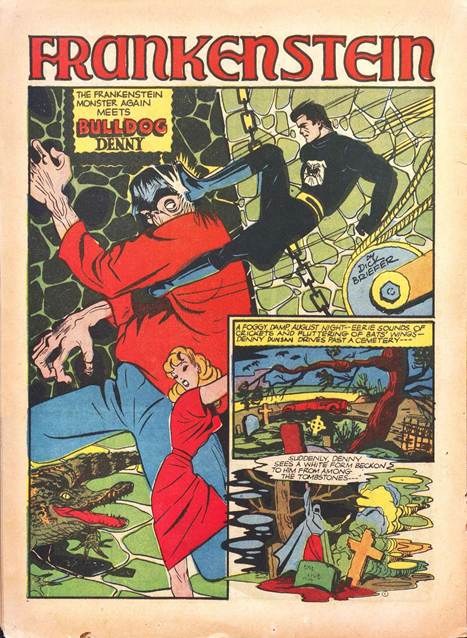
Yet, the irruption of superheroes in the Frankenstein mythos may have grated either the readers or Briefer himself, for “the Bulldog” gradually relinquished the spotlight, with a final appearance in #28 (February 1943). At that point, Briefer experimented with numerous genres (a return to horror, a war comedy) before settling on a form of macabre humor, with a softer and cuter monster, which prevailed in the series until 1945. In a memorable episode (Prize Comics #49), Frankenstein is turned by an elf into a flying superhero inspired by a comic book character, “Blooperman,” but quickly renounces this role when he fails to stop bank-robbing criminals. One is tempted to read this light-hearted story as a comment on Briefer’s unsuccessful turn to the superhero genre, at the beginning of the series. Shortly after this episode, Briefer’s Frankenstein received his own series, an eponymous comic book which ran 17 issues, from 1945 to 1948. Even in this version, and as suggested by the “Blooperman” episode, Frankenstein’s bright red and yellow costume, his superhuman strength and his status as a recurring hero align him to some extent with superheroes.
Frankenstein’s appearances in superhero comic books in the 1940s function as tales of horror—played straight or for comedic purposes—a genre which served as a crucial source for the budding superhero genre. They are also characterized by the implicit reference to cinema, often euphemized by a mention of the novel. Finally, they demonstrate the plasticity of the dual Frankenstein motif—creator and creature—used as a source of horror, as a potential for dramatic coupling or as a source of referential pleasure. Dick Briefer’s short-lived attempt to turn the creature into a straight super-villain suggests however that the monster could not be fully assimilated in the superhero genre.
A note on Classics illustrated, genre-shifting and fidelity
The example of the Classics Illustrated version of Frankenstein in December 1945 (#26; the issue went through 19 printings, until 1971) helps provide some context for the uses of the tale in superhero comics of that decade. At the level of the plot, the Classics Illustrated version was ostensibly a faithful adaptation of the novel, as befits the educational project of the series (Gabilliet 27–28), with no extended laboratory scene, for instance.
However, even in the context of an overt literary reference, the cinematic intertext is impossible to miss in the comic book, starting with a cover illustration featuring a recognizable Karloff. Moreover, the adaptation adds strong elements of eroticism and horror to the story (Jones 52–53). As part of a serialized publication, caught into a system of “realistic” representation in which female bodies were routinely eroticized, contextualized by the Universal horror movies, Shelley’s novel was thus reframed within the parameter of popular genres. The Classics Illustrated thus suggest that the aesthetic and commercial conditions of the comic book publishing industry of the early 1940s offered a limited range of possible uses for the Frankenstein motif, even outside of the superhero genre.
Frankenstein and superheroes in the 1960s: hybridization and assimilation
Superheroes went into an eclipse in the late 1940s, only to make a comeback in the late 1950s and early 1960s in a significantly different generic configuration, as science-fiction and romance displaced gangster fiction and horror as major influences on the genre. Superhero comics of the 1940s had shown a high degree of compatibility with exogenous narratives (mysticism, nationalism, etc.), but their self-aware successors of the 1960s interacted with an even wider range of sources, from Scandinavian mythology (Thor) to spy-thrillers (Nick Fury) to teenage comedy (early Amazing Spider-Man, Archie as Pureheart the Powerful).
Popular as they may have been in the context of the late 1950s monster-craze (Skal 268–74; AuBuchon), the Frankenstein creature and his cousins from horror cinema were excluded from these circulations by the 1954 “Comics Code,”4 a self-censorship framework which comics publishers had embraced to assuage public concern about the noxious influence of their products. Part B of the Code’s definition of “general standards” was dedicated specifically to representations of horror and forbade among other things: “scenes dealing with, or instruments associated with walking dead, torture, vampires and vampirism, ghouls, cannibalism, and werewolfism” (“Code”). This blanket prohibition made it impossible for the kind of borrowings and allusions of the 1940s to appear in most comic books after 1954.
In Marvel Comics of the 1960s, the Frankenstein monster nevertheless served as a silent intertext for a character such as The Hulk (Mr. Hyde with Boris Karloff’s haircut), as the subject for a knowing joke by the Thing in Fantastic Four #12 (“Can you imagine those lunkheads thinkin’ I was the Hulk??! Next they’ll be mistakin’ me for Frankenstein!”), or as a red herring, when the X-Men encounter a Frankenstein monster (#40), which turns out to be an android (on this specific issue and the constraints of the Comics code, see Darowski). The composition of the covers of these two issues is part of this silent intertext. In both cases, the heroes advance on the right side of the cover, while the creature is hiding on the left, in the foreground. The Hulk and the fake Frankenstein Monster thus occupy the same space and the same position, in what could have been a deliberate attempt to underline the similarities between the two characters. While Marvel thus composed with the Comics Code—with plenty of mad scientists but little horror—one of its rivals, Dell, was in a much better position to capitalize on the monster craze. Dell was the largest publisher in the industry in the 1950s and because it sold mostly unobjectionable comics aimed at pre-teens (Gabilliet 40; 72), it had not adopted the Comics Code. Furthermore, Dell had long specialized in adaptations and narrative extensions of films and tv shows, most notably of Disney properties. It was thus in an ideal position to capitalize on the renewed interest for 1930s movie monsters spurred by television and by such magazines as Famous Monsters of Filmland (Warren Publishing, 1958-1983).5 As a result, Dell was able to publish a licensed “adaptation” of the Universal film in 1964, which repurposed some narrative elements of the 1931 film, but altered, modernized and expanded the story. The 32-page story concludes with the destruction of the creature by fire, on a sinking ship. Dr. Frankenstein’s final words echo his son’s speech in Son of Frankenstein and tease out a possible sequel: “I have created a super-human! And someday very soon, we shall return to this spot to discover how successful I have been” (Segall and Jenney 32).
Two years later, an unexpected #2 did not pick up where #1 had ended, and offered a radically different story: the creature became a super-hero with a costume and a secret identity, in the course of a highly melodramatic plot, which includes amnesia, a tragic accident leading to an unexpected inheritance, a malevolent dwarf and a giant gorilla. The issue did not bear any Universal trademark and is not explicitly connected to the movies. Yet the in-house ad on the inside front cover of the issue makes it clear that the series is meant to be read in the context of Dell’s other media adaptations, promoting the issue along with comic book versions of Bewitched, The Beverly Hillbillies or Mighty Mouse. The revived series lasted for only three issues, and did very little with the Frankenstein intertext, beyond using a few props, such as the gothic castle. Instead, it replayed archetypal scenes from Superman and Batman, with a crafty man-servant, an alluring female journalist bent on discovering the hero’s secret identity, etc. Once more, integrating Frankenstein fully in the superhero mold proved hard to sustain, though in this case, the mediocrity of the craftsmanship may have been a more important factor than any generic incompatibility.
The 1970s, toward assimilation
While horror had been banished from most comic books after 1954, it flourished again in the next decade in magazines of comics, led by Warren Publishing’s Creepy (1964-1982) and Eerie (1965-1982). Their unusual format allowed them to escape the scrutiny afforded to comic books, and they were positioned both as a revival of the most ambitious horror comics of the previous decades, and as comic book versions of the popular monster magazines, including Warren’s own Famous Monsters of Filmland (Labarre). As such, they used the Frankenstein monster abundantly (about 13 stories in Creepy and Eerie in their first two years), often in a self-aware fashion, and always with an implied cinematic reference.
The success of these magazines, coupled with the decline of superheroes, inspired Marvel Comics to return to horror in the 1970s in magazines and comic books. By that time, the Comics Code had evolved to allow precisely the type of referential horror practiced in the Warren magazines:
Vampires, ghouls and werewolves shall be permitted to be used when handled in the classic tradition such as Frankenstein, Dracula, and other high calibre literary works written by Edgar Allen Poe, Saki, Conan Doyle and other respected authors whose works are read in schools around the world. (“Code 1971”)
These “high calibre literary works” thus included Mary Shelley’s novel, though she was not mentioned by name, and came very close to enshrining the confusion between the creature and its creator. In January 1973 Shelley’s tale became the basis for the integration of the Frankenstein creature in Marvel’s shared narrative universe, in The Monster of Frankenstein comic book (17 issues, 1973-75) and in the Monsters Unleashed magazine (11 issues, 1973-75). As a gesture towards the Code, the first four issues of the comic books present a meticulous adaptation of the novel, including the embedded narrative structure. Once this retelling is over, however, the series focuses on monster tales with twist endings, reminiscent of the early Warren formula, including numerous encounters with other canonical monsters (in #5, for instance, the creature rescues a persecuted young woman, only to discover that she is a werewolf). The visual narration is typical of the Marvel house-style of the early 1970s, derived from Jack Kirby’s idiosyncratic approach to superheroes (Hatfield 222). While in Warren magazines, the climax of the monster crossovers was usually the reveal of the creatures’ identities, in The Monster of Frankenstein, stories tend to pivot around a physical monster brawl.
The character was then brought in even closer proximity to the publisher’s superhero titles, as he was brought to the 1970s (like Captain America, he is frozen in ice) and started appearing in other titles. At that point, the whole Marvel line of comics was defined by its intertextuality, either in the form of official adaptations (Classics Comics, Edgar Rice Burrough’s John Carter, Robert Howard’s Conan, etc.) or as officious transpositions (Luke Cage and Blaxploitation, Master of Kung Fu, etc.). The Frankenstein creature thus functioned as one of these markers of intertextuality, imbued with nostalgia for “classic” horror films, yet compatible with the fictional universe the publisher had been assembling since the 1960s (Denson).6 As illustrated by the aforementioned joke in the Fantastic Four, that universe often acknowledged its sources, yet assimilated them efficiently. In the course of crossovers with most of the Marvel universe, the creature became closely aligned with the characteristics of the publisher’s heroes and antiheroes—an increasingly irrelevant distinction—and duly took its place in the successive versions of the Official Handbook of the Marvel Universe (first published in 1983).
Further toward the margins of the genre, Swamp Thing (1972-1976), offered another salient example of the use of the Frankenstein motif in superhero comic books. Published by DC Comics, Swamp Thing offered a sensual and baroque version of the myth, complete with a life-creating mad scientist (Arcane) and a heroine whose white hair with a black streak inverts Elsa Lanchester’s iconic hairdo in The Bride of Frankenstein (Whale, 1935). While the series is positioned as a horror title, it is also set in the same universe as DC’s superhero fiction, as exemplified by the encounter between the Swamp Thing and Batman (#7).
Contemporary Frankensteins
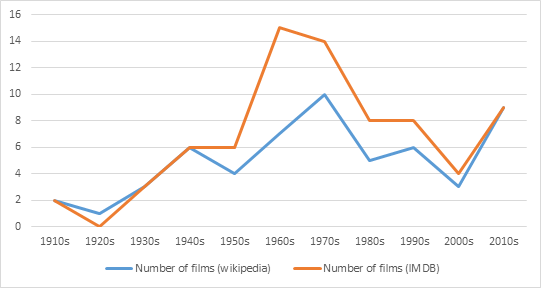
The monster did not disappear in the 1980s and 1990s, with numerous comics adaptations and parodies, including erotic versions, but it became less prominent in mainstream superhero comic books. While DC and Marvel were still committed to intermedial properties, the popularity of monster-based comic book horror waned,7 as did Frankenstein’s centrality in popular culture (see the decline in the number of movies in fig.1).
Paradoxically, this obsolescence became the basis for Frankenstein’s eventual return to superhero fiction. In the early 21st century, the character has become identified with the memory of popular culture, a resource which contemporary superhero comics and their near relatives tap eagerly.8 In 2002, Geoff Clock identified “meta-comics” as a distinct genre, which mined the history and codes of the medium to organize their narratives (Klock), but this mode of writing has arguably become the default configuration for successful superhero comics.9 While the Frankenstein monster does not fit in the chronology of Alan Moore’s The League of Extraordinary Gentlemen (it only appears briefly in The Black Dossier and in the written supplements to the second volume), it is present in Warren Ellis’s seminal Planetary as one of the buried pillars of contemporary popular culture. In the episode (#13), the main character of the series, Elijah Snow, pays a visit to the ambiguous heroes of the 19th century: Dracula, the Invisible Man and Sherlock Holmes. Frankenstein’s laboratory is depicted at length, and while Warren Ellis’s script directs the reader’s attention to the literary references, John Cassaday’s illustrations draw inspiration from 1930s cinema, while colorist Laura Martin uses desaturated colors, reminiscent of black-and white cinema. The Universal films are no longer a relevant form of popular culture, they are part of the archive, just like the novel which inspired them over a century before. That Frankenstein may be briefly used as an antagonist, but he functions as a relic, excerpted from an obsolete hypotext.
Numerous contemporary series make use of Frankenstein in a similar way, as a powerful index of the history of popular culture, and do not necessarily engage with any specific hypotext, or with the larger architext encompassing the previous renditions of the myth (Genette; Letourneux). In Jeff Lemire’s Sherlock Frankenstein, for instance, the patronym of the character serves as the mere promise of a steampunk tone. A more elaborate but similar approach is to be found in Mike Mignola’s Frankenstein Underground, a mini-series set in the Hellboy universe. Much like Swamp Thing, Hellboy and its spin-offs work on the frontier between superhero fiction and horror, with a keen and often explicit awareness of literary intertexts (Bukatman). Frankenstein’s creature first appears in the Hellboy universe as an antagonist in a short-story, not unlike its uses in superhero comics of the 1940. Since golems and artificial creatures abound in this fictional universe, the introduction of the creature itself could only be read as a move from the architext to a hypotext, a more specific reference. In Frankenstein Underground, however, Mignola transforms the creature as well as the reference and aligns them with the rest of his fictional universe: the monster finds itself in an underground realm inspired by Edgar Rice Burrough’s Pellucidar, Jacques Bergier and H.P. Lovecraft. After a brief prologue, the name of the character is all that remains of Shelley’s novel, again a mere index, or a form of evocative but shallow literary name-dropping.
Frankenstein also functions as a more complex reference, however. Jeff Lemire, who wrote Sherlock Frankenstein, also authored Frankenstein Agent of S.H.A.D.E. for DC Comics between 2012 and 2013.10 In the series, the creature is part of a team of monsters, which points to the Universal crossovers of the 1940s and to their descendance, such as NBC’s Monster Squad (1976), since it also includes a mummy, a werewolf and a creature from the black lagoon.11 The monsters serve as a covert group of morally ambiguous super-powered beings employed by the government for suicidal missions, following a well-established template in superhero comics such as Suicide Squad (DC) and Thunderbolts (Marvel). The title of Jeff Lemire’s series encapsulates this hybridity, by inserting Frankenstein’s name in the structure of Marvel’s “Nick Fury, Agent of S.H.I.E.L.D.” (first published in Strange Tales, 1965-1968). The S.H.I.E.L.D. was also a covert governmental agency, a kind of fictional C.I.A., and the series was itself a transposition of the popular James Bond films (Dr. No, From Russia with Love and Goldfinger were released between 1962 and 1964) in the Marvel superhero universe.12
However, Lemire is not merely interested in intertextual pleasures at the surface level, but uses the Frankenstein monster to tease out the Frankensteinian undercurrents within the superhero genre. The stories include tales of creators overwhelmed by their creatures and most tellingly, an encounter between the monster and OMAC—One Man Army Corp—a synthetic hero created by Jack Kirby in the 1970s, whose original series include chilling images of mass-produced synthetic humans. Lemire thus highlights not only the compatibility between the monster and the superhero genre—a compatibility amply demonstrated in the examples we have mentioned so far—but also some of the ways in which Mary Shelley’s story and its subsequent retellings have silently provided themes and stories for superhero comics.
While Frankenstein Agent of S.H.A.D.E. displays a high level of awareness regarding these generic intersections, Frankenstein figures with explicit or strongly implied connection to the archive of popular culture appear to have multiplied in contemporary superhero comics. Even The Punisher, a street-level vigilante character with no apparent connection to that story received a Frankenstein story-arc (“Franken-Castlen” 2009-2010), in which the character died and was rebuilt by a community of monsters once more inspired by the mid-century Universal cycle. When the pulp-inspired villains of the story arc attack the community, one of them exclaims: “They have a Frankenstein” (Remender et al. n.p.). The indefinite article is telling: the creatures have become so ubiquitous that they are part of the fabric of the superhero genre.
Conclusion
This overview suggests that Frankenstein has proved compatible with the superhero genre, though the uses of the story have evolved over time. In the 1940s, Frankenstein served as a shortcut to the thrills of horror cinema and the pleasures of a “body genre” which crudely manufactured comic books could only approximate through intertextual borrowings. Though temporarily restrained by the Comics Code from 1954 to 1971, this appetite for combining the thrills of horror with the superhero genre returned in the 1970s; the titles noticeably eschewed the camp and innocuous reading of the movie monsters, which had been prevalent in comics in the previous decade.
Now more than 80 years removed from the Universal movies, Frankenstein appears to be associated in superhero comics with the memory of horror as a popular genre. Crucially though, it remains alien to genre. In spite of multiple attempts at assimilation, it remains a marker of familiar otherness, part of shared culture, which has proved useful to superheroes since their inception. Superhero comics thus appear as a site in which the Frankenstein mythos—as a syncretic architext encompassing the novel and especially the filmed versions—is constantly reexamined and reactivated, helping to maintain its continued relevance in popular culture.
Notes
- 1In both cases, probably to avoid any risk of copyright infringement, the creature bears little connection to the Karloff/Pierce version of the Universal movies.
- 2This shorthand or confusion appears to have been common long before Briefer’s decision; it can be found in Edith Wharton’s The Reef (1916), for instance, and it crept into the Universal movie cycle with the title of Frankenstein meets the Wolf Man (1933), though actual dialogues in the film still maintain the distinction between the two.
- 3IMDB stands for the Internet Movie Database (www.imdb.com).
- 4The full name of the document is the “Code Of The Comics Magazine Association Of America, Inc.”, but I shall refer to it as the Comics Code, for brevity’s sake.
- 5Castle of Frankenstein (Gothic Publishing, 1962-1975) was a prominent imitation of Famous Monsters; it used a painted portrait of Karloff in Frankenstein make-up for its first issue.
- 6Another serialized Frankenstein appeared in Skywald’s derivative black-and-white horror magazines Psycho, Nightmare and Scream as “Frankenstein: Book 2,” introduced as a sequel to Shelley’s book. The filmic intertext is apparent here, from the monster to the laboratory and the presence of Pretorius (from Bride of Frankenstein). Although the serial format and the introduction in the arctic connects this to the later Marvel version, it plays out as a fairly typical Skywald horror story, with monstrous reversals and gruesome imagery.
- 7Swamp Thing, as written by Alan Moore (1984-1987) was both popular and important, but the comics it inspired, notably Hellblazer, Neil Gaiman’s Sandman and most of the Vertigo imprint used horror as part of a complex and referential generic mix, which left little space for traditional monsters. Regarding the place of these works in the history of horror in comics, see Wandtke.
- 8Prominent independent North-American comics creators, including Seth, Daniel Clowes, Charles Burns, Art Spiegelman and Chris Ware also foreground the history of the medium in some of their most acclaimed works.
- 9While the ur-example of these meta comics remains Alan Moore and Dave Gibbons’s Watchmen (DC Comics, 1986), writers like Matt Fraction, Warren Ellis, Mike Mignola and Grant Morrison have all been producing successful and highly reflexive mainstream comics since the early 2000s.
- 10This version of the character was created by Grant Morrison in a Frankenstein mini-series, and later became part of the Justice League Dark super-team, along with Swamp Thing.
- 11Marvel Comics toyed with the idea in the mid-70s, but the “Legion of Monsters” only appeared in a few scattered issues. DC Comics also used sporadically the “Creature Commandos” in Weird War Tales from 1980 to 1982, for adventures set during the Second World War.
- 12Peter Coogan discusses Nick Fury in his seminal text on the definition of the superhero (Coogan 87). He reaches the disputable conclusion that the character is not part of the superhero genre himself because he has clear ties to other genres. This counterintuitive assertion merely proves that genres never exist at the level of single characters, but are codified and identified in series of texts as well as in their assorted peritexts. It also strongly suggests that academics are not in a position to rule characters out of genres.
Works cited
- AuBuchon, Aaron. Monstrous Changes. 2018. Web. Accessed 17 Feb. 2020. https://spark.adobe.com/page/G1wH4wjIjsclB/
- Bukatman, Scott. Hellboy’s World: Comics and Monsters on the Margins. Oakland: University of California Press, 2016.
- “Code of the Comics Magazine Association of America, Inc.” Comic Book Legal Defense Fund, 26 Oct. 1954. Web. Accessed 17 Feb. 2020. http://cbldf.org/the-comics-code-of-1954/
- Comic Book Legal Defense Fund, 1971. Web. Accessed 17 Feb. 2020. http://cbldf.org/comics-code-revision-of-1971/
- Coogan, Peter. “The Definition of the Superhero.” A Comics Studies Reader, 2009. 77–93.
- Darowski, Joseph J. “‘The X-Men Meet Frankenstein! “Nuff Said”’: Adapting Mary Shelley’s Monster in Superhero Comic Books.” Adapting Frankenstein: The Monster’s Eternal Lives in Popular Culture. Ed. Dennis Cutchins and Dennis Perry. Manchester: Manchester UP, 2018. 259-69.
- Denson, Shane. “Marvel Comics’ Frankenstein: A Case Study in the Media of Serial Figures.” Amerikastudien / American Studies, vol. 56, no. 4, 2011. 531–53.
- Gabilliet, Jean-Paul. Of Comics and Men. Jackson: Mississippi University Press, 2010.
- Genette, Gérard. The Architext: An Introduction. Trans. Jane E. Lewin. Oakland: University of California Press, 1992.
- Gregory, Chase. “In the Gutter: Comix Theory.” Studies in Comics, vol. 3, no. 1, Aug. 2012: 107–28. doi:10.1386/stic.3.1.107_1.
- Hatfield, Charles. Hand of Fire: The Comics Art of Jack Kirby. Jackson: University Press of Mississippi, 2012.
- Jones, William B. Classics Illustrated A Cultural History 2nd Ed. Jefferson: McFarland Publishing, 2011.
- Kaplan, Arie. From Krakow to Krypton: Jews and Comic Books. Philadelphia: The Jewish Publication Society, 2008.
- Klock, Geoff. How to Read Superhero Comics and Why. New York: Continuum, 2002.
- Labarre, Nicolas. “Selling Horror: The Early Warren Comics Magazines.” Comicalités. Études de Culture Graphique. Forthcoming.
- Lee, Stan (writer), and Jack Kirby (penciler). “At Last, the Fantastic Four Meet the Hulk!” Fantastic Four, no. 12, Mar. 1963.
- Letourneux, Matthieu. Fictions à La Chaîne : Littératures Sérielles et Culture Médiatique. Paris : Éditions du Seuil, 2017.
- Machinal, Hélène, ed. Le Savant fou. Presses universitaires de Rennes, 2013.
- Mitchell, W. J. T. “Beyond Comparison.” A Comics Studies Reader, Ed. Jeet Heer and Kent Worcester. Jackson: University Press of Mississippi, 2009. 116–23.
- Remender, Rick (w.), et al. “Franken-Castle.” Punisher, no. 13, Mar. 2010.
- Segall, Don (w.), and Bob Jenney (p.). “The Monster Lives…” Frankenstein (Dell), no. 1, May 1963.
- Skal, David J. The Monster Show: A Cultural History of Horror. New York: Norton, 1993.
- Wandtke, Terrence R. The Comics Scare Returns: The Contemporary Resurgence of Horror Comics. Rochester: RIT Press, 2018.
- Weinstein, Simcha. Up, up, and Oy Vey! How Jewish History, Culture, and Values Shaped the Comic Book Superhero. Fort Lee: Barricade Books, 2012.
About the author(s)
Biographie : Nicolas Labarre est maître de conférences HDR à l’université Bordeaux Montaigne, où il enseigne la civilisation des États-Unis. Ses recherches portent sur la bande dessinée nord-américaine et plus particulièrement sur les questions de genre et d’intermédialité. Il est l’auteur de Heavy Metal, l’autre Métal Hurlant (PUB, 2017) et de La Bande dessinée contemporaine (PU Clermont Ferrand, 2018).
Biography: Nicolas Labarre is an assistant lecturer in American society and culture at Bordeaux Montaigne University, France. He has published many articles on North-American comics, with a focus on issues of genre and intermediality. He is the author of Heavy Metal, l’autre Métal Hurlant (PUB, 2017) and La Bande dessinée contemporaine (PU Clermont Ferrand, 2018).