The Enclave in Brian Selznick’s Novels: a Transient Space for Self-construction
Abstract: This paper studies the enclave in two novels by Brian Selznick, The Invention of Hugo Cabret and Wonderstruck, and argues that it constitutes an underlying structure allowing the author to develop his main concern, the necessity for many people to find a new family for themselves. The different spaces of the narratives are examined in terms of Michel Foucault’s concept of heterotopia. This highlights the ambivalent function of the public buildings in which the plots unfurl, as open spaces where the heroes can find shelter and friends, and as enclosed spaces where they have to hide. The enclosed spaces mirror the psychological isolation of Selznick’s handicapped or orphan heroes. Relying on Frances Tustin’s study of autistic enclaves and Benoît Virole’s analysis of deafness, this paper isolates the author’s pictorial and narrative processes to create a psychological enclave around his characters. Finally, it shows that this interior enclave is conceived as a transitory space that the protagonists leave to find the place where they belong, with the help of their biological family. The enclave thus becomes a transient space for self-construction where Selznick’s heroes can build their identities as future adults.
Keywords: Psychological enclave, Autistic, Deaf, Picture book, Transient space, Transitional object
Résumé : Cet article se propose de montrer que dans deux romans de Brian Selznick, The Invention of Hugo Cabret et Wonderstruck, l’enclave constitue une structure sous-jacente qui permet à l’auteur de développer sa principale préoccupation, à savoir la nécessité, commune à de nombreuses personnes, de se trouver une nouvelle famille. Les différents espaces narratifs sont examinés à travers le concept d’hétérotopie défini par Michel Foucault qui met en évidence la fonction ambivalente des bâtiments publics dans lesquels se déroulent les intrigues, lesquels sont à la fois des espaces où les héros trouvent un abri et des amis, et des espaces clos où ils doivent se cacher. Les espaces clos reflètent l’isolation psychologique des héros orphelins ou handicapés de Selznick. En s’appuyant sur une approche psychologique de l’enclave, basée sur l’étude des enclaves autistiques de Frances Tustin et l’analyse que fait Benoît Virole de la surdité, l’article isole les procédés picturaux et narratifs mis en œuvre par l’auteur pour créer une enclave psychologique autour de ses personnages. Finalement, il montre que cette enclave intérieure est conçue comme un espace transitoire que les protagonistes doivent quitter pour trouver, avec l’aide de leur famille biologique, une nouvelle communauté où vivre. L’enclave devient ainsi un espace transitoire de construction de l’individu où les héros de Selznick peuvent construire leur identité de futurs adultes.
Mots-clés : Enclave psychologique, Autiste, Sourd, Album, Espace transitoire, Objet transitionnel
Introduction
With The Invention of Hugo Cabret and Wonderstruck, Brian Selznick introduced a new form of picture book which can be considered as an enclave in this particular medium of children’s literature. Indeed, the very length and size of these books—with 533 pages for the first one and 640 for the second—make them stand out among picture books. This, however, did not prevent The Invention of Hugo Cabret from being granted one of the highest distinctions for picture books, the Caldecott Medal, in 2008. This unusual format presents 159 images, each of them spread over a double page, and 105 double pages of text. Text and image never face each other, as each one brings a new development to the narration. In The Invention of Hugo Cabret, Selznick “wanted to create a novel that read like a movie” (Selznick, “Caldecott Medal Acceptance” unpaged), hence the alternation of text and images, a cinematographic process that can be found in silent films. In Wonderstruck, he adapted the process in order to have the text and the images tell two different stories—a pictorial story and a verbal one set fifty years apart—which become one in the last section of the book. By their length, their format, the use of text and image as alternating narrative modes, The Invention of Hugo Cabret and Wonderstruck explore the boundaries between the picture book, the conventional novel, the graphic novel and the film. As they do not clearly belong to a definite category, they remain enclaved among other genres.
Besides their formal features, both books explore the concept of enclave as an underlying structure which allows the identities of Selznick’s heroes to develop. Each narrative involves the enclosed space of a public building where the protagonists live temporarily. In The Invention of Hugo Cabret, most of the plot unfurls in a Parisian train station where Hugo, the hero, works as the timekeeper, in a universe of clocks and mechanisms which seem to have a life of their own in his mind. This appears in his first description of the broken automaton that his father found in the attic of a museum: “The man was built entirely out of clockworks and fine machinery” (Selznick, 2007 114) and is confirmed a few pages later when “Hugo and his father began to think of the automaton as an injured animal that they were nursing back to health” (121). In Wonderstruck, Selznick takes his two heroes on a journey away from the secluded places where they live to the American Museum of National History, a place of memory and wonder, where they hope to find a family member.
In both books, the plots are set in the past, The Invention of Hugo Cabret is set in the 1930s and Wonderstruck pictorial and verbal narratives unfurl respectively in 1927 and 1977. This distance in time between the stories and their reader contributes to enclosing the narratives in a distinct reality of fictional and historical nature.
In each story, the children protagonists are either orphans or neglected by their parents. Hugo, the hero of The Invention of Hugo Cabret, is an orphan whose father, a clockmaker, died in a fire while trying to repair a broken automaton, supposedly able to write. The boy then went to live with his uncle, the timekeeper in a Parisian train station, who taught him his job. One day, Hugo’s uncle disappeared and the boy decided to stay in the small apartment where they lived within the station, because he had no other place to go. But his presence has to remain unnoticed by the station inspector who would send him to an orphanage if he learnt Hugo’s situation. As a result, the boy avoids communicating with the people who work in the station. Isabelle, the other child protagonist of the narrative, is an orphan too. However, she lost her parents as a baby, and, contrary to Hugo, was adopted by friends of her father’s. In Wonderstruck, Ben, the hero of the verbal narrative, lost his mother just before the beginning of the story, and never knew his father. A photograph and an address on a bookmark found in his mother’s belongings start him on a journey to find his father. But a bolt of lightning traveling through the telephone, as Ben is calling the number on the bookmark, leaves him completely deaf. Rose, the heroine of the pictorial story, is also a deaf child but she was born to rich and busy parents who have no time for her. Like Ben, she finds herself enclosed in a world of silence.
Deprived of their natural family, Selznick’s heroes are struggling to find a new one, as he explains in an interview: “You have the family you’re born into but you have this need to meet other people who are uniquely like you. One of the things that people told me they were most moved by in Hugo was how he creates a new family for himself. That’s a truth for so many people. You leave your family and create a family for yourself that is often a better fit. Wonderstruck is a more direct way of exploring that same theme” (Corbett, 2011 unpaged). So, both The Invention of Hugo Cabret and Wonderstruck develop narratives resting on the underlying concept of enclave, in terms of space and in terms of human groups.
This paper will study the enclave as an underlying structure that allows the author to develop his main concern, the necessity to create a new family for oneself. We will first analyze the different spaces of the narratives and the processes involved in the creation of enclaves to determine their function. We will then isolate the specific features of Selznick’s heroes that contribute to creating a psychological enclave around each of them in order to understand how the enclave is generated and what it entails. Finally, we will examine the process of self-construction that eventually enables Selznick’s heroes to leave the transient space of the enclave.
1. Transient spaces and secret spaces
The magic of mechanisms
In The Invention of Hugo Cabret and Wonderstruck, Selznick sets his heroes in transient spaces: a train station or a museum. Both places evoke the concept of heterotopia defined by Michel Foucault. According to him, heterotopias are “des lieux réels, des lieux effectifs, des lieux qui sont dessinés dans l’institution même de la société, et qui sont des sortes de contre-emplacements, sortes d’utopies effectivement réalisées dans lesquelles les emplacements réels, tous les autres emplacements que l’on peut trouver à l’intérieur de la culture, sont à la fois représentés, contestés et inversés” (Foucault 755). Foucault states six principles that describe a heterotopia:
- it is a feature of human groups and can be found in any culture in the world,
- it can function differently according to the synchrony of the culture in which it occurs,
- it can juxtapose in a single real place several spaces, several sites that are in themselves incompatible,
- it often entails a break with traditional time in what Foucault calls a heterochrony,
- it always features a system of opening and closing that both isolate[s] it and make[s] it penetrable,
- it has a function that relates it to the remaining space.
Foucault considers the museum as a heterochrony where time accumulates indefinitely through its collections. The train station can be considered as a heterotopia too, since it juxtaposes in its space other different spaces—like shops and cafés—that are not usually found in the same space. By allowing people to travel from one place to another, the train station links all the different spaces surrounding it, while remaining a space of its own, both isolated and penetrable.
In The Invention of Hugo Cabret, Foucault’s concept of heterotopia highlights specific social features of the train station that makes it a little world of its own. For the passengers who come and go, and for the people who work there, it is a living place that includes a café, where Hugo buys or steals bottles of milk or pastries, a bookshop, a toy booth, the Inspector’s office with a jail cell, and even apartments built for the people who run the station. In this little world there lives a micro society of working people, with its own gossip and folklore. When Madame Emile, the café owner, learns through her friend, who cleans the station, that the timekeeper died long ago, and that his body has just been found, she offers her own interpretation of what happened:
The clocks in the station should have stopped working when he drowned since no one was taking care of them… but they didn’t. They kept running perfectly! The timekeeper was resting comfortably at the bottom of the river. Obviously he didn’t want to be bothered, and his ghost kept the clocks running. But they went and disturbed him and haven’t you noticed? The clocks are all breaking down! The station is haunted! (Selznick, The Invention of Hugo Cabret 411)
The supernatural presence that the café owner suggests evokes magic, another feature of this “enacted utopia”, and a favorite theme of Selznick1, who explained: “When I was making The Invention of Hugo Cabret, I wanted to make it magical without putting any magic in it” (Eastland 42). For Hugo, and the reader who sees through his eyes, the magic of the train station is located in its clocks and mechanisms, which seem to have a life of their own. In the three last double pages of the opening sequence of the book, Hugo’s eye, hidden behind the number five in the gigantic clock on the wall, makes the mechanism literally alive.
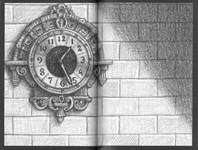
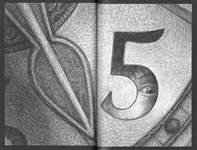
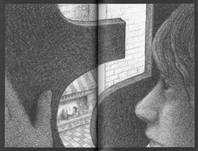
The Invention of Hugo Cabret (p. 40-41; 42-43; 44-45)
Copyright © 2007 by Brian Selznick. Used by permission of the artist.
Besides his timekeeper job, which he wishes to keep secret, Hugo works for the old man who sells toys in a booth. The owner caught him stealing mechanical toys from him, and made him work for the items he took. But the job is an opportunity for the boy to discover an environment that fascinates him: “Hugo found himself surrounded by more mechanical parts than he ever could have imagined. Everywhere he looked there were buckets of loose metal bits, tiny motors, gears, springs, nuts, bolts, and brightly colored tins” (Selznick, The Invention of Hugo Cabret 166). Next to the mechanisms that will enable him to repair his automaton and make him write, the boy discovers another type of magic: “While Hugo worked, the old man played cards. […] As he watched the old man play, he saw things that captivated him. The old man didn’t just shuffle the deck, he fanned it and flipped it and made the cards jump into an arching bridge […]” (166). Hugo’s father had told him that the first automata had been built by magicians to impress their audiences. The magic that the old man and the boy see in mechanisms and cards allows their relationship to evolve progressively from suspicion and contempt to trust and respect.
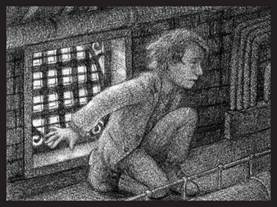
The realistic space of the train station encompasses hidden spaces too, spaces forbidden to the public, where all the mechanisms which regulate the life of the place can be found. There, Hugo needs to wind up the huge clocks of the station regularly to prevent people from noticing his uncle’s absence. In order to do that, he has to crawl within the walls, through an air vent (figure 12) so as not to be seen. Selznick’s careful attention to detail—revealed in the representation of pipes, valves and wires (figure 13)—and his naturalistic drawing style develop a realistic pictorial atmosphere while his black and white pencil drawings enclosed in a black frame remind the reader of images in silent movies. This black frame, present on every double page of the book, encloses the whole narrative in a cinematographic conception. Sequential drawings develop a feeling of storyboard (figures 12, 13 and 14), and establishing shots introduce the reader to unusual settings (figure 12) in the language of cinema. But as we mentioned, Selznick uses the language of old silent movies, a language that 21st century readers are not familiar with, which thus introduces a feeling of distance and mystery. Behind the air vent, a medium-close shot guides the reader’s gaze to Hugo’s crouching body, squeezed between the wall and the small railing bordering the narrow ledge. The light coming from the other side of the air vent contrasts with the darkness of this inner, enclosed place.
The Invention of Hugo Cabret (p. 64-65)
Copyright © 2007 by Brian Selznick. Used by permission of the artist.
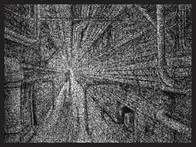
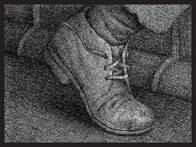
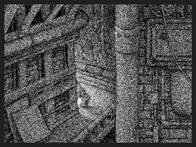
As Hugo runs in the narrow passageway (figure 13), the low vertical angle and the central perspective create the dramatic effect of enclosure enhanced by the large pipes converging toward the small figure of the boy. In the contracting space of the image, the reader can only identify the silhouette of the boy, which induces an effect of suspense that adds to the mysterious character of the place Hugo is running to. Zooming in, another process borrowed from cinema, contributes to increasing the suspense, as the reader has to guess that the close-up view of the huge shoe represents Hugo’s foot (figure 14) and to follow the foot disappearing on a narrow ledge, behind a corner surrounded by the vertical lines of walls (figure 15).
The Invention of Hugo Cabret (p. 66-67; 68-69; 72-73)
Copyright © 2007 by Brian Selznick. Used by permission of the artist.
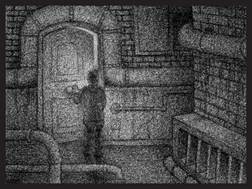
The suspense culminates when Hugo opens a large door with a big doorknob which stands out as an invitation to a different space, perhaps an apartment.
The Invention of Hugo Cabret (p. 74-75)
Copyright © 2007 by Brian Selznick. Used by permission of the artist.
The reader does not enter Hugo’s personal space with images, but with words. This change in the narrative mode modifies the rhythm of the story, and the double page of text compels us to slow down our reading pace. The text, inserted between two images, mirrors the embedded space Hugo has led us to, through the space within the walls of the station. Selznick, who explained in an interview that he used drawings for the descriptions in his book (Corbett, “Drawn to Cinema”), could have added more images. His turning to words instead shows a deliberate choice that may be linked to the more secretive character of words, which must be deciphered through reading.
Some sunlight filtered through the dirty skylight. Hugo looked at the rows and rows of jars, filled with pieces from all the toys he had stolen from the toy booth over the past few months. The jars sat on shelves made from scavenged planks he had found inside the walls of the station. Under his rickety bed lay a pile of Hugo’s drawings. His deck of cards rested on a dusty trunk in the middle of the room (Selznick, The Invention of Hugo Cabret 76).
The lexical field of marginality through “toys he had stolen,” “scavenged planks,” “rickety bed,” “dusty trunk” reveals the function of the apartment as a secret place where Hugo can live in hiding, a squalid, silent enclave which the reader discovers as Hugo’s gaze wanders around the room.
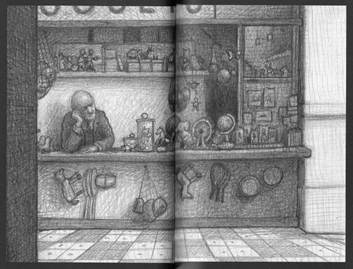
The toy booth is another enclave embedded in the heterotopia of the train station. In the opening sequence of the book, an image depicts the upper body of the old man leaning on the display table in a sleeping attitude that parallels the motionless jars and toys next to him. His feeling of boredom, his impossibility to move, as the table bars his way, are confirmed at the end of the narrative, when the old man, who turns out to be Georges Méliès, a former magician and a famous filmmaker of the beginning of the 20th century, explains how he lost his films because of the first world war: “With the money I made from the sale of my films, I bought the toy booth, where I’ve been trapped ever since […]” (406).
The Invention of Hugo Cabret (p. 34-35)
Copyright © 2007 by Brian Selznick. Used by permission of the artist.
The magic of wonder
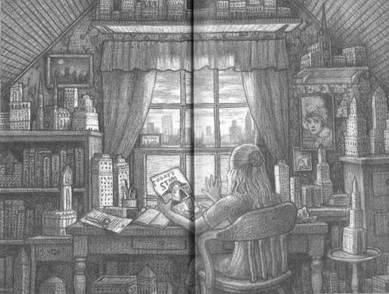
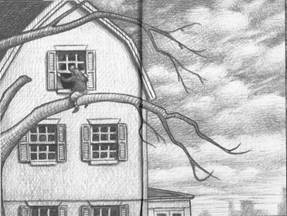
Whereas The Invention of Hugo Cabret develops the heterotopia of the train station which depends on the magic of mechanisms, Wonderstruck creates a heterotopia of wonder and discovery in the American Museum of Natural History. The same concern for authenticity runs through the two narratives that compose the story, which Selznick comments upon as follows: “Everything that happens could actually happen in the real world. They are unlikely, but not impossible” (Eastland 42). The heroes of the two narratives both live in places they want to leave. Since his mother’s death, Ben has been obliged to share his cousin’s bedroom and to endure his sneering. But the reason why he wants to leave is to find his father, and he repeatedly asks his friend Jamie to call his aunt’s family to which he will return. In contrast, Rose feels trapped in the big mansion where she lives with her authoritarian father. She refuses to learn how to lip-read and escapes through her bedroom window to go to her mother, a famous actress playing in a New York theater. But the girl exchanges one prison for another since her mother refuses to take care of her and locks her in her dressing room. Once again, a window allows her to escape. In Rose’s narrative, windows represent a gateway to the world that her parents want to protect her from. In the narrow space of her bedroom under the roof, crammed with books and miniature buildings, the window, in a central position, is the source of light and of Rose’s inspiration as she tries to make paper models of New York buildings. The realistic details of her escape—the proximity of the tree branches and of the car roof next to Rose’s father’s house, and the size of the tiny window in her mother’s dressing room (300-301)—emphasize the difficulty to leave the closed spaces she is locked in.
Wonderstruck (p. 38-39)
Copyright © 2011 by Brian Selznick. Used by permission of the artist.
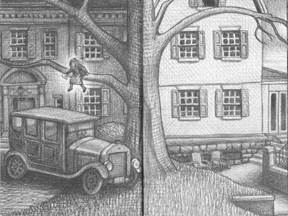
Wonderstruck (p. 58-59; 60-61)
Copyright © 2011 by Brian Selznick. Used by permission of the artist.
Rose’s and Ben’s journey to find a family member take them both to the American Museum of National History in New York. But the function of the museum is different for each of them. Ben needs to find information about his father, and for him, the heterotopia of the museum is a place of memory where the accumulation of collections allows one to go back in time and discover clues in the past. In contrast, Rose is looking for her brother who works there and runs through the halls to escape the watchman. Her erratic flight ends in a room dedicated to “cabinets of wonders” where she hides. The image displaying the room functions like a pause in the narration, as the details of the innumerable objects sitting on the shelves, in the open drawers or hanging from the ceiling retain the reader’s eyes. The central perspective, with the converging lines of the shelves, the floor tiles and the ceiling beams, creates a dramatic effect that allows the artist to cram the room with collected objects, like a little museum enclaved in the museum.
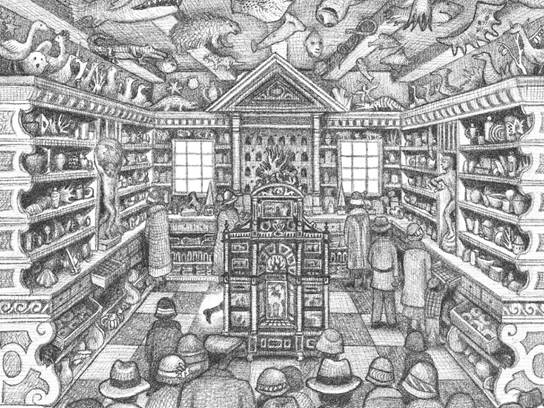
Wonderstruck (p. 403-402)
Copyright © 2011 by Brian Selznick. Used by permission of the artist.
In the sequence of five double pages that follows this picture, a point-of-view editing process alternates images of Rose’s captivated gaze and pictures of the stuffed animals on the ceiling and the objects on the shelves. This room is also the place where Rose’s brother, who recognized her as she ran past the book shop, finally finds her and takes her to his apartment. The room is thus featured as a unique place in the museum, an enclave of wonder in terms of collection and in terms of human relationship.
As we mentioned above, for Ben the museum functions as a place of memory. After his mother’s death, the wolves started haunting Ben’s dreams, so the wolf diorama awakens unexpected memories in him:
He was staring into the shimmering light of the aurora borealis cascading across a painted night sky. Beneath the blue light of an unseen moon, two wolves were running across a snowy landscape, heading right for Ben. A terrible shiver rippled through him.
It was as if someone had cut out the dream from his brain and put it behind glass (Selznick, Wonderstruck 359).
This text is the exact echo of the sequence of five images that opens the narration, before Ben’s story actually starts, at the beginning of the first part of the book. In the second image, the frontal angle of depiction allows us to make eye contact with the two running wolves, and the zooming in process on the eyes of the closest one, in the following images, takes us through its pupil, into Ben’s story which begins with a dream about wolves: “Something hit Ben Wilson and he opened his eyes. The wolves had been chasing him again and his heart was pounding” (Selznick, Wonderstruck 16).
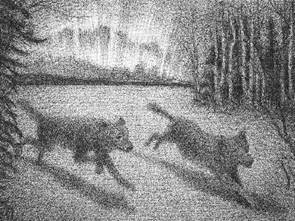
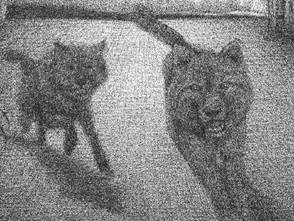
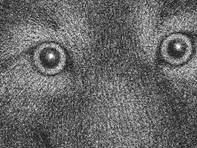
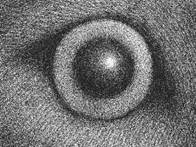
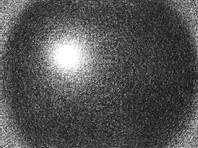
Wonderstruck (p. 4-5, 6-7, 8-9, 10-11, 12-13)
Copyright © 2011 by Brian Selznick. Used by permission of the artist.
Whereas in The Invention of Hugo Cabret, the train station had its own hidden life depending on mechanisms enclaved within the walls, in Wonderstruck, the museum has a memory of its own, hidden in its archives, stored in a place restricted to staff that Ben discovers with his friend Jamie, whose father works in the museum: “The elevator jerked and lowered slowly into the basement, where Jamie led Ben down another maze of hallways to large double doors peeling with a century worth of paint” (Selznick, Wonderstruck 407). In the archives, Ben discovers that his father built the wolf diorama, fifteen years before. But the museum keeps records of the past only. To link the past with the present, Ben needs Jamie’s help.
When Jamie takes Ben to his secret room, an old storage room where he keeps his photographs and his records, he allows him to link the past with the present. With a locked door and a KEEP OUT sign on it, the room provides a place where the boys get to know each other, and a shelter for Ben who has no place to go in New York, as Jamie writes for him before leaving: “You sleep here. It’s safe. Toilet’s down the hall. Look out for the night watchman” (Selznick, Wonderstruck 385). A place to live in and where to discover friendship, the secret room is also a place of wonder, as the reader discovers that it was the room dedicated to the exhibition about cabinets of wonder in which Rose hid, fifty years before, and the room pictured in the exhibition book Wonderstruck that Ben found in his mother’s belongings. The secret room thus epitomizes Sezlnick’s message, as he elaborates on the function of memory of the museum and the role of the curator to parallel his hero’s personal choices: “How would Ben curate his own life? And then, thinking about his museum box, and his house, and his books, and the secret room, he realized he’d already begun doing it. Maybe, thought Ben, we are all cabinets of wonders” (574). Through the metaphor of the cabinet of wonders, every human being becomes his/her own museum.
In contrast to Hugo’s apartment, the secret room doesn’t bind Ben or Jamie to it. Ben is aware that it is only a transient place, as the text states: “Maybe he could rest here for a while, on this musty fur. Until his head cleared and he could figure out what to do next” (Selznick, Wonderstruck 382). Several types of enclaves can thus be distinguished in The Invention of Hugo Cabret and Wonderstruck. While the train station and the museum are little worlds where people meet, work or discover things depending on the magic of mechanisms or the magic of wonder, other enclaves, like Hugo’s uncle’s apartment or Rose’s father’s house, prevent the heroes from leaving and communicating. In both books, these enclaves are the consequences of a painful family situation.
2. Heroes in psychological enclaves
An orphan with a mechanical mind
As we mentioned in our introduction, Hugo and Ben lost their parents and Rose feels neglected by hers. Hugo feels responsible for his father’s death since he insisted on his repairing the automaton. So, when he finds the broken machine in the ruins of the museum after the fire, he decides to take it to his uncle’s apartment to repair it himself. The boy has inherited his father’s talent to repair clocks and mechanisms: “by the time he was six, Hugo was able to fix just about anything” (Selznick, The Invention of Hugo Cabret 116). His brain itself works like a machine. When he first goes to the toy booth to work for the old man, Selznick describes his mixed feelings in terms of mechanisms: “He could feel the cogs and wheels in his head spinning in different directions” (167). The same mechanism reappears when he finally understands that he can trust Isabelle and tell her his story, after he discovered that the old man was Georges Méliès, the filmmaker: “[…] it was as if he could feel the cogs and wheels begin to engage in his mind, and the words suddenly came together” (365). Similarly, he thinks of people as parts of a big machine: “I like to imagine that the world is a big machine. You know, machines never have any extra parts. They have the exact number and type of parts they need. So I figure if the entire world is a big machine, I have to be here for some reason” (378).
The boy is persuaded that the automaton’s message will help him: “Hugo felt sure that the note was going to answer all his questions and tell him what to do now that he was alone. The note was going to save his life.” (132) To prevent questions about his presence in the station, he avoids making contact with other people and is particularly reluctant to talk. When caught stealing by the old man in the toy booth, he doesn’t protest with articulate words: “Hugo growled like a dog” (50). Asked about the notebook covered with mechanical drawings which he kept in his pocket, he “growled again and spit on the floor” (60). Hugo’s reluctance to talk and to make contact with the people around him, and his mechanical mind bear some resemblance with certain features that can be found in autistic children. Frances Tustin defines the most prominent aspect of autism in children as follows: “The greatest handicap and the most consistent amongst autistic children is the impairment in the ability to make emotional relationships with other people. They will fail to make contact or play with other children, as well as lacking responsiveness to adults” (Tustin 4). She defines a category of autistic children—“encapsulated children”—who are particularly fascinated with mechanisms, which is precisely Hugo’s case. Encapsulated in a world that depends on secrecy and hiding and centers on mechanism, he is totally unaware of others’ feelings or emotions. When Isabelle, the old man’s goddaughter, explains to him that she started looking for his notebook and would like to see what is written in it:
“Then don’t look for it.” Hugo glared at her.
“I’m trying to help you. Why are you being so mean?”
Hugo blinked. He had never thought of himself as mean before. The old man was mean, not him. Hugo had no choice… he had to keep secrets, but he couldn’t explain this to the girl. (Selznick The Invention of Hugo Cabret 168)
This reluctance to make contact with others also appears in the images. Hugo is often depicted in profile or with his eyes turned to one side, or bent on his work. When we first discover his face, he doesn’t look straight at us, but glances over his shoulder. According to Clare Painter, J. R. Martin and Len Unsworth, this type of picture invites the reader into the story while providing insight into the character’s intention (Painter, Martin, and Unsworth 30). On this image, the backward glance is ambiguous: Hugo may be inviting the reader to follow him into the story, and he may be checking for unwanted followers as well. The same backward glance reappears in two other images of the same sequence (p. 24-25 and 26-27), just before he enters the air vent, which confirms that he is indeed making sure that nobody follows him.
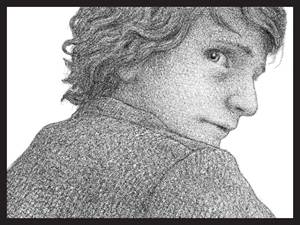
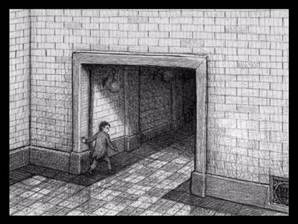
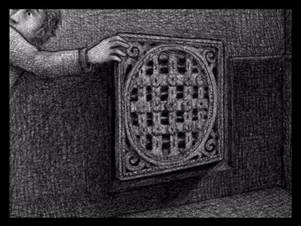
The Invention of Hugo Cabret (p. 18-19; 24-25; 26-27)
Copyright © 2007 by Brian Selznick. Used by permission of the artist.
The extraordinary material circumstances Hugo finds himself in, and the trauma of feeling responsible for his father’s death have triggered a need for secrecy in him that prevents him from making contact or entering into emotional relationships with other people. He thus lives in a psychological enclave that shares certain features with the autogenerated encapsulation of a particular type of autistic children. These features, however, do not make him autistic, as will be seen in the last part of this article. Like Hugo, the heroes of Wonderstruck have, to a certain extent, encapsulated themselves in worlds of their own.
An orphan who feels like an alien
Ben was born deaf in one ear, which makes him different from his cousin, who often jokes about his handicap. He likes to collect things and his mother offered him a box with a wolf engraved lid to keep his collection. He also enjoys looking at the stars and reproduced constellations on his bedroom ceiling, which prompted his friend Billy to compare him to an alien: “Ben had laughed along with Billy, but every time he looked through his telescope after that, he had the same thought: I’m an alien” (Selznick, Wonderstruck 23). His friend and his cousin do not understand why he prefers observing and collecting things instead of fishing and hunting, so Ben comes to think of himself as an alien. At the hospital, after being struck deaf by lightning, the thought invades his dreams: “he was an alien, circling the North Star, as Major Tom waved good-bye” (Selznick, Wonderstruck 195). When he looks at himself in the mirror of the museum bathroom, the same thought comes to his mind: “With the water and dirt dripping from his exhausted face, he really did look like an alien” (328). His feeling different from the other boys may partly explain why he is so quiet and shy. His mother joked about this feature:
When he was little, she used to call him Turtle because he was so quiet. “You know, Turtle,” she said before they left for school, “you shouldn’t be such a turtle…. Remember to stick your neck out…. Speak up, be brave.”
His mom ran her fingers down his cheek until they touched the underside of his chin, and she lifted his face so their eyes met. “Don’t be afraid to look people in the eye when they talk to you, okay?” (25-26)
In Ben’s story, the word “Turtle” is related to the little turtle made of sea shells that his mum offered him. However, the nickname used by his mother to describe his social behavior, parallels the idea of the “encapsulated child” defined by Tustin.2 When he arrives in New York, after losing his hearing, he realizes that he now lives in a world different from the one he used to know: “Ben tried to imagine the honking, screaming, screeching soundtrack, but to him it unfolded noiselessly, like a scary movie, with the sound turned off” (265). When he presses the doorbell, at the address mentioned on the bookmark, he has to talk to a lady but he can no longer understand her: “Back home, even when his family and the hospital staff had written things down for him, they still talked a lot, and Ben realized that he had to do a huge amount of guesswork to piece together a conversation” (Selznick, Wonderstruck 308-309). He thus finds himself enclaved in a world of silence and incomprehension, where communication is either impossible or useless. His feeling of alienation, already present in the way he thought of himself as an alien, becomes overwhelming. According to Benoît Virole, this feeling is common among people suddenly deprived of hearing: “La perte subite d’une des modalités sensorielles aboutit à une modification importante du sens de la réalité marquée par l’apparition d’un sentiment d’étrangeté au monde” (Virole 262). Like Hugo, but for different reasons, Ben does not try to make contact, even with Jamie who helps him to pick up the contents of his suitcase, which fell and opened on the stairs of the museum: “The boy handed Ben Wonderstruck, which he must have picked up off the stairs. Ben took the book, placed it in the suitcase, and snapped it shut. Then he rushed past the boy and pushed through the revolving doors (321).”
Ben’s feeling of isolation and alienation parallels a feature that the author had observed while researching his subject in Through Deaf Eyes, a television documentary, which featured a young deaf man, raised by hearing parents. In the acknowledgements of Wonderstruck, Selznick explains: “It wasn’t until he went to college and met other deaf people that he felt he had really found his community” (630). Finding a new community or family is a major theme in Wonderstruck and a central concern for Selznick who grew up as a homosexual in a heterosexual family. In fact, the theme becomes progressively more central in his books: while Hugo and Ben are both orphans and have to find another family, the hero of The Marvels3, published in 2015, has got his two parents but cannot find his place in his biological family. The heroine of Wonderstruck is not an orphan either, but she developed a feeling of alienation within her family because, like Ben, she is deaf.
A deaf girl trying to find where she belongs
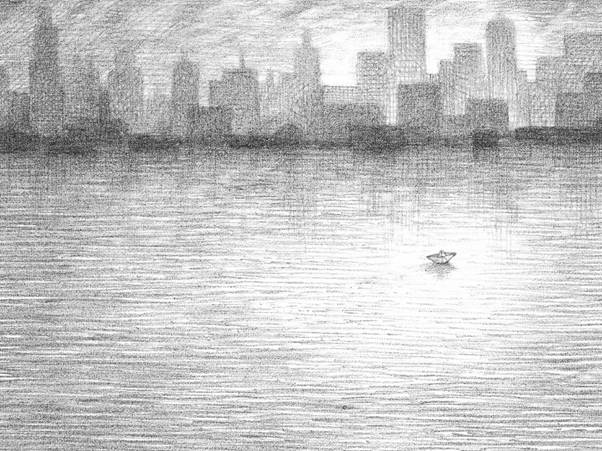
Throughout the book, deafness connects the two children in a similar feeling of alienation, that Selznick expresses in two reading modes: the words and the images. A comment from Through Deaf Eyes “about how the deaf people are the people of the eye and […] sign language is a language that you must see in order to understand,” led him to think that a story about deaf people told entirely through images “would echo the way they live” (Eastland 40). In Rose’s story, the pictorial mode is thus an actualization of the deaf girl’s world. As we noticed in part 1, Rose feels trapped in her father’s house, away from the world and New York. Her feeling of alienation also appears in her attempts to contact other people. At the end of the story, she explains that, when she was a child, she “used to write little notes and send them out into the world because [she] felt so alone” (Selznick, Wonderstruck 544), like in this sequence of images, in which she has written “help me” on a piece of paper that she folds into a paper boat, which she sends floating on the river. Rose wants to communicate but doesn’t know how. On the last image of the sequence, the wake that the tiny boat leaves behind it forms an oblique vector, showing that it is crossing the water. The lonely little paper boat is thus a metaphor of Rose, who would like to cross the water herself, to discover New York and join her mother.
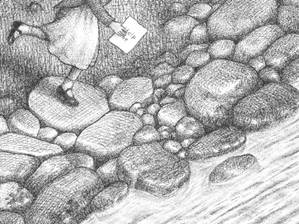
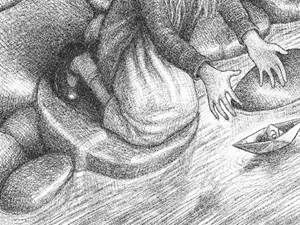
Wonderstruck (p. 72-73, 80-81, 82-83)
Copyright © 2011 by Brian Selznick. Used by permission of the artist.
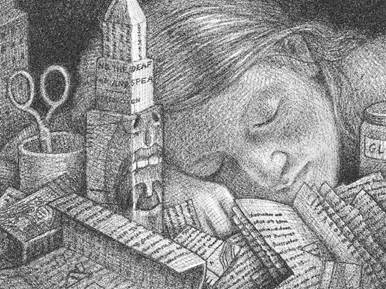
By cutting her lip-reading course book into paper skyscrapers, Rose asserts her difference with her hearing parents. The image that displays her sleeping on her desk, surrounded by paper skyscrapers cut in the pages of her lip-reading course book, is a metaphorical representation of Rose’s refusal to speak. The pair of scissors, on the left hand-side, the glue pot on the right-hand side and the cut pages of the open book suggest that she made the paper skyscraper, and that for her, a lip-reading book is nothing but cutting material. It also reveals Rose’s talent for building models, another feature which highlights her difference with her parents.
Wonderstruck (p. 192-193)
Copyright © 2011 by Brian Selznick. Used by permission of the artist.
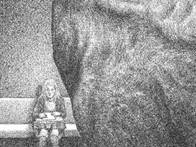
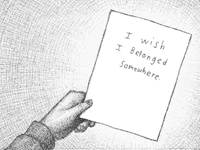
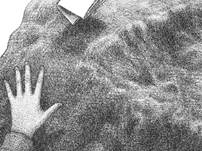
Rose’s notes to the world are an attempt to communicate in a different way. The message which she leaves in the American Museum of National History, after escaping her mother’s dressing room—“I wish I belonged somewhere”—conveys her feeling of alienation and isolation in her own family. The meteorite stands as a narrative device that connects Ben’s and Rose’s stories and adds symbolic weight to Rose’s message. One page before, Ben was looking at it, wondering: “if a meteorite was a shooting star, could you still make a wish even after it had fallen to Earth?”(345).
Wonderstruck (p. 346, 347, 350, 351, 354, 355)
Copyright © 2011 by Brian Selznick. Used by permission of the artist.
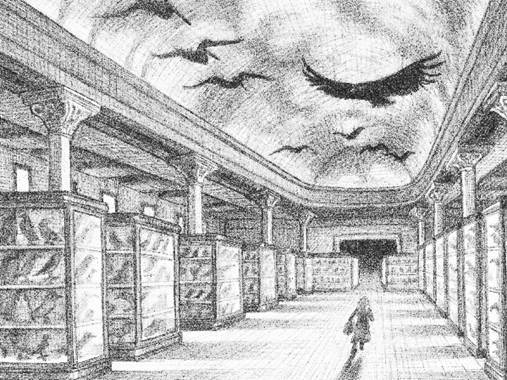
Unable to explain what she did to the watchman who scolds her, Rose panics and starts running and hiding. The creatures exhibited behind the glass windows or standing around her look suddenly unfriendly or aggressive to her. The central perspective and the low horizontal angle of view emphasize the huge size of the desert hall and of the black birds suspended from the ceiling in contrast to the tiny figure of the running girl. The detailed depiction of the large black bird positioned above Rose as if it were looming over the fleeing girl conveys her feeling of fear to the reader.
Wonderstruck (p. 370-371)
Copyright © 2011 by Brian Selznick. Used by permission of the artist.
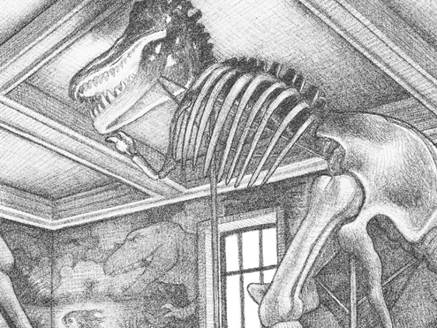
This feeling culminates when she passes the tyrannosaurus’s skeleton (figure 10). The frog’s eye shot enlarging the gigantic skeleton’s head and bones, and the lighting effect which illuminates the inside of its upper jaw contribute to building an impression of terror, enhanced by the setting which depicts a living tyrannosaurus on the wall. The direction of the depicted tyrannosaurus jaw and its gaze form vectors pointing at Rose’s head, producing a palpable sense of fear on the girl and the reader, who is taken directly into the heart of drama by the frontal angle.
Wonderstruck (p. 374-375)
Copyright © 2011 by Brian Selznick. Used by permission of the artist.
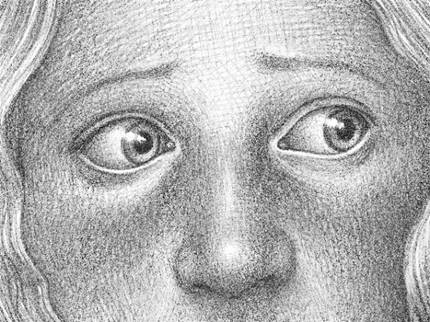
In her enclave of loneliness, incomprehension and silence, Rose starts to be afraid of the people around her. The metonymic depiction of her eyes in close-up shot enhances the silent message of fear in her gaze, imprisoned in the frame of the image, as, like Hugo, she checks for unwanted followers.
Wonderstruck (p. 378-379)
Copyright © 2011 by Brian Selznick. Used by permission of the artist.
Like Hugo and Ben, Rose is trying to find a community to which she belongs, but in contrast to Selznick’s male heroes, she still has her family and she can share her feelings with her brother, who helps her to find the community that she needs, in a school for deaf children. Hugo and Ben, who are both orphans, need some help from their lost parents, to find their way out of their isolation and alienation. In Selznick’s worlds of mechanisms and wonder, this help is materialized by a particular object.
3. Transitional objects to leave the enclave
The idea of objects that help children to go through a special period of life is reminiscent of the concept of the transitional object, developed by Donald W. Winnicott, as one aspect of the transitional phenomena which he uses to describe a particular developmental sequence of children. An infant sees itself and its mother as a whole. When infants begin to separate the “me” from the “not me,” they start using objects that help them transition from subjective omnipotence—where the mother is experienced as an extension of child—to objective reality. Winnicott defines the transitional object as follows: “a term that describes the infant’s journey from the purely subjective to objectivity; and it seems to me that the transitional object (piece of blanket, etc.) is what we see of this journey of progress toward experiencing” (Winnicott 6).
Several features of this concept can help to understand how Hugo and Ben leave their enclave. Both find themselves in psychological enclaves because of a trauma caused by the separation from either a father or a mother, and both go through an experience that will lead them to a more objective perception of themselves and the world. To achieve this, they use an object left to them by one of their parents, which functions as the transitional object.
Clockworks and dreams
The object that helps Hugo leave his psychological enclave is the automaton that he retrieves from the ruins of the museum after his father’s death. Though it binds him to the dark apartment within the walls of the station where he can repair it, it also connects him to the old man of the toy booth and his goddaughter Isabelle. It first appears in Hugo’s notebook, when the old man asks the little thief to empty his pockets. The sequence of images shows the fingers of the old man sliding constantly toward the head of the automaton, while the zoom in process progressively focuses on it, displaying the old man’s particular interest in the automaton. This interest causes him to take away Hugo’s notebook, which prompts the boy to come back for it, and thus starts a relationship with the old man.
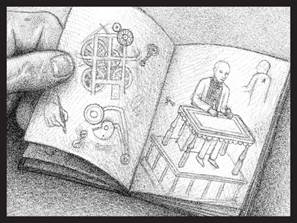
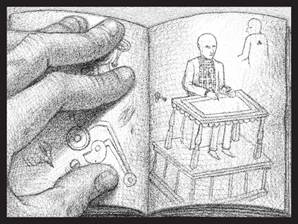
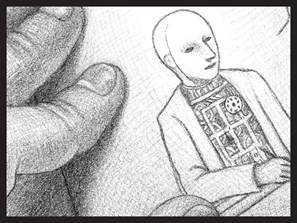
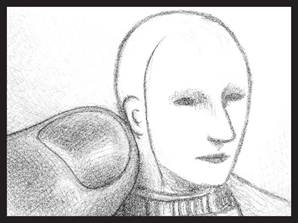
The Invention of Hugo Cabret (p. 52-53, 54-55, 56-57, 58-59)
Copyright © 2007 by Brian Selznick. Used by permission of the artist.
The automaton connects Hugo to Isabelle too, since she offers to retrieve his notebook for him, and then discovers the machine after following him into his apartment within the walls. While the text presents mostly Hugo’s point of view, an image connects both children to the automaton. The connection is made by the converging vectors formed by the children’s profiles and the automaton’s body prolonged by the sloping ceiling, and by their three gazes converging to the sheet of paper on which the mechanical man is about to write.
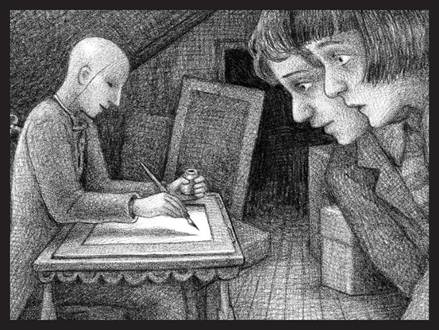
The Invention of Hugo Cabret (p. 238-239)
Copyright © 2007 by Brian Selznick. Used by permission of the artist.
Hugo had imagined the automaton’s message in his father’s handwriting, but it turns out to be a drawing signed Georges Méliès, which Isabelle reveals to be the name of her “papa Georges.” The boy recognizes the drawing as an image he saw in a film he watched with his father. The automaton thus appears as the object which connects Hugo to the old man in the toy booth and to cinema. Because the mechanical man was left by his father, its message triggers Hugo’s mechanical mind to find the connection between things and people, which takes him out of his enclave of secrecy and hiding, and helps him to find his purpose in the big machinery of the world. In the last chapter of the book, the function of the automaton as the object which allowed the hero to leave his psychological enclave is acknowledged through the hero’s voice:
Once upon a time, I was a boy named Hugo Cabret, and I desperately believed that a broken automaton would save my life. Now that my cocoon has fallen away and I have emerged as a magician named Professor Alcofrisbas, I can look back and see that I was right. The automaton that my father discovered did save me. (Selznick, The Invention of Hugo Cabret 509-510)
Cabinets of wonders
On his quest for his father, Ben is helped by the box that his mother offered him for his collections. He enjoys touching his objects one after the other, as if they brought him comfort, like transitional objects. But the box helps him to connect with Jamie, who picks it up when Ben leaves it behind on the stairs of the museum. To return it, Jamie puts a note on top of the meteorite, asking “What’s inside the box?” (Selznick, Wonderstruck 358) and provides a plan of the museum to reach a meeting place. This place turns out to be the wolf diorama which the boy selected after noticing the wolf engraved on the box lid.
In the safe space of Jamie’s secret room, the box functions as a miniature cabinet of wonder which connects the two boys by revealing their common interest in collecting things. When Ben opens it, Jamie wants to touch the objects: “He asked questions and put out his hand so he could touch all the items himself. Ben watched as Jamie held the objects, and for some reason, it made him happy. Only his mum had ever shown this much interest in his collection” (384).
The box is thus mentioned at every development of the boys’ relationship, until they discover the romantic friendship that connects them, when Jamie remarks, after showing Ben the museum by night:
“I’ve never shown anyone the museum before. Your wolf box made me think you’d like it.” Jamie paused for a moment and looked quickly at Ben. In that split second, Ben saw something in Jamie’s glance, something that connected the two of them, beyond the secret room and a love for the museum. (424)
From then on, the box is no longer mentioned, and Jamie helps Ben out of his enclave of silence and loneliness. He starts to show him sign language, and provides the new address of the book shop that Ben was looking for. There, Ben finds an old deaf lady who turns out to be Rose and his grandmother. So, the box In Wonderstruck and the automaton in The Invention of Hugo Cabret function as transitional objects left to Ben and Hugo by one of their parents to help them to leave their enclave of loneliness and alienation and to find a new family or community.
Conclusion
In The Invention of Hugo Cabret and Wonderstruck, Selznick creates heroes who either lost their parents or feel unable to fit in the family model, and try to find a new family or community for themselves. The narratives are set in enclosed public spaces which function like heterotopias that the author develops as little worlds, where the reader experiences the magic of mechanisms and wonder. Selznick’s cinematographic narrative mode—with sequential images which look like storyboards and frequent changes in the size of the frame—and the naturalistic style of his black and white pencil drawings enclose his worlds in a specific language.
The train station in The Invention of Hugo Cabret depends on the power of the clock mechanisms that regulate the life of all the people who work there, and the train departures. As a heterotopia, it encloses within its walls dark working and living spaces that bind the hero to the station, and public spaces like the toy booth, which offers him the opportunity to work with a former magician and to discover the magic of people. In Wonderstruck, the heterotopia of the museum functions as a place of memory and wonder for the two heroes trying to find a family member. As a place of memory, it connects the pictorial and the textual narratives through the specific spaces it encloses, such as the meteorite exhibition room or the “Cabinet of Wonders”. As a place of wonder, it encloses spaces that connect people, like the “Cabinet of wonders”, which Selznick develops into a metaphor of every human being, thus linking it to his contemporary reader.
In both books, the enclosed space the heroes live in or go through parallels the psychological enclave in their minds. Hugo’s mechanical mind thinks of people as parts of the big machinery of the world, in which he tries to find his own purpose by reading the message of a machine. A feeling of alienation caused by deafness, or by a nascent sexual preference in Ben’s case, keeps the heroes of Wonderstruck in an enclave of silence. To leave their enclave, Hugo and Ben need objects left to them by their parents—the automaton or the engraved box—which help them transition from their biological family to the new family or community they need.
Notes
- 1Magic is the subject of the first book that Selznick authored, The Houdini Box, published in 1996, whose title refers to Houdini, a famous magician of the late 19th century.
- 2In the French version of Tustin’s book, “encapsulated child” is translated into “enfant à carapace” (Tustin, Les États autistiques chez l’enfant 97).
- 3A similar pattern of enclave, inside an old house which looks like a museum, can be found in The Marvels which clearly mentions the theme of homosexuality.
References
- Corbett, Sue. “Drawn to Cinema.” Publishers Weekly 254.8 (2007): 64–65. Web.
- Corbett, Sue. “Q & A with Brian Selznick.” Publishers Weekly Aug 04, 2001 (2011): n. pag. Web.
- Eastland, Katherine. “Deaf Meets Wonderstruck.” Humanities 33.1 (2012): 38–42. Print.
- Foucault, Michel. “Des Espaces autres” Dits et écrits, 1954-1988. Vol. 4. Paris: Gallimard, 1994. 752-762.
- Painter, Clare, James Robert Martin, and Len Unsworth. Reading Visual Narratives. Image Analysis of Children’s Picture Books. N.p., 2013. Print.
- Selznick, Brian. “Caldecott Medal Acceptance.” 2008: 1–4. Web.
- Selznick, Brian. The Invention of Hugo Cabret. New York: Scholastic Press, 2007. Print.
- Selznick, Brian. Wonderstruck. New York: Scholastic Press, 2011. Print.
- Tustin, Frances. Autistic States in Children. 2013th ed. London: Routledge, 1992. Print.
- Tustin, Frances. Les États autistiques chez l’enfant. Trans. Christian Cler and Mireille Davidovici. Paris: Seuil, 2003. Print.
- Virole, Benoît, ed. Psychologie de La Surdité. Bruxelles: De Boeck Université, 2006. Print.
- Winnicott, Donald. Playing and Reality. 1971. New York: Routledge, 1999.
About the author(s)
Biographie : Isabelle Gras est professeure des écoles et doctorante en quatrième année de thèse à l’Université Bordeaux Montaigne, sous la direction de Mme la professeure Nicole Ollier au sein de l’équipe d’accueil CLIMAS. Ses recherches se focalisent sur le rôle de la métaphore et la relation entre texte et image dans les albums anglophones pour enfants, notamment dans les œuvres de Neil Gaiman et Dave McKean, de Shaun Tan et de Brian Selznick. Elle a été co-organisatrice du colloque « L’enclave dans les mondes anglophones » et a effectué diverses présentations à Bordeaux, à Toulon au congrès de la SAES, et Galway à la 13e conférence de ESSE. Elle a publié dans la revue Leaves, en 2015, un article qui examine la voix et le regard de l’enfant dans la littérature à public double.
Biography: Isabelle Gras is a schoolteacher and a PhD student at Université Bordeaux Montaigne, under the supervision of professor Nicole Ollier, among the research team CLIMAS. Her research focuses on the relationships between text and images in picture books as well as the role of metaphor in visual and textual narration in a selection of picture books by Neil Gaiman and Dave McKean, Shaun Tan, and Brian Selznick. She co-organized the conference on “The Enclave in the Anglophone World” and gave presentations at conferences in Bordeaux, at the 2015 SAES congress in Toulon and at ESSE 13th conference in Galway in 2016. In 2015, she published an article focusing on the child’s voice and gaze in dual audience literature, in Leaves.