Disaster and the Response of Art in Shakespeare’s The Winter’s Tale
Abstract: Shakespeare’s The Winter’s Tale presents not just the tragic decline of a hero and salvation through supernatural comedy; it also presents a ‘disaster’ and Shakespeare’s suspicion that a disaster can never be solved through human means. In this his thought anticipates Maurice Blanchot’s L’Écriture du désastre. Disaster is un-writeable and cannot be recovered from. But Shakespeare also shows how art can repair some of the damage. Art can show that disaster is impossible to recover from and at the same time recreate our impossible but necessary faith in recovery. Art can make us demand that art itself become nature, and disaster become redemption, even as it shows us that neither can ever really occur.
Keywords: Winter’s Tale, Blanchot, Disaster, Art, Shakespearean romance
Résumé : Le Conte d’hiver (A Winter’s Tale) de William Shakespeare ne décrit pas seulement la chute tragique d’un héros et son salut grâce aux ressorts comiques et surnaturels de la pièce ; celle-ci montre également un « désastre » et le doute du dramaturge qu’un tel désastre puisse être jamais réparé humainement. En cela, il anticipe la réflexion de Maurice Blanchot dans L’Écriture du désastre. Le désastre ne peut être désécrit ni être surmonté. Toutefois, Shakespeare indique dans quelle mesure l’art peut constituer en partie une réparation. L’art montre tout à la fois qu’il est impossible de se remettre du désastre et que nous devons pourtant croire à nouveau dans une impossible mais nécessaire guérison. Il nous invite à exiger de lui-même qu’il quitte l’artifice pour se transformer en nature et ainsi rédimer le désastre, tout en démontrant que ni l’une ni l’autre métamorphose ne peuvent jamais se réaliser vraiment.
Mots-clés : Winter’s Tale, Blanchot, Désastre, Art, Romance shakespearienne
Art, Disaster and the Coup de Théâtre
What is, or can be, the response of art to shock, disaster, mourning and the imperative of recovery? A strange but moving answer can be found in the concluding scene of Shakespeare’s The Winter’s Tale (1611; originally published 1623), where a commemorative statue is unveiled, grief is renewed, remorse and humility are awakened … and then the statue apparently comes to life.
The scene comes at the end of a play where characters have had several occasions already to reflect on the question of the character of ‘art’ in relation to ‘nature.’ There will be much to mourn in The Winter’s Tale: because of an apparently causeless rage of jealousy and a resultant exercise of tyranny, the law of a kingdom has been undermined; the alliance of two formerly friendly kingdoms has been destroyed; a boy, the lawful heir to the throne of the kingdom of Sicily has died; a woman, the queen of the kingdom has died; another child, the new born daughter of the king and queen, has been exposed to the elements and left to die at sea. All of these deaths, ruptures and absences are traumatic: there does not seem to be anything else to do about them but mourn. The guilt of the king, Leontes, has been made evident to everyone in the kingdom, the king included, by the delivery of a verdict and prophecy from the oracle of Apollo at Delphos. He remains king; the rule of the land is sustained. But he is not the man he used to be. He is desolate with remorse, and apparently overcome by a condition of mourning that cannot be escaped. The ‘winter’ in The Winter’s Tale refers in part to this, the wintry condition of the kingdom of Sicily after the disaster it has sustained. But the play concludes with an astonishing coup de théâtre when the statue comes to life. Sculpted by a famous artist, the statue was supposed to commemorate the dead and give mourning a place and an image; instead it comes to life, turning into nature, and undoes mourning.
“O she’s warm!” (V.iii.109) says Leontes as the statue, now the very person of his wife Hermione, comes down from her pedestal and takes his hand. “If this be magic,” he goes on to say, “Let it be an art lawful as eating” (V.iii.110-11). The statue embraces Leontes in a gesture that cannot help recall the legend of Pygmalion, as told by Ovid (see Rico). But then (unlike Pygmalion’s creation) the statue speaks: it is Hermione herself, not fashioned by her creator like a sculpture but preserved, she says, by her own volition in the midst of death. She is not, and never has been simply a statue. For she is also, or has also become, herself, a living creature.
I think of this coup de théâtre as a dramatization of what seems to be for Shakespeare the aporia of the ‘response of art’. For in this coup art succeeds in undoing mourning by becoming (or having all along been) the one thing that art cannot be: a work of nature. Art may succeed in responding to disaster so well that it redeems the disaster, but only when it is no longer art. There is a well known passage that would seem to deny that there is an aporia in the idea of art becoming nature. Discussing the ‘art’ of grafting flowers and creating hybrids, Polixenes, King of Bohemia, argues that when art alters nature in this fashion, the art itself is nature:
Yet nature is made better by no mean
But nature makes that mean: so, over that art
Which you say adds to nature, is an art
That nature makes. You see, sweet maid, we marry
A gentler scion to the wildest stock,
And make conceive a bark of baser kind
By bud of nobler race: this is an art
Which does mend nature, change it rather, but
The art itself is nature. (IV.4.89-97).
The ‘art’ in question here is a practical rather than a fine art. And the argument involves the straightforward claim that when a practical art allows humans to make improvements on a natural condition, that art ‘is’ nature in some sense, perhaps as a part to a whole: art is nature in the sense that art is a part of nature. So, at least in the frame of a practical (or ‘applied’) art, although it may seem that a human activity which alters nature thereby violates nature, the case is rather that the human activity and the resulting alteration are both parts of nature. There is no aporia at all: art is nature.1
But in the concluding scene of The Winter’s Tale, the identity of art and nature is more problematic. In the first place, the statue that comes to life is the product of both a practical and a fine art. Two centuries before the distinction between applied art and fine art would become commonplace, with the introduction of the locution ‘the fine arts,’ or in French ‘les beaux arts,’ Shakespeare already dramatizes a distinction between the two kinds of art and insists upon it (see Kristeller; Shiner). This statue, as one character insists, is very much the work of what we would now call the practitioner of a fine art, “that rare Italian master Giulio Romano, who (had he himself eternity and could put breath into his work) would beguile nature of her custom, so perfectly he is her ape” (V.ii.82-5). Yet Shakespeare also challenges the distinction, and in the end undermines it. If art becomes nature, in the final scene of the play, that is in part because a fine art becomes a practical art, a grafting onto nature rather than an imitation of nature. The ‘art’ through which Hermione comes to life, as Leontes says, would seem to be either like ‘magic’ or else like ‘eating’. It is not so much the work of a ‘master’ as an application of the will to live, or to make life live again, undertaken by way of a practice as a fulfilment of a wish. In the second place, the play itself problematizes the difference between what happens on the stage, that is to say what happens in the diegetic world of the play, and what happens in the theatre. In the diegetic world of the play, a work of art becomes a work of nature; in the theatre, a work of art is still a work of art. Nothing has come to life in the theatre except theatre itself. The “theatre of wonder,” as one critic has called it, both represents an act of wonder and evokes a wonder outside the representation, in the experience of theatre-going (see Bishop).
The response of art, the response of art to a disaster, the response of art as an aporia, where the aesthetic becomes the practical, and vice versa, and where art both does and does not merge with nature and fulfils a latent wish–any reading of the final scene of The Winter’s Tale has to come to terms with these themes. But these themes become especially pertinent if one wishes, as I do here, to address the problematic of ‘the disaster’ itself, the disaster as explained in Maurice Blanchot’s L’Écriture du désastre (1980), which is to say the disaster explained as the inexplicable. The disaster, for Blanchot, is not an event, it is not an objective fact, and yet it is; precisely in its inexplicability, in its non-objectivity, in its utter negativity, the disaster is. Blanchot is responding mainly to the Holocaust, although his remarks, it seems to me, may be applied to other disasters. His point, I take it, is not that the Holocaust cannot be historically explained, as for example in Hannah Arendt’s The Origins of Totalitarianism (1951) or Daniel Goldhagen’s Hitler’s Willing Executioners (1996), but that, on the one hand, it cannot be contained by its explanation, the negative event of the disaster always exceeding (or evacuating) the words that may be used to articulate it; and, on the other hand, but which amounts to the same thing, it cannot be explained away–literally, explanation cannot make the disaster go away. Yet the disaster cannot have a ‘future’ either (Blanchot, 1986: 2) It cannot have a future, first of all, in writing–or in any art (from the historical monograph to the memorial) that would try to articulate it, to make it into an object of expression and expectation. For purposes of writing, even of moral response, Blanchot argues, the disaster is not even an ‘event,’ and it did not take place.
Blanchot’s view is controversial. It seems to imply an embrace of fatalism and quietism in the face of evil and the necessity of death, dying and mourning: fatalism in the place of resistance, silence in the place of speech, passivity in the face of the activity of life (see Rose; Stone). There is nothing to do about the disaster except to acknowledge its disastrousness. But in the context of shock and the demand for reconstruction, the response of art and a text like The Winter’s Tale, the question all the same arises as to what would happen if one were to try to apply Blanchot’s insights (and his implicit refusal of insight, of resistance and speech) to the tragic catastrophes of The Winter’s Tale and the reversal of tragedy that comes with its miraculous, tragicomic ending. The controversy itself is worth consideration. The disaster: to what does it lead us, or fail to lead us? And what intervention, if any, can art make in our being led, or not led, to respond to it? I believe that Blanchot’s notion of the disaster can help us understand The Winter’s Tale, if by nothing else than by reminding us of how much is at stake in the disaster that strikes the kingdom of Sicily in the first three acts of the play. I also believe, however, that The Winter’s Tale has something to tell us about Blanchot’s notion of disaster, including something about the limitations of that idea, its refusal of praxis, its refusal to find either a before or an after in the disaster, to find something to work with in the disaster. Blanchot implies that there can be no art after the disaster, that there is no response of art, or at least no response which is not at the same time ineffective, addressed to the wrong phenomena, inscribed with the wrong symbolism. Shakespeare, avant la lettre, seems both to agree and disagree with this analysis. For in his late plays, like The Winter’s Tale, he highlights the incommensurability of what Blanchot calls “the disaster.” In all the four late ‘romances,’ Pericles, Cymbeline, The Tempest and of course The Winter’s Tale, the disasters that come are under-motivated; as I will show in what follows, they are morally unintelligible.2 And yet they are; they come into being and they disrupt. And so they anticipate Blanchot’s concept of the disaster as unredeemable negativity. Conversely, however, the shock of the disaster is ultimately resolved, and it is art that comes to the rescue–but only art in the form of an aporia. Thinking of what happens in the first part of The Winter’s Tale as a ‘disaster’ in the sense that Blanchot attributes to the word is something of a leap, to be sure. It works against the strain of critical traditions which emphasise the personal dramas in plays like The Winter’s Tale (see, for example, Nichols). Taking one or more characters as key to the analysis of what happens in the play–whether that character is Leontes in his crazy jealousy, his wife Hermione in her victimization, or the woman of the court Paulina in her advocacy–or explicating the systematic relations that bind the characters together, even in rivalries, critical treatments of the play in this strain tend to overlook ‘the disaster.’ Misfortune, sufferance, death and loss can all be accounted for as tragic outcomes of individual trajectories: the misfortunes of Leontes, or Hermione, or Paulina, and so forth. Such accounting of tragedy can be undertaken even when it is not so much personal failing or vulnerability that is thought to bring about misfortune as it is the system in which the individuals characters must experience their fates–in an essay by Catherine Belsey, for example, the system of the ‘nuclear family,’ or in an essay by Peter B. Erickson the system of ‘patriarchy.’ It may be, as Belsey puts it, that the play shows “death invading the concord of the family unit” and “sexual jealousy dismantl[ing] a marriage” (104). Or it may be, as Erickson puts it, that The Winter’s Tale dramatizes the ‘disruption’ and ultimate ‘revival’ of patriarchal order. But if ‘invasion,’ ‘dismantling,’ and ‘disruption’ are words marking destruction and discontinuity, they don’t quite amount to disaster. To name a case of misfortune or loss as a ‘disaster’ is to attribute to it a certain scale, both in quantity and quality. It is to find in misfortune a totality, or perhaps more accurately an ‘unworking,’ as Blanchot would put it, an uncountable negativity, not an injury or a disruption that can be rectified but a violent disappearance. The critical tradition knows that something has gone terribly wrong in Shakespeare’s imaginary kingdom of Sicily, but critics have not been inclined to see in the catastrophe the quantity and quality of a disaster.
When is a misfortune a disaster? Blanchot, unfortunately, is no guide here. And yet, in certain circumstances, disaster is. Perhaps in laying waste to the possibility of a commensurate symbolic response, like a ‘response of art,’ disaster is–in which case disaster comes to be defined by the resources for response that remain for the survivors. The difference between mere misfortune and misfortune on the scale of a disaster is that the survivors cannot redeem or avenge it, even symbolically. If in the ‘work of mourning’ as Freud initially explained it, the survivor has to shift his or her cathexis (or libidinal investment) from the lost object to a new one, the disaster leaves the survivor without the possibility of a new object; it has foreclosed the possibility of the new (see Clewell). The scale of the disaster, the scale of the misfortune such that it merits the name of a disaster, would be measured not by the mere quantity of loss but by the fact that, whatever the quantity, it has reached the condition of a quality of loss from which the path of recovery is foreclosed. Blanchot claims that the Holocaust is just such a disaster. History itself cannot recover from it. For the disaster is at bottom outside of history. And perhaps, though on this subject Blanchot is silent, any other disaster worthy of the name–if there be any such disaster, though again, Blanchot is silent about that too–would be disastrous precisely from its unrecoverability. The disaster cannot be redeemed.
The Winter’s Tale actually emphasizes that the misfortunes of the characters in the first part of the play amount to a disaster of this kind. It even suggests that the disaster they suffer is collective rather than merely personal. It is probably true, on a meta-level of representation, that the disaster that strikes is aimed at the system of the nuclear family, or the system of patriarchy, or even both. Certainly it is true, on a personal level, that a disaster strikes Leontes himself. He has lost the entirety of his family, and with it his posterity. But on the level of the action of the play itself the disaster is already collective in the sense that the whole kingdom is shown to suffer from it. In the last part of the play, after sixteen years have passed, the state is suffering. There is no heir to the throne. The state is in danger of facing a crisis of succession or even, as one courtier suggests, civil war or foreign invasion. Such dangers, of course, were commonplace in the early modern period. No disasters had to occur to bring them on, only dissent and infertility. Nor were extreme means necessary to avoid the danger. ‘Care not for issue’, Paulina tells Leontes,
The crown will find an heir: great Alexander
Left his to the worthiest; so his successor
Was like to be the best (V.i.46-49).
Leontes can simply choose someone to replace him when he dies, as Alexander chose his bodyguard Perdiccas to take over his empire. But learned members of Shakespeare’s audience would have known that the succession of Alexander did not work out well, leading to forty years of civil war in Macedonia and its territories. And they would have remembered their own anxieties about succession during the last years of Elizabeth’s reign, where conflict was only narrowly avoided by the popular appointment of James VI of Scotland to the English throne. The drama, embracing the idea of the inextricability, so far as monarchies are concerned, of the systemic, the personal, and the public, revived anxieties like those. It shows that the public or political world is unsafe so long as the personal life of the reigning monarch and the systems through which that life is governed are in a condition such as that in which we see the kingdom of Sicily to be, a state of disaster. The problems of the kingdom cannot be solved because the problem of what has happened to the king and his family cannot be solved. Not only has a king lost his queen and his heirs; not only has the king suffered a collapse into deep remorse and mourning; not only have such normally reliable structures such as what we now call the nuclear family and patriarchy been disrupted, and the foreign alliances of the nation been jeopardized; but the kingdom as a whole is in a state of shock. There is no future in this kingdom.
Staging Disaster
At least one recent, major production of The Winter’s Tale has literalised this disaster through sound and sight. Directed by David Farr and performed by the Royal Shakespeare Company, first in Stratford-upon-Avon (April 2009), then in London (2010) and finally in New York City (2011), this production puts the play in eighteenth century dress, and shows the opening action in a royal drawing room, dominated by a pair of towering bookcases.3 In Act 3, Scene 2, Leontes defies the message from the oracle of Apollo, which declares his wife innocent of adultery. “There is no truth at all i’ the oracle,” he says, insisting that an inquisition against her (for both adultery and treason) continue. “The sessions shall proceed: this is mere falsehood” (III.ii.137-38). Immediately the news is brought of the death of the king’s son, Mamillius. And immediately Leontes knows what the reason is. “Apollo’s angry; and the heavens themselves / Do strike at my injustice” (III.ii.143-44). Then the queen swoons and dies. Immediately, Leontes repents his behaviour and publically confesses his culpability. But it is too late for repentance. In the David Farr production, after Leontes one more time expresses his sorrow and confesses his guilt, the scene itself erupts. A rumbling like thunder is heard. The stage seems to shake, as from an earthquake. The scenery begins to tumble. The two great bookcases fall about twenty degrees, and the books and papers in them tumble to the ground.
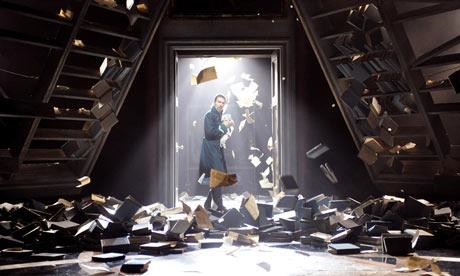
At least one spectator, a reviewer for The Telegraph, seeing the production in London, felt that the scene of disaster was inspired by 9/11 (Cavendish). The twin bookcases remind us of the twin towers. The collapse seems to speak for itself. Even observers who were not reminded of 9/11 saw in the staging an allegory for a collapse of a civilization, which is at a minimum what the director and designer intended (Gerard). In other words, what has befallen the kingdom of Sicily is a disaster.
The staged collapse of the architecture of Leontes’s world is of course an interpretive intervention. It is not in the text, although an earlier passage, spoken by one of the ambassadors sent to the oracle, give credence to the interpretation, when he refers to “the burst / And the ear-deafening voice o’ the oracle / Kin to Jove’s thunder” (III.i.9-10). What Farr and his designer Jon Bausor seem to have done is to take hints from the text and combined them with a post-9/11, post-disaster sensibility. But in doing so, they may have only confirmed a more abstract principle in the play that was there all along, namely that what Leontes and his kingdom have suffered is what Blanchot calls a disaster.
In support of this claim, at least three more pieces of evidence may be cited, one inherent to the psychology of the play, one to the dramatic situation and one to its dramatic structure. On the psychological level there is what is shown to be Leontes’s dilemma. The reason why Leontes and his state cannot move forward from the tragedy that has befallen them is that Leontes is stuck in a condition of mourning and self-recrimination, and he is stuck there because the paths for the work of mourning and forgiveness have been foreclosed. He is unable to marry again because he cannot forgive himself, and he cannot release himself from the binds of loving the woman he has killed. The only woman he could love would be the woman he has lost, but the woman he has lost is … lost, and no substitutes are possible. In other words, there is no equivalent. And only an equivalent would do. “There is none worthy, / Respecting her that’s gone” (V.i.34-5), Paulina insists. Leontes even goes further by speculating that if he were to marry another woman, and treat her better than he had treated Hermione, the latter would rise from the grave and “incense me / To murder her I married” (V.i.61-2). Since there is no possible substitute, the dead Hermione will not be substituted. But if a substitute were found, Leontes would have to do for the second wife what he has already done to the first, and cause her to die. Leontes’s condition is incurable. Or rather, Leontes’s condition is incurable through any conventional and plausible means. The oracle has already pronounced that “the king shall live without an heir, if that which is lost be not found” (III.ii.133-4), meaning the lost child, Perdita, exposed to the elements. Paulina later reiterates the problem, emphasizing the quandary it imposes:
Is’t not the tenor of his oracle,
That King Leontes shall not have an heir
Till his lost child be found? Which that it shall,
Is all as monstrous to our human reason
As my Antigonus to break his grave
And come again to me, who, on my life,
Did perish with the infant (V.i.38-44).
“Monstrous to our human reason,” implausible and even unnaturally grotesque, the divine decree, according to Paulina, requires not that a substitute wife be found and a substitute heir be born, not that Leontes recover through the work of mourning and be able to father a legitimate ‘issue,’ but rather that that which can never be recovered, that which is ‘lost,’ as lost as her dead husband Antigonus, be found. Instead of a substitute, Leontes must find what he is actually lost in the disaster he brought down upon his kingdom, his real daughter. Yet the idea is ‘monstrous.’
Such a quandary pertains to the question of remarriage too. Leading Leontes on, Paulina extorts the promise that she will be the one to decide if Leontes ever remarries, not Leontes himself, and yet that the person Leontes would marry would have to be “As like Hermione as is her picture” (V.i.73). And as for that, it shall only be, says Paulina, apparently taunting Leontes, ‘when your first queen’s again in breath; / Never till then’ (V.i.83-84). There can be no substitutes. Only the recovery of what has really been lost will do. The disaster can only be redeemed when it is no longer a disaster.
Impossible Worlds, Insoluble Problems
And so we come, from the psychological and situational quandaries in which the kingdom is placed, to the overall dramatic world in which such suffering demands a solution: the dramatic world of the late plays, the tragicomedies or romances, where the marvellous and the supernatural have overtaken the realism of Shakespeare’s hitherto tragic world. The tragedies look for real solutions to real problems, and when such solutions cannot be found, tragedy comes as a consummation. The romances begin with real problems already brought to the edge, or over the edge, of tragic outcome, and reverse those outcomes with miraculous endings. There are many different ways to account for the generic shift in Shakespeare’s last plays, and their reliance on the marvellous. But one account is surely this: that in a play like The Winter’s Tale, Shakespeare develops a dramatic dilemma which cannot be resolved by realistic means or worked out through the mode of tragedy and catharsis. And in The Winter’s Tale, I am arguing, the problem is that the dramatic dilemma is a disaster. It has no future, except by means which accomplish the impossible, which negate the undeniable and annul the disaster. In other words, though still improbably, it has no future except by means of ‘art.’ Critic Catherine Belsey is right, I think, to point out that collections of secular statuary were not yet common at the time that Shakespeare wrote this play (Belsey, 90-101; and see Snyder, The Winter’s Tale, 254n), and she is right too to point out that the only common statuary of the dead in Shakespeare’s world was either iconic or funereal. Set in niches or fixed on the lid of a sarcophagus, statues of real world rather than mythological figures, as also of saints from the real world history of Christianity, were usually inserted into a context of worship, of mourning and reverence. There is an element of this dimension of experience when Leontes goes to see the statue. “We came / To see the statue of our queen” (V.iii.9-10), says Leontes to Paulina, meaning himself and his newfound daughter Paulina. It appears to be mainly for Perdita’s benefit that they have come. For Perdita has never seen her mother. And the emotional context seems very much like a visit to a tomb, in a holy place; again, a context of mourning and reverence. But it is very specifically a ‘gallery’ of statues that Leontes and Perdita visit, and “not without much content,” as Leontes says, “/ In many singularities” (V.iii.9-12).4 It is, again, the work of Giulio Romano (1499-1546), a famous artist who had trained under Raphael, though Shakespeare has incorrectly (and perhaps mischievously) identified him as a sculptor rather than a painter and architect.5 And in this case, unlike the funereal statuary popular in Shakespeare’s time, the work of art is praised for being not just life-like but vivid, as if still alive: the artist “so near to Hermione hath done Hermione,” says a courtier, “that they say one would speak to her and stand in hope of answer” (V.ii.85-87). If funereal statues put their figures at rest, as if halfway to heaven, the statue of Hermione, like the work of genuine masters of Italian statuary, from Donatello to Bernini, looks as if it were in motion, or on the verge of motion.
The immediate response of Leontes and Perdita is significant. “I am ashamed,” says Leontes, when the statue is unveiled (V.iii.37). He is ashamed, he says, because the statue is more life-like than he is. “Does not the stone rebuke me / For being more stone than it?” Yet after the shame comes guilt. The ‘majesty’ of the statue has “My evils conjured to remembrance.” As for Perdita, she is struck, according to Leontes, with admiration, as if petrified. The statue has taken ‘the spirits’ from Perdita, and left her “Standing like stone” (V.iii.37-42). Only then Perdita moves from astonishment to something like prayer:
And give me leave,
And do not say ‘tis superstition, that
I kneel and then implore her blessing. Lady,
Dear queen, that ended when I but began,
Give me that hand of yours to kiss (V.iii.46).
Shakespeare is dramatizing the work that art performs, both as art responds to a tragic loss and as onlookers respond to the art. Such a work of art is not disinterested, in a Kantian sense; for the existence of this statue and what it represents and the very excellence through which it makes its representation are not matters of indifference to those who experience it. On the contrary, they matter absolutely. Here in the realm of memorial art, though artistry can be measured against the most exacting standards, and thus ‘judged’ in a Kantian sense according to conditions of disinterestedness, a practicality is what matters most (Kant 45-51). The principle is probably general: what we see in the last act of The Winter’s Tale is an exemplification of what is probably the general, and perhaps even obvious, common sense idea that memorial art works with the aesthetic principle of artistry for the sake of artistry in order to construct a practical situation, a transaction between the living and the dead, or between the survivor and the catastrophe (see Carroll). But note what happens in this particular transaction, in Shakespeare’s play: first shame, then guilt, then wonder. And then, finally, a breach: “give me that hand of yours to kiss” (V.iii.46). In the shame, guilt and wonder there is also a wish. If the memorial artwork has a power over the viewer, one of its powers is to provoke into manifestation a latent wish, that the dead should not be dead, and that the artwork turn into a work of nature and life.
The Statue Awakes… “Your Faith”
One of the reasons this particular memorial statue is capable of provoking this sentiment is that it has been accomplished so well. Even the courtiers, who have much less interest in the statue than the daughter, are moved to want to speak to the statue and have the statue answer. Or rather, at least, they have heard that that is what people like them would want to do if they were to come into its presence. The language is perhaps deliberately unclear. “So perfectly” is the artist Romano the “ape” of nature, we have seen one of the courtiers to say, “so near to Hermione hath [he] done Hermione that they say one would speak to her and stand in hope of answer” (V.ii.90-2). On the one hand, the courtier extolls the realism of the artwork with the certainty of one who has seen it; on the other hand, he attributes the sense of the marvellous that viewers experience to something “they say.” In any case, the statue is thought to be effective in its realism, and because of its realism. And this is all to the credit of the artist. But just as the courtier’s report is doubtful–has he or has he not himself seen the statue?–so is the ontological status of the statue itself. Has it ever really been just a statue? Has it not always actually been a living person? The text plays with the ambiguity, with the undecidability of the question it raises about the ontological status of the statue. And then it raises the stakes some more. It shows, or seems to show the statue actually coming to life, as if it hadn’t been alive before, and it attributes to this act of coming to life the power of a kind of magic. “I’ll make the statue move indeed,” says Paulina. “It is required / You do awake your faith,” she says to her audience. “Music, awake her; strike!” she says to her musicians. “’Tis time” she says to the statue itself; “descend; be stone no more.”’ “Hermione descends,” the interpolated stage directions say (V.iii.88-103).
It is curious, for a modern sceptic like myself, to know that this coup de théâtre, when performed with competence, almost always works on the stage. It is curious that I myself always find myself moved by it. I find myself moved even when I read and re-read the scene. I feel as if I too have awakened my ‘faith’. But that is where the aporia of art comes in, the aporia that both makes the drama work and makes understanding the drama a puzzle.
When Hermione comes to life and descends from the pedestal, a wish, even a collective wish is fulfilled. This wish is not, if its fulfilment indicates this precisely, a wish that everything go back to the way it was before, that the disaster be altogether undone, that the people involved and the kingdom as a whole go back to the beginning, as if nothing had happened. Mamillius and Antigonus, two victims of the disaster, are gone for good. The statue-person of Hermione is not a representation of Hermione as she was sixteen years earlier, but rather as she would be today, “As [if] she lived now” (V.iii.32), with sixteen years of age accumulated in her person. The child, Perdita, is found not as she was, an infant, and given the royal, familial upbringing she missed, in her own nuclear family. Instead she is found at sixteen, having survived and thrived, in implausible circumstances. The wish is rather that time should not have been stopped, that the disaster should not have taken place outside of history, that what Blanchot might call the working of history be carried through. Although the fulfilment of this wish still requires that “that which is lost” be “found,” and that a mother thought dead be reunited with a child thought dead, it has this difference from what, in Freudian terms, would be considered a (merely) infantile wish: it allows for a kind of return not to the primordial past but to the historically situated future. With the recovery of that which is lost, the child as a young adult, and the resurrection of the queen who seems to have died, the disaster is annulled–not in that it has not happened, but precisely because, with these two events, the disaster has happened. It has entered history. And history has moved on.6
The Role of the Work of Art in Response to Disaster
The role of the work of art in response to disaster, in The Winter’s Tale, is above all this triggering of an event, a restoration of history. And this is where Shakespeare shows himself to be both in agreement and disagreement, avant la lettre, with Blanchot. He agrees: the disaster as such is an ‘unworking.’ It is outside of time. It is unredeemable in time. But he disagrees: the disaster nevertheless must be redeemed. And the work of the work of art, responding to the disaster, is to trigger this redemption. But even as Shakespeare both agrees and disagrees with Blanchot in this way, he also introduces new difficulties. The role of art, in The Winter’s Tale, is first of all to trigger an impossible wish; it is to bring back the spectator to a condition of mourning, where the cathexis for the lost object is not displaced onto a new object but rather restored, fixed on the substitute for the lost object. The monument makes the spectator mourn again, which means arousing the wish that that which is lost be found again. But the role of art is secondly to satisfy the wish. Or rather, what we ask of the work of art is that it satisfies the wish it arouses. And art, Shakespeare seems to suggest, would do that if it could. It would bring to life not that which is imaginary but that which is real.
Of course, it cannot: not without magic, not without art becoming the one thing it cannot be, which is to say nature. In a play full of discrepancies and impossibilities, Shakespeare rehearses this latent and irrepressible, if also discrepant and impossible, demand: that art bring back the real, or, to put it in the terms of one of his characters, that art become a mending of nature, and hence nature itself. We see this happen on stage. A statue comes to life and a disaster is annulled. History is redeemed. We also note something analogous happening in ourselves. For the play awakens our faith, it awakens our wonder and our hope. But only as theatre does it do so: the disaster to which we respond is a disaster of and in the theatre, and the escape is of and in the theatre too. The Winter’s Tale does not really make art turn into nature. It only arouses in us the wish that art could be like that. And if it satisfies that wish, it only does so for a moment, on stage. And then the play, unlike the wish, is over.
Notes
- 1Especially noteworthy among the critics that have addressed the issue of art in the play are Barkan and Sokol.
- 2Two works from 1972 continue to define the field of study that are called the ‘romances’ or ‘the late plays,’ with the possible addition of two collaborative texts, Henry VIII and Two Noble Kinsman: Smith Shakespeare’s Romances; and Felperin, Shakespearean Romance. Recent reconsiderations include Simon Palfrey (1997); Richards and Knowles (1999); and Power and Loughnane (2012).
- 3My thanks go to Bruce Brandt, Bruce Davis, Irene Middleton and John Drakakis, who kindly responded to an online inquiry about these performances.
- 4At one point, Paulina refers to the space where the statue is placed as a ‘chapel,’ but she may well mean this figuratively only: there are absolutely no other indications that the statue is placed in a holy space.
- 5I say ‘mischievously’ because what Giulio Romano was probably best known for in Shakespeare’s England was his illustrations for Aretino’s pornographic I Modi.
- 6It is relevant that the novella that was the source for The Winter’s Tale, by Robert Greene, is entitled Pandosto: The Triumph of Time. This source, just like The Winter’s Tale, combines catastrophe and comedy in pursuit of an implausibly happy ending. It does not include a resurrection of the Hermione figure, and the Leontes figure comes to the bad end of suicide, but still, the subtitle of the novella can claim that within it there “is discovered by a pleasant history, that although by the means of sinister fortune, truth may be concealed, yet by time, in spite of fortune, it is manifestly revealed” (Greene, title page).
Bibliography
- Appelbaum, Robert. “‘Lawful as Eating’: Art, Life and Magic in The Winter’s Tale.” Shakespeare Studies 42 : 32-41.
- Arendt, Hannah. The Origins of Totalitarianism. New York: Harcourt, Brace, 1951.
- Barkan, Leonard. “‘Living Sculptures’: Ovid, Michelangelo, and the Winter’s Tale.” ELH 48.4 (1981): 639-667.
- Belsey, Catherine. Shakespeare and the Loss of Eden. Basingstroke: Palgrave, 2001.
- Billington, Michale. “The Winter’s Tale.” The Guardian 10 April 2009. 9 September 2013. <http://www.guardian.co.uk/culture/2009/apr/10/winters-tale-courtyard-stratford-review>
- Bishop, T. G. Shakespeare and the Theatre of Wonder. Cambridge: Cambridge University Press, 1996.
- Blanchot, Maurice. L’Écriture du désastre. Paris: Gallimard, 1980.
- Blanchot, Maurice. The Writing of the Disaster. Trans. Ann Smock. Lincoln: University of Nebraska Press, 1986.
- Carroll, Noel. “Art and Recollection.” Journal of Aesthetic Education 39.2 (2005): 1-12.
- Cavendish, Dominic. “The Winter’s Tale, RSC, Roundhouse, London.” The Telegraph 17 December 2010. 9 september 2013. <http://www.telegraph.co.uk/culture/theatre/theatre-reviews/8210378/The-Winters-Tale-RSC-Roundhouse-London.html>
- Clewell, Tammy. “Mourning Beyond Melancholia: Freud’s Psychoanalysis of Loss.” Journal of the American Psychoanalytic Association 52.1 (2004): 43-67.
- Erickson, Peter B. “Patriarchal Structures in The Winter’s Tale.” PMLA 97. 5 (1982): 819-829.
- Felperin, Howard Michael. Shakespearean Romance. Princeton: Princeton University Press, 1972.
- Gerard, Jeremy. “Crowds Gasp as Shelves Crash, 1000 Books Fly in RSC’s ‘Tale’.” Bloomberg.com 8 August, 2011. 9 September 2013 <http://www.bloomberg.com/news/2011-08-08/crowds-gasp-as-crashing-shelves-send-1-000-books-flying-in-winter-s-tale-.html>
- Goldhagen, Daniel. Hitler’s Willing Executioners: Ordinary Germans and the Holocaust New York: Knopf, 1996.
- Greene, Robert. Pandosto: The Triumph of Time. London, 1588.
- Kant, Immanuel. Critique of Judgment. Trans. Werner S. Pluhar. Indianapolis: Hackett, 1987.
- Kristeller, Paul Oskar. “The Modern System of the Arts: A Study in the History of Aesthetics, Part I.” Journal of the History of Ideas 12.4 (1951): 496-527.
- Nichols, Mary P. “Tragedy and Comedy in Shakespeare’s Poetic Vision in The Winter’s Tale.” Shakespeare’s Last Plays: Essays in Literature and Politics. Ed. Stephen W. Smith and Travis Curtright, Travis. Lanham, MD: Lexington, 2002. 137-155.
- Palfrey, Simon. Late Shakespeare: A New World of Words. Oxford: Clarendon Press, 1997.
- Power, Andrew J., and Rory Loughnane, eds. Late Shakespeare: 1608-1613. Cambridge: Cambridge University Press, 2012.
- Richards, Jennifer, and James Knowles, eds. Shakespeare’s Late Plays: New Readings. Edinburgh: Edinburgh University Press, 1999.
- Rico, Barbara Roche. “From ‘Speechless Dialect’ to ‘Prosperous Art’: Shakespeare’s Recasting of the Pygmalion Image.” Huntington Library Quarterly 48.3 (1985): 285-295.
- Rose, Gillian. “Potter’s Field: Death Worked and Unworked.” Maurice Blanchot: The Demand of Writing. Ed. Carolyn Bailey-Gill. London: Routledge, 1996. 190-208.
- Shakespeare, William. The Winter’s Tale. Ed. Susan Snyder and Deborah T. Curren-Aquino. Cambridge: Cambridge University Press, 2007.
- Smith, Hallett. Shakespeare’s Romances: A Study of Some Ways of the Imagination. San Marino: Huntington Library, 1972.
- Shiner, Larry E. The Invention of Art: A Cultural History. Chicago: University of Chicago Press, 2001.
- Sokol, B.J. Art and Illusion in ‘The Winter’s Tale.’ Manchester: Manchester University Press, 1994.
- Stone, Dan. “‘Do Not Forget the Very Thing that Will Make You Lose Your Memory’: Blanchot’s ‘Désastre’ and the Holocaust.” Theoretical Interpretations of the Holocaust. Ed. Dan Stone. Amsterdam: Rodopi, 2001. 147-168.
About the author(s)
Biographie : Robert Appelbaum a fait sa thèse de doctorat à l’Université de Berkeley en Californie et est actuellement professeur de littérature anglaise à l’Université d’Uppsala en Suède. Il a écrit de nombreux articles sur la littérature des 16e et 17e siècles et sur la culture. Il est l’auteur de cinq ouvrages, dont récemment Working the Aisles: A Life in Consumption (2014) and Terrorism Before the Letter: Mythography and Political Violence in England, Scotland and France 1559-1642 (à paraître).
Biography: Robert Appelbaum received his PhD from the University of California, Berkeley, and is currently Professor of English Literature at Uppsala University, Sweden. He is the author of many articles on the subjects of early modern literature and culture and of five books. The most recent areWorking the Aisles: A Life in Consumption (2014) and Terrorism Before the Letter: Mythography and Political Violence in England, Scotland and France 1559-1642 (soon to be published).