Reconstruction as opportunity? New Orleans’ Public Schools in the Aftermath of Katrina

Abstract: In the aftermath of hurricane Katrina, the reconstruction of New Orleans was at times described as a “clean slate” or a “green field opportunity” for a city that had been repeatedly singled out for failed integration, entrenched poverty, and corruption among other afflictions. The public schools of Orleans Parish, qualified as “abysmal” on a regular basis, had long epitomized those ills. This article means to explore the first steps undertaken to put New Orleans’ school system back on its feet after Katrina. It examines the reasons that led to the adoption on an unprecedented scale of the charter school model and the national stakes behind this educational revolution.
Keywords: Charter schools, Education reform, Katrina, New Orleans, Reconstruction
Résumé : Au lendemain du passage de l’ouragan Katrina, la reconstruction de La Nouvelle Orléans se vit tour à tour qualifiée d’aubaine et de deuxième chance pour une ville qui s’était longtemps distinguée par ses problèmes d’intégration raciale, son taux de pauvreté et une corruption endémique. Les écoles publiques de la paroisse d’Orleans, régulièrement décrites comme calamiteuses, concentraient l’ensemble de ses maux en leur enceinte. Cet article se propose d’explorer les modalités de la reconstruction du système éducatif de La Nouvelle Orléans après Katrina. Il s’agira ici d’examiner les enjeux et les éléments de contexte ayant conduit au recours, à une échelle inédite, au modèle des écoles sous contrats alors encore controversé aux Etats-Unis.
Mots-clés : Écoles sous contrat, Réforme de l’éducation, Katrina, La Nouvelle Orléans, Reconstruction
In the 1970s, education professor Ray Budde coined a new expression, that of “charter school,” to refer to a new form of organization for public education. Budde advocated a system in which teachers would be granted greater freedom in designing curriculums and managing their schools, in exchange for more accountability (Budde, 1988). The idea gained attention in the 1980s, as the report A Nation at Risk1 pointed to a crisis in American education—a crisis which could supposedly lead to the demise of the American nation in a time of heightened international competition (National Commission on Excellence in Education, 1983). That landmark report led to a questioning of the functioning of the school system and triggered a movement of reform. Economic models were considered a suitable foundation. The mechanisms of free trade inspired a new approach to improving the school system: competition was a key to emulation. Deprived from fair competition with private schools, public schools had been able to slowly degrade and yet still maintain their population. To the advocates of reform, the surest way to boost the quality of public schools was to restore competition. Families should be free to pick a school. Confronted with the risk of losing their students and shutting down, public schools would have to rise to the challenge and significantly improve. That movement brought back Budde’s idea to the front of the stage.
In 1991, the state of Minnesota put together the first charter school program, and was quickly followed by other states. Even though it bore the same name and relied on the same principle of greater freedom in exchange for greater accountability as Budde’s initial idea, the actual charter school that was created then–and still prevails today—was somewhat different from Budde’s model of a teacher-controlled school. Indeed, charter schools have become a lot more flexible. They remain public schools, funded by public money. As such, they cannot charge tuition fees. It is the way they are managed that differentiates them from regular public schools. Charter schools are managed as private interests and can be created by teachers—in keeping with Budde’s idea—but also by firms, unions, parents or any community member, as long as a charter is granted by public authorities. Any person or company willing to set up a charter school needs to submit a plan stating academic goals to be reached. The quid-pro-quo principle prevails. In exchange for greater flexibility and autonomy in the way the school is run, the creator of the school commits himself to reaching set goals in terms of academic performance. The charter, as any regular commercial contract, is signed for a limited period of time—usually five years—at the end of which public authorities assess whether the objectives have been reached and decide whether the charter is renewed or not. Advocates of charter schools praise this system for its stress on accountability. Schools are made responsible for their performances, as the threat of being shut down at the end of the charter looms over.
The introduction of charter schools did not go unnoticed and they remain today a controversial measure in the field of education. Technical issues go unsolved: how can academic performance be properly measured? More fundamental questions are raised too: is a successful school one that reaches the highest scores on tests or one that makes students progress? If performance is what matters to maintain a charter school open, isn’t there a risk that charters get more selective in admission, possibly cream-skimming regular public schools from successful students, and thus turning them into second-class schools?2 From an ethical perspective, is it appropriate to sign a 5-year blank check to non-professional educators and can public education become a profit-making venture for entrepreneurs who could apply for charters?
The study of the reconstruction of New Orleans after Katrina provides a unique context of observation of the progression of charter schools from the periphery to the mainstream of American education. When hurricane Katrina hit the Gulf coast on August 29, 2005, the city of New Orleans happened to be on its path of destruction. The material damages caused made Katrina the costliest natural disaster in U.S. history. With material destruction came the displacement of population and the sadly famous public response in the few following days. The havoc wreaked by hurricane Katrina posed unprecedented challenges in terms of reconstruction. The very slow return of the population to the city demonstrates the difficulty to cope with such a large-scale process of rebuilding.3 Yet, in many regards, the reconstruction of New Orleans was hailed as a potential opportunity to improve a city that had been plagued with socio-economic issues. Just as the levees were to be rebuilt stronger, some saw the reconstruction as an opportunity to erase a school district failing on many different levels and build in its place a school system that would force the admiration and potentially become a model for the rest of the nation. This process of reconstruction from scratches relied heavily on a recourse to charter schools. Yet, beyond the opportunity to improve schools for New Orleans children, one could wonder whether that reconstruction narrative was, or not, also an opportunity for a completely different group, that of charter school proponents.
We will focus here on the features of the experience of reconstruction of New Orleans public schools, before expanding our focus to consider the situation of the New Orleans’ reconstruction experiment within the broader framework of educational reform in the United States.
A narrative of reconstruction as redemption
In the aftermath of Katrina, public figures embraced a discourse that hailed Katrina as a potential chance for the city, or at least an opportunity to rebuild the city on stronger foundations. The public schools too were associated with that idea that a second chance may have been granted. The city was given a chance at redemption: the disaster could catalyze a sweeping reform of the city and provide the opportunity to correct much of what was wrong with it.
At the time, the reconstruction appeared as a chance to give a fresh start to a school system that had been well-known nationally for its failures and inability to address the issues of a racially and economically stratified society. The levels of the public schools had often been qualified as abysmal, the system being plagued by mismanagement, corruption, and academic failure. The chaotic financial management of Orleans Parish public schools before 2005 was a notorious feature. School consultant Dirk Tillotson notes that the cases of felony fraud had been so numerous among employees of the school district that the Federal Bureau of Investigation had ended up setting an office within the district (Tillotson 2006: 69). Racial integration also loomed as an unsolved issue. According to the 2000 U.S. Census, Orleans Parish had a population made up of 28% whites and 67% blacks (US Census Bureau, 2000). Yet, the public school population in the parish was 93% blacks and 3% whites (Louisiana Department of Education, 2006). Interestingly, the ratios were reversed in some surrounding parishes, hinting at an Orleans Parish white middle class flight to other parishes or to parochial schools. De facto segregation was still prevailing in public schools. Those schools were also serving a disproportionately socio-economically disadvantaged population, with 73% of the students qualifying for free lunch prior to Katrina (Louisiana Department of Education, 2006). The parish could not count on important funds, indeed receiving less money than most other American schools.4 As a result, perspectives were not bright in terms of academic performance. In keeping with the No Child Left Behind Act’s stress on the measuring of performance, the state of Louisiana had developed a school performance accountability system. Based on that data, Orleans Parish had been labeled as “academically unacceptable” in 2004-2005, after several years spent in the “academic warning” category (Louisiana Department of Education, 2006). The combination of mismanagement, academic failure, and latent segregation contributed into making New Orleans public schools some of the worst in the nation. The destruction brought forth by Katrina could only mean complete collapse after decades of agony, or a clean slate for a district in desperate need of rescue.
Based on public declarations in the weeks following the hurricane, it appeared that the tabula rasa plan had gathered many supporters. As put by journalist Erik Robelen, New Orleans was “eyed as a clean educational slate,” or in scholar Paul Hill’s words, the city was granted a “green-field opportunity to fashion a diverse new collection of public schools” (Robelen 2005). Public authorities sang no different tune. By late September 2005, Louisiana Governor Kathleen Babineaux declared: “we are not going to simply re-create the schools of New Orleans the way they were.” She called on “all Louisianians and all Americans to join an historic effort to build a world-class, quality system of public education in New Orleans” (Robelen 2005). At the district level, Phyllis Landrieu, in charge of the Orleans Parish School Board prior to Katrina, stated that “for the first time, New Orleans [could] be a national model for education” (Frank 2005). The task force appointed by New Orleans Mayor Ray Nagin, the Bring New Orleans Back Commission, embraced similar ambitions, stating its vision for the future of the city in the following words: “we can and must set ambitious goals and become a model for large urban school districts throughout the country” (Bring New Orleans Back Education Committee, 2006).
One question was left: how should those ambitious goals be realized amidst the devastation?
A sweeping reform: the mode of reconstruction
In the wake of Katrina, as the levees broke, up to 80% of the city was flooded. The days following the hurricane were dominated by confusion. With hundreds of thousands inhabitants displaced all across the country and a scattered administration, reconstruction emerged as an unprecedented challenge.
Schools were apprehended as a key element to speed up the reconstruction. Getting the economy back on track implied providing schools to serve the children of the parents making up the returning workforce. Yet, with 106 of the 124 severely damaged by wind or flooding, the task assigned to the Orleans Parish school board was titanic. The first measures by the school board seemed to suggest that the school reopening would take long. The district’s 7,500 employees—teachers and staff—were placed on disaster leave without pay (Dingerson 2006). A handful of schools located in the least damaged areas of the city were granted the charter school status. Meanwhile, the fate of the remnant schools was in limbo. Change came in November 2005, as the Louisiana state legislature took over 107 schools–those that had been labeled as “academically unacceptable” in the past—and integrated them in a new administrative structure known as the Recovery School District (Landrieu 2006). Confronted with disorganization and financial issues, the authorities turned to the charter school model as a solution. That choice was encouraged by decisions made at the federal and state level: on September 30, 2005, the U.S. Department of Education announced it would grant $20.9 million for the opening of charter schools in Louisiana. A few days later, Governor Babineaux issued an executive order waiving large portions of the Louisiana charter school legislation, making the conversion to charter and the creation of charters much easier (Dingerson 2006). With legal restrictions removed and a financial incentive, the charter school model became a key element in the reconstruction of the public school system. Indeed, as numbers show, they were soon to become a staple of the New Orleans educational landscape. While right before Katrina, only 3% of New Orleans public schools were charter schools, they represented 84% of the schools that had reopened by the end of the school year following the hurricane. By the next school year, charter schools represented 57% of the public schools of the city, and have remained at that level since then.
The situation in New Orleans was unprecedented. Across the nation, charter schools represented roughly 4% of all public schools.5
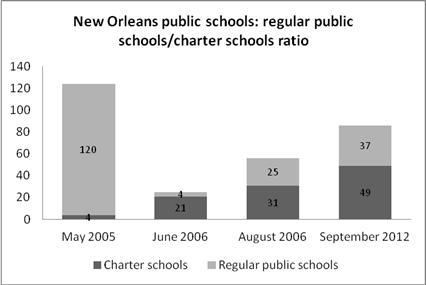
Titles in the media seized the stakes. For USA Today, “New Orleans [put] charter schools to big tests” (Frank 2005). On NPR, New Orleans was described as a “citywide lab” for charter schools (Abramson 2006). With the national debate over the benefits of charter still open and the absence of consensus on their performances, New Orleans turned out to be an exceptional testing ground for supporters of the charter movement to prove the validity of their position. Greg Richmond, president of the National Association of Charter School authorizers, was one of them and stressed the pivotal dimension of the New Orleans experiment: “New Orleans is likely to be the largest charter-school city in the country. If they do it well, it will show the country that charter schools work well on a large scale. And if they stumble, then opponents will point to it as an example of why you shouldn’t do this” (Frank 2005). Beyond its technical and organizational dimensions, the reconstruction of New Orleans public schools was to settle the dispute between pro- and anti-charter schools, fueling or appeasing the controversy over that new model of school management.
Reconstruction: a fertile ground for ideological battles?
Charter schools remain a fairly recent development in the field of education. They have succeeded upon building up a politically bipartisan consensus around them, both main political parties in the United States having at some point proved their support for the measure—from Bill Clinton devoting part of the federal budget to help develop some 3,000 charter schools by the end of his second term to George W. Bush and the No Child Left Behind Act which also provided a great incentive for charter schools. Yet, those schools have remained quite controversial within the education community. Beyond technicalities, many have seen in charter schools a subversion of the principles of public education and a symptom of a drift towards privatization.
Charter schools participate in a larger movement, that of education reform, that has developed since the 1980s. This movement has been characterized by the use of economic principles as a source of inspiration to reform and improve public education. Interestingly, one of the first proponents of a change in the dynamics of public education was no other than economics Nobel Prize recipient Milton Friedman. In 1955, in an essay entitled “The Role of Government in Education,” Friedman denounced the State monopoly in education and advocated free choice for families to restore competition (Friedman 1955). Friedman was to become one of President Reagan’s top advisers and is certainly no stranger to the voucher principle. Reagan’s campaign platform included two measures for education: the restoration of prayer in school and the introduction of vouchers. Vouchers are tax-credits that would be granted to families willing to register their children in private institutions, so that the tax-credit would cover for tuitions. The target is again the increasing of school choice for families so as to stimulate competition. While some attempts at implementing the voucher system have been made in a few states, the conflict with the anti-establishment clause of the Constitution has blocked any attempt at largely developing this system. Considering that the tax-credits could benefit private parochial schools, the development of such a system is unlikely, though some loopholes could be found. Building up on a similar logic, parent trigger laws are currently gaining momentum. Those laws, which have been passed by a handful of states so far, enable parents from a school to take over the administration of their school if a majority signed a petition. The possible consequences range from the dismissal of the principal and staff, the transformation into charter school, or the shutting down of the school leading to the relocation of students to other schools. So far, no petition has succeeded. Yet, the support from some highly-ranked officials and important political figures suggest that in the future, those petitions could be successful. Charter schools pertain to the same movement as vouchers and parent trigger laws. They are based on subcontracting and emphasize the notion of accountability—accountability being the politically correct term at the moment to refer to market-based education and the liberalization of the system. Charter schools, as the least legally challengeable vehicles of the reform, have become the spearhead for a movement ideologically charged.
In this context, the reconstruction of New Orleans’ school system after Katrina takes a different dimension. Has this unique setting–a devastated city and a struck down school system—been regarded by reform advocates as a golden opportunity to accelerate the institutionalization of a controversial model? In 2007, journalist and activist Naomi Klein argued that it was the case and that reform advocates had taken advantage of the uncertainties following the disaster (Klein 2007). In her essay The Shock Doctrine, Klein contends that the public disorientation prevailing after major shocks has been consistently instrumentalized to move forward with unpopular measures promoting a greater economic liberalization. Klein provides examples, ranging from the adoption of ultra-liberal policies in South America following coups as in Chile in the 1970s to the redistribution of Iraqi oil reserves to major companies amidst the Iraqi war in the early 2000s. The reconstruction of New Orleans’ public schools in the aftermath of Katrina is taken as an example of that “shock-therapy” (Klein 2007: 3-7). Interestingly, Milton Friedman is credited by Klein as the creator of the shock doctrine. Friedman’s ties to the education reform movement give additional substance to Klein’s argument. Thus beyond the fact that the reconstruction of New Orleans provided an extraordinary laboratory for a large-scale experiment on charter schools, one may be tempted to argue that it was also seized as an opportunity to advance a controversial model amidst a city and a population too shocked and disoriented to resist or push for alternatives. Though no written evidence exists of a purposeful ultra-liberal take-over amidst confusion in New Orleans, Klein’s point is not to be debunked as the ties between education reform and liberalism cannot be denied.
Charter schools have remained a controversial issue within the education community and have been denounced as a disguised attempt at dismantling public education. Yet, charter schools have conquered bipartisan support and have slowly expanded. The New Orleans experiment has contributed to this advancement, breaking a lock and suggesting that the charter model could be a workable large-scale model. To some extent, the reconstruction of New Orleans has worked as a Trojan horse, swinging over charter schools into mainstream education. Numbers show that, even though they currently represent only 6% of all public schools in the United States, charter schools are attracting more and more families, gaining 13% more students every year and having currently more than 900,000 children on a waiting list to get in (US Department of Education, 2013).
The New Orleans school reconstruction experiment is a singular example. The rebuilding was designed from the very onset as an opportunity to improve a failing system. Yet, beyond the narrative of a redemptive reconstruction, one must question the identity of the initiators behind the sweeping change in school governance. The reconstruction of New Orleans was unquestionably seized as an opportunity to advance charter schools, with the support of state and local authorities. Still, the outcome of the experiment remains an unsolved matter. True, charter schools have become a staple of post-Katrina New Orleans. However, the success of the experiment has not been demonstrated yet as the level of academic performance in the parish of New Orleans remains to this day alarmingly low. Some progress has been achieved but it is difficult to determine whether it is linked to the massive introduction of charter schools, to constantly changing modes of evaluation of academic performance, or to a change in school population due to the new demographics, the flooding after the hurricane having displaced a majority of people from low-income neighborhoods. In that extent, the reconstruction of New Orleans’ school system remains unfinished: schools have reopened, students returned but the debate over the results of the experiment remains open, preventing charter school advocates from truly capitalizing on their New Orleans breakthrough.
Notes
- 1The report was the work of a commission—the Commission on Excellence in Education—appointed by Secretary of Education T.H. Bell, under Ronald Reagan’s presidency. The alarmist report pointed to the frightful state of education and identified the failure of the school system as one of the major causes for the nation’s economic decline in the face of international competition. It called for return to a more academic-oriented form of education. The report made a strong impression and has remained to this day a landmark in history of education.
- 2Charter schools participate in providing more school choice for families. Some fear that school choice is actually favoring families better-equipped to navigate the school system to pick the best school for their child.
- 3According to the 2000 census, New Orleans had a population of 485,000. Four months after Katrina, 158,000 inhabitants were back. They were 208,000 one year after the hurricane. The 2010 census indicates a population of 360,000.
- 4The major funding sources in the American school system are States (providing 47% of funds) and local districts (44%). Louisiana ranked among the states providing the least money, with an average per-pupil expenditure of $7,209 in 2004, well below the American state average of $8,287, and far behind states such as New Jersey and its $12,981. The local funding rests on the real estate tax. Yet, in an effort to improve the poorest inhabitants’ access to property, the city of New Orleans has waived this tax for properties under a certain value. As a result, 65% of New Orleans’ real estate is exempted from the tax, cutting an important source of funding for public schools (Bureau of Governmental Research 2005 : 3).
- 5There were some 5,300 charter schools in the United States as of 2011, out of 98,000 public schools (Aud 2013: 48-49).
Bibliography
- Abramson, Larry. “For Charter Schools, New Orleans is Citywide Lab.” NPR News. National Public Radio. 3 October 2006.
- Aud, Susan, et al. “The Condition of Education 2013.” US Department of Education, National Center for Education Statistics. May 2013 <http://nces.ed.gov/pubs2013/2013037.pdf>
- Bring New Orleans Back Education Committee. “Education Committee Final Report.” Bring New Orleans Back. January 2006 <http://www.bringneworleansback.org/Resources/BNOB%20Education%20Committee-Final%20Presentation-1%2017%2006%20-%20web.pdf>
- Budde, Ray. Education by Charter: Restructuring School Districts. Andover: West Ed, 1988.
- Bureau of Governmental Research. “Unfair Assessments, Excessive Exemptions. How New Orleans’ Property Tax System Hurt Government and Tax Payers.” Emerging Issues (May 2005): 1-11.
- Dingerson, Leigh. “Dismantling a Community Timeline.” The High School Journal 90 (December 2006-January 2007): 8-15.
- Frank, Thomas. “New Orleans Puts Charter Schools to Big Test.” USA Today 27 November 2005: 10A.
- Friedman, Milton. “The Role of Government in Education.” Economic and the Public Interest. New Brunswick: Rutgers UP, 1955. 123-144.
- Klein, Naomi. The Shock Doctrine. New York: Henry Holt and Company, 2007.
- Landrieu, Phyllis. “Orleans Public Schools—A Year in Review.” New Orleans Public Schools. 29 August 2006 <http://www.nops.k12.la.us/content/homepage/documents/2006_Board/message%20from%20board%20president%2008-29-06.doc>
- Louisiana Department of Education. “2004-2005 District Accountability Report Card: Orleans Parish.” Louisiana Department of Education. Spring 2006 <http://www.doe.state.la.us/lde/pair/sps2005/rptcards/2005DRC036.pdf>
- National Commission on Excellence in Education. A Nation at Risk: The Imperative for Educational Reform. Washington, DC: US Department of Education, 1983.
- Robelen, Erik. “New Orleans Eyed As Clean Educational Slate.” Education Week 25 (21 September 2005): 22-23.
- Tillotson, Dirk. “What’s Next for New Orleans?” The High School Journal 90 (December 2006-January 2007): 69-74.
- Tough, Paul. “A Teachable Moment.” The New York Times 14 August 2008.
- US Census Bureau. “Census 2000 Data for the State of Louisiana.” Census Bureau Homepage. 2000 <http://www.census.gov/census2000/states/la.html>
- US Department of Education, “National Conference Highlights Federal Grants to Charter Schools.” US Department of Education. 2 August 2013 <http://www.ed.gov/oii-news/national-conference-highlights-federal-grants-charter-schools>
About the author(s)
Biographie : Laurie Béreau a soutenu en 2013 une thèse consacrée au motif de la « crise de l’éducation » dans l’Amérique des années 1950. Elle est PRAG à l’Université de Strasbourg et appartient à l’équipe SEARCH. Ses recherches actuelles portent sur les politiques de réforme éducative aux États-Unis et sur les tensions entre sphère privée et sphère publique en matière d’éducation.