Subjective Readings of Charles Bukowski, a Multifaceted Outsider
Introduction
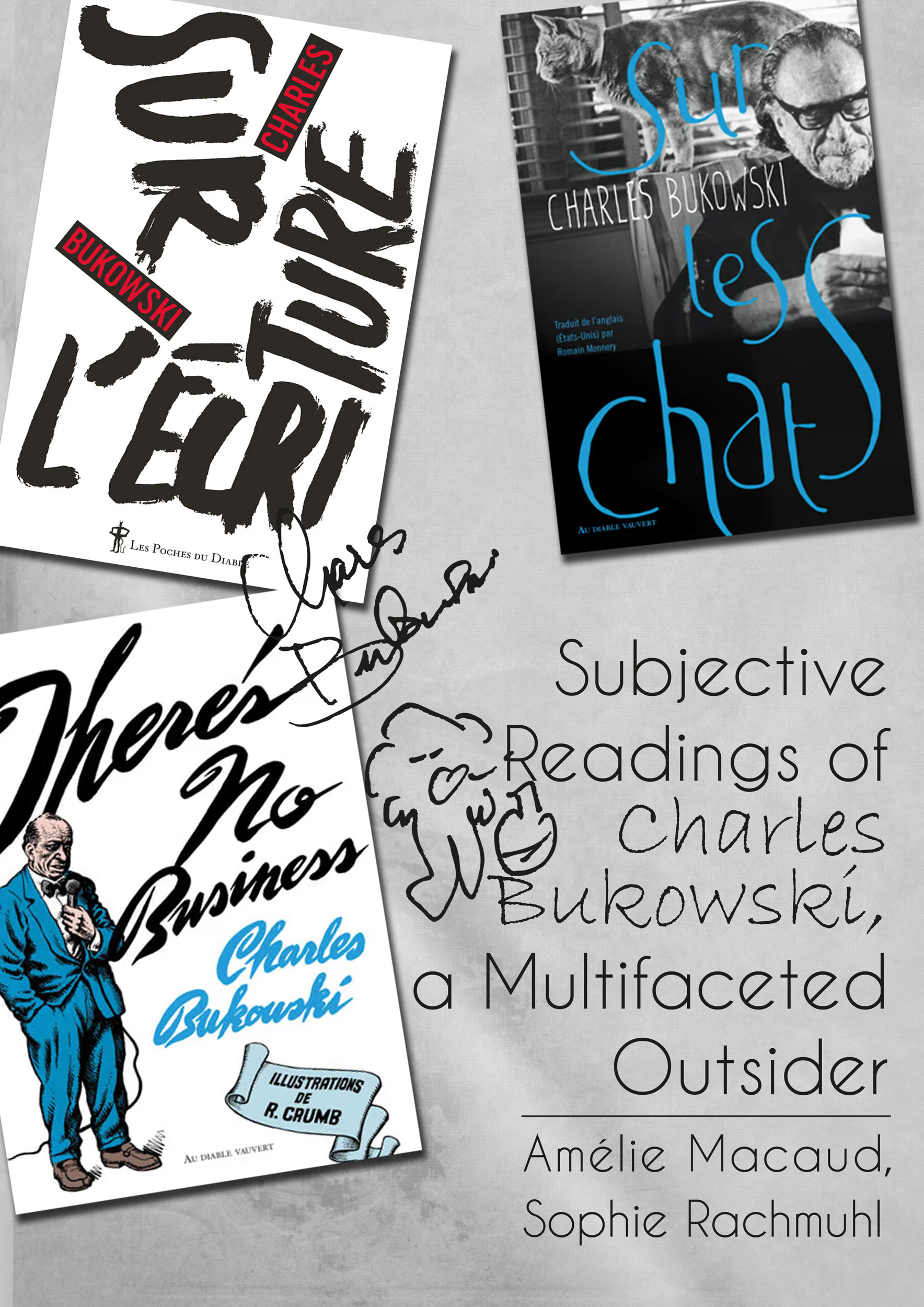
Keywords: Charles Bukowski
Mots-clés : Charles Bukowski
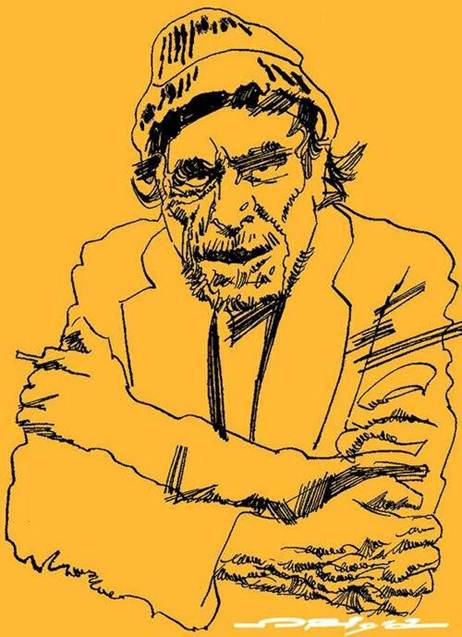
In August 2020, Charles Bukowski would have turned 100. To celebrate the life and work of the famous Los Angeles writer, his readers worldwide gathered online to share texts, videos, and personal tributes on Facebook, the social media platform. The event was meant as a real life one, but the pandemic changed many people’s plans. Bukowski’s centenary was just one amongst many others. The online event was initiated and organized by members of two reader-based online communities, and a bookstore owner in Los Angeles. It drew support from those who had known the author personally, such as his daughter, Marina Bukowski, and his friend Cupcake.
This moment of collective gathering was more than an act of nostalgia. It reflected a continuing engagement with Bukowski’s work: he is still widely read, discussed, and his work is shared, in real life and online. Who has not seen on their social media a meme displaying Bukowski’s face, with a quote excerpted from his over sixty published books? His work, mostly poetry, but also quotes from his novels, his essays or short stories, remain alive today through social networks, open mics, memes, videos, and, of course academic studies.
The call for papers of the International Conference dedicated to Charles Bukowski’s reception in June 2024 and entitled “Reading, Readings, and Loving Charles Bukowski” invited contributors to consider such questions as “How was Bukowski presented and read before and after his global fame?”, or “How is he or his image re-presented today, in literary, visual, and digital media?” The conference brought together scholars, artists, poets, and readers of Bukowski from around the world to discuss his legacy. Some of these participants agreed to share their papers with us in this issue of Leaves.
Our 2024 conference, held in Bordeaux on the occasion of the 60th anniversary of the twinning between Bordeaux and Los Angeles, seemed a perfect moment to honor a writer who placed Los Angeles, the city, its poetry and writers, on the literary map of the United States and the world. The conference2 was academic but also artistic, with a photograph exhibition by Joan Gannij–Charles Bukowski’s photographer in the 1960s-70s–and it invited readers alongside scholars to share their stories about their personal encounter with Bukowski—the way they heard of him, read him and how his life and writings echoed their own.
The special issue also evokes Charles Bukowski’s reception across a range of approaches: music theory, comparative studies, arts, psychoanalysis, to name a few. Indeed, the proceedings aim to keep this multifaceted approach: at once literary, academic, and artistic. Not all contributions are strictly academic; on the contrary, many are subjective readings, personal reflections, or visual and audio tributes. The willingness of our authors and artists to share their work and time, allows us to present videos, photographs, and original creative works alongside essays about Charles Bukowski’s work, life, and reception. As a result, this issue departs from a “standard” academic journal format and is meant as a multimedia experience. It is slightly unconventional, but so was Charles Bukowski. Readers of the proceedings can view them as a tribute to Bukowski’s work.
Abel Debritto–a Bukowski scholar turned Bukowski editor for Ecco Press–explained his research journey on the Los Angeles author in the introduction of his seminal book, King of the Underground: From Obscurity to Literary Icon (2013), on Bukowski’s work in minor magazines, in which the scholar expresses academia’s lack of interest for the writer:
When I began my research on Bukowski, the academic interest in his work was virtually nil, and the very few articles and reviews written from the unblemished turrets of knowledge were usually disdainful and pejorative, if not worse. Even though Bukowski was intermittently published in the academic quarterlies from the very beginning of his career […] academia chose not to champion his work. At the other end of the spectrum, his staunch supporters blindly praised both his virtues and his many flaws. There seemed to be no middle ground, and critics and biographers had deemed unnecessary to study Bukowski’s output in an unbiased, accurate fashion. (Debritto 3)
This lack of interest was reciprocal. In 1969, Bukowski, in a letter to Gerard Dombrowski who had published Charles Bukowski. A critical and Bibliographical Study by Hugh Fox, said of the latter: “On the Fox book on me–all right, I drank a few nights with the man, and if you want some stinking gossip–he is not my type. He is University and caught between the squeezed balls of his teachings” (On Writing 104). Bukowski goes on to explain “You know, the main problem, so far, has been that there has been quite a difference between literature and life, and that those who have been writing literature have not been writing life, and those living life have been excluded from literature” (104). Bukowski’s criticisms extend to creative writing courses, “You look around and they are teaching CREATIVE WRITING at some university. Now they think they know how to WRITE and they are going to tell others how to” (168). These are just a few examples among many.
Even though academic interest in Bukowski’s work still seems to be lacking in the United States, the opposite seems to be true in countries like Germany or France. For instance, a doctoral dissertation by Greta Matuszynski entitled Vers une nouvelle façon de traduire la littérature étrangère : Analyse des procédés d’appropriation culturelle et socio-politique d’une œuvre littéraire étrangère : la traduction française des romans de Charles Bukowski (2024), was written on Charles Bukowski’s translations into French. Amélie Macaud, one of the co-editors of this special Bukowski issue, wrote her doctoral dissertation, La construction de l’oeuvre de Charles Bukowski: de l’art de la publication et du mélange des genres (2021) on the construction of Bukowski’s oeuvre and success through his cult persona, publishing, and other media. Master’s students throughout the years have written their theses on his fiction and poetry, starting with the other editor of this Leaves issue, Sophie Rachmuhl, and her Master’s thesis Unrealism in Charles Bukowski’s Short Stories (1986), up to Hessam Fazli’s recent thesis on what he calls The Art of Failure in Bukowski’s last novel Pulp (2025). Dina Moinzadeh, whose PhD dissertation La voix incarnée : poétiques de la présence chez Charles Bukowski focused on Bukowski’s poetry (2016), was part of the scientific committee for the international conference on Charles Bukowski. Other Charles Bukowski scholars joined the conference in Bordeaux: David S. Calonne, one of Bukowski’s biographers, spoke about Charles Bukowski and classical music. Abel Debritto, editor of Charles Bukowski for Ecco Press, gave the keynote, and evoked the many findings and gems of Bukowski’s archives, scattered across continents. His 865-page long new book Catalog of Ordinary Madness: A Complete Bio-Bibliography of the Works of Charles Bukowski, published in 2024, collects and lists all the writings of Charles Bukowski. Roni, who runs Charles Bukowski’s society in Germany “Bukowski Gesellschaft,” regularly organizes conferences in Germany, and is an active member of the Bukowski.net forum. He spoke about being a Charles Bukowski fan online, and evoked the website database.
Charles Bukowski was a prolific and multifaceted writer, with over sixty books published, and a large number of uncollected and unpublished poems and writings in Californian—but not only—archives like Santa Barbara University Special Collections, Berkeley, or the Huntington Library. He wrote novels (from Post Office (1971) to Pulp (1994)), poetry collections (from Flower, Fist, and Bestial Wail (1959) to Essential Bukowski; Poetry (2018) edited by Debritto), and poems and stories for magazines, some later compiled into books (Notes of a Dirty Old Man (1969)).
His path to literary recognition was unconventional. Supported early on by underground magazines and independent presses (Debritto 2013), Bukowski collaborated with many independent editors such as John Bryan (Open City), Jon Webb (The Outsider), and other poets like Steve Richmond or Lawrence Ferlinghetti. He refused to belong to any existing poetry group—for example the Beat generation, with which he has often been associated—and remained fiercely independent. He had a publisher, John Martin’s Black Sparrow Press, but never stopped sending his texts to underground magazines. John Martin was part and parcel of the making of Bukowski as a famous writer. He offered him the opportunity to make a living of writing, which Bukowski took on, never looking back. The publisher recently passed away and an obituary of John Martin was written by another famous Los Angeles publisher, William Mohr, one of the contributors to this special issue.3
The special issue dedicated to Charles Bukowski reads like a three-part narrative. The first evokes Bukowski’s reception, from being known as a successful poet in Los Angeles, to becoming a famous writer internationally. The second delves into the work of Bukowski and his artistic identity, as a painter and melomane. The authors in this section examine how these arts helped him write and create his persona, Henry Chinaski. The persona and Bukowski’s authorial figure tended to become one. Bukowski used his persona to create a myth, that of the “dirty old man.” The final section deals with the construction of this Bukowskian image, from the myth to the remediation of the persona by mediators of literature and reading communities online.
From Los Angeles to worldwide reception
“The City crawls into you, you know, it makes you a part of it”
(Bukowski, “Do you read a notebook”)
Charles Bukowski and Los Angeles are indiscernible for Mike Sonksen in his audio tribute of both the city and the writer. Mike Sonksen, Los Angeles poet and scholar, indefatigable critic and reviewer of Los Angeles poets and poetry, provides a personal reflection and a poem on Charles Bukowski and Los Angeles in “The Geography of Charles Bukowski: Mapping Everyday Los Angeles” which recalls an excerpt from Barbet Schroeder’s Charles Bukowski Tapes where the writer shows the German director around his L.A. neighborhood.4 Sonksen uses Bukowski’s poems like “the city is a poem” or “Philippe 1950s” to evoke the staples of Los Angeles for Charles Bukowski, such as Longwood Avenue or Carlton Way where the author lived. Sonksen’s “The Geography of Bukowski: a Prose Poem” can be read and/or listened to.
William Mohr’s article “The Canonical Legacy of Anthologies: Reading and Being Read by Charles Bukowski” evokes the reception and the “canonability” of Bukowski by discussing his inclusion or non-inclusion in poetry anthologies in the United States. William Mohr unearths the reasons why Bukowski was an outcast in mainstream poetry anthologies, as well as in most academic circles—Mohr goes as far as using the word “hostility.” One essential reason is Bukowski’s belonging to the West Coast, more particularly Los Angeles, whereas the poetic canon is mostly defined by East Coast critics and publishers in the United States. Mohr goes on to try to construct his own virtual canonical Bukowski anthology by endeavoring to select Bukowski’s best 100 poems, and finding a method to do so. To help him in this quest, he looks at numerous West Coast (and just a few beyond) anthologies which feature Bukowski poems, including Mohr’s own, Poetry Loves Poetry, An Anthology of Los Angeles Poets (1985). As Mohr knows, being himself a publisher and small-press owner (Momentum Press), as well as a poet, anthologist and participant in, and scholar of, what he terms the “Los Angeles Poetry Renaissance” (see his book Hold-Outs, The Los Angeles Poetry Renaissance, 1948-1992, 2011), anthologies are a pathway into making writers and literary genres legitimate and visible. Bukowski’s prominent presence in West Coast small-press anthologies, and absence in those of the mainstream East Coast, testify to his cult and outsider status, with a liberating, welcome influence for many poets simultaneous to his lack of acknowledgement and scorn by others. This inclusion through exclusion has been shown to be one of the most specific traits of Los Angeles poets, invisible as they are in the blinding light of Hollywood, discarded by the East, and isolated in the gigantic Los Angeles space.5 Mohr’s conclusion is that, amid Bukowski’s prolific output, potential for contradiction, idiosyncratic reception and interpretation, each attentive reader can only end up with their own Bukowski anthology.
Bukowski’s renown expanded outside of Los Angeles in the late 1960s. His impact was not only felt in California, but also around the world: Bukowski is translated in many different languages like German, Italian, Arabic, to name but a few. Grégory Dulieu, French poet and avid Bukowski reader, contributes two original pieces. One evokes the rapport between Charles Bukowski and John Fante, two well-known literary figures. John Fante inspired Bukowski and the latter asked John Martin’s Black Sparrow Press to republish Fante’s work. The second contribution by Dulieu is a poem which can be read as an homage to Charles Bukowski and John Fante, in which the French poet, speaking bluntly and graphically, and sometimes with the same type of vulgarity known to Bukowski’s prose, uses the French-translated titles of the authors to create a story of his own making.
Charles Bukowski’s work inspired Dulieu and many others because it was both poetic and melancholic and at times, rough and vulgar. It was real, raw, as Bukowski mentioned in numerous interviews: what he wrote about was what he saw from his roominghouse window, and what he experienced. What he wrote about, how he wrote, and how he worked as a versatile artist were also sources of interest for our authors.
From Image to Text: The portrait of Bukowski as an artist
The intermedial quality of Bukowski’s work is evidenced in his writings. The animal imagery that can be found in the many doodles he drew in his correspondence is also found in his poems, as Cécile Raas, a doctoral student, demonstrates in her article “Le pacte entre animaux et humains, une lecture zoopoétique de la poésie de Charles Bukowski.” Through the prism of zoopoetics, she evokes Bukowski’s work, the image created within his poetry through the concept of animality, “highlighting the remarkable plurality and variability of non-human presence in the texts.” This interpretation is a new take on Bukowski’s poetry and his use of images in his texts. His interest for the animal kingdom adds to the complexity of a multifaceted author.
How did Bukowski create these texts and these images? This is what David S. Calonne, one of Bukowski’s biographers, explores in his lyrical essay “‘The Energy of the Miracle’: Charles Bukowski and classical music” where he evokes the crucial role of music in Bukowski’s life and more importantly, in his creative writing process. In this article, the text is interspersed with music and audio files. Calonne explores the role of the composers that were influential in and for Bukowski’s writing: Tchaikovsky, Wagner, Mahler, Handel and Shostakovich. One can feel and hear the music that was “an essential part of Bukowski’s writing ritual,” in Calonne’s article, and follow his musical analysis of an excerpt from the movie Barfly while watching it.
Yet, Bukowski was more than a melomaniac writer, he was also a visual artist.
As a painter, Bukowski also self-created his image, through artwork and doodling, as William Marling explains in his essay “Charles Bukowski and European art.” In it, he examines Bukowski’s lesser-known practice as a visual artist, drawing connections between his doodles, his paintings, and European art, stating that “an overview of Bukowski’s drawing and painting suggests that he was heavily influenced by European sources.” John Martin, himself a book collector, used to ask Bukowski for paintings to add to his first editions and hardcovers, believing in the value of the relationship between text and image in the eye of collectors. Marling connects Bukowski’s written work and poems such as in “His Wife, the Painter” (1969) to his practice of visual arts.
Bukowski is clearly defined as a complete artist by the three authors in this section, whether using music for creative purposes or art in his books, and images in his writing. Despite these sophisticated artistic qualities and sensitivity, Charles Bukowski’s myth was that of an alcoholic poet, a womanizer, a belligerent macho and disorderly loner. His myth and persona, that of “the dirty old man,” was cultivated not only by his own provocations in interviews and texts, but also by the media and his publishers. The myth is in the following articles debunked by the persons who have known him personally, or who have had a first-hand account of people who did, or yet, by those who have studied him from a psychoanalytical perspective.
The Dirty Old Man myth debunked
Roni, Charles-Bukowski-Gesellschaft, chairman of the Charles-Bukowski-Society, in his article “Look Who’s Talking: Charles Bukowski: his person & his persona,” summons this myth and the man behind the myth. He explains that the myth is never too far from reality, drawing from examples and comparisons like the notoriously famous episode at Apostrophes on French television recounted in Bukowski’s travelogue Shakespeare Never Did This (1979). He also cites the not-so-divergent accounts of former girlfriends of Bukowski, whose relationship and encounters with him were told in the novel Women (1978). Roni explores, in his own words: “the vivid interaction and intermixing of Bukowski’s fictional existence with his actual life, of his protagonist’s character and his own, the persona and the person.”
Friedrich and Judith Bahmers, in their short text “Reading Bukowski in the Mirror of his Psychocutaneous Acne Illness,” take another path to debunk the myth, and delve into the author’s image in the earlier years of his life. Through their studies of Bukowski’s skin damage caused by acne, we are able to better understand Bukowski’s self-image, from a medical and psychoanalytic perspective. Would Bukowski have still been Bukowski had he not had severe acne causing long lasting scars to his features? The Bahmers note that his traumatic childhood and teenage years probably affected his adult psyche and his behavior, even though they also note that he quickly realized that “his appearance [did] not stand in the way of his success with women.”
Bukowski’s face was, and still is, displayed everywhere. Photographers like Joan Gannij made sure of that. During the conference, the American photographer and writer exhibited never-before-seen photographs of the author, and evoked her work with Charles Bukowski, how she came to meet and work with him, and the relationship they built around their respective artforms.6 In her article entitled “Meeting Bukowski (Reluctantly, with skepticism),” she tells the story of their first encounter, from working at Los Angeles’ public radio station KCET with journalist Glenn Esterly to meeting the writer who would become invaluable to her life and career. She also shares a poem entitled “Bukowski Reading, 1974,” and two of her portraits of Charles Bukowski; one she presented at the exhibit in Bordeaux, and another that was published in the inner title page of the first edition of Bukowski’s first work published in German Stories und Romane. The encounter and the pictures depart from the myth of the dirty old man, and depict a man with a melancholic soul.
Bukowski’s poetry readings were and still are part of his myth-making. In an early documentary, the spectator sees Bukowski vomit before giving a poetry reading. The author had to drink in order to speak in public, as he was extremely shy and ill-at-ease being front and center stage. Stress was eating him up. The movie director Inès Sedan, in her short text soberly entitled “Sur Bukowski” (“On Bukowski”), recalls how she found a KCET recording of one of Bukowski’s poetry readings on the video sharing platform YouTube, and decided, against the advice of her former producer, to create a short movie dedicated to the author reading his poem “Love.” A link to the highly visually enjoyable movie entitled Love, He Said is available at the end of her paper. In the latter, she describes how she was drawn into the rabbit hole of discovering Bukowski’s writings, and understanding that the image of the Dirty Old Man was, and is, just that. A Myth.
Conclusion
Inès Sedan’s work illustrates that Bukowski’s work still thrives not only on paper but also on the screen. The virtual world has welcomed his figure and fans gather around forums like Bukowski.net or Reddit to invoke his work, his life, quite often still mingled together. His image and words are remediated, to use a term coined by Bolter and Grusin (1999), reinterpreted, and re-presented across platforms, evidenced by the short video below. Bukowski’s influence seems to be expanding online, rather than receding, and his poems and writings, but also his image, are always around, and will undoubtedly continue to be. The site Bukowski.net is only the visible part of the iceberg, but many other websites and social media platforms show and discuss Bukowski’s writings and images, remediating them and offering new interpretations online. The video “Charles Bukowski Online” on YouTube, made by Amélie Macaud, who has studied Bukowski’s online reading community and archival website,7 is a non-exhaustive sample of some of the websites or social media platforms with pages either dedicated to Bukowski, or with images of the author.
In this issue, the media mirror the artist’s work and image, his use of music and visual arts to create his work. He was a multifaceted writer with, now, a multifaceted issue of Leaves dedicated to his work and authorial figure, as well as his readers, his friends, his life, and his work.
Thanks and Acknowledgments
This three-year long project on Charles Bukowski would not have been possible without the generous support of the laboratory CLIMAS, the Institut des Amériques, the Région Nouvelle-Aquitaine, the Université Bordeaux Montaigne, and the City of Bordeaux. Their support allowed us to host the 2024 conference and bring this multimedia and multidisciplinary issue to life. We also thank all the contributors—writers, artists, photographers, and readers—who helped shape this living portrait of Charles Bukowski and his readership, and the editors of the journal Leaves for their help.
Thank you, and “Don’t Try” (Bukowski)
Notes
- 1By Origafoundation - Own work, CC BY-SA 3.0, https://commons.wikimedia.org/w/index.php?curid=4816888
- 2The filmed conference can be found via this link: https://www.canal-u.tv/chaines/bordeaux-montaigne/aimer-charles-bukowski-1-invitation-a-une-lecture-subjective-6-et-7-juin
- 3The obituary of John Martin by William Mohr can be found here: https://www.billmohrpoet.com/john-martin-the-one-and-only-editor-and-publisher-of-black-sparrow-press-1930-2025/
- 4The video can be found on YouTube: https://www.youtube.com/watch?v=WaAAQqVONoc
- 5See Sophie Rachmuhl’s 2015A Higher Form of Politics , The Rise of a Poetry Scene, Los Angeles 1950-1990, edited by Paul Vangelisti, of Invisible City. This book was translated with George Drury Smith, founder of Beyond Baroque Foundation, from her dissertation Los Angeles 1950 - 1990 - The Rise of an Arts Scene and a Poetic Discourse on the City (1996).
- 6She has recently shown her pictures at Beyond Baroque, Los Angeles’ foremost literary art center in an exhibit entitled East of Western: Close Ups of Charles Bukowskihttps://yovenice.com/2025/10/23/video-westside-photo-exhibit-shows-charles-bukowskis-complexity/
- 7See her article “Charles Bukowski’s Online Reading Community: Safeguarding the Author’s Work by Building a Consensus” (2024) and “Le rôle des archives de lecteurs en ligne pour le chercheur en littérature - Étude d’un site web dédié à Charles Bukowski” (2024).
- 8The video “Charles Bukowski Online” can also be found on YouTube. https://youtu.be/EQ0IhECuObE
Works Cited
- Bukowski, Charles. On Writing. New York, Ecco Press, 2018.
- Bolter, David J., and Richard Grusin. Remediation: Understanding New Media. Cambridge, MAn MIT Press, 1999.
- Calonne, David S. Charles Bukowski. London, Reaktion Book, 2012.
- Debritto, Abel. A Catalog of Ordinary Madness: A Complete Bio-Bibliography of the Works of Charles Bukowski. Seattle, WA, Chatwin Books, 2024.
- Debritto, Abel. Charles Bukowski, King of the Underground. London, Palgrave/MacMillan, 2013.
- Fazli, Hessam. Pulp and Beyond: Exploring the Art of Failure in Charles Bukowski’s Final Novel. Master thesis. Université Jean Moulin Lyon 3.
- Macaud, Amélie. “Charles Bukowski’s Online Reading Community: Safeguarding the Author’s Work by Building a Consensus.” Sillages Critiques, 2024, 36.
- Macaud, Amélie. La construction de l’œuvre de Charles Bukowski: de l’art de la publication et du mélange des genres. PhD dissertation. Université Bordeaux Montaigne, 2021.
- Macaud, Amélie. “Le rôle des archives de lecteurs en ligne pour le chercheur en littérature - Étude d’un site web dédié à Charles Bukowski.” Les Cahiers du numérique, 2024, 20 (3-4), pp. 361-80.
- Matuszinski, Greta. Vers une nouvelle façon de traduire la littérature étrangère : Analyse des procédés d’appropriation culturelle et socio-politique d’une œuvre littéraire étrangère : la traduction française des romans de Charles Bukowski. PhD dissertation. Université de Lille, 2024.
- Moinzadeh, Irandokht Dina. La voix incarnée : poétiques de la présence chez Charles Bukowski. Littératures [Thèse de doctorat]. Université de Nanterre - Paris X, 2017.
- Mohr, William, ed. Hold-Outs, The Los Angeles Poetry Renaissance, 1948-1992. Iowa City, University of Iowa Press, 2011
- Mohr, William. “John Martin, the One and Only Editor and Publisher of Black Sparrow Press (1930-2025).”https://www.billmohrpoet.com/john-martin-the-one-and-only-editor-and-publisher-of-black-sparrow-press-1930-2025/
- Mohr, William. Poetry Loves Poetry, An Anthology of Los Angeles Poets. Los Angeles, Momentum Press, 1985.
- Rachmuhl, Sophie. A Higher Form of Politics, The Rise of a Poetry Scene, Los Angeles 1950-1990. Los Angeles, Otis Books Seismicity Editions and Beyond Baroque Foundation, 2015.
- Rachmuhl, Sophie. Los Angeles 1950-1990—The Rise of an Arts Scene and a Poetic Discourse on the City. PhD dissertation. Université Paris 5, 1996.
- Rachmuhl, Sophie. Unrealism in Charles Bukowski’s Short Stories. Master thesis. Université Paris X Nanterre, 1986.
- “Aimer Charles Bukowski.”Canal-u.tvhttps://www.canal-u.tv/chaines/bordeaux-montaigne/aimer-charles-bukowski-1-invitation-a-une-lecture-subjective-6-et-7-juin
- “Bukowski Database.”Bukowski.net
- “Charles Bukowski Online.”https://youtu.be/EQ0IhECuObE
- “The Charles Bukowski Tapes de Barbet Schroeder: Extrait.”https://www.youtube.com/watch?v=WaAAQqVONoc
- “Westside Photo Exhibit Shows Charles Bukowski’s Complexity.” https://yovenice.com/2025/10/23/video-westside-photo-exhibit-shows-charles-bukowskis-complexity/