Meeting Bukowski (Reluctantly, with Skepticism)
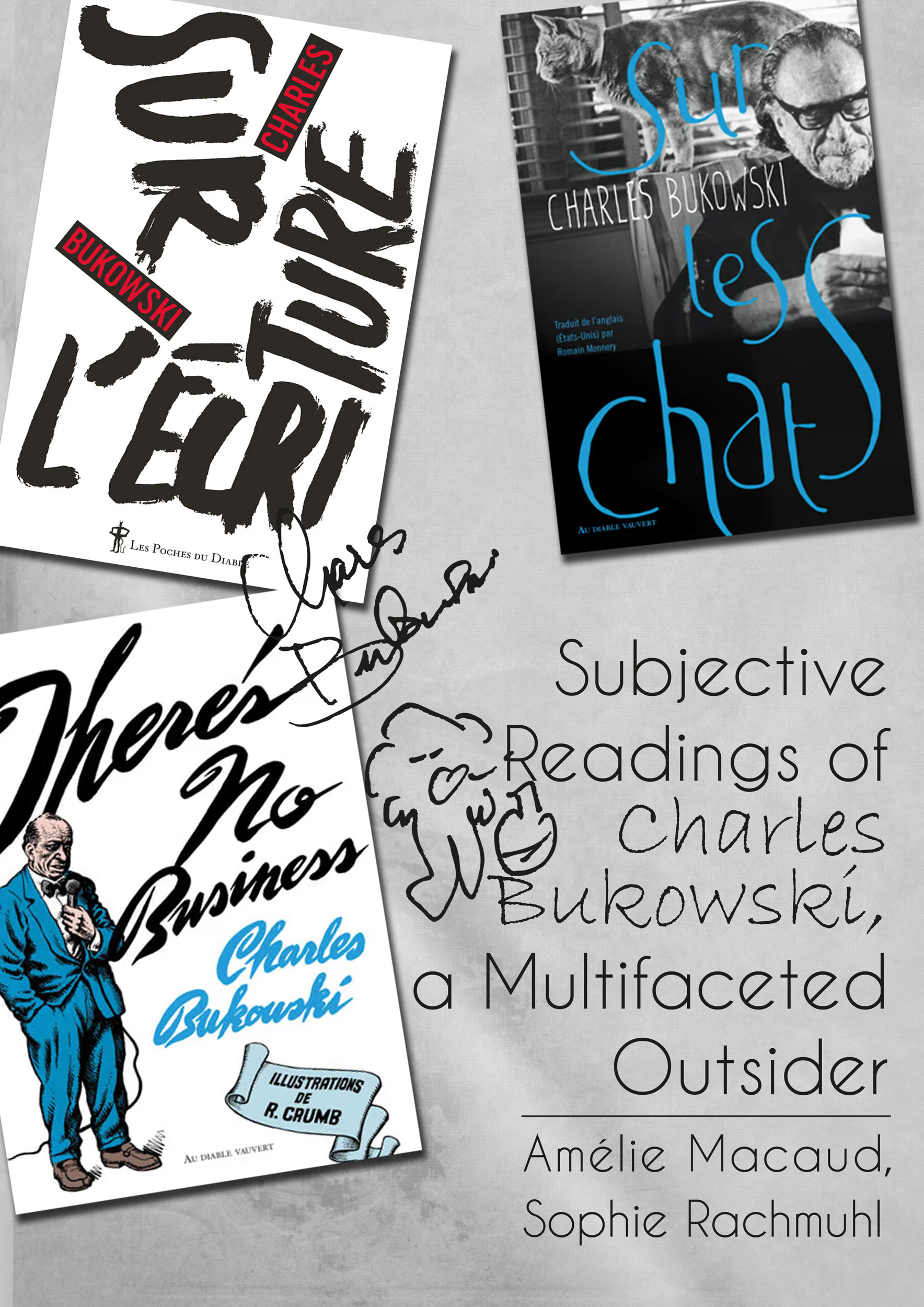
Abstract: My speech is based on my reluctant meeting with Charles Bukowski who I had only known through his outrageous columns. After experiencing an unforgettable poetry reading, I discovered his poetry, and agreed to photograph this complex figure (reluctant gentleman), ultimately revealing the man behind the myth.
Keywords: Glen Esterly, Dirty old man image, Alter ego, Personal mythology, Formidable figure, Carl Weissner, Trusted kinship, Searing soulful portraits
Résumé : Mon texte évoque ma rencontre (à reculons) avec Charles Bukowski que je ne connaissais qu’à travers ses chroniques scandaleuses. Après avoir assisté à une lecture de poésie inoubliable, j’ai découvert sa poésie, et ai accepté de photographier ce personnage complexe (un gentleman réticent), révélant finalement l’homme derrière le mythe.
Mots-clés : Glen Esterly, Image du vieux dégueulasse, Alter ego, Mythologie personnelle, Figure formidable, Carl Weissner, Relation de confiance, Portraits d’une saisissante intensité
Back around 1974, my friend and KCET colleague Glen Esterly was going to be interviewing Charles Bukowski for Rolling Stone and asked me to come along and take some pictures. As a young woman of the volatile and changing times, more humanist than feminist, I was not impressed with the “Dirty Old Man’s” body of work in that period: his weekly columns in the LA Free Press offended my sensibility and seemed too calculated for shock value. I didn’t realize that Henry Chinaski was Bukowski’s alter ego and that he was busy creating a personal mythology in the spirit of Henry Miller and Anaïs Nin. I told Glen to forget about it. Not interested. No way.
Glen knew I was a fan of the Beat poets and that I was studying creative writing with Sam Eisenstein, one of the top writing teachers at Los Angeles City College, which Bukowski had attended decades before. Glen told me not to write him off before I saw him in action; which would take place at a poetry reading later that week at Cal State L.A. I went, he read, and I was convinced that his was a voice to be reckoned with: a blue-collar bard, the poet laureate of the disenfranchised. I snapped a couple of shots, shook his hand briefly and told Glen that I was in. Here’s a poem I wrote about that memorable evening.
Bukowski Reading, 1974 by Joan Gannij
All the femlib propaganda
Hasn’t prepared me for this
Poetic encounter
I sit with emotions in check
Hoping to appear mysterious
In my close proximity
Afraid of being too solicitous
Yet tempted to open his continuous cans of beer
Rescue his discarded poems from the floor.
Hell, I just showed up to listen
Take a few pictures check him out
I wasn’t ready for the barrio hecklers
Whisky bottle props
Disjointed obscenities
Their childish taunts a rhythm of urban angst
When he chose not to react
He sealed the bargain
The crowd was restless
Almost disappointed when no blood was shed.
He remarked later that some people might figure
He brought them along for adversity
But after they walked off with his beer
Any speculation died off
About that.
My mother was a glamour photographer in Hollywood in the 1950s. She taught me that when you “steal” pictures from someone, you should give them back. A week or so after the reading, I dropped by Hank’s bungalow on Carlton Way with Glen for the first interview. I arrived before Glen and was more intimidated than frightened by this formidable figure. His reputation had preceded him and as a fledgling journalist/photographer, my experience was limited to upcoming rock stars and actors whose faces were easier to read, and whose temperaments were less volatile. When Hank opened the door with a Cheshire Cat grin on his face, I entered reluctantly, handed him a small folder, and took a seat on the well-worn couch, hoping that Glen would get there sooner than later. Hank looked through the box of photos and didn’t say a word. He didn’t have to; the subtle stream of tears was enough. He soon gained his composure, then said matter of factly, “They always come and take things from me: they take my beer, my smokes, my women.” He paused, then said, “Thanks, Kid. You made my day.” Glen arrived soon after and I took a dozen “warm up’’ shots on Hank’s front porch, using color film. I never printed them until April 2024, as my focus was on making more serious black and white images that fateful afternoon. Maybe I was afraid he would look like someone’s eccentric uncle. And happily, I was proved wrong.
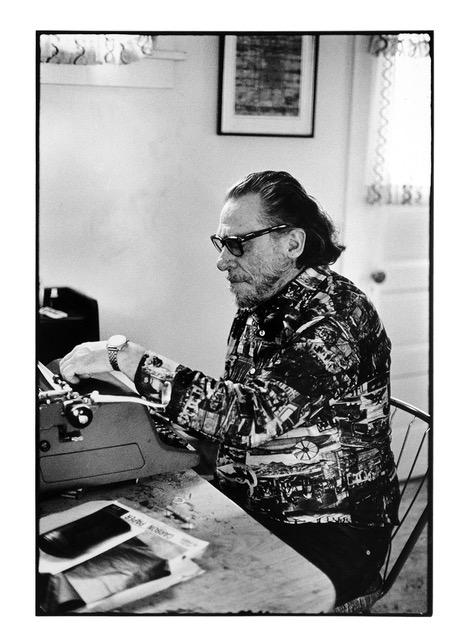
@joangannij, 2025
Over the next weeks I returned a few more times on my own, making a series of photos that would not get published in Rolling Stone. It turned out they had a policy of using staff photographers for assignments, which turned out to be more of an advantage than disappointment. I never would have imagined that many of those images would become iconic over the next 20 years. At least that’s how Hank described them. I guess you could call my images the “unplugged version’’ One day I received a letter in a red, white and blue Air Mail envelope with lots of interesting stamps, postmarked Mannheim, Germany. It was from Carl Weissner, Hank’s German translator and European publishing agent. I learned that after our last meeting, Hank had contacted Carl to arrange for my photos to be on all of his translated book covers. It was his way of thanking a fledgling photographer for giving him something rather than taking. Many years later when finally meeting up in person at the Frankfurt Book Fair, Carl and I would refer to Hank as “our matchmaker’’ who to me, felt more like my eccentric uncle. Carl circulated my photographs not only to Hank’s publishers around the world (from Israel to Iran, Japan to Finland, and many lands in between) but also to respected German publications like Zeit and Der Spiegel.
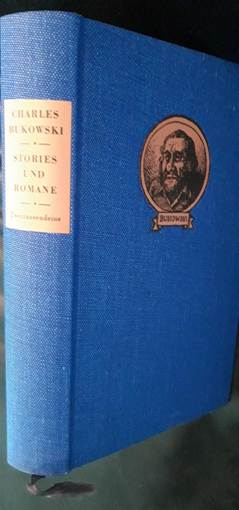
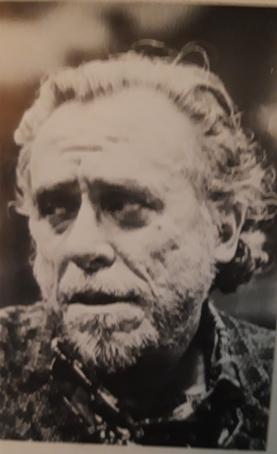
In 1976, Hank was invited to Germany to promote his first books Stories Und Romane, a deluxe hard-covered book in cobalt blue, with a small print of my photograph attached after the title page (Fig 1. And Fig 2.). It would launch Charles Bukowski abroad and become a bestseller. And the best was certainly yet to come. I had moved south of Los Angeles to San Diego with my family and was busy establishing my career as a journalist/photographer, as well as becoming immersed in the local poetry scene. Michael Montfort, a German photographer based in Los Angeles, joined him on that tour and would soon make his own iconic images.
@joangannij2025
In 1994, right after the death of Charles Bukowski, I heard from his publisher John Martin who asked if I had any photos in my archive that he might not have seen. I had lost most of my archive in the L.A. earthquake earlier that year, but to my surprise, I discovered an envelope of negatives which I had never printed in a file I had in Amsterdam, which were images of Charles Bukowski which I had considered too serious to print back in the 1970s. The range of emotions captured in the photos came about because of the trusted kinship between Charles Bukowski and myself. After I relocated south, we remained in contact by phone and letters. He was both a confidant and a mentor for me, sharing news of his impending move to San Pedro (“on the advice of my accountant”) and his unfolding relationship with Linda Lee, critiquing my poems and sending me some of his own as well.
In the eight “found” (newly discovered) portraits, one sees the authentic man behind the outrageous image of the “dirty old man with a bottle in his hand” which he cultivated so slyly. It’s like Picasso told Gertrude Stein, when she professed to hate his portrait of her: “Just wait twenty years.” Indeed, twenty years later, these portraits show you the many faces of Charles Bukowski, the man behind the myth. Subsequent exhibitions in London, Helsinki and Amsterdam which featured these portraits were received with enthusiasm by the public and the press. In 2001, a special collector’s limited-edition book was produced, The Cruelty of Loveless Love, which featured those portraits as well as a never published sequence of the Hank & Georgia series, John Martin generously supplied 18 unpublished poems of Hank’s to be included in the book, which included a foreword by Carl Weissner. After seeing the searing, soulful portraits, Carl would write, “That look. I have always liked Joan for capturing it so well. And I’m sure Bukowski must have sensed something that day. I don’t believe he ever let a photographer get this close again.”
About the author(s)
Biographie : Joan Gannij est née à New York, a grandi à Hollywood et vit à Amsterdam depuis 1987. Auteure primée de livres pour enfants, poète et parolière de jazz et de pop respectée, elle a récemment terminé ses mémoires, One-Way Ticket: on my way to Here. En tant que journaliste, elle s’est forgée une réputation en photographiant les personnes sur lesquelles elle écrit. Parmi eux, Muhammad Ali, Joan Baez, Steven Spielberg, Henry Miller, Jane Fonda, Martin Scorsese et Charles Bukowski. Elle a exposé ses portraits de l’écrivain emblématique à Helsinki, Londres et Amsterdam, et en octobre 2025, elle a présenté une exposition en avant-première intitulée East of Western: Close Ups of Charles Bukowski, au Beyond Baroque Literary Arts Centre de Los Angeles. Le même mois, elle a été l’une des principales intervenantes lors d’une conférence internationale à Monterey, en Californie, intitulée « Henry Miller in the 21st Century ».
Biography: Joan Gannij was born in New York City, raised in Hollywood, and has been based in Amsterdam since 1987. She is an award-winning children’s book author, poet and a respected jazz and pop lyricist, and recently completed a memoir, One-Way Ticket: on my way to Here. As a journalist, she has earned a reputation for making photographs of the people she has written about. Among them, Muhammad Ali, Joan Baez, Steven Spielberg, Henry Miller, Jane Fonda, Martin Scorsese, and Charles Bukowski. She has exhibited her portraits of the iconic writer in Helsinki, London, and Amsterdam, and in October, 2025, had a premiere exhibition entitled? East of Western: Close Ups of Charles Bukowski, in Los Angeles at Beyond Baroque Literary Arts Centre. That same month she was a keynote speaker at an international conference in Monterey California: “Henry Miller in the 21st Century.”