Cloning Terror in David Blacker’s A Cause Untrue
Abstract: Seismologists have scientific tools at their disposal to indicate the magnitude
of earthquakes as well as calculate their epicentres. 9/11 ranks high on the Richter
scale with its shockwaves felt around the world, particularly in Afghanistan, Pakistan
and Iraq which have never fully recovered from their after-effect. While some conspiracy
theorists or ‘truthers’ dispute the mainstream account of the 9/11 attacks of 2001
or suggest that the collapse of the Twin Towers was a CIA cover-up, most analysts
recognise that 9/11 had a momentous impact on the American psyche and geopolitics.
The convulsions and aftershocks of the WTC attack have generated a proliferation of
9/11 literature, films, artworks, and theoretical texts.
My article explores the ramifications between local and global terror in David Blacker’s
novel, A Cause Untrue, which is set in the Sri Lankan civil war between the Sinhalese Buddhist majority
and the predominantly Hindu Tamil separatists. Using Foucault and Agamben’s concept
of biopower and Mbembe’s necropolitics, I argue that State agencies and terrorist
networks deploy similar demonisation discourse and use similar strategies to sustain
the war and legitimise further acts of terror.
Keywords: Sri Lankan Anglophone literature, David Blacker, A Cause Untrue, Sri Lanka’s civil war, Terrorism, Ideology of terror, Post-9/11 fiction, Biopower
Résumé : Les sismologues ont à leur disposition des outils scientifiques pour leur indiquer
la magnitude des tremblements de terre et leur permettre de calculer leur épicentre.
9/11 représente un puissant séisme sur l’échelle de Richter avec ses ondes de choc
qui se sont propagées dans le monde entier, particulièrement en Afghanistan, en Iraq
et au Pakistan qui ne se sont jamais véritablement remis de leurs répliques. Alors
que des théoriciens du complot ou ‘sceptiques’ contestent la version officielle des
attaques du 11 septembre 2001, ou bien suggèrent que l’effondrement des tours jumelles
est un coup monté de la CIA, la plupart des analystes reconnaissent que le 11 septembre
a eu un impact considérable sur la psyché collective et la géopolitique américaines.
Les soubresauts et les répliques de l’attaque contre le World Trade Center ont suscité
une prolifération d’œuvres littéraires et artistiques, de films, et d’ouvrages théoriques
consacrés au 11 septembre.
Mon article explore les ramifications entre le terrorisme planétaire et le terrorisme
à l’échelle locale dans le roman de David Blacker, A Cause Untrue qui a pour toile de fond la guerre civile au Sri Lanka entre la majorité cinghalaise
bouddhiste et les séparatistes tamouls, majoritairement hindous. Invoquant le concept
de biopouvoir de Foucault et d’Agamben, ainsi que celui de nécropolitique de Mbembe,
je montre que l’État et les groupes terroristes déploient la même rhétorique de diabolisation
et utilisent des stratégies identiques pour entretenir le conflit et ainsi légitimer
de nouveaux actes de terrorisme.
Mots-clés : Littérature sri lankaise anglophone, David Blacker, A Cause Untrue, Guerre civile au Sri Lanka, Terrorisme, Idéologie de la terreur, Fiction post-11 septembre, Biopouvoir
I came leaving my heritage
Like a drop of morning spittle
Breaking free from the fear of war
That hung heavy on the heart
Swiftly crossing the Mute Sea
My babies on my shoulders
Their mouth still unsweetened
By the first golden breast-milk
The sound of their mother tongue-
Killing all our heritage
Losing mother and father
A close host of friends
Casting away life’s richness
Thrusting away
Our language from the tip of the tongue…Sunil Govinnage, “The Mute Sea and My heritage,” from Mataka Divaina (Island of Memories)
Apart from the short fiction of Jean Arasanayagam, Punyakanta Wijenaike and Pradeep Jeganathan, most Sri Lankan Anglophone literature tends to eschew the armed conflict and its political repercussions.1 At the cost of being ostracised for their alleged pro-western bias, diasporic writers such as Ambalavener Sivanandan, Michael Ondaatje, RomeshGunesekera, ShyamSelvadurai and more recently, Rosa Tearne or V.V. Ganeshananthan have not had such qualms and their novels deploy different discursive strategies to confront the civil war and address the ethnicisation of terror.2
Two notable exceptions from Colombo are worth mentioning. Both Nihal de Silva and David Blacker partly locate their novels in the Tamil-controlled jungles in Northern Sri Lanka. Yet, both are polar opposites. The Road to Elephant Pass charts the idealised odyssey of a Sri Lankan army officer with a Tamil defector from the heart of darkness. Tragically, both protagonist and writer fall victims to the military solution. David Blacker’s multi-viewpoint political thriller of Iliad dimension, A Cause Untrue, instrumentalises 9/11 to deterritorialise the conflict and represent it in the global cartography of terror. In an increasingly militarised society, the civilian population is marginalised. Either invisible or collateral damage, the Tamil minority is caught between Eelam’s Tamil violent separatism and Sinhala ultra-nationalism as epitomised by Jathika Chintanaya.
Based on David Blacker’s novel – part autobiography, part documentary and part thriller – the present study examines how terror, be it perpetrated by the Liberation Tigers of Tamil Eelam (LTTE) or state-sponsored, annihilates identity, paralyses social interaction and contaminates the body politic. After a study of the 9/11 terror frame as a paradigm for the deterritorialisation of Sri Lanka’s civil war recast as War on Terror (GWOT), terror will be discussed from the perspective of biopower. The final part engages with the spectacular, an essential constituent of the ideology of terror.
Understanding Terror: the global – local nexus
Although the main focus of A Cause Untrue is the Eelam war, the 26-year civil conflict between the Government of Sri Lanka armed forces (GoSL) in which David Blacker served as a nineteen-year-old rifleman and the LTTE Tamil separatists, as well as its geopolitical ramifications, the novel is foregrounded with the 9/11 attacks on the twin towers. The reader may fail to see the connection and construe the prologue-like opening chapter as a blueprint for international terrorism as the locale alternates between Sri Lanka and foreign cities such as Toronto, Ottawa, Cologne, London, Paris, Sydney, Oslo, Canberra, Singapore and Chennai.
The situation of the Sri Lanka civil war in the global cartography of terror coincides with the eschatological temporality and ideology of terrorism. In this respect, it is worth pointing out that the epigraph to the prologue, aptly entitled ‘Fire,’ is borrowed from a disputed quotation from Nostradamus prophesying Armageddon. Just as millenarists reconstruct present-day catastrophes with hindsight interpretations of the French seer’s Quatrains, the novel’s ethics of truth alluded to in the title is contingent on the narrative frame, selective inclusion or exclusion of information and amalgamation of unrelated episodes predicated on the foundational genealogy of 9/11.
Millenar(ian)ism shares a proximity with radical ideologies like terrorism, especially its religion-inspired variety, with their common beliefs in blind adherence to dogma and allegiance to a charismatic guru-like leader, apocalypticism, the inadequacy or corruption of the state and its rulers, the need for divine retribution, willingness to wage holy war and the individual or collective sacrifice of the movement’s followers to establish a new world order. While the Branch Davidians or the Order of the Solar Temple (OTS) can be categorised as exclusively millenarist sects, others such as Aum Shinrikyo (Ōmu Shinrikyō, “Supreme Truth”) are apocalyptic cults doubling as a terrorist organisation involved in extortion, assassination, chemical weapon procurement and biological warfare (sarin gas attacks in the Tokyo subway). In this light, the framing of the narrative with the twin towers does not only tar the LTTE with the same apocalyptic brush as the al-Qaeda network (Benjamin and Simon, 2012). It further resonates with Samuel Huntington’s “clash of civilizations” or Manichean binary of the West versus barbarism, now coded as “Islam,” which articulated George W. Bush’s “axis of evil” or global war on terror (Butler 2). Symmetrically to Osama bin Laden’s deployment of Muslim apocalyptic literature, the born-again evangelical US president claimed he had received a mandate from God to embark on a crusade of “infinite justice” against “evil doers.” He choreographed the response to 9/11 in Manichean and exceptionalist terms couched in cold-war rhetoric to articulate his “axis of evil” theory:
Every nation, in every region, now has a decision to make. Either you are with us, or you are with the terrorists. (George W. Bush, 2001)
I don’t believe there’s many shades of gray in this war. You’re either with us, or against us; you’re either evil, or you’re good. (George W. Bush, 2002)
The GWOT was sanctioned by various legal instruments, amongst which the aptly-named USA Patriot Act and NSA wiretapping program reinforcing the Federal Intelligence Surveillance Act (FISA). Fuzzy legal definitions of torture and rendition – the latter borrowed from the slave trade – were invoked to normalise the exceptional (Hafetz 2012) such as the suspension of habeas corpus provisions on US territory, foreign soil or legal black holes such as Guantanamo, Diego Garcia, Bagram and Abu Ghraib.3
Foreign governments, and not only military regimes, took advantage of the new climate to pass anti-terror legislation or tighten already draconian laws (Blacker 35, 58). Although the government of Sri Lanka has no sympathies with America’s nemesis, it views the collapse of the World Trade Center as a golden opportunity to put human rights do-gooders in their place, as the Director of Military Intelligence admits: “Now the Americans knew what it felt like to be kicked in the balls. But it wasn’t enough.” (Blacker 23) Brigadier Arjuna Devendra denounces the West’s feeble response to Sri Lanka’s domestic war on terror, particularly the bloody attack on the capital’s central bank in 1995: “The world, […] and the Americans in particular, had ignored it, but now they could do so no longer. In his hands he held the weapon that would destroy the LTTE.” (Blacker 24)
The trump card that the head of intelligence is referring to is evidence of LTTE’s logistical support for 9/11. Hani Hanjour and Majed Moqed, two of the al-Qaeda hijackers, were facilitated entry into the US with passports stolen and forged by the LTTE (Blacker 28-29). Further video surveillance evidence gathered in Germany suggests close cooperation between al-Qaeda and an LTTE umbrella organisation (Blacker 31). Although a Sri Lankan government minister raises doubts about the cogency of such circumstantial evidence, as well as the tenuousness of the alliance between the two terrorist networks, most of the intelligence and army chiefs agree to exploit 9/11 and play up this alleged link between their local enemy and the enemy which is the focus of international attention (Blacker 29). Before we attend to the rationale behind the realpolitik calculation, the conclusions of the Joint Intelligence Committee and the State Minister for Defence are echoed at the end of the novel. Discussing the outcome of the negotiations between the Government of Sri Lanka and the LTTE in Thailand, John Jayavickrama, the new Defence Secretary and Brigadier Arjuna Devendra contemplate the likelihood of fabricating “new” evidence to incriminate the LTTE:
If the PM were to concede too much to the Tigers […] it might be necessary for new ‘evidence’ to be found of Tiger connections to international terror. The connection to Al Qaeda last year was very good, Arjuna, very good. Very convincing too. A definite link to the drug trade might be what is needed next […]. The closer the connection to an area of American interest the better. Alternately, a link to a US-targeted terrorist group might also be useful. (Blacker 579)
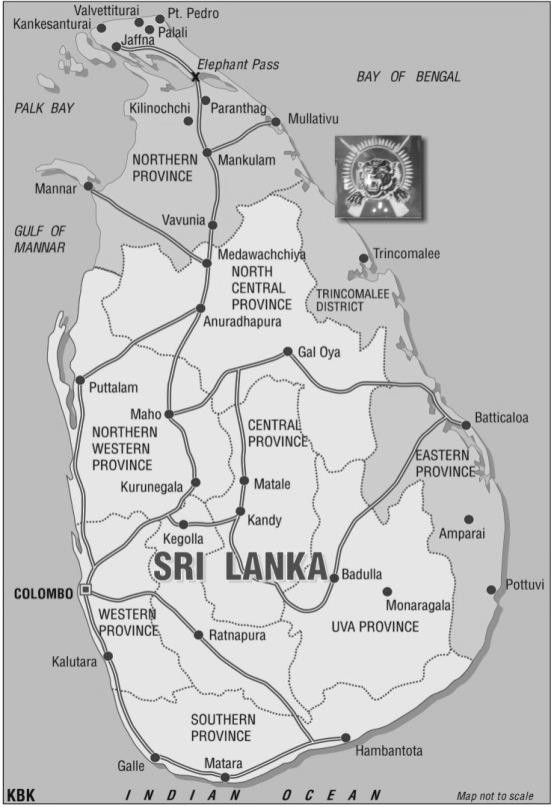
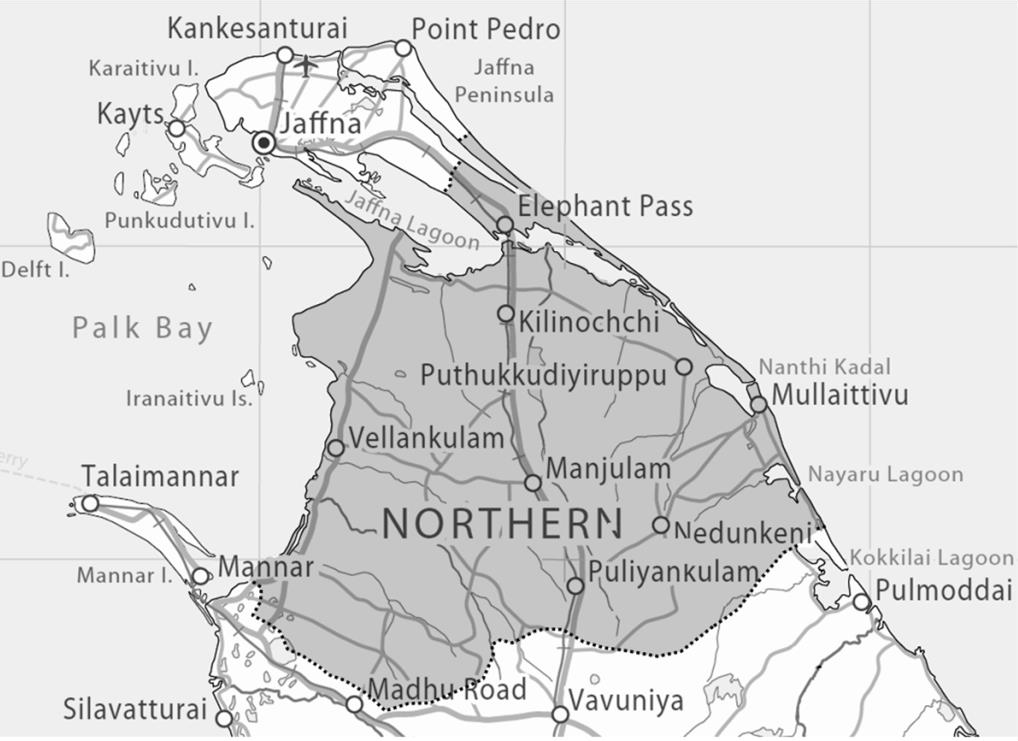
Three reasons explain the Government of Sri Lanka’s strategy. On a military level, the LTTE and the Sri Lanka army are at a stalemate, with the Jaffna peninsula and the Trincomalee District held as Eelam, thus “effectively cutting the country in two.” (Blacker 12, 92; see maps below).4 Both the GoSL armed forces and the Siruththai Puli insurgents have suffered heavy casualties, while the civilian population trapped in the war zones incurred a very high death toll (Blacker 71). It is relevant to note that even on the battlefield when involved in military engagements, the Tamil units are never referred to by the author, himself a GoSL veteran, as soldiers, unlike the Sinhalese armed forces, but always with the tags “terras,” “terrorists” and “LTTEers.” For a militarised society, dehumanizing the enemy gives legitimacy to the war – brutal tactics become acceptable since our enemies are barbarians.
Like its cumulative evidence of collusion between al-Qaeda and the LTTE, the Sri Lankan government’s indiscriminate use of the terror tag to describe both its opponent’s suicide attacks against civilians and conventional military operations in uniforms alike, is politically motivated. The GoSL’s overall objective is to deterritorialise the war, to redefine it under the aegis of the GWOT and thus remove both its ethnicity and the legitimate grounds which triggered it in the first place. By stocking up its “war on terror” rhetoric and committing itself to a military solution against a “foreign” terror network, the GoSL cosies up to its Sinhalese hardliners who harbour xenophobic suspicions of the West, while at the same time rehabilitating its reputation as a black-listed regime , to the effect that its much-decried 1979 Prevention of Terrorism Act becomes an emergency template for the US Patriot Act.
Far from being “Aiyah,” the avuncular figure displayed in the corner shops of the Tamil diaspora,5 Vellupillai Prabhakaran, combines the ruthlessness of a Carlos the Jackal (Ilich Ramírez Sánchez) or bin Laden with the charisma of a Che Guevara. The most wanted man in Sri Lanka, India and on Interpol lists has evolved the LTTE into a sophisticated terrorist network worth US$200-300 million at its peak, with multiple trans-national business ventures. These include investment in real estate, shipping, grocery stores, gold and jewellery stores, gas stations, restaurants, film and other mass media organisations (Blacker 110).
[At the helm of the LTTE, Prabhakaran] was personally responsible for the deaths of tens of thousands of Sri Lankans–Sinhalese and Tamil and Muslim; and was the most wanted man in Sri Lanka and India.
With absolute power over the Tigers and the areas of the country they controlled, he ruled with an iron fist and brooked no criticism. The LTTE murdered and terrorized into non-existence all other Tamil political parties in the northeast of the country. (Blacker 110-111).
Thus the GoSL exploits the concept of terrorism to deny the LTTE the status of a rebel army, which amounts to criminalising armed resistance to perceived national, ethnic, class, religious or other oppression.6 With this mindset, Prabhakaran cannot be compatible with the paradigm case of the ‘terrorist turned national leader or statesman – along the lines of Jomo Kenyatta, Menahem Begin, Yasser Arafat, Nelson Mandela, Martin McGuinness, or Xanana Gusmão (Blacker 72). One dissenting voice in the novel raises one of the central issues in the definition of terrorism and terrorists. Indeed Rajan Kumaraswamy, a civilian who has sympathies for Tamil nationalism, yet is critical of the LTTE, exposes the international community’s hypocritical double standards on terrorism. He sees the creation of al-Qaeda, the Taleban or the LTTE by the CIA, ISI or RAW as Frankenstein monsters disguised as state policy (Blacker 70-71; see 355).
Whereas some of the above mentioned terrorists / freedom fighters have had their criminal records whitewashed, Prabhakaran’s name is indelibly associated with the following heinous crimes:
- the assassination of Alfred Duraiappah, the Mayor of Jaffna on 25 July 1975;
- the assassination of former Indian Prime Minister Rajiv Gandhi, on 21 May 1991;
- the assassination of Sri Lankan President Ranasinghe Premadasa, on 1 May 1993;
- the assassination of Sri Lankan MP and peace negotiator Neelan Tiruchelvam, on 29 July 1999;
- the suicide attack against Sri Lankan President Chandrika Kumaratunga on 18 December 1999;
- the assassination of Sri Lankan Industry Minister C.V. Goonaratne on 7 June 2000.
It must be noted that the targeting of high profile politicians and army personnel did not stop after 9/11. Carried out to punish India for its intervention in Sri Lanka with the IPKF, the assassination of Rajiv Gandhi marked a shift in the perception of the LTTE. It alienated its support in India, particularly in the state of Tamil Nadu. It drew attention to its human rights abuse, notably the forced recruitment of child soldiers, issued with cyanide vials to wear around their necks and instructed to bite down on the cylinders in the event of capture. This appalling record led to its proscription as a terrorist organisation in India under the Unlawful Activities (Prevention) Act and in several other countries (Blacker 169). The killing which contributed significantly to India’s decisive tilt in the civil war towards the Colombo government is mentioned several times in the novel to leverage peace talks between the LTTE and the GoSL. Throughout the 1990s, the LTTE, which claimed responsibility for most of its suicide bombings, staunchly denied killing the former Indian prime minister. At a press conference in 2002, when tasked with acknowledging his role in the assassination, Prabhakaran did not deny the LTTE’s involvement: “This is a tragic incident that took place 10 years ago, and I would rather not comment on it.” (Blacker 573)
The LTTE ideologue and commander has orchestrated suicide bombing attacks with a global network of terror, particularly the Black Tigers, including the Sea Black Tiger wing, who employed state-of-the-art “bomb suit” technology against military and civilian targets (Blacker 148). They allegedly received glider and speedboat training in Europe and Southeast Asia for infiltration operations and sabotage missions. Furthermore, these elite “kamikaze” squads are rumoured to have trained Mujahiddeen in Afghanistan in suicide bombing techniques and improvised explosive devices (IED), a technique pioneered by the LTTE, in return for anti-aircraft and Stinger expertise (Blacker 30). Out of the several deadly attacks hatched by the LTTE in the novel such as the assassination of the Sri Lankan ambassador in Paris, the sinking of a ship off the port of Rotterdam, the bombings in the Toronto Metro, outside the Nova Scotia Bank in London, at the Frankfurt Trade Expo, at the Sri Lanka Consulate in Sydney, and of the Canadian Forces CC144 Challenger (Blacker 154, 156, 162, 164, 168, 169, 280; 441-442), most attacks can qualify as suicide missions, particularly the hijacking of Canadian Airline AC634, codenamed operation Rama and the assault on and occupation of the Canadian Embassy in Colombo, codenamed operation Sita (Blacker 337; 373).
The two attacks which feature prominently in the novel will be commented further on. Both have been plotted at the highest level to impact Canada’s foreign policy agenda and curbing of domestic Tamil organisations. Operation Sita has been masterminded by the LTTE’s commander – the name of Prabhakaran is suggested, yet never introduced (Blacker 116). Yet, the LTTE denies all responsibility for the raid, which they blame on a rival Tamil faction, the Eelam Republican Army (ERA), to restore the LTTE’s credibility and appear more moderate. Before the attack is launched, Devini Sundaralingam, the Black Tiger commanding officer in charge is given the final accolade as she is treated to a special personal meal with the guru-like leader. (Blacker 110-111) The whole scene in which Major Sundari recalls her “short lifetime dedicated to war” evokes a similar episode between Malli and the Leader in The Terrorist (Santosh Sivan 1998).
Operation Rama is similarly planned with Canada’s foreign policy clout in mind. The two copycat attacks seem designed to inflict maximum damage on Sri Lanka’s image and foreign policy. Yet, in the first case the LTTE goes public to distance itself from the ERA terrorist outfit, whereas it appears in the media spotlight in the hijacking of the Canadian airline. The inconsistency becomes rapidly apparent to the Sri Lankan Intelligence Committee monitoring the two synchronized attacks (Blacker 380). To the dismay of the GoSL, operation Rama turns out to have been orchestrated by DFI, the Police’s Foreign Intelligence Directorate and a rival agency of Military Intelligence.7 The DFI has funded dissident factions of the LTTE as well as set up Muslim and Tamil units to fight the Tigers and carry out selective assassinations (Blacker 424-425). Operation Rama was planned as an extension of the policy to discredit the LTTE, with the recruitment of fake Tamil guerrillas trained in hijacking tactics by the ISI in Islamabad (Blacker 431). The State Minister for Defence explodes when he comes to learn the full ramifications of the operation which amounts to “state-sponsored terrorism” (Blacker 436).8 Publicly, the politician like the Head of the Intelligence Committee cannot condone the hijacking which, should it be leaked to the press, would scupper the GoSL’s counter-campaign to have Western governments with sizeable Tamil communities like Canada take a firmer stand against the LTTE’s umbrella front organizations such as TEEDOR, The World Tamil Association and TRO, and curb their propaganda and fund-raising activities.
Biopower
Michel Foucault and Giorgio Agamben have conceptualised totalitarianism in relation to the Panopticon and the state of exception. Their complementary theory of biopower can shed further light on the Global War on Terror and the paranoia of contemporary societies in which security becomes the basic principle of state activity.
A focus on security bears within it an essential risk. A state which has security as its sole task and source of legitimacy is a fragile organism; it can always be provoked by terrorism to become itself terroristic (Agamben 2001).
Interviewed on NBC’s Meet the Press, just days after 9/11, Dick Cheney elaborated on how terror was no longer confined to the exceptional, but had become a paradigm of governance which imposed a new model of truth and normality, outside the rule of law:
We also have to work, though, sort of the dark side, if you will. We’ve got to spend time in the shadows in the intelligence world. A lot of what needs to be done here will have to be done quietly, without any discussion, using sources and methods that are available to our intelligence agencies, if we’re going to be successful. That’s the world these folks operate in. (NBC, 2001)
The Canadian government is pressed to emulate the US administration and “to clean up its own backyard,” (Blacker 36, 131, 132) after Washington submitted the GoSL’s “conclusive” evidence against the LTTE. Thus, the Canadian Ministers of Defence and Foreign Affairs and International Trade legitimise deportations to Sri Lanka as well as crackdowns on “criminals” as well as “so-called Tamil community-service organizations [which] are nothing but cover groups for the LTTE.” (Blacker 132) During one such raid in Scarborough’s Tamil Town to flush out an LTTE cell and bust an extortion / money laundering ring, Canadian snipers are assigned a shoot-to-kill mission. They spray a building with bullets after a “bastard,” or “sonsofbitches” and act “like jackbooted thugs terrorizing innocent diners while using machine-guns and grenades to massacre mere tax evaders.” (Blacker 52, 67, 75) In power politics and international relations, there has always been a difference between the foreground with its legal framework and the extrajudicial background – Cheney’s “dark side.” However, with the discourse of GWOT, the difference has been blurred, which means that the dark side has been normalised and institutionalised. The GoSL minister’s revulsion at the bogus hijack is not so much out of concern for the potential loss of civilian lives or military operatives, but rather for the likely political and diplomatic fall-out. He has no such qualms engaging in State Terror, early on in A Cause Untrue, when the Directorate of Military Intelligence (DMI) plots “black” operations against Tamil sympathisers in Western capitals, violating the laws of these countries and irrespective of the collateral damage to the general public (Blacker 83, 172). It is highly significant that the same Intelligence Committee should lambast the bogus hijacking and sanction the death squads. With global terror, the citizen becomes a hostage to the state’s imperatives of control and security.
Foucault’s biopower, Agamben’s “homo sacer” and Mbembe’s necropolitics help us understand how paranoid states manipulate fear to decide who to incarcerate, who to eliminate.9 Thus the terrorist other is the perfect paradigm in the context of civil war as he is de-humanised and becomes a “disposable body,” to use Mbembe’s terminology.10 The novel provides countless references to the female body as a site of biopolitical control, either as suicide bombers or as rape victims (de Mel 2007: 219-20). The LTTE uses rape as a weapon to humiliate and terrorise civilians as in the embassy scene, as well as to battle-harden their unseasoned recruits. Furthermore, it is fitting that from opposite spectrums in the novel, rival agents of death, and SL Army corporal Dayan Premasiri have “a lifetime dedicated to war.” Both become ruthless executioners when it comes to prisoners of war (Blacker 101, 115, 256). Both depend on drugs and the adrenaline of war, finding it near-impossible to morph back into civilian life and the enemy’s tracer bullets are a more alluring spectacle than the lanterns of a religious festival (Blacker 111, 47).
Terror Lens
Contrary to the age of Thucydides, Mitchell emphasises, in which historical events and their perception were not synchronous, events and comments are filtered through mass media:
Contemporary war can be seen and shown in multimedia presentations in real time – and not just broadcast media such as television, but social media […], on devices such as cell-phones and digital cameras. The shaping of perceptions of history does not have to wait for historians or poets, but is immediately represented in audio-visual-textual images transmitted globally. (Mitchell 2011: xi)
A Cause Untrue redefines the civil war raging in the tear-drop island between Tamil ethnic separatism and Jathika Chintanaya or Sinhala ultra-nationalism in the light of 9/11. The novel’s prologue sets the tone for the spectacle of terror which is an integral part of the ideology of terror. With the intrusion of the media 24/24 and 7/7, Blacker highlights how the panopticon can mutate from discipline in enclosed, exceptional sites to free-floating forms of power and virtual control (Foucault 1991: 209). Thus the novel does not start with the response of 9/11 survivors or witnesses. It adopts a voyeuristic approach with cameras and microphones on board American Airlines Boeing 767, as though the reader turned viewer was watching a film looping endlessly.
Not only does the author borrow terms from cinematography such as “slow-motion,” “freeze,” or “cutting off the scene” (Blacker 3-4), but close-up angles, swish pan, tilt shot and voice-off also suggest a filmic composition. The technicolor spectacular is further reflected by live graphic violence – with the co-pilot and a stewardess having their throats slashed – screams and the “smell in the cockpit [an] overpowering […] mix of shit, blood, urine and raw terror.” (Blacker 6)11
The media framed a national narrative of 9/11 with the constant replay of the twin towers collapsing again and again in Pearl Harbor-fashion (Blacker 131), the ubiquitous Star and Spangled Banner, and George W. Bush as knight at arms and saviour in complete synchronisation with the US President’s monumental struggle of good versus evil. The coverage became most of the time so formulaic and melodramatic that it failed to contextualise the terrorist acts, choosing to compare the phenomenon of terrorism to natural disasters and villify the terrorists as irrational and barbarous. Osama bin Laden was repeatedly portrayed as the archetypal evil genius, in the guise of a faceless abstraction or a creepy Godzilla-like Superman with the eyes of a homicidal maniac (Winch 2005). Such national recuperation of terror has provoked two radically different types of reaction. It lent credibility to the 9/11 Truth Movement and conspiracy theorists who accused the CIA of masterminding the terror attacks. At the opposite end of the spectrum, the live spectacle of terror with the magnitude of the devastation, the sacrifice and solidarity of the rescuers as well as the split-screen demonstrations of joy in Arab countries orchestrated public emotion towards a retaliatory response.
Terrorists are not only the target or object of media attention. Traugott and Brader, Giustozzi and Mitchell illustrate how media-savvy terrorists control the spectacle of terror just like intelligence agencies (Blacker 102). They use the tools of the media to stage spectacular performances, particularly macabre executions to gain worldwide attention, mobilise support and boost recruitment or conversely to engage in psychological warfare by hacking into the enemy’s propaganda network (Blacker 287-288). Elaborating on Foucault’s biopower, Mitchell proposes to read the spectacle of terror through the lens of cloning. His central metaphor is borrowed from the world of genetics and biotechnology in which cells proliferate and then migrate from host to host across geographical borders with risks of metastising. Similarly, cell mutation and viral infection can be applied to a wide range of biopolitical phenomena affecting the body politic (Mitchell 2011: xii-xiii). Cloning is instrumental in understanding the state of terror not only because it illustrates the symbiotic relationship between terrorism and counter-terrorism – eg. in the case of the CIA, ISI and al-Qaeda – but as an extension of biopower, it is the master metaphor of image-making itself:
the nexus of cloning and terror runs like a bright thread through the iconic figures of facelessness, headlessness, and anonymity ; through a procession of twins, doubles, multiples and mirror-images, mutating and spreading like viruses. (Mitchell xiv)
The prologue to A Cause Untrue demonstrates that voyeurism is also central to the spectacle of terror. The reader as passive audience watches the “real time” killing of 9/11 hostages. The dynamics of voyeurism are intrinsic to the thriller or spy genres in which disposable bodies are controlled at the end of computer screens, cameras, binoculars or the crosshairs of a gun, for the benefit of a desensitised audience. Thus the male scopic drive is ever present in this hyper-kinetic novel with its self-referential associations with movies (cowboys, cartoons, James Bond, Rambo…). It manifests itself in the opening lines of the first chapter as a Tamil courier enters the field of vision of camouflaged Corporal Dayan Premasiri, ready to be killed. The scene which is re-enacted repeatedly with different permutations can be related to pornotopia. In one scene which is intended as comic relief to the orgy of killing – the corporal at one point contemplates keeping as fetish the earlobe of an LTTE teenager he had executed – Dayan Premasiri’s unit witness their leader having sex with his wife. The second scene has more significant political repercussions, as Patricia Fenster, the wife of the Canadian Minister for Foreign Affairs, is caught on film performing a sex act with her husband’s head of security. The photographs are exploited for political blackmail (Blacker 186-192). A further link between pornography and warfare is provided when counter-terror cells manage to hack into the websites and webservers of pro-LTTE organizations like TamilNet and replacing content with bona fide images of Prabhakaran being sodomised. (Blacker 287-288, 329) This is an oblique variation on the stereotyping of war often reduced to male anal sex in soldiers’ parlance (Blacker 434).
Whether to proselytise or denigrate the LTTE, the ERA’s operation Sita and the Intelligence Services’ operation Rama have been planned and choreographed with a media agenda. Major Mahesh Balachandran, in charge of the former operation, summarises the situation: “[t]ime for the situation to begin. He had no doubt that the audience, in the form of the international media, was ready and waiting.” (Blacker 454) DeviniSundaralingam (aka Colonel Sundari), in charge of the latter operation from the Embassy’s communication centre, is similarly attuned to a 24-hour news culture with “producers keen to see action that would keep viewers glued to their screens.” (Blacker 528) Both commanders of operations Sita and Rama are acutely aware of the power of media narratives, hence the need to control media exposure. Once the two attacks are aired, both worry that the rival operation may cannibalise media space (Blacker 402, 558-559). In the two operations, media images are also used by counter- terrorism agencies to gather information about the perpetrators to plan an assault. The monitors that the Intelligence agencies have put in place with wires and cables suggest coverage of test cricket, rather than crisis management (Blacker 487).
Yet, noteworthy differences should be pointed out between the two operations. As operation Rama is a bogus hijack, its media choreography is minimal. As soon as the attackers storm into the cockpit, they disable the closed circuit surveillance equipment and favour a communications blackout. Furthermore, Mahesh Balachandran never speaks directly to the press, opting instead to use the pilot to relay information to a chosen negotiator. Although the international networks are better equipped, they are relegated by the Intelligence media unit, several miles away from the scene and fed minimal select information. The orchestration of operation Sita follows a completely different compositional paradigm. Devini Sundaralingam is not satisfied with the presence of a CNN team and Sri Lankan TV stations outside the Canadian Embassy. She insists on having the hijackers’ demands live on BBC World Service, as she is convinced coverage by the UK channel is likely to be less partisan towards the Sri Lankan government. She decides what equipment the BBC should use and what format the broadcast would take:
First of all, this is not an interview. You will ask no questions. You may do the usual introduction, but after that I’ll give a statement that will explain our acts and end with our demands. After this, you’ll be allowed to leave. The BBC is just a voice for us. (Blacker 387)
In exchange for the scoop, the news channel-turned both voyeur and purveyor of voyeurism is required to film the live gang rape of the Embassy’s senior visa officer and CSIS head of station (Blacker 391-392, 542). When the live broadcast is discontinued, Devini Sundaralingam gives the BBC an ultimatum and eventually shoots the hostage, once they are back on air, to teach both the authorities and the media a lesson (Blacker 396). The ERA-LTTE commander later monitors the press for private and official responses to the horrific events broadcast by the BBC. Such pornographic violence works at literal and symbolic levels. On the one hand, it prefigures the ensuing mayhem during the apocalyptic assault by the counter-terrorist forces (Blacker 531-552). On the other hand, it is a constituent of biopower and the culture of terror in which the other is reduced to “homo sacer.” The terrorist Other has become the disposable, bio-degradable contemporary savage whose “trophy pictures” in Abu Ghraib or Guantanamo interrogate “our” civilisation.
When examining the pornography of violence, one should also raise the issue of the nationalisation of death, or rather the confiscation of death as a private and personal event by the GoSL or the LTTE. Given the totalitarian nature of the LTTE, its combatants are required to sacrifice their lives to the cause. They acquire a new identity when they join a training camp, have no right to a sex life, and gear their whole lives towards their suicide missions. It is only when they die that they recover their identity. A martyrology developed with the Eelam flag and shrines with the photographs of the fallen heroes, as was illustrated by the death of Annai Poopathy (Blacker 111, 116). As a mirror-image, the Sri Lankan government celebrates its war dead in much the same way, with full army regalia and the national flag draped over the coffins. The novel commemorates such a national icon, Lance Corporal Kularatne adulated posthumously by the media and the public alike popularly known as ‘Hasalaka Gamini’,12 adding that the Ministry of Defence withdrew information that he was killed by friendly fire (Blacker 87-88). This public relations-like omission echoes another key admission about the State’s disposal of bodies, to use Mbembe’s terminology. Special Forces killed in action in enemy territory or abroad had their bodies destroyed by their comrades and their coffins would be sealed. The bodies of missing soldiers would often be replaced by logs or enemy bodies: “Dayan knew of several occasions when Sinhalese families had possibly buried or cremated the body of the terrorist who had killed their own dearly departed loved one.” (Blacker 83)
This cameo confidence which could easily be missed in such an action-packed thriller says a great deal about the culture of terror. Dayan’s realization of the nationalised staging of death is the subject of Pura Handa Kaluwara. Prasanna Vithanage’s 1997 film – which incidentally was banned by Sri Lanka’s censor board – apparently barely scratches the surface of the civil war, apart from the ubiquitous army fatigues, yet its impact is as powerful as in A Cause Untrue, as it defines the characters’ closed social horizons. Whereas the families of official war heroes are showered with gifts of lands, houses or government subsidies, many families in the rural south never recovered from the deaths of their sons. Many parents of soldiers killed in action either spurned compensation from the government or chose to spend their monthly allowance on memorials and merit-making ceremonies, particularly bus shelters featuring the photos and names of their deceased sons (Kent 2010 : 38). Prasanna Vithanage’s Vannihami depends on his son’s military pay. The news of Bandara’s death in the north deals a crippling blow to the poor farmer who finds himself unable to marry off his daughter, repair his leaking home, or repay a loan. However, the blind farmer declines to sign the administrative papers entitling him to a government allowance. He feels alienated from the funeral, symbolised by the Sri Lankan flag-draped coffin and the Buddhist ceremony. There can be no proper mourning unless Vannihami embraces his deceased son. The film vindicates the old man’s obdurate ethical stance while, at the same time, puncturing the government’s script, as Vannihami digs up the casket and exposes the logs for the missing body.
Pura Handa Kaluwara’s penultimate scene reverberates in the closing stages of A Cause Untrue as Dayan Premasiri visits the parents of Sandra Koch, a fellow operative who was killed in an intelligence operation in Germany. Dayan makes no reference to the fact that financial compensation would be provided to buy their silence. The meaning of the book’s title is thus refracted in both Dayan’s hard eyes and the gaze of Sandra’s father, “a man who had given both his children to a war he had no interest in and an enemy he had never met.” (Blacker 569) The implicit critique of the war reflects the views of the nation’s minority communities – the Muslim Moors or the Burghers – marginalized by the Sinhalese-Tamil hegemonic discourses and sucked into the civil war.13
The ‘After’ prefix and the post-9/11 tag appear to be premature, even unsuitable for a novel like A Cause Untrue bracketed by terrorist attacks and steeped in systemic violence. They may still appear as such, four years after the end of the civil war with its disputed numbers game and humanitarian rights record. According to the UN, there were 80,000–100,000 casualties between 1982 and 2009, with a death toll estimate for the final stages of the civil war ranging from 15,000 to 20,000. Still reeling from the post-colonial convulsions of the nation-state, the government of Sri Lanka has steadfastly blocked all human rights inquiries from international agencies and independent journalists are still censored or threatened.
Out of most other major novels dealing with the Sri Lanka civil war, such as When Memory Dies (Sivanandan 1997), Anil’s Ghost (Ondaatje 2000) and Heaven’s Edge (Gunesekera 2002), only the latter was written after 9/11. Yet, all these works can a have a legitimate claim to represent post-9/11 fiction. All three works share similarities with A Cause Untrue in their representation of graphic violence – they all end up with violent killings. Contrary to David Blacker’s novel with its narrower compass and marginalised civilian voices, Sivanandan, Ondaatje and Gunesekera “propound paradigms of harmony and mutual understanding transcending boundaries or revisionist theories premised on racial purity and ethnocentric nativism.” (Zinck 228) Such works allow a space for working through trauma and regeneration. There is no such space in A Cause Untrue with its hegemonic discourse on terror. The only space provided is the terror spectacular or the media simulacrum, the screen of images through which the GoSL and the LTTE see each other. The novel does not articulate a crisis of representation. Yet, it does expose the extent to which both sides project a narrative of terror, rendering obsolete any comparable fictions the cinema has to offer (Blacker 570-571). A legacy of the War on Terror has been the normalisation of terror as a substitute for justice and international relations. If we are to understand the “post” 9/11 prefix as the after-shock ripples following an event of the magnitude of 9/11, then in that sense only, can A Cause Untrue with its paradigm of normalised violence be considered as a “post”-9/11 novel.
Notes
- 1Noontide Toll offers a contrasting kaleidoscope of the war zones, as its characters revisit the past, seek an easy way out, or keep their trauma bottled-up inside (Gunesekera, 2015).
- 2I have chosen to retain the singular, although the plural–civil wars–would more accurately reflect the multiform dimension of the successive wars.
- 3The Bagram Theater Internment Facility, also called the Parwan Detention Facility, was a United States-run prison in Afghanistan. It was notorious for torture and prisoner abuse. On March 25, 2013, the prison was handed over to the Afghan authorities. Another legal black hole was US base, San Diego where ghost prisoners were detained.
- 4Map 1 represents in shaded grey the separatist territories claimed by the LTTE at
its zenith, although it failed to hold on to the Eastern Province, South of Trincomalee,
as a result of the Colonel Karuna’s defection encouraged by the GoSL.
Map 2 illustrates the LTTE’s rump state in the closing stages of the war. - 5Aiya in Sinhala and Tamil means elder brother.
- 6There are obvious parallels with the Naxalite, Kashmiri, Manipuri and Bodo insurgencies in India, Baluchi separatism and Pashtun irredentism in Pakistan and the Jumma autonomism in Bangladesh.
- 7The Directorate of Foreign Intelligence (DFI) and the Directorate of Internal Intelligence (DII) are agencies under police control, contrary to the Directorate of Military Intelligence (DMI).
- 8Although it is a work of fiction, it refers to standard guerrilla tactics overhauled by the Intelligence agencies. In addition, the GoSL worked out a deal with the Karuna faction, an LTTE splinter group to carry out sabotage and extra-judicial operations against its former organisation.
- 9Significantly, the GoSL commandos train in their “Killing House” (Blacker 79).
- 10Even self becomes mechanised in a society dominated by the proliferation of instruments of death. Moreover the body, as Dayan Premasiri represents it, is often reduced to organs or body functions like bowel discharge, erection…
- 11In operation Sita, visual, auditory and olfactory cues are equally used to create a cinematic reality effect.
- 12A life-size statue was erected at Elephant Pass in 2013 to perpetuate the myth of the supreme sacrifice of ‘Hasalaka Weeraya’ (Hasalaka Hero).
- 13The Burghers are the dwindling descendants of Eurasians, mainly Portuguese, Dutch, German and British colonists from the XVIth century. Like David Blacker they are recognizable owing to their European names.
Bibliography
- Agamben, Giorgio. Homo Sacer. Sovereign Power and Bare Life. Stanford, CA: Stanford UP, 1998.
- Agamben, Giorgio. “HeimlicheKomplizen. ÜberSicherheit und Terror” (Trans. Soenke Zehle). Frankfurter AllgemeineZeitung, No 219, 20 September, 2001: 45.
- Arasanayagam, Jean. All is Burning. New Delhi: Penguin India, 1995.
- Blacker, David. A Cause Untrue. Colombo: Perera-Hussein, 2005.
- Bush, George W. Office of the White House Press Secretary, “Presidential Address to a Joint Session of Congress and the American People, United States Capitol. Washington, D.C. 20 September 2001. 15 jullet 2015. <http://www.whitehouse.gov/news/releases/2001/09/print/20010920-8.html>
- Bush, George W. “Remarks at a Fundraiser for Governor Scott McCallum.” Milwaukee, Wisconsin, 11 February 2002.
- Butler, Judith. Precarious Life: The Power of Mourning and Violence. London: Verso, 2004.
- Da Silva, Nihal. The Road to Elephant Pass. Colombo: VijithaYapa, 2003.
- Foucault, Michel. Discipline and Punish. The Birth of the Prison. London: Penguin, 1991.
- Foucault, Michel. Society Must be Defended. London: Penguin, 2003.
- Ganeshananthan, V.V. Love Marriage. New York: Random House, 2008.
- Giustozzi, Antonio. Decoding the New Taliban: Insights from the Afghan Field. New York: Columbia University Press, 2009.
- Govinnage, Sunil. “The Mute Sea and My heritage.” Perth: My Village Down Under: A Collection of Australian Poetry. Nugegoda: Sarasavi Publishers, 2011.
- Gunesekera, Romesh. Heaven’s Edge. London: Bloomsbury, 2002.
- Gunesekera, Romesh. Noontide Toll. New York, NY.: The New Press, 2014.
- Hafetz, Jonathan. “Military Detention in the ‘War on Terrorism’: Normalizing the Exceptional after 9/11.” Columbia Law Review, Sidebar, Vol. 112 (2012): 31-46.
- Huntington, Samuel P. The Clash of Civilizations and the Remaking of World Order. New York: Simon & Schuster, 1996.
- Jeganathan, Pradeep. At the Water’s Edge. New York: South Focus, 2004.
- Kent, Daniel Webster. “Proof of Buddhism: Interpreting the Bodies of Sri Lankan Buddhist War Dead.” The Sri Lankan Journal of Humanities, 36.1-2, 2010: 19–39.
- Mbembe, Achille. “Necropolitics.” Public Culture 15: 1, 2003: 11-40.
- Mel, Neloufer de. Militarizing Sri Lanka: Popular Culture, Memory and Narrative in the Armed Conflict. New Delhi, 2007.
- Mitchell, W. J. T. Cloning Terror: The War of Images, 9/11 to the Present. Chicago: University of Chicago Press, 2011.
- “NBC News’ Meet the Press.” Guest: Vice President Dick Cheney, Moderator/Panelist: Tim Russert - NBC News, 16 September 2001. 15 juillet 2015. <http://emperors-clothes.com/9-11backups/nbcmp.htm>
- Ondaatje, Michael. Anil’s Ghost. London: Picador, 2000.
- Pura Handa Kaluwara (Death on a Full Moon Day), Dir. PrasannaVithanage, dist. Torana, 1997, 74 min.
- Selvadurai, Shyam. Funny Boy, London: Vintage: 1995.
- Sivanandan, Ambalavaner. When Memory Dies. London: Arcadia, 1997.
- Tearne, Rosa. Mosquito. London: HarperPerennial, 2008.
- Traugott, Michael W. and Ted Brader. “Explaining 9/11.” Framing Terrorism. Pippa Norris, Montague Kern, and Marion Just (eds). New York: Routledge, 2003. 183-201.
- The Terrorist (Theeviravaathi), dir. Santosh Sivan. dist. Winstar, 1999, 95 min.
- Wijenaike, Punyakanta. The Enemy Within. Ratmala, Colombo: SarvodayaVishvaLekha, 1998.
- Zinck, Pascal. “The Return of the Natives: Infernal Paradise in Michael Ondaatje and Romesh Gunesekera’s Heaven’s Edge.” India and the Diasporic Imagination. Eds. Rita Christian and Judith Misrahi-Barak. Pulm, Presses Universitaires de la Méditerranée, 2011. 215-229.
About the author(s)
Biography: Dr Pascal Zinck holds a PhD from Paris IV-La Sorbonne. He is an Associate Professor
of English at the Universities of Paris Sorbonne Cité and Paris Ouest-Nanterre. He
specialises in postmodernism as well as postcolonial and multicultural critical theory
with an emphasis on South Asian diasporic fiction, memory, terror and trauma studies.
He has spoken at contemporary literature conferences in Europe, the US and Australia
and has published widely on Kazuo Ishiguro (Peter Lang and Cambridge Scholars). He
has written articles on postcolonial Sri Lankan and Pakistani fiction.
His current research focuses on war, ethnicity, memory, nationalism and fundamentalism
with further articles on the works of Michael Ondaatje, Ambalavener Sivanandan, Romesh
Gunesekera, Jean Arasanayagam, Selina Hossain, Mohsin Hamid, Kamila Shamsie, Uzma
Aslam Khan and H M. Naqvi.
He is part of an international research team with Dr Stephen Morton and Dr Veronica
Thompson exploring cultures of terror and terrorism in South Asian literature and
film. He has edited River of my Blood, Selina Hossain’s novel on the Bangladesh liberation war, which is due for publication
in 2016.