Preface
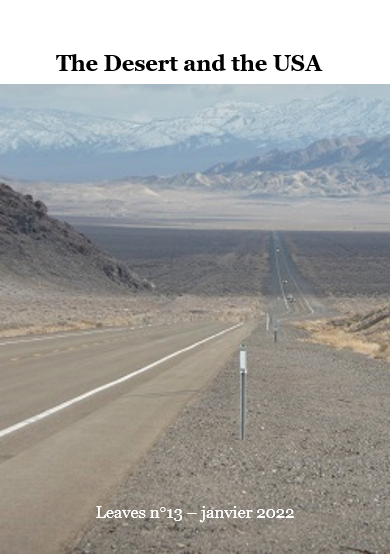
This volume looks at American culture through a conceptual lens that owes its analytical properties to both the geoecological materiality and the cultural history of its referent. I am talking about the desert. Its aridity has puzzled, frightened, and fascinated Europeans all at the same time, particularly those settler colonialists who came to America from those parts of Europe whose vegetation was (and, for the time being, continues to be) defined by the temperate climate created by the Gulf Stream. The colonial powers of England and France came to the North American continent with an environmental mindset used to the agricultural possibilities rooted in the fertile soils of arboreal geographies and the (relative) reliability of precipitation evenly distributed across four seasons. With the possible exception of the Spanish, Europeans who came to North America between the beginning of the seventeenth and, roughly, the end of the nineteenth centuries did not expect to enter a territory which, in its Western regions, featured landscapes that were vast, foreign and arid–a space well beyond the confines of the well-watered, arboreal landscapes of their imagination. Since the early nineteenth century, the landscapes west of the Mississippi river were known as the Great American Desert. And the topographical, climatological, and cultural challenges this posed for the American empire’s westward expansion became an intrinsic, iconic part of its national mythology.
The success of the American project was and continues to be measured in no small part by the nation’s ability to conquer its arid regions. As Tom Lynch has recently put it in his “Foreword” to Reading Aridity in Western American Literature (2020): “In spite of John Wesley Powell and Wallace Stegner, in spite of invocations to get over the color green, in spite of feeble efforts to celebrate xerophilia, Americans, for the most part, still think making the desert bloom with golf courses, cotton fields, lawns, and daffodils is a good thing.” Lynch advocates for a fundamental revision of Western modernity’s perception of the desert as wasteland and of desertification as catastrophe or tragedy. By this he does not mean to deny the ecological realities created by ill-conceived methods of water management, the consequences of which can be observed in the Colorado river delta or the Aral Sea. Rather, he argues for the recognition of deserts as unique ecologies that are different from, rather than lacking the characteristics of greener geographies. Deserts do support life; and they are home to cultures with long histories and traditions, as can be observed in the American South West. Even Death Valley, the driest and, arguably, most dangerous place on the North American continent, was home to the Timbisha Shoshone, an indigenous people that long preceded the builders and present-day proprietors of The Oasis at Death Valley, a hotel resort and camp ground near Furnace Creek with a golf course and palm tree groves.
Many of the essays collected in this volume locate their arguments at a point where the ecological and geographical realities of the (American) desert intersect with its cultural and literary histories. They take a closer look at the productivity of “the desert” as a tool for understanding the historical, psychological, cultural, political, and environmental challenges for the American experiment in the immediate past of the twentieth and the present of the twenty-first century. At the same time, this anthology has the potential to contribute to the reconceptualization of “desertification” in the sense suggested by Tom Lynch–as a mode that will help us to diversify our understanding of the many environmental foundations of a multiplicity of human cultures on earth.
About the author(s)
Biographie : Nawelle Lechevalier-Bekadar, agrégée d’anglais, est PRAG à l’Université Rennes 2 et membre du laboratoire ACE (Anglophonie, Communautés, Écritures). Elle est l’auteure d’une thèse intitulée « Something was wrong » : l’Esthétique du malaise dans l’œuvre de Brian Evenson, qui sera publiée aux Sorbonne Université Presses. Elle vient de publier Brian Evenson : L’empire de la cruauté aux Presses Universitaires de Rennes, un ouvrage collectif codirigé avec Sylvie Bauer et Florian Tréguer. Elle travaille actuellement sur les questions de violence, malaise et fanatisme dans la littérature américaine contemporaine.
Biography: Nawelle Lechevalier-Bekadar is an associate professor at Rennes 2 University. She is the author of a thesis entitled “Something was wrong”: The Aesthetics of Malaise in Brian Evenson’s work to be published by Sorbonne Université Presses. She has just published Brian Evenson: L’empire de la cruauté at the Presses Universitaires de Rennes, a collective work co-edited with Sylvie Bauer and Florian Tréguer. She currently works on questions of violence, malaise and fanaticism in contemporary American literature.