What Does Sculpture Do? From Photographs to Statues:Remediating Memory and Remedying the Past

Abstract: In Birmingham, AL, Dallas, TX, Greensboro, NC, and Clinton, TN, sculptures erected to mark some of the major moments of the Civil Rights movement share one common point: they were based on photographs taken in 1956, 1960 and 1963, without being perfect replicas of the images from which they were created. How photographed scenes became monuments celebrating the courage and the determination of individuals lifted to the ranks of heroes is at the center of this article. Whether the original photograph was shot during a protest march or a walk to school, during a sit-in, or staged in a bus, the transformation from printed image to sculpture offers the opportunity for figures such as the Greensboro Four and the Clinton Twelve to rise from the relative obscurity that the long shadow of Rosa Parks has cast over the Movement, and for them to become a vital part of the Civil Rights memorial landscape. For each of the examples analyzed, the process of remediation permits the study of the symbolic shift that took place when the siting of the monument in the urban space replaced the background of the photograph.
Keywords: Clinton Twelve, Greensboro Four, Birmingham Foot soldiers, Rosa Parks, Civil Rights, Remediation, Monuments, Photography
Résumé : À Birmingham (Alabama), Dallas (Texas), Greensboro (Caroline du Nord) et Clinton (Tennessee), les sculptures érigées pour marquer quelques temps forts de la lutte pour les droits civiques partagent une même caractéristique, celle d’avoir été créées à partir de photographies prises en 1956, 1960 et 1963, sans pour autant être de fidèles reflets des images qui les ont inspirées. Cet article analyse le processus de remédiation qui conduit les scènes photographiées lors d’une marche de protestation, d’un sit-in, d’une séance de pose dans un bus ou d’un trajet pour se rendre à l’école, à devenir des monuments célébrant le courage et la détermination d’individus désormais considérés comme des héros. Si Rosa Parks demeure la plus célèbre d’entre eux, il n’en reste pas moins que cette remédiation offre une opportunité de sortir de l’oubli à d’autres figures importantes, telles que les Quatre de Greensboro ou les Douze de Clinton, et de les inscrire dans le paysage mémoriel du mouvement des droits civiques. Dans chacun des cas étudiés, ce que le processus de remédiation a permis de saisir, c’est le glissement symbolique opéré lorsque le lieu d’implantation du monument dans l’espace urbain se substitue à l’arrière-plan photographique.
Mots-clés : Les Douze de Clinton, Les Quatre de Greensboro, Les marcheurs de Birmingham, Rosa Parks, Droits civiques, Remédiation, Monuments, Photographie
The process consisting of “doctor[ing] negatives of sculptural subjects with ink or bleach in order to block out the surroundings completely” became part of what Geraldine A. Johnson presented as the type of “visual conventions [which] proliferated in the thousands of photographs of sculpture produced by the likes of Braun, Anderson and Alinari, so much so that eventually any three-dimensional object set against a neutral background could begin to be read sculpturally” (Johnson 282). Isolating the object in the photograph could thus participate in the making of “sculptural artifacts.” One of Johnson’s references concerns “involuntary sculptures,” “crumpled bus tickets, scraps of soap, and squirts of toothpaste” (Johnson 282), photographed by Brassaï with Salvador Dali’s captions and published in Albert Skira’s and E. Tériade’s Surrealist journal Minotaure in 1933. The possibility of reading these found objects sculpturally is allowed by “the visual conventions associated with ‘voluntary’ sculptures” (Johnson 283). If sculpture can be isolated with a neutral background, an object can be isolated and read sculpturally, in that case then—not surprisingly—certain photographed objects or subjects could be read sculpturally and fulfill the transfiguration potential implied in this logic by becoming sculptures. A blocked-out background could not only serve as a foil to the sculptural object or object-to-be-sculpture, it would also obliterate a setting, the very contextual frame which allowed the scene to have taken place. The sculptural quality of the object/subject predicated on its abstraction or isolation from the rest of the photograph would call for a re-investing of that missing part, in conformity with the very essence of sculpture to exist somewhere in time and space. As W. J. T. Mitchell would write: “What sculpture wants is a place, a site, a location both literally and figuratively” (Mitchell 250). But not just any place.
This article investigates these “involuntary sculptures” photographed, which became real sculptures, and for which the blocked-out background literally needs to be replaced. With the remediation of photographs pertaining to the African-American struggle to end segregation and promote equality, lifting out a contextual backdrop questions the role conferred to sculpture in fixing a version of history in the memorial landscape. While there is no doubt that monuments exist to celebrate, what the sculptures dedicated in Birmingham, Dallas, Greensboro or Clinton have to say depends on the moment caught in the photograph and furthermore on the importance bestowed upon such moments through the process of their very remediation.
Political Rereadings
Bill Hudson’s photograph of Walter Gadsden with policeman Richard Middleton’s dog lunging at him, taken on May 3, 1963, and which was on the front page of the New York Times and other mainstream newspapers (Berger, Seeing 11, 165; Spratt 85), became Ronald McDowell’s sculpture Dogs (The Foot Soldier Monument, 1995-96) installed in Kelly Ingram Park (Fig. 1). The artist had followed the request of Birmingham’s first black Mayor Richard Arrington, elected in 1979, to have a clear rendering of the event caught (Upton 167-68), but he departed from the original in a number of ways. Not only did the features differ, from photograph to sculpture, the age and attitude of the boy did as well, leaving the man answering to the name of Gadsden at a loss in front of a not-so-accurate rendering: “That statue doesn’t look like me,” he declared in an interview in 1996. “It looks like a totally different boy. That looks like an African boy” (in Gladwell). This question of resemblance seems almost secondary in the light of Gadsden’s accidental presence as an onlooker and not a participant in the demonstration: the heroic status of the foot soldiers will take on its full importance not necessarily in the sculpture itself, but in the accompanying inscription.
Gadsden was not one of the foot soldiers that the inscription on the pedestal is celebrating:
This sculpture is dedicated to the Foot Soldiers of the Birmingham civil Rights Movement.
With gallantry, courage and great bravery they faced the violence of attack dogs, high powered water hoses, and bombings. They were the fodder in the advance against injustice. Warriors of a just cause; they represent humanity unshaken in their firm belief in their nation’s commitment to liberty and justice for all.
We salute these men and women who were the soldiers of this great cause.
Richard Arrington, Jr.
Mayor of Birmingham
May 1995
By filling the whole surface of the pedestal, these words are given as much importance as the sculpture itself and forcibly link inscription and sculpture; yet what is offered are two distinct narratives: one of resistance and strength; the other of mistreatment and abuse. In that sense one could think that McDowell is playing into what the photograph has ended up meaning.
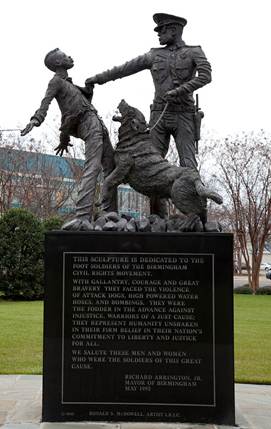
Kelly Ingram Park, Birmingham, AL.
The George F. Landegger Collection of Alabama Photographs in Carol M. Highsmith’s
America, Library of Congress, Prints and Photographs Division.
After all, as Martin A. Berger has stated, “photographs illustrating white-on-black violence proved both visually compelling to whites and capable of nudging society toward racial reforms” (Berger, Seeing 8). Reassuring and basic, the dominant narrative that such images displayed stuck to certain visual codes: “the depiction of blacks as victims [which] has been a historical constant, without regard to the social conditions of the time and place” (46). For Diane McWhorter, this photograph has “become one of those rare cultural artifacts that change history. It nationalized the African-American freedom movement […]” (McWhorter “Movement”). Commissioner Connor’s “picturesque brutality,” with “the police dogs—and their demonological other half, the firehoses blasted at the demonstrators” (McWhorter “Movement”)—became the timely confrontation which turned the tide of public opinion in favor of the demonstrators, offering the necessary twist to the campaign, that Martin Luther King Jr. had been expecting and planning when he decided to involve children in his demonstrations (D. Johnson 4; Berger, Seeing 95-102). Gadsden’s “self-defense in the face of obvious aggression” is a detail that Berger has credited a Jet magazine article of 1963 for bringing out, the familiarity of the boy with dogs explaining his reaction and knee thrust: he knew “how to protect himself” (Berger, “Race” 96). This detail and what McWhorter saw as “a dazzling effrontery,” namely “Gadsden’s left hand grasping Middleton’s wrist” (McWhorter, “Movement;”Carry Me 375), opened the way for Berger’s reading of “active resistance” (Berger, “Race” 96).1 By eliminating that very approach, the artist—ignoring the ambiguity of the photograph (Spratt 85)—is clearly siding with a victimization of the boy, confirming the general orientation adopted in the park with the work of James Drake, Children’s March (1992) or Firehosing of Demonstrators (1992). Leaving aside either passive or active resistance, McDowell has decided on an unresolved yet expected moment, with the choice of an imminent fall of the boy as a way of designating an aggressor. The disturbing combined forces of man and animal are staged to come across as the ultimate evil which plagued social relations. If the sculpture exists here, it is due to Mayor Arrington’s feeling that a clear statement was missing in James Drake’s sculpture Police Dog Attack (1993).
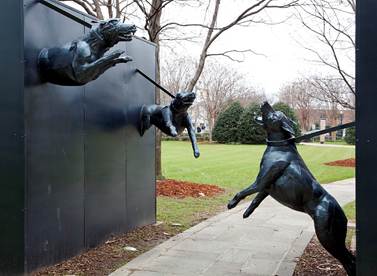
Kelly Ingram Park, Birmingham, AL.
The George F. Landegger Collection of Alabama Photographs in Carol M. Highsmith’s
America, Library of Congress, Prints and Photographs Division.
Composed of two blue-steel walls facing opposite sides of a path, with dogs projected, Police Dog Attack forces an aggressive presence onto the viewer and is meant to recall what had been endured by protestors (Fig. 2). The focus on the dogs is a truncated remediation of situations seen in well-circulated photographs of these attacks (Charles Moore’s Police Dog Attack, Birmingham, Alabama, May 3, 1963; or Bill Hudson’s); with the absence of policemen and protestors, the sculpture revealed itself wanting. The words “Birmingham Police” inscribed on the leash of the dogs, naming those in charge of the K9 unit, do not simply link the animals to that division but inevitably impose dogs as surrogates of human decisions. And for Arrington it was not obvious “that particular human beings controlled the dogs,” leading to McDowell’s commission and the statement the mayor favored: Blacks were victims of White aggression (Upton 167-68).
The new commission would remedy not only the absence of policemen but that of children as well, whose participation in the marches decided by the Southern Christian Leadership Conference was seen as Martin Luther King Jr.’s most dramatic decision to date. Absence undoubtedly had displaced the sense of confrontation to the present of the onlooker. It disrupted the battle between good and evil which had marked “the shift of the civil rights discussion from the political to the moral realm” and which in time had become essential to King’s strategy, as Davi Johnson underlined. According to him, “King’s challenge was to make visible the injustice of segregation for a group of individuals (white moderates) who did not regularly experience or even witness the evils of racism firsthand.” More precisely: “the best means of making racism visible was by exposing its action on black bodies” (Johnson 3). The absent black bodies in Drake’s Police Dog Attack erased just that, the victims. On the other hand, the presence of a black body in McDowell’s Dogs corresponds to the planned use of “the black body against prejudice” (Rustin in Blair and Michel 34) but also confirms an adherence to the widely accepted template of racial domination to transmit the necessary message of power struggle, and that only violence seemed capable of conveying.
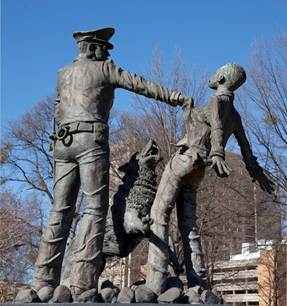
Kelly Ingram Park, Birmingham, AL.
The George F. Landegger Collection of Alabama Photographs in Carol M. Highsmith’s
America, Library of Congress, Prints and Photographs Division.
The transformation of Gadsden into a much younger boy in McDowell’s sculpture serves to magnify the mockery made of the attitude of the policeman, quite theatrical in the face of no imminent danger. But it falls on one detail to transform a bombastic gesture into blind gesticulation. The artist has rigged out the policeman with large glasses, declaring: “he’s almost like a blind officer. He doesn’t even see the kid, because he’s so far beyond that” (in Gladwell). The disproportion between the forces involved disqualifies the impersonation of authority and questions what the gesticulation is articulating and what it stands for (Fig. 3). The breaking point of the equilibrium does not so much concern the black boy about to fall as we are made to see. One might argue that the sculpture celebrates the last effort of a vanishing power, the uselessness of (blind) gesticulation, unreasoned, suggesting that the agency of the foot soldier can only exist through the exhausting of white power. What the substitution for a younger boy articulates as well is the distance adopted with Gadsden, and his own lack of concern for the cause of the demonstrators he ended up being mistakenly involved with. As questions of identity have surfaced with another well-circulated photograph of Charles Moore, of three youths being firehosed in Birmingham, Alabama, on May 3, 1963, we see that recognition of one’s image is also acknowledgement of one’s role. After having claimed for years to be in the picture, Carolyn McKinstry issued a statement to put an end to what she called an “ongoing misidentification” (in Garrison), finally allowing Mamie Ruth King Chalmers to reclaim her identity. Being recognized as the one in the picture meant re-endorsing the story behind the image, a re-appropriation of the fight which had been hers.
If name and identity could become such delicate issues, it is certainly due to the voice of those who filled the ranks of anonymous demonstrators finally made audible. A sculptural remediation of the onlooker caught by Bill Hudson would have been a symbolic usurpation, for both Gadsden himself and for the cause the sculpture was dedicated to. By relenting any claim to an actual foot soldier, McDowell’s Dogs has pointed to the limits of remediation to embrace the symbolic importance of the cause. It could explain why a new design to celebrate the 50th anniversary of the 1963 Birmingham Civil Rights Campaign was felt necessary: a monument to foot soldiers “should serve as a means to cultivate understanding of what ordinary people can do to participate non-violently in a meaningful political cause” (A Monument to Foot Soldiers 8). The 2013 competition instructions stipulated that “no names of individual foot soldiers be inscribed on the monument.” Expected to be sited on the opposite end of a diagonal where McDowell’s sculpture is placed, the new monument would no doubt offer what the remediated photograph of Hudson omitted, the collective experience of foot soldiers, as a story of struggle and yearning, made visible in the multiplicity and diversity of bodies, restored in their decisive role in the Birmingham campaign. The winning design of Ai Qiu Hopen (The Gate of Freedom, 2013) is an intricate grouping of figures thrust in a forward momentum, with at one end of the composition bodies on the ground lying or kneeling, children singing and marching, their faces turned toward the sky, bodies all pressed together in an ascending push upward, arms and hands lifted and a child on a man’s shoulders releasing doves, on the other end. It is an imposing way of putting them center stage thus avoiding the diversion of attention to clashes between police and demonstrators which had long obscured the agency of Blacks. It is not yet clear, though, if representing an African American woman alone, Rosa Parks sitting on a bus seat for example, could embrace the symbolic implications of winning one’s dignity and place and declare one’s agency in the same way.
Critical Oneness
Statues of Rosa Parks have by now adopted what has become a conventional approach, incorporating what made her known in the Civil Rights movement, her remaining seated when asked to give up her place to a white man in a Montgomery bus on December 1, 1955. The iconic image taken by a United Press International photographer, showing her sitting in a bus in front of a white man was not taken that day but, despite this, has often stood as her declaration of civil rebellion. It was staged on December 21, 1956, and corresponded to the aftermath of the Supreme Court decision of the November 13, 1956 ruling that declared segregation on buses illegal. The identity of the man in the photograph has long been overlooked, even though Nicholas C. Chriss himself revealed it in 1986: “to this day no one has ever made clear that it was a reporter, I, covering this event and sitting behind Mrs. Parks, not some sullen white segregationist!” (in Applebome). His presence in the staged photograph, read in the context of bus desegregation, served to impress a new spatial order allowing what had been contested when Parks was arrested and described in the police report as “a colored female sitting in the white section of the bus, and [who] would not move back” (“Police Report”). This new order illustrates the possibility of a dispassionate coexistence of people of different colors, devoid of violence or any sense of oppression, unlike with Bill Hudson’s photograph. Although there is nothing natural about the setting, the logic behind its circumstances does not stem from a sincere and spontaneous transformation in human relations either. Parks is sitting in front of Chriss, this time to confirm her compliance with the law, more than the viability of the ruling. The contrasting details in body language, facial expressions and gazes or sitting arrangement have been read as playing in the substantiation of “a gendered power inequality” which confirmed each person in their own world, conveying “a sense of separate spheres that counters allegations of sexual impurity or racial ‘miscegenation’ that were often used to discredit the idea of integration” (Fackler 275). The distance between Parks and Chriss has been understood as participating in the construction of the image of respectability that Parks was meant to express and that her light-skin color facilitated (quite ironically), with “her visual assimilation to White middle-class femininity” (Fackler 275). Omitting Chriss in a sculptural remediation reframes the race relations visually constructed in the photograph, to say nothing of the meaning of Parks’s image itself.
Erik Blome transposed the staged photograph and relied on the accepted and shared knowledge of Parks’s decision to remain seated. Blocking out the background of the photograph literally erased the stage, and dissociated Parks even further from the usually celebrated quality of “her quiet defiance” (Engel). Being lifted out of a double context of transportation and race, the sculpture reduces Parks to a representation twice removed from reality, but which is nonetheless expected to epitomize it. Among the three identical sculptures created by Blome, for the Rosa Parks Museum and Library in Montgomery, Alabama (2000), the Dallas Area Rapid Transit’s West End (2005), or the Rosa Parks Transportation Center Lobby in Lafayette, Louisiana (2011), the one in Dallas engages the viewer in its spatial display. Occupying a plaza, Rosa Parks is alone in her bus seat, a black fountain wall behind her, inscribed with an oft-used quotation from Martin Luther King Jr.’s 1963 speech “I Have A Dream”: “until justice rolls down like waters and righteousness like a mighty stream” (Fig. 4). Juxtaposing the words of King and the statue of Parks in Dallas does not offer any inkling as to the kind of justice sought for, avoiding all particulars for an uncomplicated approach. In a sense, the solitary image on the plaza fully embraces and illustrates that simplification, the “oneness” that came to characterize Parks when she “emerged as the symbol of the struggle and the victory” of bus desegregation (Schwartz 130).
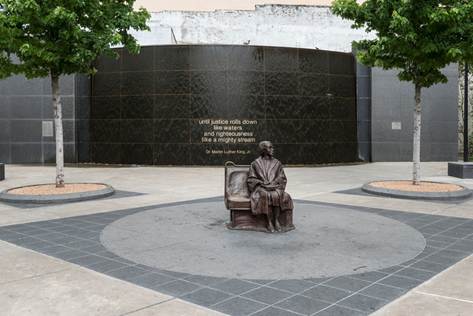
Dallas Area Rapid Transit, Dallas, TX.
The George F. Landegger Collection of Alabama Photographs in Carol M. Highsmith’s
America, Library of Congress, Prints and Photographs Division.
For Barry Schwartz, “oneness refers to the recognizing of one exceptional individual and the ignoring of others, many of whom may have performed as well as or better than the one acclaimed” (Schwartz 125). The place given to Parks does not rely on something she would have done first or better, but “on ascribed, not achieved, status” (Schwartz 134): there was the necessity of having one black woman resist bus segregation instead of many, but also the necessity of finding someone beyond criticism, who could be a perfect symbol of respectability (Rolland-Diamond 230-232). As Schwartz and others have pointed out, the recognition of Parks was detrimental to others who had defied bus segregation as well, “unsung heroes” as they have been called: Claudette Colvin, Mary Louise Smith or Aurelia Browder, Sarah Mae Flemming, Suzi McDonald or Irene Morgan (“Claudette Colvin,”“Unsung”). Very often referred to as “the other Rosa Parks” (“Other”), Colvin, fifteen at the time when she “bucked Jim Crow” for refusing to give up her seat, “was arrested and charged with assault and battery and disorderly conduct after she refused to move to the rear of a city bus” on March 2, 1955, nine months before Parks (“Arrest”). But her arrest would not be the needed test case: “her suitability as a standard-bearer of the movement” was questioned; Colvin later admitted that Rosa Parks was “the right person,” since what was needed was “someone who could bring together all the classes” (in Younge); her own role had readied Montgomery black leaders Jo Ann Robinson, E.D. Nixon and Fred Gray, for the right opportunity (Gray, “Lecture” 742), leaving Parks to trigger the Montgomery bus protest (Gray, Bus Ride 94). The oblivion which befell Colvin’s story left Parks’s unchallenged.
Rosa Parks Plaza, Eugene, OR.
Photo: V. Ha Van.
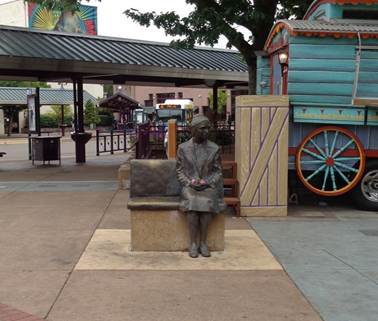
The unique place allowed Parks, declared “a hero to the Nation because of a simple act of defiance,” (Wynn) led to an all too familiar image, ritualized in its own way: Rosa Parks sitting in Eugene, Oregon (Rosa Parks, Peter Helzer, 2009; Fig. 5), in the collection of National Statuary Hall (Rosa Parks, Eugene Daub and Firmin Studios, 2013), in Essex County, New Jersey (Rosa Parks, Jay Warren, 2014), or more recently in San Bernardino, California (Rosa Parks, Patrick Jewett, 2018) and at Georgia Institute of Technology in Atlanta (Continuing the Conversation, Martin C. Dawe, 2018), with always, for those involved in the commissioning, the same pride of having a monument which could serve as an inspiration or a reminder of her legacy (Mazzola, Duncan, Whitehead, Braukman, Bras). The images became formulaic to the point of inviting variations, out of necessity: a younger Parks in Eugene, for which 19-year-old Lacie Heffron had posed (Malkin), leaving aside any pretense of resemblance, but still heavily relying on the photograph; a 92-year-old Parks facing the iconic version of herself at 42, on the campus of Georgia Tech; Rosa Parks with or without her hands on her bag, with or without glasses, etc.… Such interpretations would not stir the sort of protest that interpretations of Martin Luther King had, with Erik Blome and his Rocky Mount statue based on Bob Fitch’s 1966 photograph of King, but which was said to be “ugly,” “not an exact likeness of Dr. King” (Fears), even “arrogant” (Gettleman); or with Lei Yixin’s colossal King for the capital (Martin Luther King, Jr. Memorial, 1998-2011), which for years had been a bone of contention (Upton 121-33).
San Jose State University, San Jose, CA.
Photo: V. Ha Van.
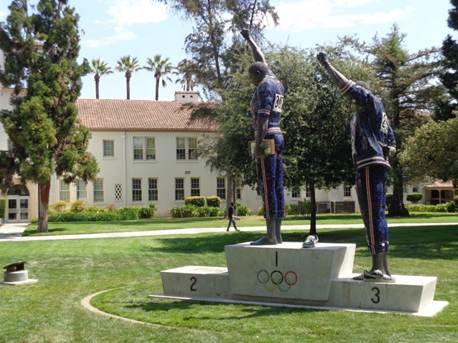
Unlike what the remediated photograph of Tommie Smith and John Carlos allowed in San Jose State, with an empty 2nd place on the dais for the public “to take a stand,” as the sculpture required (Fig. 6), the empty space left on Rosa Parks’s seat in Dallas is not quite the same invitation.2 It has become the sacred space of a perimeter of racial advance that you cannot share. To sit next to Rosa Parks is either to have a set for an original photograph or to share in the mythologized image that has been officially accepted. The sculpture remediated the unrealistic and symbolic situation of Rosa Parks sitting alone, not of anyone sitting with regular users, but as the iconic figure the photograph had constructed, a woman originally looking through a window, now looking away, indifferent to those near her.
If a sculpture of a sitting Rosa Parks remains a sure way to be faithful to a collective memory that had enshrined her as the hero who dared sit, more than anything else it was the photograph which had confused, not to say collapsed, distinct situations and played into the myth: a staged photograph taken in the aftermath of a Supreme Court decision (Browder v. Gayle) which did not even have Rosa Parks as a plaintiff since her case was tried in a state court, the plaintiffs being Claudette Colvin, and also Aurelia Browder, Susie McDonalds, Mary Louise Smith and Jeanette Reese. But that sculpture perpetuated a singular tale, hard to alter.
To depict Rosa Parks standing would definitely contravene with an accepted image and be perceived as tampering with what collective memory has made of her. Ed Dwight had opted for that path (Rosa Parks, 2010, Grand Rapids, Michigan): “I have her standing, on a granite pedestal, in front of a fragmented cast bronze bus seat, representing a ‘turning point’ in history, that she has ‘placed’ behind her” (Dwight, quoted in Stand Up 2). The deliberate discarding of the pose in the photograph, which was reproduced on the pedestal of an artistic rendering but not on the finished work (Stand Up 2), reflects the refusal to comply with the accepted typecasting for determination and courage, belittled and confused with “the right to rest her tired feet” (Wynn), obviously erasing the preparation, the careful planning of activists, the patient, deliberate refusal of bus segregation. Dwight wanted Parks “to be equal” to the statue of Senator Arthur Vandenberg immediately across the street (in Harger). He adopted the same conventions of the full-length figure, freeing Parks from the constraints of the staged photograph. What Dwight could do with this typecast is nonetheless permitted by the profusion of existing statues of a seated Rosa Parks; other still unknown/unsung heroes do not have the requisite visibility to allow unconventional representations. As Maurice Agulhon has so aptly put, what could distinguish a “great man”—or a “great woman” for that matter—from another, relies not so much on what makes one more important, than on the multiplication of statues erected to that person, a clue to a changing status, from being a historic figure to being a symbolic figure (Agulhon 13-14). Heroes need to be enshrined first before any liberty with their image can possibly be entertained, as the fame of the four Greensboro sit-inners would show.
Critical Multiplicity
Appropriately enough, the photograph used for the February 2, 1960 article covering the Greensboro students’ sit-in has four of them waiting to be served at Woolworth’s lunch counter: Joseph McNeil, Franklin McCain, Billy Smith and Clarence Henderson. A photograph taken the previous day, after the store closed, was not published, even though it showed the “four leaders” of “the ‘sit-down’ move” (Sykes): McCain, McNeil, David Richmond, and Ezell Blair, Jr.—a shot taken too late to meet the deadline of the Greensboro Record. The selection of one image over the other responded to the necessity of updating the visual record with what happened on February 2.
The image taken the first day showed four young men who had carefully chosen their outfits, neat overcoats, dress pants, polished black shoes, ties and hats. They played by the rules, and, as has been shown by Rebekah J. Kowal, expanding on William Chafe’s civility paradigm, the very performance of their “acting white” was “the sit-inners’ challenge […] to naturalize their presence at the Woolworth’s lunch counter so that what had appeared to local whites as ‘unnatural’ would be revealed as wholly consistent” (Kowal 149). What the photograph had caught was the aftermath of the tensions and fear that these men reportedly felt, the long hours of sitting and imagining the possible reactions of employees and customers. Coming out of Woolworth’s after that first day was experienced as relief, allowing the four to become themselves again, not acting “others.” But the non-performative aspect of their attitude could legitimately be questioned since a photographer was waiting for them. Jack Moebes recalled that he had “asked them to pose and they walked—in fact they walked down once,” adding: “I shot one and I wanted to get another one, so they backed up and walked down again in front of the store” (Moebes with Pfaff 2). Walking casually as they were did not reflect the trespassing of racial boundaries the way the sit-in visually intimated. In a strikingly non-aggressive way, the photograph of February 2 of four men at the counter disturbed what William Chafe had called a “progressive mystique,” which had ruled the very environment the four men evolved in. He defined this “progressive mystique” as the very system which appears to allow the exchange of ideas, only out of politeness, or the possibility of change, but only under unanimous consensus, leading to the quieting of social interaction under the veneer of paternalism and civility (Chafe, “Greensboro” 44-45, Civilities 81-101). With this system, “all efforts at change are directed into a series of controlled and well-defined channels of communication that remain consistent with, and not threatening to, the overall structure of the status quo” (Chafe, “Greensboro” 45). The sit-in was trying to challenge “the viability and well-being of the status quo” (Chafe “Greensboro” 47), in the hope of attacking its core, by using its very code of civility.
Forfeiting the image of men striding for that of men sitting was to choose frame and performance over the singularity of authorship, with the unexpected consequence of temporary oblivion into which the first photograph fell. After the first day of the sit-in, “nobody was interested in it,” Moebes declared (Moebes with Schlosser 15). The image “was not used for ten years” according to its author, but then “had a great deal of significance, particularly since no one had ever been able to get the four of them together. So on the tenth anniversary, actually, it did have […] some value” (Moebes with Pfaff 7); “it took on significance, [with] the fact that they were the originators” (Moebes with Schlosser 9). The non-violent approach which had been essential to the movement gained a certain resonance in the context of the late 1960s and beginning of the next decade, and David Richmond was always ready to expound on the virtues of non-violence (Harris). In fact, the way commemoration was constructed around the Greensboro Four, as they were called with the 1973 ABC telecast, evolved from the very publication of the first photograph of the students at the Woolworth counter, and around the question of place. The 1980 state historical marker, approved by the North Carolina Highway Historical Marker Commission, acknowledging that “Sit-ins launched the national drive for integrated lunch counter, Feb. 1, 1960, in Woolworth’s store 2 blocks south”, chose not to credit anyone. In 1990, names were not omitted, appearing under portraits etched in a plaque celebrating the “Birthplace of the Civil Rights Movement” and further explaining that “Four Students at North Carolina A&T State University conducted the first lunch counter sit-in […].” Placed at the entrance of the Woolworth, it fixed the “where,” the same way “the bronze likenesses of their footprints” were positioned in front of the store (“Four Who Led”), determining the importance of the site in the construction of history.
North Carolina A&T State University, Greensboro, NC.
Photograph: By Cewatkin [CC BY-SA 3.0 (https://creativecommons.org/licenses/by-sa/3.0)], from Wikimedia Commons.
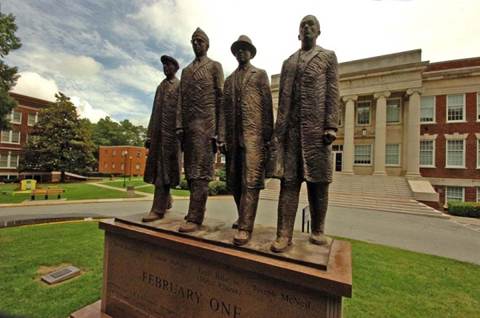
James Barnhill’s monument unveiled in 2002 includes the names of the Greensboro Four, the monument’s title February One, as well as the following inscription (Fig. 7):
These four A&T freshmen envisioned and carried out the lunch counter sit-in/of February 1, 1960, in downtown Greensboro. Their courageous act against/social injustice inspired similar protests across the nation and is remembered as/a defining moment in the struggle for civil rights.
It remediated Moebes’s first photograph, thus focusing on the men and not on what has been described as “the acts of defiance [which] were tantamount to the enactment of an alternative reality in which black and white patrons were entitled to the same services” (Kowal 150). By departing from the very action at the lunch counter, Barnhill moves beyond simply making an artistic choice: “when you think about the sit-ins […] you think about guys at a counter. It’s not a sculpturally moving thing” (in Hill). The historical moment chosen is not the trespassing of racial boundaries but the spatial embrace of a frontal advance of men progressing. The dynamic of the four walking figures became unwavering determination. By focusing on the men, the monument is both pulling them out of context and setting them back into the place where things started, the University where they had studied and met. The institution becomes the cradle of the fight, where men thought and prepared, were freely allowed to conceive of the plans to sit in and protest the conditions of Blacks. Away from the-spot-where-things-happened, the monument commissioned by A&T Chancellor James C. Renick shows where change comes from.
February One (and not “Greensboro Four”) is not a fortuitous choice for a title; it determines the prominence given to the time element, and the value bestowed on the absolute uniqueness of a day, “one” and only, not “first” in a succession of either lesser or greater moments. It embraces within a day and a month the whole experience which transcends both time and place to stand as a universal moment. The passage from photograph to sculpture displaced four men who are taller than life, from the street both to the pedestal and to the institution of A&T, and placed them in a towering position above the viewer, unknowing of anyone’s presence, above the fray, four heroes that they have become. The distance created between viewers and sculptures pushes the men away from the realm of the ordinary and the present. This gap is somehow counterbalanced by the shoeprints aligned with the names of each man, in front of the Woolworth’s, leaving an absence to be filled with steps of real persons invited to follow a path. That kind of gap has been carefully negotiated in Clinton, TN; we are asked to recognize new actors in the struggle for equality, and thus accept the question of the multiplicity of heroes, in opposition to the case of Rosa Parks’s oneness.
Reclaiming the Place
Although the students in Clinton took on a “lead role in 1956 in Southern school integration” and even if it did attract media coverage, in the press and on television, what happened there somehow had “slipped into history’s footnotes” and was eclipsed by what happened in 1957 in Little Rock Central High School, Arkansas (Fowler).3 While registration of the twelve students from the Green McAdoo School (the name given to Clinton Colored School in 1948 to honor a black citizen of the community) was conducted “without disrupting ordinary school routine and without picketing or violence of any kind,” the days following the arrival of John Kasper, on August 25, 1956, “from somewhere in the East,” with “his declared purpose […] to run the Negroes out of the school or to cause Brittain, its principal, to resign his job, and so to violate the court’s desegregation order,” “violence became rampant in Clinton,” leading to the arrival of 667 National Guardsmen to restore order on September 2, 1956 (Kasper v. Brittain).
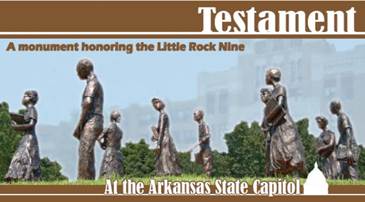
In the well-known case of Little Rock, the level of attention that the integration of nine students engendered, with the ordering of the Arkansas National Guard by Governor Orval Faubus to keep the students from entering the school (September 4, 1957) and the dispatching of federal troops by President Eisenhower to protect and escort them, was fed by media coverage, following the steps and trials of those who came to be known and remembered as the Little Rock Nine. Public attention was also fed with iconic images which marked people’s consciousness, something that Clinton was deprived of. Among the photographs of Clinton printed in Life Magazine was one by Howard Sochurek showing students walking to school, with a caption including Clinton principal’s remark “You have all shown great courage” (“Halting” 37; see Figure 16). Acknowledgment and recognition of that courage only appeared in the 21st century, whereas national recognition had been bestowed on Little Rock at various times: Central High School was included on the National Register of Historic Places in 1977, designated as a National Historic Landmark in 1982, and as a National Historic Site in 1998. Each of the Little Rock Nine was honored with a Congressional Gold Medal, recognizing them as “civil rights pioneers whose selfless acts considerably advanced the civil rights debate” (U.S. Congress). The formulation which declared the admission of the Little Rock Nine as “the most prominent national example of the implementation of the Brown decision [which] served as a catalyst for the integration of other, previously segregated public schools in the United States” (“An Act”), once and for all determined how history would be read and left no room to doubt the pertinence of the statement. No wonder the Clinton Twelve resented all the attention which they felt had been stolen from them, as Rachel L. Martin has written (30). Why should Central High be considered as “a hallowed place, a place every bit as sacred as Gettysburg and Independence Hall,” to use President (but also former Arkansas Governor) Bill Clinton’s immoderate praise, and not Clinton High School (in Fullerton)? Why should the terms of “selfless heroism” used in the act authorizing the award of gold medals be the prerogative of the Little Rock Nine? The belief that the Clinton Twelve were entitled to “similar treatment” (Martin 28) led the Green McAdoo Cultural Organization to proceed with its plans to “preserve and represent the history of integration in Clinton in a cultural heritage museum,” plans including a monument (“Green McAdoo” section 8, p. 4). Ironically, the incentive to bring Clinton back onto the map of Civil Rights came from the attention the Little Rock Nine captured with the unveiling of John and Kathy Deering’s Testament, in front of the Arkansas State Capitol, on August 30, 2005, a project that John Deering began reflecting on with the 40th anniversary of Little Rock integration in 1997 (Fig. 8). As he explained, the sculptures are based on individual approaches:
The placement of the figures in general, the overall composition, is intended to convey that the students might be walking as a group to enter the school. This is the one element that is the most stylized, since The Nine usually arrived at school in smaller groups, or individually (an actually scarier prospect than the way they are depicted in the sculpture). (quoted in Kraus)
Brochure, n.d.
The composition of the group offers an aggregate of figures placed at ground level on a delineated surface, without them being completely separated from the surroundings, since the intention was “for observers to become virtual witnesses, imagining themselves amid the blur of protestors, reporters and troops” (Testament). The figures are shown standing in various positions, feet set firm on the ground, whereas movement seems induced by the folds of skirts or pants only.
A glance at the sculptures in Clinton reveals a more compact and unified configuration based on a photograph of the students walking together (Figs. 9, 10). Taken by Sochurek, on September 5, 1956, three days after order was restored in town, the photograph shows ten boys and girls carrying their books: Bobby Cain, Robert Thacker, Maurice Soles, Gail Ann Epps Upton, Alva Jay McSwain Lambert, Jo Ann Crozier Allen Boyce, Ronald Hayden, Alfred Williams, Regina Turner Smith, Minnie Ann Dickie Jones. They are advancing without anyone to either block or protect them. By erasing onlookers, the framing of the image conveys the idea that the street belongs to the black students, an impression contradicted by the absence of Anna Theresser Caswell that day, who was “crippled by polio and an easy target for segregationists” (Adamson 32). That blown-up photograph became one of the displays of the Green McAdoo Museum with the figures delineated, and the background left out. Only ten students can be distinguished, but twelve portraits and biographies are on display in the museum, including the two missing in the photograph, Caswell and William Latham.
The similarity between the Little Rock Nine and the Clinton Twelve is that we are faced with a group: the number attached to each group acts as a shortcut which mirrors that ambivalent feeling toward multitudes. In Clinton, a singular narrative had not reached the public to make it easily heard, grasped or remembered the way the story of the Little Rock Nine had been with Elizabeth Eckford’s fame. Not very often named individually, the students shown in the photographs published in the press “though seriously involved in the process to desegregate Clinton schools, were dehumanized in many ways by that process,” as June Adamson deplored (31). The twelve sculptures restitute individuality to each student, integrating those absent in the photograph as well, with a statue of Caswell and one of Latham. A plaque is affixed next to the piece, bearing the title The Clinton 12–Walking into History, the name of the artist, William F. Duffy, and his company, The Large Art Company, and the necessary details to identify the twelve students, with numbers and corresponding names placed on a small image of the work. With its inconspicuous additions, the remediation of the photograph allowed the monument to be historically significant in its challenge to the very legitimacy of the Little Rock Nine monument, and its interference in the genealogy of commemorations. If the Clinton Twelve could not set the time machine back and reclaim the national attention already bestowed, it could disrupt the existing narrative by inserting the group in the Civil Rights memorial landscape, and the accepted and academic version of Civil Rights history. Remediating the photograph of the Clinton Twelve is returning to a place, reclaiming Clinton as an important site where people have existed and decided they would affirm their rights to go to the school of their choice. The sculptures are pointing to the local, the genuinely rooted and not the highly symbolic meaning of a place like Capitol State grounds, which could admittedly be held as a “location […] heavy with meaning,” since the statues are in the vicinity of the Governor’s office, Faubus’s in 1957 (Hammer), but which severed the sculptures of the Little Rock Nine from a place of origin.
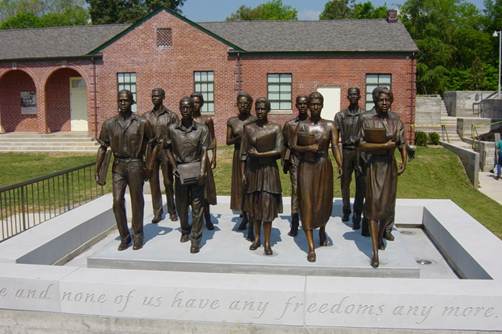
Green McAdoo Cultural Center & Museum, Clinton, TN.
© Photo courtesy of the Large Art Company.
The Clinton sculptures impose the coherence of black bodies, not in a confrontational way but as the firm assertion of dignity and resolve. Their presence confirms a higher degree of recognition granted to Clinton history with the inscription of Green McAdoo School on the National Register of Historic Places in November 2005, with the opening of the Green McAdoo Cultural Center for the 50th Clinton High School desegregation anniversary, as well as with the release of Clinton 12 in 2006 (directed by Keith Henry McDaniel and narrated by James Earl Jones) and the Disney clip “Be Inspired” (2006), with actor Cameron Boyce presenting his grandmother. The unveiling of the sculptures in May 2007 signals a conquest of space and memory. Walking into History is not just a mere title; it refers to the everyday action of walking. This simple act marks the re-possessing both of a place that some felt had been usurped, and of a memorial present which is constantly rewriting itself. The twelve sculptures remediate the advance of a group of students whose integration finds its place in a historical chronology. The essential difference with their rivals is that the Clinton Twelve sculptures achieved a historical importance out of their distinct presence, not in the shadow of the symbolic meaning an official building like a capitol could confer.
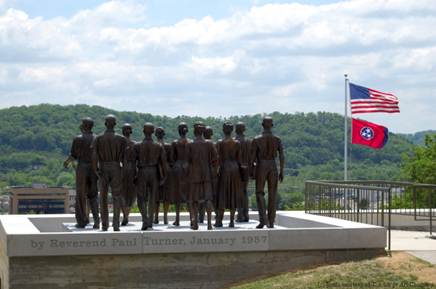
Green McAdoo Cultural Center & Museum, Clinton, TN.
© Photo courtesy of the Large Art Company.
The remediation of photographs is not just a process consisting of transforming “involuntary sculptures” into monuments but it also involves renegotiating a place to “be.” With the Foot Soldiers of Birmingham, Rosa Parks, the Greensboro Four or the Clinton Twelve, it has led to the restaging of the more or less artificial situations caught by photographers several decades earlier. These situations could be seen as pointing beyond themselves, toward the future embedded in these “involuntary sculptures” that the process of remediation could bring out. Regardless of the circulatory status of the images, this potential transformation relied only on the desire to revisit the past, “a will to remember” as Pierre Nora would characterize it (19). As the material responses to the photographs themselves, sculptures transformed actions into symbols, protagonists into heroes, and gave visual prominence and substance to what was deemed worthy of remembrance and celebration. Remediation forcibly redirects a struggle for Civil Rights—an act of protest or an attitude of determination—into the realm of commemoration, thus articulating the deserving nature of the events addressed and enriching a pantheon of heroes. It determines what and who will be remembered by validating the authority of the monument to speak of the past. What happened in Birmingham, Montgomery, Greensboro or Clinton then became what is remembered in places which do not always have a direct link with that past, as in the case of the statue of Parks in Dallas. If one cannot deny but rather concur that “Where an event is commemorated—and, conversely, where it is not commemorated—affects how it is remembered” (Dwyer and Alderman 16), the act of remediation urges us to rethink the question of the place of an event’s commemoration and pushes us to reconsider how this “where” displaces and replaces what was in the photograph. In the end though, the blocked-out background remains the unalienable place marker that the monument carries within itself no matter where it stands; it is there that we find the defining locus of memory.
Notes
- 1Concerning Berger’s analysis, see Brunet 332-334.
- 2A presentation of Smith and Carlos’s monument was included in a paper I gave at the University of Angers (France) in May 2015, and is expected to be published as “The Third Dimension of Icons: Sculptural Transformations of Iconic Images,” in Icons in the United States and Great Britain (Cambridge Scholars).
- 3Edward R. Murrow devoted one of his broadcasts of the series “See it Now” to “Clinton and the Law: A Study in Desegregation” (January 6, 1957).
Bibliography
N.B.: Otherwise noted, sites were accessed on June 12, 2018.
- Adams, Alvin. “Picture Seen Around World.” Jet 24.25 (10 Oct. 1963): 26-27.
- Adamson, June N. “Few Black Voices Heard: The Black Community and the Desegregation Crisis in Clinton, Tennessee, 1956.” Tennessee Historical Quarterly 53.1 (Spring 1994): 30-41.
- Agulhon, Maurice. “Nouveaux propos sur les statues de ‘grands hommes’ au XIXe siècle.” Romantisme 100 (1998): 11-16.
- “An Act to Establish the Little Rock Central High School National Historic Site in the State of Arkansas, and for Other Purposes.” Public Law 105-356. Weekly Compilation of Presidential Documents 34 (6 Nov. 1998): Presidential Remarks. <https://www.gpo.gov/fdsys/pkg/PLAW-105publ356/pdf/PLAW-105publ356.pdf>
- Applebome, Peter. “The Man behind Rosa Parks.” New York Times. 7 Dec. 2005: B5.
- “Arrest Ala. Girl, 15, for Bucking Jim Crow.” Jet 7.20 (24 March 1955): 7.
- Berger, Martin A. “Race, Visuality, and History.” American Art 24.2 (Summer 2010): 94-99.
- Berger, Martin A. Seeing Through Race. A Reinterpretation of Civil Rights Photography. Berkeley: California UP, 2011.
- Blair, Carole and Neil Michel. “Reproducing Civil Rights Tactics: The Rhetorical Performances of the Civil Rights Memorial.” Rhetoric Society Quarterly 30.2 (2000): 31-55.
- Bras, Rafael L. “A Single Act of Courage.” 26 Feb. 2018. <http://www.provost.gatech.edu/blog/single-act-courage>
- Braukman, Stacy. “Continuing the Conversation.” 22 Feb. 2018. <http://www.news.gatech.edu/features/continuing-conversation>
- Brunet, François. La Photographie, histoire et contre-histoire. Paris: PUF, 2017.
- Chafe, William H. Civilities and Civil Rights: Greensboro, North Carolina, and the Black Struggle for Freedom 1980. Oxford: Oxford UP, 1981.
- Chafe, William H. “Greensboro, North Carolina.” William E. Leuchtenberg (ed.). American Places. Encounters with History. New York: Oxford UP, 2000: 41-51.
- “Claudette Colvin: An Unsung Hero in the Montgomery Bus Boycott.” Jet 107.9 (28 Feb. 2005): 12-13.
- Duncan, Maryjoy. “Statue of Rosa Parks Unveiled in Downtown San Bernardino State Building.” IECN. 5 Feb. 2018. <http://iecn.com/statue-rosa-parks-unveiled-downtown-san-bernardino-state-building/>
- Dwyer, Owen J. and Dereck H. Alderman. Civil Rights Memorials and the Geography of Memory. Chicago: The Center for American Places at Columbia College, 2008.
- Engel, Eliot L. “On the Passing of Rosa Parks.” Congressional Record 151.137 (25 Oct. 2005): E2174.
- Fackler, Katharina M. “Ambivalent Frames: Rosa Parks and the Visual Grammar of Respectability.” Souls 18.2-4 (Apr.-Dec. 2016): 271-282.
- Fears, Darryl. “Depiction of King Divides N.C. City.” Washington Post. 19 Jan. 2004. <https://www.washingtonpost.com/archive/politics/2004/01/19/depiction-of-king-divides-nc-city/e56cf4a3-7bc0-4517-9982-c1f5209c336e/?utm_term=.30803bb647ff>
- “Four Who Led Greensboro Sit-in Return to Scene.” Jet 77.19 (19 Feb. 1990): 51.
- Fowler, Bob. “The Ultimate Risk.” Knoxville News Sentinel. 26 Feb. 2006. <http://web.archive.org/web/20060322223021/http://www.knoxnews.com/kns/local_news/article/0,1406,KNS_347_4497096,00.html>
- Fullerton, Jane. “Law Signed. Central Now Historic Site.” Arkansas Online. 7 Nov. 1998. <http://www.arkansasonline.com/news/1998/nov/07/law-signed-central-now-historic-site/>
- Gant Hill, Cathy. “Famed Freshmen Take Another Stand.” Greensboro News & Record. 2 Nov. 2001. <http://jamesbarnhill.com/press/2016/10/31/famed-freshmen-take-another-stand>
- Garrison, Greg. “Civil Rights Activist Carolyn McKinstry Drops Claim She Was in Famous Firehose Photo In 1963.” 26 Aug. 2013. <http://www.al.com/living/index.ssf/2013/08/civil_rights_activist_carolyn.html>
- Gettleman, Jeffrey. “Rocky Mount Journal; King Statue, a Unity Symbol, Severely Tests the Dream.” New York Times. 13 Dec. 2003. <http://www.nytimes.com/2003/12/13/us/rocky-mount-journal-king-statue-a-unity-symbol-severely-tests-the-dream.html>
- Gladwell, Malcolm. “The Foot Soldier of Birmingham with Malcolm Gladwell.” Revisionist History Podcast Transcript. 7 July 2017. <https://medium.com/@emaina1/the-foot-soldier-of-birmingham-with-malcolm-gladwell-revisionist-history-podcast-transcript-82cbd4e628a3>
- Gray, Fred D. Bus Ride to Justice. 1995. Montgomery: NewSouth Books, 2002.
- Gray, Fred D. “Lecture: Bus Ride to Justice: A Conversation with Fred Gray.” Case Western Reserve Law Review 64.3 (2014): 733-753.
- “Green McAdoo School. Clinton, Tennessee.” United States Department of the Interior National Parks Service.National Register of Historic Places Registration Form. NPS Form 10-900. <https://npgallery.nps.gov/GetAsset/5e5cd0c7-cfa3-4580-b47d-d0d4463246bb>
- “The Halting and Fitful Battle for Integration.” Life Magazine 41.12 (17 Sept. 1956): 34-41.
- Hammer, David. “Little Rock Nine Statues Unveiled.” Houston Chronicle. 31 Aug. 2005. <https://www.chron.com/news/nation-world/article/Little-Rock-Nine-statues-unveiled-1487408.php>
- Harger, Jim. “Rosa Parks Statue Dedicated in Downtown Grand Rapids.” 30 Sept. 2010. <http://www.mlive.com/news/grand-rapids/index.ssf/2010/09/rosa_parks_statue_dedicated_in.html>
- Harris, Harvey. “Sitters-In Invited to Return.” Greensboro Daily News. 1 Feb. 1973: A18.
- Johnson, Davi. “Martin Luther King Jr.’s 1963 Birmingham Campaign as Image Event.” Rhetoric and Public Affairs 10.1 (Spring 2007): 1-25.
- Johnson, Geraldine A. “Photographing Sculpture, Sculpting Photograph.” Sarah Hamill and Megan R. Luke (eds.). Photography and Sculpture: The Art Object in Reproduction. Los Angeles: The Getty Research Institute, 2017: 277-291.
- Kasper, John, Appellant, v. D.J. Brittain, Jr. et al., Appellees, 245F.2d 92 (6th Cir. 1957). <https://www.leagle.com/decision/1957337245f2d921311.xml>
- Kowal, Rebekah J. “Staging the Greensboro Sit-Ins.” TDR: The Drama Review 48.4 (Winter 2004): 135-154.
- Kraus, Kerry. “Impressive Sculpture Memorial Honors the Little Rock Nine.” Arkansas Department of Parks & Tourism. 26 June 2007. <https://www.arkansas.com/group-travel/mediaroom/display.aspx?id=860>
- McWhorter, Diane. “The Moment that Made a Movement.” Washington Post. 2 May 1993. <https://www.washingtonpost.com/archive/opinions/1993/05/02/the-moment-that-made-a-movement/20eef454-daa6-45f3-a29a-4b03b9d16097/?utm_term=.9e22f17f4af3>
- McWhorter, Diane. Carry Me Home. Birmingham, Alabama. The Climactic Battle of the Civil Rights Revolution. New York: Touchstone, 2002.
- Malkin, Whitney. “Seat of Honor.” Register-Guard. 9 Jan. 2009: A1.
- Martin, Rachel L. Out of the Silence: Desegregation of Clinton, Tennessee, High School. Dissertation. Chapel Hill: University of North Carolina, 2012.
- Mazzola, Jessica. “Newark Home to State’s First Rosa Parks Statue, Officials Say.” NJ.com. 2 Oct. 2014. <http://www.nj.com/essex/index.ssf/2014/10/newark_home_to_states_first_rosa_parks_statue_officials_say.html>
- Mitchell, W.J.T. What Do Pictures Want?The Lives and Loves of Images. Chicago: Chicago UP, 2004.
- Moebes, Jack. Interview with Eugene E. Pfaff. Greensboro Voices/Greensboro Public Library Oral History Project. 18 Apr. 1979. <http://libcdm1.uncg.edu/cdm/singleitem/collection/CivilRights/id/871/rec/2>
- Moebes, Jack. Interview with Jim Schlosser. Greensboro Voices/Greensboro Public Library Oral History Project. 17 Dec. 1997. <http://libcdm1.uncg.edu/cdm/singleitem/collection/CivilRights/id/909/rec/6>
- A Monument to Foot Soldiers. A National Design Competition for Architects, Artists, Designers. Birmingham, AL: Office of the Mayor, Special Projects, Community Affairs Committee, Rev. Birmingham, 2013. <http://www.revbirmingham.org/wp-content/uploads/2013/04/FINAL-COMPETITION-PDF-7.pdf>
- “The Other Rosa Parks: Now 73, Claudette Colvin Was First to Refuse Giving Up Seat on Montgomery Bus.” Democracy Now! 29 March 2013. <https://www.democracynow.org/2013/3/29/the_other_rosa_parks_now_73>
- “Police Report on Arrest of Rosa Parks.” File Unit: Aurelia S. Browder et al. v. W. A. Gayle et al., No. 1147, 9/1938 - 11/26/1968. Series: Civil Cases, 9/1938 - 11/26/1968. Record Group 21: Records of District Courts of the United States, 1685–2009. <https://catalog.archives.gov/id/596074>
- Rolland-Diamond, Caroline. Black America. Une histoire des luttes pour l’égalité et la justice (XIX-XXIsiècle). Paris : Editions La Découverte, 2016.
- Schwartz, Barry. “Collective Forgetting and the Symbolic Power of Oneness: The Strange Apotheosis of Rosa Parks.” Social Psychology Quarterly 72.2 (2009): 123-142.
- Spratt, Meg. “When Police Dogs Attacked: Iconic News Photographs and Construction of History, Mythology, and Political Discourse.” American Journalism 25.2 (Spring 2008): 85-105.
- Stand Up for Rosa Parks. Rosa Park Sculpture Project Commemorative Booklet. 30 Sept. 2010. Last accessed 5 Feb. 2018. <http://www.grand-rapids.mi.us/administrative-services/diversity-and-inclusion/Documents/Community%20Relations%20Commission/Before%202016/13850_Donor%20Booklet%20Final.pdf>
- Sykes, Marvin. “A&T Students Launch ‘Sit Down’ Demand for Service at Downtown Lunch Counter. Woolworth Made Target for Demonstration Here.” Greensboro Record. 2 Feb. 1960: B1.
- Testament. A Monument Honoring the Little Rock Nine at the Arkansas State Capitol. Brochure, n.d. <https://www.sos.arkansas.gov/uploads/education/LR9Brochure.pdf>
- Tieberii, Jeff and Carol Jackson. “Franklin McCain Dies. Helped Start Sit-In Movement at Greensboro Lunch Counter.” 10 Jan. 2014. <http://wfae.org/post/franklin-mccain-dies-helped-start-sit-movement-greensboro-lunch-counter#stream/0>
- United States Congress, Cong. House. “Little Rock Nine Gold Medals and Coins Act.” Congressional Record 144.141 (9 Oct. 1998): H10324.
- “The Unsung Heroes of the Montgomery Bus Boycott.” Journal of Blacks in Higher Education 50 (Winter 2005/2006): 107.
- Upton, Dell. What Can and Can’t Be Said. New Haven: Yale UP, 2015.
- Whitehead, Brian. “Statue of Rosa Parks Takes Seat at State Building in Downtown San Bernardino.” The Sun. 2 Feb. 2018. <https://www.sbsun.com/2018/02/02/statue-of-rosa-parks-takes-seat-at-state-building-in-downtown-san-bernardino/>
- Wynn, Russell Albert. “Rosa Parks Congressional Gold Medal.” Congressional Record 145.84 (15 June 1999): E1253.
- Younge, Gary. “She Would Not Be Moved.” The Guardian. 16 Dec. 2000. <https://www.theguardian.com/theguardian/2000/dec/16/weekend7.weekend12>
About the author(s)
Biographie : Véronique Ha Van est maître de conférences à l’Université Le Havre Normandie, et actuellement en délégation CNRS au LARCA-UMR 8225. Ses recherches se concentrent sur l’histoire des formes dans l’espace public aux États-Unis, notamment sur les questions de placement et de déplacement de la statuaire et les controverses qui les accompagnent. Son travail porte autant sur les collections du Capitole et du National Statuary Hall de Washington, DC, que sur les monuments aux Confédérés, mais aussi sur les œuvres de Danh Vo ou Carl Andre.
Biography: Véronique Ha Van is Associate Professor at the University of Le Havre Normandie and currently on research leave CNRS, LARCA-UMR 8225. Her research focuses on the history of forms in US public space, especially on questions of placement and displacement of statues and the controversies that surround them. She has written on the collections of the Washington Capitol and National Statuary Hall, and has more recently focused on Confederate monuments. The works of Danh Vo and Carl Andre form another essential aspect of her research.