Collective Memory and Historiographic Enclaves in the Post-Cold War World: The Korean War (1950-1953) in the United States
Abstract: This paper focuses on the Korean War (1950-3) to raise the question of memory sites as historiographic enclaves, that is, not only as places of “cultural comfort”, but also of historical convenience. Since such a designation has been rarely used in history as an academic discipline, these historiographic enclaves were addressed in both their potential ethnic and political acceptations. In order to build bridges between these two levels of meaning, the concept of “collective memory” was brought up to discuss the memorialization of the Korean War in the United States, both in opposition to and in congruence with Korea, North and South. Once the political aspects of these historiographic enclaves have been brought to the fore, this study is meant to analyze them in relation to all the memory sites dedicated to the war, more specifically, in the US. Since these lieux de mémoire (in P. Nora’s term) have become the site of specific commemorative practices, the historiographic enclaves are likely to be entwined with some discourses which reflect various national imaginaries and can therefore create contestation. If such contestation exists, it would suggest the history of the Korean War, known as the “forgotten war” in the US, has been enclosed within the larger realm of Cold War history so as to fit it in the anti-Communist teleology of the latter, removing the ethnic particularities of what post-revisionists would rather call a “civil war”.
Keywords: Korean War (1950-1953), American studies, Historiography, Memory sites
Résumé : Cet article examine le cas de la guerre de Corée (1950-3) pour soulever la question des lieux de mémoire comme enclaves historiographiques, c’est-à-dire en tant qu’espaces synonymes non seulement de « confort culturel » mais également de conventions historiques. Ces enclaves historiographiques — termes rarement utilisés en histoire — ont été abordées sur un plan à la fois potentiellement ethnique et politique. Afin de relier ces deux plans, le concept de « mémoire collective » a servi à traiter de la commémoration de la guerre de Corée aux États-Unis, à la fois en ce qu’elle se rapprochait et se distinguait de la Corée, Nord et Sud. Après avoir abordé les aspects politiques de ces enclaves historiographiques, cette étude propose de les analyser au prisme des lieux de mémoire dédiés à la guerre et, plus particulièrement, aux États-Unis. Puisque ces « lieux de mémoire» (d’après la terminologie de P. Nora) deviennent le lieu de pratiques commémoratives particulières, il est probable que de telles enclaves historiographiques puissent se retrouver associées à des discours reflétant différents imaginaires nationaux et ainsi donner lieu à des contestations. Si ces contestations existent, cela suggère que l’histoire de la guerre de Corée, connue sous l’appellation de « guerre oubliée » aux États-Unis, a été enclavée dans l’histoire plus générale de la Guerre froide afin de mieux correspondre à la téléologie anti-Communiste de cette dernière et ce aux dépens des particularités ethniques de ce que les historiens post-révisionnistes préfèrent appeler « une guerre civile ».
Mots-clés : Guerre de Corée (1950-1953), Études américaines, Historiographie, Lieux de mémoire
Conventionally known today as “the Forgotten War,” the conflict that divided the Korean peninsula in the aftermath of the Second World War has greatly contributed to make international relations what they are today on both sides of the Pacific. Nowadays, the significant role the United States had in a conflict which it has always seen as a struggle against Communism, is still the object of historiographic debates, especially for revisionist historians who are more concerned with the evolution of the peninsula than with ideology. After the war, Korean-Americans with their “unique history” as immigrants and a minority seem to have significantly influenced the politics of commemoration in the US.
While the collective memory of the Korean War can be expected to have contributed to turn diasporic communities into ethnic enclaves, recent studies have also shown that Korean-Americans are not impervious to multiple internal issues. At the political level, US-Korea relations date back to the late 19th century and early 20th century. In 1919, a group of Western-educated Korean nationalist intellectuals worked from small diasporic enclaves in America to help form the peninsula-wide March 1st Movement. During and after the Korean War, Korean diasporas influenced US foreign relations with North Korea. By the same token, the commemoration of the Korean War has had a pivotal part to play after the war. Not only has it given memory a pragmatic function on local, national, and international levels, it has also created historiographic enclaves where official discourses about history produce and reproduce narratives of the conflict, and where collective memory is shared at the risk of alienating some of its key belligerents, such as North Korea or the People’s Republic of China (PRC).
This paper ultimately raises the question of memory sites as historiographic enclaves, that is to say, enclosed spaces of remembrance, or mnemonic enclaves, in which history is told in a way that more or less derives from other historiographies. As products of a specific historiography, memory sites may indeed reflect a discourse on history that can either be integrated or contested. This unusual designation suggests that the history of the Korean War, known as the “forgotten war” in the US, has been figuratively “enclaved” within the larger realm of Cold War history so as to fit it in its anti-Communist teleology, thus removing the ethnic particularities of what revisionists and post-revisionists would rather call a “civil war.” In order to reaffirm these ethnic particularities, it will be compelling to consider the emergence of historiographic enclaves in the US in light of the long immigration tradition that has existed between the American continent and the Korean peninsula. In so doing, it will then be possible to determine how these Korean enclaves, which existed decades before immigration from Korea boomed, can (or cannot) relate to the development of a collective memory of the Korean War in the US.
Emergence and development of Korean enclaves
Before the concept of historiographic enclaves can be convincingly discussed, it is necessary to clearly define that of enclave first. When applied to Korean immigration to the United States, initially taken in its ethnic acceptation as a place of “cultural comfort”1 more than a political territory, the term “enclave” unequivocally refers to areas in the US where Korean culture thrives linguistically and economically. Such Korean enclaves, however, are not exclusively ethnic and, in the course of this study, it will be argued that they can also be defined in economic and psychosocial terms.
A long immigration tradition
While Korean presence in the US began to consolidate quite late, the first immigration wave dates back to the early 1900s when about 7,200 Koreans—most of whom were young males—went to work for the Hawaii Sugar Planters Association (Park 8; Patterson 104).2 Since no official immigration occurred in these years, no data exist for 1906-9 and 1925-50. In the 1910s and 20s, until more restrictive quotas were implemented in 1924 and 1928, most migrants were “picture brides,” but they also comprised a handful of students and political refugees (Hurh, Korean Americans 34). By 1920, some 8,000 Koreans emigrated to the US and they notably settled in northern California as well as in Chicago, where there were thirty Koreans living there in 1930 according to a recent study (Koval 154-8).
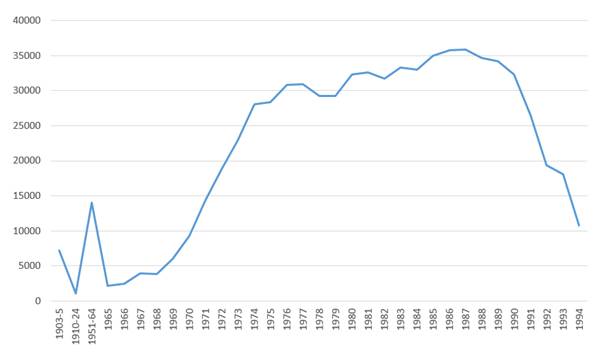
As gathered from Figure 1, Korean immigration to the US occurred in three distinct waves, the second of which occurred during and after the Korean War, between 1951 and 1964.3 Korean immigration then witnessed a major gender shift, with more women (mostly military brides) immigrating than men (Zhao and Park 710). Whereas Korean immigration boomed after 1965 as a result of the Immigration Reform Act (which enforced family reunification and abolished national-origin quotas), Korean-Americans only emerged as a distinct group in the 1990 census while the North/South distinction was introduced in immigration data in 2009. In 2010, Korean-Americans were the fifth largest Asian group in the US (Foner 151).
As Korean presence increased consistently with the third wave, after the Immigration Reform Act was passed, family networks began to emerge and Korean-Americans concentrated in specific locations reflecting their occupational activities, most notably in California and New York (Yoo 79-81, 169). Hence, most Korean entrepreneurs who emigrated after 1965 were then still “products” of the Korean War (Light and Bonacich 20). By the 2000s, the only areas prone to be regarded as proper ethnic enclaves were located in Midtown Manhattan and some three miles west of downtown Los Angeles, where half of the Korean population resided in 2006. In the mid-2010s, the fastest-growing Korean enclaves could be found in New Jersey (Palisades Park) and New York (Long Island).
Ethnic enclaves or economic niches?
With an annual flow wavering between 11,183 naturalizations of Koreans (in 2010) to 22,759 (in 2008) from all over the peninsula,4 “Koreatowns” began to materialize in the vicinity of most US cities such as, to name a few, Atlanta (Buford Highway) and Baltimore (Charles Village) as early as the 1990s and 2000s.5 Like the Albany Park neighborhood at a time when Chicago comprised the third largest Korean-American community in the US, most of these Koreatowns grew out of some commercial districts started there in the 1980s and consisted almost exclusively of a few restaurants (Park in Kim, Koreans in the Hood 207). Before the number of naturalized Koreans decreased in the 1990s, Albany Park was Chicago’s most significant ethnic neighborhood in terms of Asian population. The Census Bureau reported 11,939 “Asians” living there (Holli and d’Alroy Jones 483; Koval 160). Considering their commercial nature and function, Koreatowns are more likely to be described first as economic niches with potential ethnic interests more than “ethnic” enclaves in the strictest sense.
Aside from commerce, Korean presence in the US has indeed contributed to form a Christian nationalist image of Koreans (Choe 107-8). Religion was still an important aspect of Korean society during the war as some Christians living in the North fled the country and went to the US when it broke out (Park 12). Besides, Korean businesses were also preceded by the introduction in the US, of more or less “patriotic” newspapers in Korean as early as the first migration wave (Kent et al. 103). The short-lived Korean Times published in Honolulu (1905-1906) and Korean News (Kongnip Sinmum), first printed in San Francisco in 1905, were the first Korean newspaper printed in the US. Though Korean News was later absorbed by New Korea (Sin-Han Minbo), it is still published today in Los Angeles.6
It now appears that Korean culture and language are two indicators of “ethnic organizations” managing “social relationships” among Korean-Americans in these neighborhoods (Hurh, et al 97). But the term “enclave” in its legal acceptation is improper to characterize these areas as a whole. If, as inferred above, Korean immigration is statistically linked to state economic performances both as cause and effect (Noland in Bergsten and Cho 70), these areas are probably best described as economic niches established either inside (enclave businesses) or outside (non-enclave businesses) Korean enclave economies. While enclave businesses consist of protected markets exclusively reserved to the Korean customers of an enclave economy in particular, more inclusive non-enclave businesses also exist.7
The point here is that a strictly ethnic approach to Korean enclaves in the US is, at best, restrictive or, at worst, fallacious. A recent study reported that Atlanta’s Koreatown, though it concentrates most businesses catering exclusively to Korean customers, cannot be assessed satisfactorily “on the basis of the ethnic composition of their residents” (Yoo 45). An earlier study similarly acknowledged that Chicago’s Koreatown was multiethnic and quite “dispersed” (Park in Kim, Koreans in the Hood 207). In 2000, furthermore, Los Angeles Koreans made up only 20 percent of the population in Koreatown (Min, Asian Americans 38), the majority of the population consisting of Hispanics, primarily Mexicans (Waters et al. 494).
In fact, Korean-Americans presumably prefer leaving to the suburbs over remaining in an “ethnic” neighborhood (Abelmann and Lie 106). In addition, generational gaps exist insofar as family networks do not necessarily provide access to prestigious jobs, except for Korean-Americans with high educational and social backgrounds (Yoo 167-8). For example, the “1.5 generation” refers to formally first-generation young child immigrants who, though they were born in Korea, can be differentiated from both their parents, who were the pioneers of the Korean community in the US, and their own (US-born) offspring (Hurh 164).
Collective memory and psychosocial enclaves
This rapid overview of Korean enclaves is quite revealing of the numerous factors that may impede the formation of collective memory, described by a scholar as a “psychosocial enclave.”8 In 2003, Korean communities all over the US organized various events to celebrate the centennial of Korean immigration. However, Korean immigration to the US today is not the same as it was when Korean immigration began to develop in the early 1900s. At the time, Koreans were praised for their tendency to “Americanize” in opposition to the “un-American” and riotous Japanese (Choe 109). In line with the foundation of the first Korean church in Hawaii in 1903, a distinct Christian nationalist image began to develop. American missionaries convinced Koreans to immigrate because “it would be the proper and advantageous thing to become Christians” (Patterson, Korean Frontier 97).
Early research showed that the first wave contained up to 40-50 percent Christians, and that every Korean community had at least one church (Choy 257). With an estimated 70-80 percent of the Korean-American population being affiliated with Protestant ethnic churches (Shon in Lee and Nadeau 672) and 11 percent with Roman Catholicism (Hurh 24; Carnes and Yang 48-9), though there also exists a Buddhist minority of 2-10 percent (Hwang in Lee 703-704), Christianity—especially Presbyterianism—remains quite prominent today in the 21st century (Patterson 42; Park in Kim, Koreans in the Hood 208). Nevertheless, generational gaps also translate (slightly) different religious attitudes, specifically in terms of cultural accommodation as second-generation Koreans need less “transference” than first-generation ones (Cha in Kwon et al. 142). Comparably, each wave was motivated by specific push and pull factors changing in tandem with the political configuration of the world (Hurh 40-1).
While Korean enclaves could theoretically be interpreted as locations where the collective memory of the Korean War is presumably liable to be built, generational gaps make its existence even more difficult to assess. Before the Korean War, collective memory in East Asia dealt mainly with “the political and imperatives of nation building, alliance, and security” (Goh 164). In this respect, another bone of contention involves the relationship of Korean-Americans to their conception of national identity and ethnicity (Kim, Preaching 39).
After the fall of Japan, Korea was partitioned along the 38th Parallel and two areas of influence, one administered by the US (in the South), the other by the USSR (in the North).9 Just as its northern counterpart, South Korea remained an authoritarian regime (though there were several phases) until 1987 when it went through a democratization process. Many Koreans thus fled the peninsula as a result of the two authoritarian nationalistic states created there in the late 1940s.
As the Cold War drew to a close and South Korea democratized, collective memory became more concerned with historiographic questions including, for instance, “whether and how to establish an agreed record of shared history, to make restitution for historical wrongs, to mourn and learn from history, and in doing so to ‘move on’ […]” (Goh 164). In Korea, nonetheless, the reminiscence of the civil war as well as the current political situation of North Korea as an economic, political, and historiographic enclave makes the concepts of collective memory and Korean ethnicity quite multiform, and consequently, unworkable.
Role and attitudes of Korean enclaves regarding the Korean War
How then define Korean enclaves in the US when it is impossible to account for the existence of a single, homogenous collective memory that, in practice, was actually forged in a country which, in spite of its diversity and as a result of the Cold War, manifested discourses and practices which specifically excluded part of the Korean population (North Korea)? To assess the formation of historiographic enclaves, it will be revealing to study how they can be analyzed in relation to American political life before, during, and after the Korean War.
The Korean diaspora and the buildup to independence
Like the Kim dynasty in the North, South Korea traces its legitimacy as a sovereign state back to the Japanese occupation (1905-45). Yet, such a claim on behalf of South Korea would not have been valid had the US not acknowledged it as more legitimate than North Korea’s. Already in the 1910s, after the creation of the Korean National Association in 1909 as a merger of two other Korean organizations (in Hawaii and California), a group of Western-educated Korean nationalist intellectuals worked from small diasporic enclaves to help form the March 1st Independence Movement of 1919.10 The Korean First Methodist Church in Hawaii also played a significant part in such nationalistic undertakings (Kim, Korean-Americans 48). Moreover, the press in the US became an effective means for Koreans to make their plea for independence known overseas.
Syngman Rhee, South Korea’s first President, left Japan-occupied Korea for the US in November 1904 and went back for good in 1945 to seize power and establish the Republic of Korea (ROK). At home, he came from an upper-class background and had been sent to jail for his active participation in the Independence movement for Korea. Influential as he was, he immigrated officially on a student passport and sent most of his time in the US where he completed his M.A. at Harvard, earned a Ph.D. in politics from Princeton and met W. Wilson (Tucker et al. 200). Unofficially, however, he had been traveling to carry messages from a king’s aide to the Korean legation in Washington D.C.
While some recently published archives made plain his lobbying actions for the post-independence reconstruction of Korea (Oliver 92), Rhee’s influence was felt as a “big splash” as he made his case for independence on several occasions when in exile: he presented Roosevelt with a petition that contained 4,000 signatures in favor of Korean independence from Japan, but failed to secure any concrete help from the US. In 1919, he most notably backed the March 1st Movement and momentarily seized power to declare a Provisional Government. After the Second World War, he actively corresponded with Truman and formed the Republic of Korea (ROK). During the Korean War, he disapproved of MacArthur’s removal when the use of the atomic bomb came into debate (Haruki 151; Choe 57).
Korean lobbies and the commemoration of the war
Though it could be argued that Rhee decidedly contributed to making the Korean War what it was as a result of his insistence that the US-dominated UN forces cross the 38th Parallel and start what historian B. Cumings called the “Second Korean War,” it also seems that his influence was somewhat limited. In the mid-1980s, at a time when Korea Newsreview announced a figure of $3.2 million spent by Korea in lobbying in the US, his failure to secure concrete help from the US right after the war was used as an illustration of his “poor lobbying.”11 Still, in the face of the “red menace” and in spite of a few internal disjunctions in the diaspora, it was strong enough to help form a political, military and economic alliance “forged in blood” that seems to have survived the Cold War to extend into the 21st century (Stueck 186).
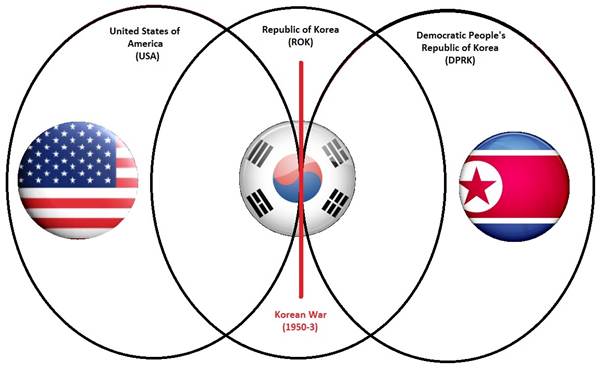
It could be argued that Rhee initiated the tradition of Korean lobbying in the US and that he helped mold the historiographic enclaves of the Korean War, thereby alienating the North Korean narrative from the US narrative. Each circle in Figure 2 refers to a historiographic enclave in particular, with the Korean War as yardstick. It shows that the Republic of Korea shares its history of the war with both the United States and the Democratic People’s Republic of Korea, while the other two clearly do not share theirs. Though Figure 2 was purposely reduced to these three then-belligerent countries only, it would also be relevant to compare how others (like the PRC) would fit in this pattern.
Today, the United States has the second largest Korean diaspora in the world, with over 2 million Koreans living there according to ROK’s Ministry of Foreign Affairs and Trade. When the commemoration of the “Forgotten War” became a political issue, by the mid-1980s, Korean multinational corporations in the US significantly contributed to finance Korean War memorials at both the federal (Washington DC) and local (as in Wilsonville, OR) levels. Though the overall sum of corporate donations was quite modest compared to all individual donations, Hyundai Motors of America gave some $1.2 million for the memorial on the Mall (Hass 37). In addition, funding from South Korean multinational corporations has been used for maintenance. In late 2015, for instance, Samsung and Hyundai were to give $1 million and $20,000 respectively on the occasion of the 20th anniversary of the national memorial dedication.
As former army colonel William Weber, who served in the war, recently argued, it seems that the “greatest support comes from corporate Korea” though there also were individual donations from US legionnaires and Korean-Americans. As Won-Kyong Kim (EVP at Samsung Electronics) put it, the memorial is indeed “very meaningful” to South Koreans (Smith 2015). However, just like the anti-communist Cuban and Taiwan lobbies in the US, the Korean diaspora advocates national interests for Korea over strictly “ethnic” ones (Brzezinski 198).
Though ethnicity is obviously relevant as the term “diaspora” suggests (Bergsten and Choi 16), it plays no part in the structural differences between North and South Korea. Both have thus called for reunification ever since they were divided, though each according to its own terms. Since these debates had begun before the Korean War “broke out,” they can fairly be assumed to represent a first historiographic misunderstanding between Korean and US histories of the conflict, most notably when it implies (as any war does) cases of extreme violence, that is to say, “specific forms of action and particular social phenomena seemingly standing beyond violence” (my translation).12
The contested meanings of Korean War historiography
In the US, the Korean War began as a “police action” (in Harry S. Truman’s terms). Yet, the war was seen differently in Korea, not only in the North and South of the peninsula, but also by the civil population moving in-between the two newborn states. In the decades that followed the war, sovereignty conflict in the Korean peninsula led to a displacement of the urban bourgeoisie from the North to the South and saw the flight of one part of the urban middle class, including northerners, from South Korea to the US (Light and Bonacich 20).
To emphasize the civil war specificities of the Korean conflict and remove the superpower-limited binary vision of the Cold War inherited from Consensus historiography, historians (such as Cumings The Origins of the Korean War) pointed to recent evidence that the USSR was not ready to start another war and that Stalin’s decision to support the DPRK was initially not part of his plan. In a 1949 telegram from Tunkin to the Soviet Foreign Ministry, the Chinese government acknowledged Kim Il-sung’s wish to invade the South, and that Kim was aware his “partial operation” would “probably turn into a civil war.” It also revealed that “in the leading circles of both the north and the south,” there were “more than a few supporters of civil war.” However, neither the Chinese government or the Soviets thought it “advisable” for the north to begin a civil war (“Telegram from Tunkin”).
By the time the Cold War ended with the collapse of the USSR, newly-democratized South Korea published unreleased archives. It became clear that South Korean President Rhee knew Maoist China would enter the war in the event the US crossed the 38th Parallel and invaded North Korea up to the Yalu River, that is, the natural border between DPRK and PRC, not because Stalin commanded him so.13 Since then, the politics of commemoration that has surrounded the Korean War—the war that the US must remember not to forget—has conversely been challenged by the emergence of new dividing lines in US historiography, most notably the role the US had in turning a state-to-state conflict into an international war, tilting the balance in favor of South Korea, not because it was a “free” democracy, which it was not, but because the US had strategic interests in siding with Rhee.
Contested meanings and interpretations of the conflict most certainly do not call into question the historic event itself but they clearly challenge its historiography. In so doing, they lay emphasis on the “multiple silences surrounding th[e] violent history” of the Korean War (Cho 12), one of the most significant of which being the No Gun Ri killings for which President Clinton arguably apologized in 2001.14 As a relatively recent article suggested, the “Incident”–eventually acknowledged as a massacre–might have been “the tip of the iceberg in regard to the matter of mass killings committed by US and ROK troops” (Dong-Choon 523). A more recent study showed that the fact the report of the killings had been “glossed over” was part of Clinton’s rhetorical strategy to bring a “didactic closure,” emphasizing that it had been but “one pain” among many others and that South Koreans must not forget that both countries fought hand in hand for the cause of freedom (Choi, Embattled Memories 8-9).
While the obliteration of these unique historic particularities can be said to have contributed to turn these diasporic communities into ethnic enclaves, the latter are yet not impervious to multiple internal issues which some scholars have identified as “generational gaps” (Cabrera 2008). Since “the amount of historical memory ingrained into the individual” is one of the three criteria used for generational comparison (Choi et al. 17), individual and collective memories of the war as well as the attitudes of Korean-Americans towards historiographic issues and commemorative practices may create gaps, most especially in a post-Cold War context as a new generation has begun.15
The politics of historiographic enclaves in commemorative practice
What can be drawn from the No Gun Ri revelations as an illustration of the contested meanings of the Korean War is that historiographic enclaves, if they exist, are likely to be politicized and give way to the creation of commemorative practices. Following a worldwide wave of historiographic awakening turning the Korean conflict into the “Forgotten War,” memory sites burgeoned everywhere, leaving in their wake political and cultural bridges between different nations around the world. In the Korean peninsula, nevertheless, the South had to cope with the “contradictions of the continuing Korean War” and could no longer ignore, or “forget” its northern neighbor (Jager and Miter 3). Considering such a historiographic enclave as that of the “Forgotten War,” it will be determining to analyze how the Korean War has been ideologically framed by the teleological system of the Cold War when, in fact, it would have been more suitable to integrate it as part of decolonization history, in line with the other civil wars which swept across the post-colonial world after the Second World War.
Memory sites as enclaved spaces of remembrance
In light of growing academic attention to two overlapping areas of the humanities, space and memory, scholars began to cross-examine the authenticity of certain memories as well as “the role of invention in […] tradition and collective historical experience” (Said 175). Because memory and its representations raise critical questions about national identity, power and empowerment, new areas of research have surfaced since the late 1980s. The study of memory sites emerged as a historiographic and historical movement that epitomized both a “reflexive turning of history upon itself” and the “end of a tradition of memory” (Nora 289). Across the pond, these developments resulted from the “memorial mania” (as reads the title of a recent book by Doss Memorial Mania), already deemed a “memorial fever” at the time by some local newspapers,16 which has struck the US since the 1980s: by the mid-2010s, the ROK Ministry of Patriots and Veterans had identified 139 Korean War memorials in the US (including Hawaii).17 In fact, there are twice as many memorials in the US as there are in South Korea.18
This phenomenon illustrates what P. Nora called “the multiplication of the number of private memories demanding their individual histories” (292) since—with some exceptions—most of these Korean War memorials resulted from local initiative. Since memory is a “perpetual actual phenomenon, a bond tying us to the present,” these “temporal enclaves” could be argued to have been designed to “fix” it according to a specific interpretive framework based not on an objective message but rather on its subjective reception (Nora 287). In other words, what is remembered is not the Korean War itself, but particular fixed representations of it—the war “we” must remember not to forget—so that it becomes an integral part of its history. For the same reason, the phrase “Forgotten War” can be found in a majority of these memorials.
Several factors may account for such craze. The first one could be the long development of Korean communities in the US.19 Indeed, if we compare the map of Korean War memorials in the continental US and the map of Korean population by US county, it seems that a majority of these memory sites are located near counties with considerable Korean populations. The fact that this memorial craze took place after Korean immigration increased considerably adds weight to this contention because it makes collective memory synonymous with assimilation.
Yet several facts also impede an exclusively ethnic-based interpretation. To begin with, memory sites are not necessarily located in the vicinity of Korean enclaves.20 Most local memorials were dedicated in the 2000s, as Korean immigration decreased and never reached figures as high as in the 1970s. Furthermore, most of these memorials were built as a result of local initiative, especially on behalf of veterans and associations. Korean enclaves themselves are not exclusively ethnic because, in many instances, they are best described as economic niches.21 In economic terms, though, corporate Korea showed greater support for the maintenance of Korean War memorials than US corporations. In this respect, it is unquestionable that Korean enclaves have had a role to play in the politics of commemoration, and they still do, provided they have the agency to do so.22 In the same way as memory sites can be inclusive, they can also be contested and become the object of historiographic debates.
However, the war also acquires some historiographic quality in repetition and rememoration (Nora 293), that is, in the course of commemorative practices that take place, almost ritually, every year. It is therefore essential to acknowledge the “discursive character of historical facts” (Callinicos 47). To suggest that these lieux de mémoire can be seen as enclaves implies that the interpretive framework “fixing” the meaning of memory sites can prove to be impervious to other historical readings and representations of the past—the “master” or “grand” narratives. Their integration and rejection do not depend on ethnicity, but on the way individuals or communities appreciate the gap between memory sites and historical facts. Once the boundaries of collective memory are fixed around a shared idealized vision of the past, memory sites become enclaved spaces which exclude key historic actors (like North Korea or the PRC) and bar them access to collective rituals of remembrance. If, as E. Said contended, master narratives can “never [be] undisputed or merely a matter of the neutral recital of facts,” contested memories are then likelier to manifest publicly over both discursive and material sites of historical remembrance as they actualize exclusive forms of discourse and reflect particular national imaginaries that alienate other individual and collective—in any case subjective—memories accordingly.
National imaginaries, conflicting memories
While the diaspora is the “privileged site for the articulation of [national] distinction” (Sahlins in Geyer, and Bright 369), the Korean-American community has not usually been associated with acts of contestation or vandalism against Korean War memorials in the US. The absence of virulent contestation may in fact spring from the long political and economic relationship the two countries have enjoyed since the emergence of a Korean diaspora on the continent. These relationships, as it was argued with the “circles of memory,” have paradoxically managed to alienate a part of Korea (the North) and make it a political, economic and historiographic enclave in spite of itself.
It follows that memory sites, whether they are physically enclaved within or without the architectural space of a city, are likely to become mnemonic enclaves in that they set limits to memory so as to suit the historiographic conventions shaping acts of collective remembrance such as annual official commemorations. Given the way these memorial sites were designed, it is obvious that they were literally fashioned by national imaginaries in that they carry an interpretive framework whose vocabulary and grammar of remembrance (and forgetting) were dictated by the master narratives of national identity, in the US as well as in Korea, North and South.
In the US, the presence of South Korean flags in the design of some Korean War memorials—sometimes even engraved as part of a relief picture as in Elliottsburg, PA—cannot truthfully account for the conflict as it was lived at the time because it persists in rejecting North Korea’s legitimacy as a sovereign Korean state. Similarly, the inclusion of certain flags of UN member states can be used to stir the visitor’s attention away from the lead role and responsibility the US had in this war, as in the supervision of POWs.23 The statue of a brooding soldier standing on a representation of the 38th Parallel at the Utah memorial both conveys the idea that the US never crossed it, and that if it did, it is meditating on this decision.
With respect to the Korean War, the syntactic structure and linguistic patterns of remembrance and forgetting found in all these memorials have the particularity that they shed light on a common history which finds its consistence retrospectively in line with a specific telos found in formulas like “Freedom is not free,” “Never forget” (Utah) or “May we ever protect the freedoms for which they fought” (South Dakota). These teleological arguments have become a constant feature of the rememoration of the Korean War. As any other medium, they give the past its possibility and pose the terms of an ethics of remembering and forgetting, meaning not only what should be remembered or forgotten, but also how the memorials should be read.
These events reflect Said’s theory that master narratives invent tradition according to the image the West has of post-colonial cultures. This led to contestation of meanings, notably in Incheon, South Korea, where the statue of MacArthur was vandalized in 2005 by anti-US groups who claimed that depicting a “war criminal” was a “national disgrace,”24 thereby turning the memorial into something akin to a US mnemonic exclave of historicism, that is, a politically significant territory characterized by laws of historical evolution excluding the local population from the grand narratives of its collective memory.
The historiographic conventions of mnemonic enclaves
As they build a bridge between the present and the past, memory sites seem to become enclaved once they conflate the master narratives of national imaginaries with the mnemonic signifiers constitutive of the “insider’s understanding of one’s ‘country, tradition and faith” (Said 176), like the statues of soldiers extolling the virtues of the “supreme” or “ultimate sacrifice.”25 Since memories of the past are shaped after the fact, memory sites become mnemonic enclaves, the historiographic conventions of which comprise an interpretative framework making the understanding of these discursive and material sites possible, and give them meaning. By the same token, they generate a “sense of solidarity” as they were designed to acknowledge past sacrifices and simultaneously praise the individual’s willingness to make sacrifices for a higher cause in the future (Kramer 30).
Quoting from Krapp’s enticing study of cultural memory and its media, memory sites can also be said to “oscillate between… a burnished, idealized image of a golden past, or… a haunting confrontation with the irrevocable past” (98). Once considered as historiographic enclaves, however, these conventions seem to imply that the diachronic reading of memory sites must generate historical revisionism in both discursive and material terms in order to fit in with the realities of the contemporary world. The “free world” rhetoric that Bush senior used on a regular basis and on various occasions during his term was supposed to make the best of a world now empty of the Communist threat.26
And yet, in making past and present collide symbolically, he also completely dismissed the fact that “free world” combat and support units included nationals from the Union of South Africa (then ruled by the Nationalist Party whose Apartheid policy was still in place when Bush’s speech was delivered), Thailand (a military dictatorship since 1932), Greece and Colombia (then living through a period of violent political and civil strife) or even that South Korea was a police state. To deal with this paradox, the present-day flags of then-undemocratic countries are flown instead of the actual flags these countries used at the time (Figure 3).27 A few memorials chose to omit mentioning some of them, like Korean War Memorial, State Veterans Building in Salem, Oregon.28

Just as the historiographic conventions of mnemonic enclaves have material consequences, they similarly have an impact on the historical discourse. The epitaph of the Nashville memorial reads that “the communistic military aggression was defeated” in Korea. Given that fighting ceased when the Armistice was signed on July 27, 1953, after two years of trench warfare and that no peace treaty has been concluded ever since, both sides claim to have won the war, though in fact neither did. Nevertheless, before the democratic reconversion of South Korea in 1987, it would have been more difficult for the US to talk about “victory” in East Asia. Such a retrospective historicist approach conveys the idea it was directly responsible for the democratization of the ROK which, in many respects, it was not.
By 2013, on the occasion of the 60th anniversary of the ceasefire, similar examples of such historiographic conventions could be found at the Seoul exposition. While on one panel, Stalin was put among the Commanders of the Korean War (although the USSR was not directly involved in it), another panel divided the conflict into four distinct periods. The first of these periods was “the prewar period” (전쟁 개시전, lit. “before the start of war”). This period has often been overlooked in American traditional historiography of the Korean War. Conversely, unlike American historians inclined to depict the Korean conflict as a civil war—such as Bruce Cumings,29 the Seoul exposition did not distinguish between different Korean Wars, which actually translates slightly different historical perceptions and discourses.
In this “agreed record of shared history” (Goh) made flesh by conventional spaces of remembrance, the sacred plays a more prominent role than the abject, that is, “what an identity rejects because it instils horror” and which yet remains “formative of the ego” (Lechte 10). This dual process of attraction/ repulsion echoes that of remembrance/ forgetting and remains congruent with the different opposites which all lieux de mémoire conflate (Nora 295-6). Considering that abjection “structures all religious structuring” (Kristeva 17). Moreover, the emergence of memory sites and their social and cultural construction as historiographic enclaves dividing the world into sacred and profane spheres fit in perfectly with Bellah’s notion of civil religion in that “national institutions, rituals and ideologies function like a religion,” as they “provid[e] constituents with a sense of supra-individual transcendence and collective continuity”.30 This brings, in the last analysis, the issue of American identity in a global age to the fore.
Conclusion: Historiographic enclaves and international relations
In light of Benedict Anderson’s Imagined Communities (1982), it can be argued that the institutionalization of collective memory in the form of memory sites is an integral part of the broader administrative and bureaucratic structures forming the tissue of US nationalism today (Kramer 26). Given that Anderson later acknowledged that “our relationship to the past is today far more political, ideological, contested, fragmentary, and even opportunistic than in ages gone by” (Anderson, “Western Nationalism” 38), memory sites could be described as the result of conventions that will determine their nature and function during official commemorative practices, thereby making them historiographic enclaves in both discursive and material terms. Beyond national considerations, however, the historiographic conventions so essential to their existence and relevance seem to translate a slow-paced invention of international identities at a time when US position in the Korean peninsula is increasingly being threatened by emerging Asian countries.
Indeed, the specificities of the Korean War fit in remarkably well with the invention of a new international identity hinging on civil religion on grounds that it binds the belligerents together using the ghost of the Cold War as common denominator while removing facts that proved contrary to the values it advocates, such values as the common “sacrifice” of soldiers from all around the “free world” under the same banner. This trend has been reflected in a memorial—and historiographic—craze that struck the US as the Cold War was drawing to a close, and culminated in 2007 when the Victims of Communism Memorial of Washington DC was inaugurated by President Bush, whose dedication speech likened Communism to terrorism using, like his father, the “free world” rhetoric.31
It follows that the commemoration of the Korean War has played a decisive role in the politicization of its collective memory around the globe, like an organizational culture of memory based on a historiographic consensus with its self-contained telicity. What made the emergence such mnemonic enclaves in US historiography of the Korean War is the long immigration tradition that has existed for over a century between the two continents, and the Christian nationalist image which developed accordingly. The link between the US and (South) Korea has generated enough points of convergence for the memory of the war to be shared, institutionalized, and organized. While Korean communities contributed to shape American politics of commemoration after the war, US foreign relations with North Korea continued to deteriorate (Edwards 48), turning a part of Korea into a “Communist enclave shut off from outside world trade” (Orrick 243). It has, in a sense, strengthened the vision that there existed two Koreas when, instead, it should have debunked it. Only then will the Korean War be won.
Notes
- 1A phrase used by Collet and Furuya in their study of Little Saigon to describe ethnic communities in general.
- 2Korean migration to Hawaii resulted from Horace N. Allen’s (a medical missionary of the Presbyterian Board of Foreign Missions) negotiations with the King of Korea. Yi, M-Y. “Korean Immigration to Hawai’i and the Korean Protestant Church.” In Choe 41-2.
- 3With the 1952 McCarran and Walter Act, the ban on Asian immigrations was lifted and Asian migrants became eligible for citizenship.
- 4Department of Homeland Security. 2013 Yearbook of Immigration statistics, 2015, 54. The 2010 figure includes the number of naturalizations from South (11,170 naturalizations) and North Korea (13 naturalizations). The 2008 figure for North Korea is unknown.
- 5For Buford Highway in Georgia, see Kim, C.S., “Asian Adaptations in the American South” (Hill and Beaver 141). While Charles Village is often referred to as “Koreatown” or “Little Korea”, it has never been officially acknowledged as such. The author reports similar cases in San Diego and Seattle (Moon 22). For the Greater Dallas Korean American Chamber of Commerce (Dhingra 30).
- 6See “The Korean Press” in Mansfield-Richardson (2014).
- 7Terminology used by Yoo 2014. Non-enclave businesses, that is a Korean business outside an enclave economy, can be found in black residential areas and typically illustrate what the author calls “coethnic labor” as they typically hire ethnic minority employees (Yoo 156-9).
- 8A phrase used by Figlio 2011 about collective memories in general though his article focuses on Germany.
- 9In 1948, these two areas became states in their own rights: the Republic of Korea (ROK) in the South and the Democratic People’s Republic of Korea (DPRK) in the North.
- 10Medlicott, C-A. “A ‘Natural’ State? Nature and Nation in North Korea.” In Zhu, Z., 2012, 257. See also Kim, K.Y. “Korean National Association.” In Zhao, X. and E. Park 714.
- 11Koreanews. Vol. 14, 1985, 30.
- 12“[U]ne forme d’action spécifique, un phénomène social particulier, qui semblent se situer dans un ‘au-delà de la violence’” (Sémelin 479).
- 13China entered the war in November 1950, after the US managed to repel DPRK troops and crossed the 38th Parallel. China’s decision was met in order to protect its boundaries, by fear the US would export its Liberation war against DPRK into the PRC, especially Manchuria.
- 14In this respect, Choi S. made a distinction between regret and apologies in Embattled Memories, 2014, 10S.
- 15For example, such generational gaps can be expected to be found in the “1.5 generation” mentioned earlier, as the term refers to people born in Korea but nurtured on American soil, which gives them a unique vision of the events.
- 16“Memorial Fever,” The Victoria Advocate, 11 Mar. 1988, 4. The same phrase was more recently used by K.A. Hass in Sacrificing Soldiers on the National Mall, 2013, 39.
- 17Only a few states do not have any proper Korean War memorials (Alabama, Alaska, New Mexico, North Dakota etc.) Some of them include the Korean War as part of other wars like the Second World War (New Hampshire). Korean War Veterans Association. Web. Feb. 23, 2016. <http://www.kwva.org/memorials/index.htm>.
- 18Ministry of Patriots and Veterans Affairs. Web. Feb. 20, 2016. <http://english.mpva.go.kr>
- 19The Oregon memorial in Wilsonville, for example, was dedicated to the Korean community.
- 20For example, Florida gathers quite a significant Korean population, but the state only has a couple of war memorials. Similarly, Alabama has a larger Korean population than South Dakota but while the latter has only one memorial, the former has none. The same thing can be said about Wyoming. The single memorial there can be found in the city of Cody whose population comprised only 0.58% Asian-Americans.
- 21Most “Koreatowns” usually refer to Korean restaurants, some of which located near highways along with other ‘ethnic’ restaurants.
- 22At the local level, for instance, the memorial bench at the Hudson Memorial in Jersey City, NJ was dedicated by the Korean community to Joseph Cassalla as he contributed to erecting the memorial.
- 23MacDonald, C.A. In Cotton, J. and I. Neary, eds. The Korean War in History, 1989, 136.
- 24“MacArthur Statue Prompts Protests in South Korea” Taipei Times, 18 July 2005. Web. 27 Feb. 2016.
- 25To mention a few: Metairie, LA; Pineville, LA; Jersey City, NJ; Fort Lee, NJ; East Meadow, NY; Lebanon, PA; Richmond, VA and Guam.
- 26E.g., at the Korean National Assembly in Seoul on January 6th, 1992 (Bush 41), at the International Conference on Humanitarian Assistance to the Former USSR. (Bush 127, 129). At the groundbreaking ceremony for the Korean War Veterans Memorial on the Mall in June, he said that soldiers “fought so that the enslaved might be free” and added: “For stopping totalitarianism, the entire free world still salutes you” (Bush 935).
- 27For example, contrary to what the flag suggests, it was the Union of South Africa (and not the Republic) that fought in the Korean War. And yet, it did not prevent Bush’s instance of parachronism when he declared that, in the Korean War, the “free world” fought against Communism.
- 28It is now commonplace to find present-day flags flown in some Korean War memorials (e.g. Olympia, WA) or displayed in ceremonies (the 60th anniversary of the Armistice in Seoul), instead of the actual flags countries used at the time. Though these historical ‘revisions’ seem to be inherently natural, they cannot stand the contradictions found in speeches talking about “the free world” fighting against “slavery.”
- 29Using data gathered from foreign local archives, Cumings used this “pre-war period” as evidence of the Korean War as a civil war. This stance is usually labelled as ‘revisionist’ in Korean War historiography. Cf. Cumings The Origins of the Korean War and Cumings The Korean War: A History.
- 30Soltysik Monnet, A. “War and National Renewal: Civil Religion and Blood Sacrifice in American Culture,” European Journal of American Studies, 7.2 (2012).
- 31The memorial consists of the Goddess of Democracy, a bronze replica of that made during the Tiananmen Square protests (1989). Bush saw it as a warning against North Korea and Cuba, two countries out of the three comprising the Axis of Evil. “Like the communists, our new enemies are dismissive of free peoples, claiming that those of us who live in liberty are weak and lack the resolve to defend our free way of life.” My emphasis. Fekeiki 2007.
Works Cited
Primary sources
Archives
- “Telegram from Tunkin to the Soviet Foreign Ministry in Reply to 11 September Telegram,” September 14, 1949. History and Public Policy Program Digital Archive, AVP RF, Fond 059a, Opis 5a, Delo 3, Papka 11, listy 46-53. Web. Mar. 18, 2015. <http://digitalarchive.wilsoncenter.org/document/112132>
Government papers
- Bush, George Herbert. Public Papers of the Presidents of the United States 1992-93. Book 1-January 1 to July 31, 1992. Washington: US Government Printing Office, 1993.
- Office of Immigration Statistics. 2013 Yearbook of Immigration Statistics. US Department of Homeland Security. 2013. Web. Feb 24, 2016. <https://www.dhs.gov/sites/default/files/publications/Yearbook_Immigration_Statistics_2013_0.pdf>
Press articles
- “MacArthur Statue Prompts Protests in South Korea.” Taipei Times. N.p., 18 Jul. 2005. 27 Feb. 2016. <www.taipeitimes.com/News/world/archives/2005/07/18/2003264019>
- “Memorial Fever.” The Victoria Advocate [Victoria, TX]. Google News. 11 Mar. 1988: 4. Web. 12 Feb. 2016. <https://news.google.com/newspapers?id=PL9dAAAAIBAJ&sjid=CF4NAAAAIBAJ&pg=3318%2C2190837>
- Fekeiki, Omar. “The Toll of Communism.” The Washington Post. June 13, 2007. Web. Oct. 12, 2016. <http://www.washingtonpost.com/wp-dyn/content/article/2007/06/12/AR2007061201125.html>
- Koreanews. Vol. 14, Seoul: Korea Newsreview Inc., 1985.
- Smith, Jada F. “Korean War Memorial Group Finds More Aid in Korea Than in US” The New York Times, 10 Nov. 2015. 02 Feb. 2016. <www.nytimes.com/2015/11/11/us/politics/korean-war-memorial-foundation-wonders-where-the-us-corporate-aid-is.html?_r=0>.
Secondary sources
Electronic publications
- Choi, BoKyung, Daniel Lim and Jeffrey Mitchell. “The K Factor: Korean-American Attitudes toward and Impact on US-Korea Policy.” Center for Strategic and International Studies: Washington DC, March 2008. 25 Feb. 2016. <http://csis.org/files/media/csis/pubs/08-03-25_k-factor_english.pdf>
Essays, articles and chapters
- Abelmann, Nancy and John Lie. Blue Dreams: Korean-Americans and the Los AngelesRiots. Cambridge, MA: Harvard University Press, 2009 [1997].
- Anderson, Benedict. Imagined Communities: Reflections on the Origin and Spread of Nationalism. London: Verso, 1983.
- Anderson, Benedict. “Western Nationalism and Eastern Nationalism: Is There a Difference That Matters?” New Left Review, 2001:9 (2001), 31-42.
- Bergsten, Fred and In-bom Choe, eds. The Korean Diaspora in the World Economy. Special Report No. 15. Washington, DC: Peterson Institute for International Economics, January 2003.
- Brzezinski, Zbigniew. Second Chance: Three Presidents and the Crisis of American Superpower. New York: Basic Books, 2008.
- Cabrera, Rosa M. Beyond Dust, Memories and Preservation: Roles of Ethnic Museums in Shaping Community Ethnic Identities. Chicago: University of Illinois, 2008.
- Callinicos, Alex. Theories and Narratives: Reflections on the Philosophy of History. Cambridge: Polity Press, 1995.
- Carnes, Tony, and Fenggang Yang, eds. Asian American Religions: The Making and Remaking of Borders and Boundaries. New York: New York University Press, 2004.
- Chang, Roberta and Wayne Patterson. The Koreans in Hawaii: A Pictorial History, 1903-2003. Honolulu: University of Hawaii Press, 2003.
- Cho, Grace M. Haunting the Korean Diaspora: Shame, Secrecy, and the Forgotten War. Minneapolis: University of Minnesota Press, 2008.
- Choe, Yong-Ho. From the Land of Hibiscus, Koreans in Hawai’i, 1903-1950. Honolulu: University of Hawaii Press, 2007.
- Choi, Suhi. Embattled Memories: Contested Meanings in Korean War Memorials. Reno: University of Nevada Press, 2014.
- Choy, Bong-Youn. Koreans in America. Chicago: Nelson Hall, 1979.
- Collet, Christian and Hiroko Furuya. “Enclave, Place, or Nation? Defining Little Saigon in the Midst of Incorporation, Transnationalism, and Long Distance Activism.” Amerasia Journal 36.3 (2010): 1-27.
- Cotton, James and Ian Neary, eds. The Korean War in History. Manchester: University of Manchester Press, 1989.
- Cumings, Bruce. The Origins of the Korean War: Liberation and the Emergence of Separate Regimes 1945 1949. Vol 1. Princeton, N. J: Princeton University Press, 1981.
- Cumings, Bruce. The Korean War: A History. New York: Modern Library, 2010.
- Dhingra, Pawan. Managing Multicultural Lives: Asian American Professionals and the Challenge of Multiple Identities, Stanford: Stanford University Press, 2007.
- Doss, Erika. Memorial Mania: Public Feeling in America. Chicago: University of Chicago Press, 2010.
- Dong-Choon, Kim. “Forgotten war, forgotten massacres--the Korean War (1950–1953) as licensed mass killings.” Journal of Genocide Research 6.4 (December 2004), 523-544.
- Edwards, Paul M. To Acknowledge a War: The Korean War in American Memory. Westport, Conn: Greenwood Press, 2000.
- Eui-Young Yu, Peter Choe, Sang Il Han, and Kimberly Yu. “Emerging diversity in Los Angeles Koreatown, 1990-2000.” Amerasia Journal, 30.1 (2004), 25-52.
- Figlio, Karl. “A psychoanalytic reflection on collective memory as a psychological enclave: Jews, German national identity, and splitting in the German psyche.” International Social Science Journal, 62 (2011): 161–177.
- Foner, Nancy. One Out of Three: Immigrant New York in the Twenty-First Century. New York: Columbia University Press, 2013. Rev. Ed. of New immigrants in New York, c2001.
- Geyer, Michael and Charles Bright. “World History in a Global Age.” In Burns, Robert M., ed. Historiography: Critical Concepts in Historical Studies. Vol. V: Politics. London: Routledge, 2006, 366-390. Originally published in American Historical Review 100.4 (1995): 1034-1060.
- Goh, Evelyn. The Struggle for Order: Hegemony, Hierarchy, and Transition in Post-Cold War East Asia. Oxford, United Kingdom: Oxford University Press, 2013.
- Haruki, Wada. The Korean War: An International History. New York: Rowman & Littlefield, 2013.
- Hass, Kristin Ann. Sacrificing Soldiers on the National Mall. Berkeley: University of California Press, 2013.
- Hill, Carole E. and Patricia D. Beaver, eds. Cultural Diversity in the US South: Anthropological Contributions to a Region in Transition. Athens, GA: University of Georgia Press, 1998.
- Holli, Melvin and Peter d’Alroy Jones. Ethnic Chicago: A Multicultural Portrait, Grand Rapids Wm. B. Eerdmans Publishing, 1994.
- Hurh, Won Moo. The Korean-Americans. Westport: Greenwood Press, 1998.
- Hurh, Won Moo, Hei C. Kim, and Kwange C. Kim. Assimilation Patterns of Immigrants in the United States: A Case Study of Korean Immigrants in the Chicago Area. Washington D.C: University Press of America, 1979.
- Hurh, Won Moo and Kwang Chung Kim. Korean Immigrants in America: A Structural Analysis of Ethnic Confinement and Adhesive Adaptation. Rutherford, N.J.: Fairleigh Dickinson University Press, 1984.
- Jager, Sheila Miyoshi and Rana Mitter, eds. Ruptured Histories: War, Memory, and the Post-Cold War in Asia. Cambridge, MA: Harvard University Press, 2007.
- Kwon, Ho-Youn, Kwang Chung Kim and R. Stephen Warner, eds. Korean Americans and Their Religions: Pilgrims and Missionaries from a Different Shore. University Park, PA: The Pennsylvania State University Press, 2001.
- Kent, Allen, Harold Lancour and Jay E. Daily, eds. Encyclopedia of Library and Information Science (Vol 24). New York: Marcel Dekker, Inc., 1978.
- Kim, Ilpyong J. Korean-Americans: Past, Present and Future. Elizabeth, NJ: Hollym International Corporation, 2004.
- Kim, Kwang Chung, ed. Koreans in the Hood: Conflict with African Americans. Baltimore: John Hopkins University Press, 1999.
- Kim, Matthew D. Preaching to Second Generation Korean-Americans: Towards a Possible Selves Contextual Homiletic. New York: Peter Lang, 2007.
- Kim, Simon C. Memory and Honor: Cultural and Generational Ministry with Korean American Communities. Collegeville, Minnesota: Liturgical Press, 2013.
- Koval, John P. The New Chicago: A Social and Cultural Analysis. Philadelphia: Temple University Press, 2006.
- Kramer, Llyod. “Historical Narratives and the Meaning of Nationalism.” In Burns, Robert M. (ed.). Historiography: Critical Concepts in Historical Studies (Vol. V: Politics). London: Routledge, 2006, 23-43.
- Krapp, Peter. Déjà Vu: Aberrations of Cultural Memory. Minneapolis: University of Minnesota Press, 2004.
- Kristeva, Julia. The Powers of Horror: An Essay on Abjection. Trans. Leon S. Roudiez. New York: Columbia University Press, 1982 [1980].
- Lechte, John. Key Contemporary Concepts: From Abjection to Zeno’s Paradox. London: Routledge, 2003.
- Lee, Jonathan H. X. and Kathleen M. Nadeau, eds. Encyclopedia of Asian American Folklore and Folklife. Santa Barbara, CA: ABC-CLIO, 2011.
- Light, Ivan and Edna Bonacich, eds. Immigrant Entrepreneurs: Koreans in Los Angeles(1965-1982). Berkeley: University of California Press, 1988.
- Mansfield-Richardson, Virginia. Asian Americans and the Mass Media: A Content Analysis of Twenty United States Newspapers and a Survey of Asian American Journalists. London: Routledge, 2014.
- Min, Pyong G. “Koreans: ‘An institutionally complete community’.” In Foner, Nancy ed. New Immigrants in New York. Rev. ed. New York: Columbia University Press, 2001, 173-200.
- Min, Pyong G., ed. Asian Americans: Contemporary Trends and Issues. 2nd ed. Thousand Oaks, Calif: Sage Publications, 2006 [1995].
- Moon, Seung-Jun. Immigration, Acculturation, and Mass Media Effects: Cultural Values and Evaluations of Caucasian and Asian Advertising Models. Madison, Wisconsin: University of Wisconsin-Madison, 2004.
- Nora, Pierre. “Between History and Memory: Lieux de mémoire.” Trans. Marc Roudebush. In Burns, Robert M., ed. Historiography: Critical concepts in Historical Studies(Vol. IV: Culture). London: Routledge, 2006, 284-302. The original English version of this article was published in Representations 26 (1989): 7-25.
- Oliver, Robert T. Syngman Rhee and American Involvement in Korea 1942-1960: A Personal Narrative. Seoul: Panmun Book Co,1978.
- Orrick, Bob. Indelible Memories. Canadian Sailors in Korea 1950-55. A Retrospective Look at the Korean War. [Place of publication unspecified:] Xilibris Corp, 2010.
- Park, Kyeyoung. The Korean-American Dream: Immigrants and Small Business in New York City. Ithaca and London: Cornell University Press, 1997.
- Patterson, Wayne. The Korean Frontier in America: Immigration to Hawaii, 1896-1910. Honolulu: University of Hawaii Press, 1994.
- Said, Edward. “Invention, Memory, and Place.” Critical Inquiry, 26.2 (2000): 175-192.
- Sémelin, Jacques. « Introduction : Violences extrêmes : peut-on comprendre ? » Revue internationale des sciences sociales 4-174 (2002), 479-481.
- Seth, Michael J., ed., Routledge Handbook of Modern Korean History. London: Routledge, 2016.
- Soltysik Monnet, Agnieszka. “War and National Renewal: Civil Religion and Blood Sacrifice in American Culture.” European Journal of American Studies, 7.2 (2012). Web. 27 Feb. 2016. <https://ejas.revues.org/9672>.
- Stueck, William. Rethinking the Korean War: A New Diplomatic and Strategic History. Princeton: Princeton University Press, 2002.
- Tucker, Robert W, Charles B. Keely, and Linda Wrigley, eds. Immigration and US Foreign Policy. Boulder, Colorado: Westview Press, 1990.
- Waters, Mary C, Reed Ueda, and Helen B. Marrow, eds. The New Americans: A Guide to Immigration since 1965. Cambridge, Mass: Harvard University Press, 2009 [2007].
- Yoo, Jin-Kyung. Korean Immigrant Entrepreneurs: Networks and Ethnic Resources. London: Routledge, 2014.
- Zhao, Xiaogian, Edward J.W. Park, eds. Asian Americans: An Encyclopedia of Social, Cultural, Economic, and Political History. Santa Barbara, CA: ABC-CLIO, 2014.
- Zhu, Zhiqun. New Dynamics in East Asian Politics: Security, political economy, and society. New York: Continuum International Pub. Group, 2012.
About the author(s)
Biographie : Thibaud Pascal Danel est doctorant en Lettres et civilisations anglo-saxonnes à l’Université de Nice Sophia-Antipolis et enseignant d’anglais dans le secondaire. Sa recherche se concentre principalement sur les différentes formes d’irrédentisme aux États-Unis à travers les siècles. À mi-chemin entre l’analyse du discours et l’étude des représentations, sa thèse de doctorat porte sur la guerre de Corée et sur les enjeux historiographiques soulevés par la question de la mémoire et de ses usages politiques dans les mondes anglophones.
Biography: Thibaud Pascal Danel is a PhD candidate in English studies at the University of Nice Sophia-Antipolis and an English teacher in secondary schools. His research interests essentially focus on the different aspects of United States irredentism throughout the centuries. His doctoral dissertation is at the crossroads between discourse analysis and the study of representations. It deals with the Korean War and the historiographic stakes its memorialization and politicization have raised in the English-speaking worlds.