Murals after “the Troubles”: Rebuilding the Image of Northern Ireland (1994-2012)
Abstract: Although the history of mural painting in Northern Ireland started long before the conflict erupted in the late 1960s, this iconic genre became deeply associated with the “Troubles”. In the 1980s, Republicans adopted mural painting as an effective tool for political communication and a visual call to arms, while Loyalist murals experienced a rebirth. Besides a few other themes, depictions of armed members of paramilitary organisations started to cover the walls of both Catholic and Protestant areas of Belfast and Derry, mirroring the levels of unrest in the province. After the ceasefires and the 1998 Good Friday Agreement, sectarian violence gradually receded from Northern Ireland; political murals, however, did not suddenly vanish. Since the mid-1990s, there have been important changes in the themes depicted in murals, but also many disturbing elements of continuity, pointing to the persistence of a war culture. As individuals, associations and state agencies recognised the negative impact which paramilitary murals could have on business, tourism and, crucially, the future of the peace process, calls were made for their removal. This paper traces the evolutions in the iconography and perceptions of mural paintings in Northern Ireland from the initial ceasefires in 1994 to the early 2010s, focusing on the successive attempts by individuals, organisations and state agencies to intervene in Northern Ireland’s muralscape as a way to rebuild a more positive image of the province. It aims to assess the extent to which these initiatives have led murals away from a highly divisive iconography in favour of a broader, more inclusive one.
Keywords: Northern Ireland, Murals, Post-conflict transition, Re-imaging Communities programme, Identity
Résumé : Bien que l’histoire de la peinture murale en Irlande du Nord remonte à bien avant le déclenchement du conflit à la fin des années 1960, ce genre pictural est devenu intrinsèquement lié aux « Troubles ». Dans les années 1980, les Républicains adoptent la peinture murale pour un faire l’un de leurs outils les plus efficaces en termes de communication politique ainsi qu’un appel aux armes ; à la même période, les peintures murales Loyalistes connaissent une renaissance. Les représentations de paramilitaires, notamment, commencent alors à recouvrir les murs des quartiers catholiques et protestants de Belfast et Derry, reflétant l’insécurité grandissante de la province. Après les cessez-le-feu et l’Accord de Belfast de 1998, la violence recule progressivement en Irlande du Nord ; les peintures murales à contenu politique, cependant, n’ont pas disparu d’un seul coup. Depuis le milieu des années 1990, les peintures murales ont connu d’importants changements dans leur iconographie, mais aussi de nombreux éléments de continuité surprenants, qui révèlent la permanence d’une culture de guerre. Pour certains (des individus isolés, des associations ainsi que des agences publiques), il devient clair que les peintures murales, notamment les plus militaristes, peuvent avoir un impact négatif sur le développement économique, le tourisme et, surtout, les perspectives de paix de la province ; c’est ainsi que s’élèvent des voix pour demander leur disparition. Cet article retrace les évolutions qu’ont connu les peintures murales, en termes d’iconographie et en termes de perception, entre les premiers cessez-le-feu en 1994 et le début des années 2010 et met en lumière les tentatives successives, qu’elles soient privées ou publiques, d’agir sur les peintures murales nord-irlandaise dans le but de reconstruire une image plus positive de la province. Il s’agira plus précisément d’évaluer dans quelle mesure ces initiatives ont conduit les peintures murales à s’écarter d’une iconographie marquée par les divisions communautaires au profit d’une imagerie plus inclusive.
Mots-clés : Irlande du Nord, Peintures murales, Transition post-conflit, Programme « Re-imaging Communities », Identité
From Harry’s Game to Hidden Agenda and The Boxer, most films devoted to the conflict in Northern Ireland include images of Belfast’s murals as a way to convey a sense of place to the spectator. This is revealing of the degree to which murals have become associated to the Troubles, even though the history of mural painting in Northern Ireland started long before the conflict erupted in the late 1960s. From the early 1980s onwards, Republicans adopted mural painting as an effective tool for political communication and a visual call to arms, while Loyalist murals experienced a rebirth when paramilitaries started to use them as a way to mark out their territory, intimidate others and honour the memory of their dead companions in arms. Besides a few other themes, depictions of hooded gunmen invaded the walls of both Catholic and Protestant areas of Belfast and other parts of Northern Ireland, mirroring–and, to some extent, encouraging–the towering levels of violence in the province1. After the ceasefires and the 1998 Good Friday Agreement, the murals did not suddenly vanish. The years of conflict left a deep imprint not just on the social fabric and the politics of Northern Ireland but also on its visual environment. Reconstruction after the Troubles therefore had to involve a significant part of image re-building.
The question of the changing place and aspect of murals following the ceasefires has been widely addressed since 1995. Following the publication of first monograph in 1991, Bill Rolston continued to document and analyse the changing iconography of murals in the three volumes of three volumes of Drawing Support, published between 1992 and 2003, thus examining the transitions from war to peace. The iconography of this transitional period was highly ambiguous, as has been noted by Neil Jarman (1996) and Jeffrey Sluka (1996). The impact of the cultural tradition of mural painting in the construction of Belfast as a tourist destination in the post-conflict era has received much attention over the last decade and a half (Rolston 1995; Jarman 1998; Causevic and Lynch 2008; Brunn et al. 2010). In contrast, the public and private efforts at re-building the image of Belfast through the transformation of its muralscape have only just started being scrutinised by researchers (McAtakney; Hill and White; Rolston 2012), although they had long been documented and commented upon by journalists and touched upon in passing by McCormick and Jarman in 2005.
The present article offers a review of the existing literature, complemented by personal analyses of murals and media discourse and by observations made during field trips in Belfast in 2011 and 2012. It traces the evolutions in the iconography and perceptions of mural paintings in Northern Ireland from the initial ceasefires in 1994 to the early 2010s, focusing on the successive attempts by individuals, organisations and state agencies to intervene in Northern Ireland’s muralscape as a way to rebuild a more positive image of the province. It aims to assess the extent to which murals have moved away from a highly divisive iconography in favour of a broader, more inclusive one. After briefly considering the limited evolutions in the iconography of murals in the period that immediately followed the ceasefires, I will analyse the impact of a preliminary series of, largely unconnected, locally-based attempts at altering some of Northern Ireland’s murals, which were initiated between the late 1990s and the mid-2000s, before turning to the more comprehensive government-led programme, entitled Re-imaging Communities, which was set up in 2006.
Murals in Northern Ireland, 1994-early 2000s: a post-conflict iconography?
On 31 August 1994, the IRA proclaimed a ‘complete and unequivocal’ ceasefire, thus putting an end to a 25-year long campaign. This was followed six weeks later by a reciprocal ceasefire declared by Loyalist paramilitaries. The peace process developed, fluctuating between moments of rapid progress and long periods of stagnation. In 1998, the Good Friday Agreement, which introduced devolution and power-sharing, was signed by all the negotiating parties, including Sinn Fein, and then approved by referendum. Doubts remained however as to the permanence of the peace introduced under the agreement. The Omagh bombing carried out by dissident Republicans in August 1998, showed that a fraction of the Republican community opposed the agreement, but was forcefully condemned by all parties including Sinn Fein. The most serious, if not the most fatal, threats to the permanence of the settlement lay in growing Unionist opposition to the Good Friday Agreement. Moreover, tensions over the question of disarmament led to repeated suspensions of the power-sharing institutions introduced under the agreement.
The uncertainties of this period are reflected by the ambiguities of the iconography of mural paintings produced between the mid 1990s and the early 2000s. Indeed, although the levels of paramilitary violence diminished, paramilitary murals survived the ceasefires and can even be said to have developed during that period, as Jarman (1996) and Rolston (2003, 2012) have underlined. This was particularly clear in the Loyalist camp as some of the most aggressive Loyalist murals were actually produced at the time of the peace process, like the black and white composition showing the figures of three armed men in profile surrounded by the motto “We are the pilgrims, Master: We shall go always a little further,” which was painted by the UVF on Mersey Street, East Belfast, in 1996. A year previously, another local group of the same paramilitary organisation had painted two large gunmen wearing balaclavas and pointing their guns at the spectator in the Mount Vernon Estate in North Belfast; the text “Prepared for War, Ready for Peace” reinforced the threatening dimension of the iconographic programme of the mural. This was all the more striking as this mural appeared in an area that had until then barely been touched by the practice of mural painting (Jarman, 1998: 5). Among the most hostile images used by Loyalists in the years following the ceasefire, we must mention several Ulster Freedom Fighters murals which appeared in Belfast and elsewhere between 2000 and 2002, using the mascot of the heavy metal group Iron Maiden, referred to as Eddie. The savage face of the latter combined with the outline of the Grim Reaper in the background, as well as graves in the foreground which often bore the names of Republican politicians or paramilitaries, made this series of murals particularly intimidating (Rolston, 2003: xi). The almost exclusive emphasis on militaristic themes in the Loyalist murals produced from the mid-1990s to the early 2000s has been interpreted as reflecting the Unionist community’s anxiety and ambivalent views about the peace process, but also as a defence of each paramilitary group’s territory, not just against Republicans but against other Loyalist factions (Rolston, 2003: xi; McCormick and Jarman; Rolston, 2012: 452).
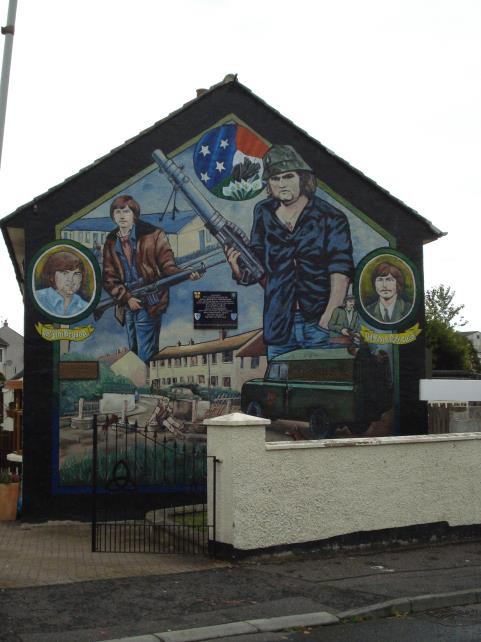
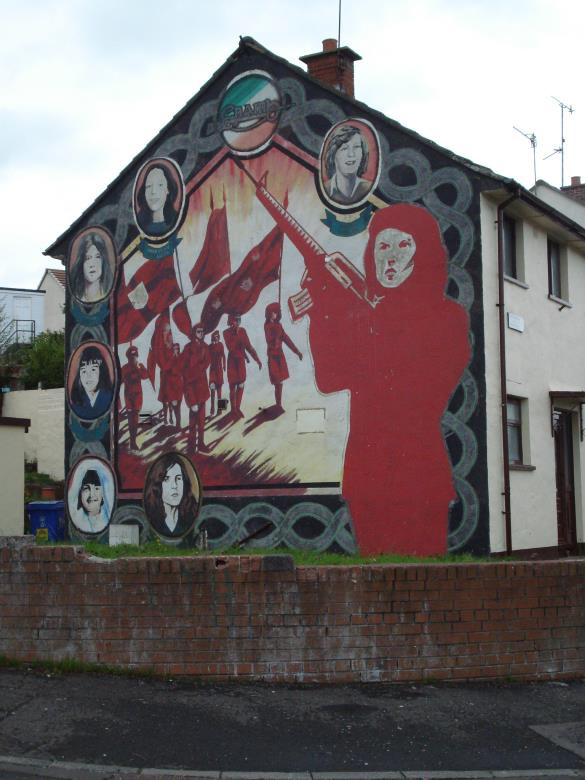
Unlike Loyalists, Republican muralists commonly turned to political subjects rather than purely paramilitary ones, for example commenting on the slowness of the peace process or giving the Republican viewpoint on such issues as decommissioning, policing or collusion (Rolston, 2003: 35-43). This, however, cannot be regarded as a new development: as early as the mid 1980s, murals referring to historical or cultural themes as well as to political issues had coexisted with depictions of IRA gunmen (Rolston, 1992: 43-6; 49-51). Sluka claimed that, after the ceasefire, the only guns featured in Republican murals appeared in the hands of the British army or of the RUC rather than in those of the IRA (Sluka, 384). This is not wholly accurate however as IRA guns did appear in a number of murals painted after the Good Friday Agreement and in particular in the series painted in the Ballymurphy area of West Belfast in 2001-2002 (fig. 1-2). Rolston analyses these murals as memorials to local IRA volunteers who died during the Troubles, arguing that they did not represent “the end of the moratorium on militaristic murals” (Rolston, 2003: ix). However, the prominent place of weapons in these compositions (either right in the centre, or in the foreground, or both) should not be played down: there was a permanence in these as well as in other Republican murals of the paramilitary theme after the IRA ceasefires and the Good Friday Agreement, albeit to a much smaller extent than in Loyalist murals.
The first phase of image rebuilding (late 1990s-mid 2000s)
The fact that the gun was taken out of politics, but not yet out of the murals, led to calls for the removal of paramilitary murals, which were widely echoed by the press, both locally and nationally. On a few occasions, specific murals led to demands for their removal or for significant alterations. Thus, in 1998, the Democratic Unionist Party (DUP) complained, in the context of the recent Omagh bombing, about the erection of a Republican mural in a public park (North Belfast Herald, 19 August 1998). Two years later, Sinn Fein asked for the names of Republicans appearing on the graves of a version of the Eddie mural to be removed (McKee). In both cases the essential argument was that the murals were offensive for members of the other community and were meant to intimidate them and keep them out of certain areas. It is no accident that these demands emanated from Sinn Fein and the DUP, the two most polarized parties in Stormont, nor that their demands targeted murals produced by members of the opposite community, not their own. In such cases, it can be argued that Northern Ireland’s muralscape had become one of the many areas in which the sectarian divisions between the ethno-political blocs in Stormont manifested itself, others being, then as now, the question of flags or parades.
Paramilitary murals in general and the more militaristic Loyalist murals in particular, were also criticised by members of Alliance, a centrist party with cross-community appeal, and by isolated individuals. Among the arguments that were put forward was the idea that such murals perpetuated the conflict at a time when people aspired to peace. Glyn Roberts, the East Belfast Alliance chairman is thus reported to have said: “murals are part of the negative psyche which needs to change as the peace process moves forward. […] paramilitary murals are part of the past, accentuating division instead of harmony” (Burrows). More pragmatically, murals with hooded gunmen were also said to affect the value of houses negatively and to discourage potential businessmen from setting up shop in the immediate neighbourhood of such paintings (Murray Brown; Belfast Telegraph, 2002).
Residents’ attitudes to the murals in their neighbourhood remain the object of much debate. In 1996, Sluka claimed that there was strong local support for the murals; he dismissed calls for their removal as reflecting “a one-sided bourgeois view which grossly misinterprets the degree of local support for the murals and the relationship between the local working-class communities and political symbols” (Sluka 382). However, accounts published in the press or quoted by Jarman show that many residents, especially in Loyalist areas, actually wanted to see certain murals go because they found their paramilitary iconography threatening, while often not daring to voice their opposition to such images for fear of reprisals (Jarman 1998: 11). The exact degree of support for murals in the years that followed the ceasefires is thus difficult to assess, but it seems undeniable that opposition to at least some of the murals also came from the residents, and not just from politicians and individuals who did not belong to the community concerned.
In this context of growing criticism of paramilitary murals, a preliminary series of initiatives was set up in order to change the aspect of some of Northern Ireland’s murals. These early attempts at image-rebuilding were not connected; they usually concerned just one mural or a group of paintings in one small area, and they involved a large variety of participants who rarely interacted together (Hill and White 74; McCormick and Jarman 66; Rolston 2012: 453). It has been shown that those involved in these early projects included isolated individuals, cultural organisations (like the West Belfast Athletic and Cultural Society, the East Belfast Historical and Cultural Society or the Ulster-Scots Agency) or the Northern Ireland Housing Executive (NIHE)2 (Rolston 2012: 453). The role of the Alliance Party has probably not been emphasized enough yet: Alliance councillors indeed seem to have been particularly active between 1998 and 2002 in attempting to remove paramilitary murals (Burrows;News Letter, 2001; Wallace, May 2002).
Early projects aimed at refashioning Northern Ireland’s muralscape encountered important difficulties. First, it has been noted that council workers in charge of cleaning up the sites were intimidated by paramilitaries, which sometimes led to their refusal to intervene on subsequent similar projects (Jarman 1998: 11). Similarly, at least two Alliance officials who had been involved in the removal of paramilitary murals were the victims of reprisal attacks on their homes by Loyalists (Wallace, May and June 2002). Finally, the removal of paramilitary paintings was sometimes followed by similar murals appearing on the same or nearby locations soon afterwards, illustrating the paramilitary groups’ determination to mark out what they regarded as their territory. It was the case when the NIHE undertook large-scale renovation works involving the demolition of the building located on Mount Vernon Road on which the notorious mural “Prepared for Peace, Ready for War” had been painted. According to McCormick and Jarman, the demolition work could not proceed until the NIHE had provided the paramilitaries with a new wall overlooking the original site, where another version of the painting swiftly appeared (McCormick and Jarman 66).
Yet other image-rebuilding projects proved more successful. In 1998, local Alliance party members initiated a project to remove some of the paramilitary imagery from the Ballyduff estate in North Belfast. Through collaboration with local community development workers, they managed to convince paramilitaries to accept the changes, and then to get local youth involved in designing and painting the new mural (Burrows). The same year, a businessman named Tom Ekin spent more than a year trying to contact and then convincing the UFF to replace a mural on Sandy Row which he considered detrimental to his business. He finally succeeded in having the paramilitary mural replaced with a long street scene featuring King Billy, local buildings and a footballer, among other themes (Murray Brown).
Some of these achievements, however, need to be qualified. In the Monkstown estate of North Belfast, several paramilitary murals were replaced with new, less aggressive compositions in 2001-2002 (McCormick and Jarman 66). One of the original UVF murals, located on Devenish Drive, showed four masked gunmen aiming their guns at the viewer. They were replaced by imagery that is unquestionably less threatening: the new mural reproduced the statue of Edward Carson towering in front of the Parliament Buildings in Stormont and showed the figures of First World War soldiers in the background. Although this mural was referred to as “cultural” by McCormick and Jarman, it is in fact profoundly political: Carson and the First World War are powerful historical references that have served to rally the Unionist community. Moreover, in spite of the change in the iconography of the mural, the names of the same UVF men continue to appear on the wall, which therefore intentionally combines the commemoration of unchallenged Unionist heroes with a memorial to dead members of a paramilitary organisation, thus capitalising on the appeal of the former to promote the latter.
Finally, in all the cases of actual transformations mentioned here, the changes in the iconography of murals were made possible because of close cooperation with the paramilitaries who had produced the original murals. This could be read as a positive sign as paramilitaries proved ready to cooperate and abandon their most aggressive imagery for new symbols of Protestant unionist identity. However, it is equally possible to interpret these negotiations as an indication, not only of the attachment paramilitaries feel for the murals, as was noted by McCormick and Jarman (67) but, more crucially, of the influence they continue to exert at the local level and the lack of willingness on the part of state agencies to confront them on these issues.
Coordinated state intervention in Northern Ireland’s muralscape: the Re-imaging Communities programme (2006-2012)
From the mid 2000s a new phase of image-rebuilding started in Northern Ireland. A number of coordinated, government agency-led programmes were set up, which addressed not only the question of murals but the larger issue of Northern Ireland’s sectarian visual environment (including flags, bunting, and other forms of symbolism). The most important of these programmes is called Re-imaging Communities and was launched in July 2006. It followed on two earlier government-led initiatives: Belfast City Council’s ‘Brighter Belfast’ project and the ‘Art of Regeneration’ project which was started in February 2004 by Northern Ireland’s Department for Culture, Arts and Leisure and the Arts Council of Northern Ireland (ACNI) (Hill and White 75-6; Rolston 2012 : 453-4).
The Re-imaging Communities programme was therefore not the first government-led initiative to modify Northern Ireland’s muralscape, but it certainly was the most far-reaching one. Led by the ACNI, the programme received funding of £3.3 million for an initial three-year period; it was then renewed and is still running in 2015. The stated objective was “to encourage communities to reflect on and plan for ways of replacing divisive imagery with imagery that reflects communities in a more positive manner” in order to transform the “visible signs of sectarianism and inter-community separation” (Independent Research Solution 2009: vii). In other words, it was felt that changing Northern Ireland’s muralscape would help bring about reconciliation and harmonious community relations, and thus strengthen the peace process. From the start, the programme has largely relied on local community groups, who apply for funding of up to £50,000 per project and are then to organise consultations with local residents–which usually also involve paramilitaries–in order to define the project (Rolston 2012: 454-5). A total of 123 projects had been funded by the time Independent Research Solution’s monitoring report was published in 2009, out of which 39 involved altering and removing murals as well as painting new ones across Northern Ireland (Hill and White 75-6).3
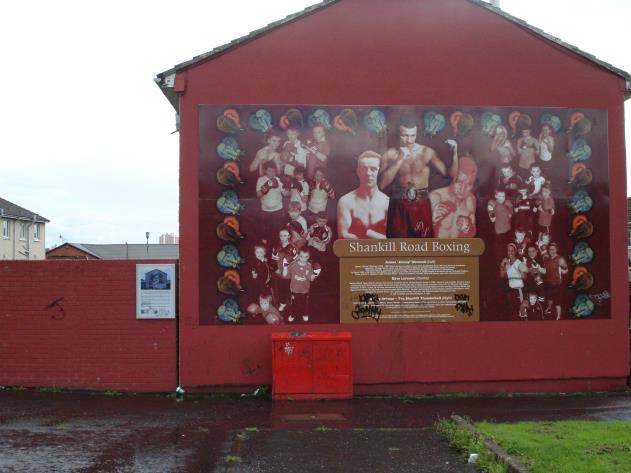
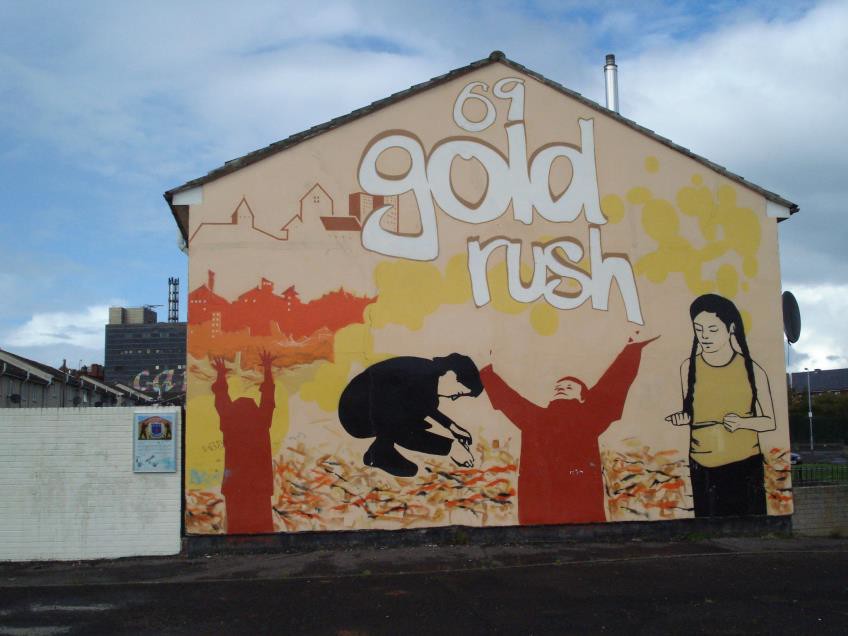
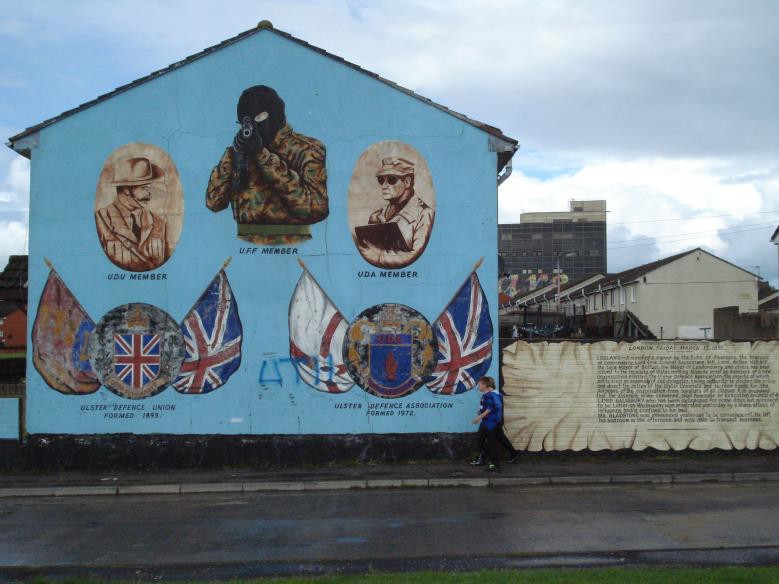
One of the most striking examples of the impact of the programme is to be found in Lower Shankill, in the area of Hopewell Crescent where six Loyalist murals were replaced by new compositions, while four new murals were added, all ten having been unveiled on 16 June 2009 following work involving the Lower Shankill Community Association (McNeilley 2009). Among other changes, a siege of Derry mural was replaced with depictions of local boxing champions while an Ulster Defence Association mural was replaced with the so-called 1969 Gold Rush4 (fig. 4-5).
In spite of this apparent success, the Re-imaging Communities programme has been criticised on various grounds, by local people and scholars. First of all, the programme was criticised for being unfair to Nationalists. The programme initially limited Arts Council funding to groups based in a Protestant working-class community, which caused the moderate Nationalist Social Democratic and Labour Party (SDLP) to accuse the Arts Council of openly breaking the law by excluding Catholic areas (Rolston 2012: 454). The objectives and targets of the Re-imaging communities programme were redefined to be all-inclusive, but it is clear that Protestant areas have benefited more than Catholic ones. This is largely explained by the fact that the most militaristic murals are to be found in Loyalist, not Republican, neighbourhoods. But it is probably also the result of a certain distrust on the part of Republicans for a (British) state-controlled programme aimed at altering the content of murals which long served to voice their resistance to the British state. Rolston goes further than that and claims that the Re-imaging programme boils down to a form of censorship and that this censorship has been applied differently for Nationalist and Unionist paintings. Contrasting the example of a Nationalist mural depicting the Flight of the Earls in the Ardoyne area of North Belfast, in which a sword had to be removed following a request by the ACNI, with the numerous Unionist murals commemorating the First World War, he wittily asks: “How can a four-centuries-old sword be more contentious than a century-old gun?” (Rolston 2012: 458). He concludes: “A policy based on the de-politicisation of murals can thus support the continuing expression of Loyalist sentiments while being more rigid in policing republican sentiments” (Rolston 2012: 460).
A second set of criticisms of the programme, and more generally of all types of image-rebuilding initiatives, centred on the idea that removing or transforming conflict-related murals would imply losing the historical memory of the Troubles as well as damaging the tourism industry (Rolston 2012: 460; Hill and White 84). Murals have indeed played a major role in the budding tourism activity in Northern Ireland: taxi and walking tours are organised to show the most popular murals on both sides of the sectarian divide to tourists, and the Northern Irish Tourist Board itself devotes a section of its website to the historical and cultural interest of the murals (Hill and White 83). In 2007, The Rough Guide listed Belfast’s murals among the best 25 British tourist attractions, which left the Belfast Telegraph more puzzled than proud (Lowry). Tourism has grown since the ceasefire and the Belfast Agreement as visitors no longer fear for their security, but it is paradoxically the memory of the Troubles which attracts many of them. Therefore, in 2006, visual artist Grayton Perry sympathised with the tour guides, saying he could understand their fears as he could not “imagine visitors paying to gawp at gable ends of council houses painted with the regulation images of peace and understanding, instead of the vicarious thrill of seeing living pieces of a violent history” (Perry 2006). In the context of a growing “dark tourism,” the removal of paramilitary murals could indeed weaken the slightly disturbing appeal of Belfast’s muralscape (Hill and White 84). As Rolston is reported to have said: “Re-imaging could kill the goose that laid the golden egg” (Latimer).
But Rolston’s main criticism about the Re-imaging programme is that he considers that it betrays the spirit of the original murals, which “have been sanitised, de-politicised” (Rolston 2012: 460). Not only are many of the new murals digitally rather than manually produced, the whole initiative is at variance with the locally-based, bottom-up approach which characterised murals as it involves a top-down intervention in which established artists from outside the communities are commissioned by governmental bodies to work in a specific area. The result is that many of the new murals are characterized by a “blandness” that has nothing to do with the powerful visual statements produced in the past (and indeed still produced today) by local artists who share the ideals and values of the community within which they work (Rolston 2012: 457-8).
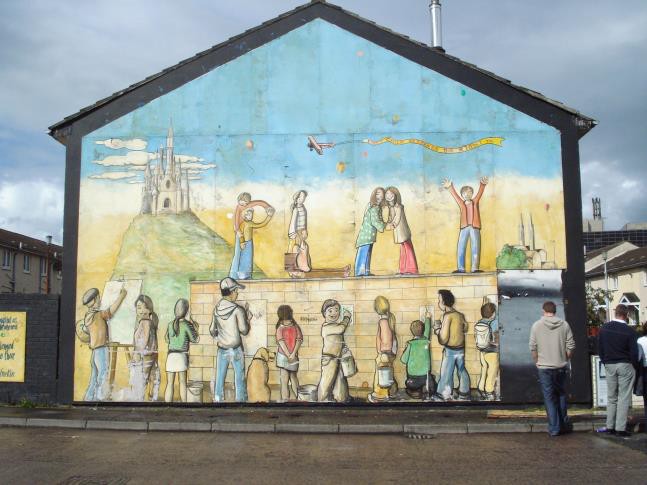
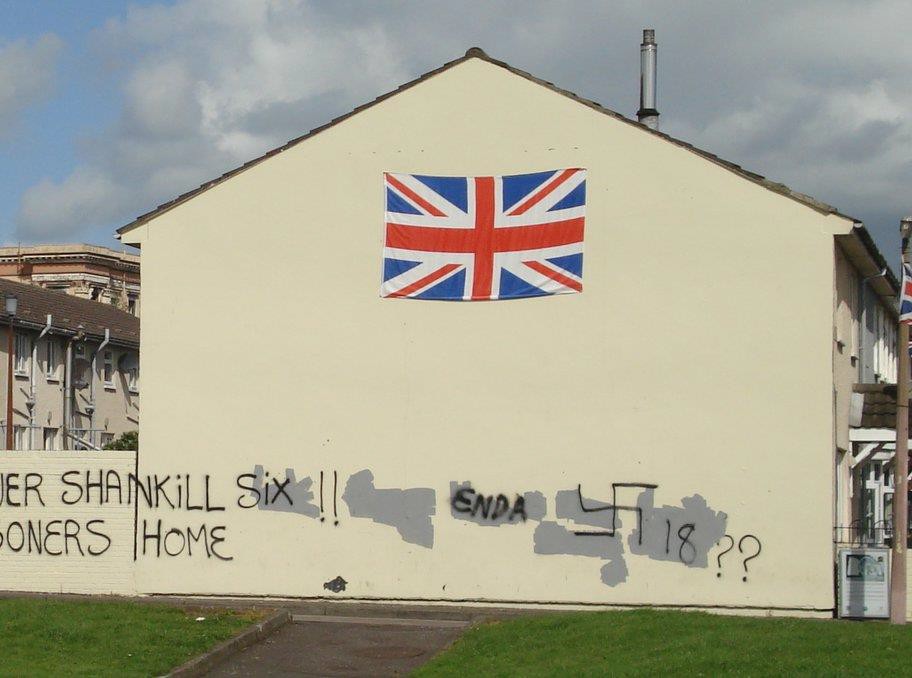
Echoes of this argument can be found in the mouths of some of the local residents of areas touched by the Re-imaging programme. A Lower Shankill resident thus reportedly complained about the disappearance of one of the most ferocious Loyalist murals in these words “At least the Grim Reaper was an authentic reflection of what we feel” (quoted by Latimer). This is not an isolated view. Some of the murals produced under the Re-imaging programme have indeed been particularly short-lived, which is generally an indication of lack of support from within the community, as has been shown by McCormick and Jarman (2005). Several of the murals created under the Re-imaging programme were defaced with graffiti shortly after being unveiled, including one of the rare Re-imaging murals created in Nationalist West Belfast (Hill and White 77). Many of the murals of Hopewell Crescent were also covered in graffiti and, as I saw during my fieldtrips to Belfast, a mural entitled “Right to Play” was significantly damaged just two years after its creation and had been painted over a year later (fig. 5-6).
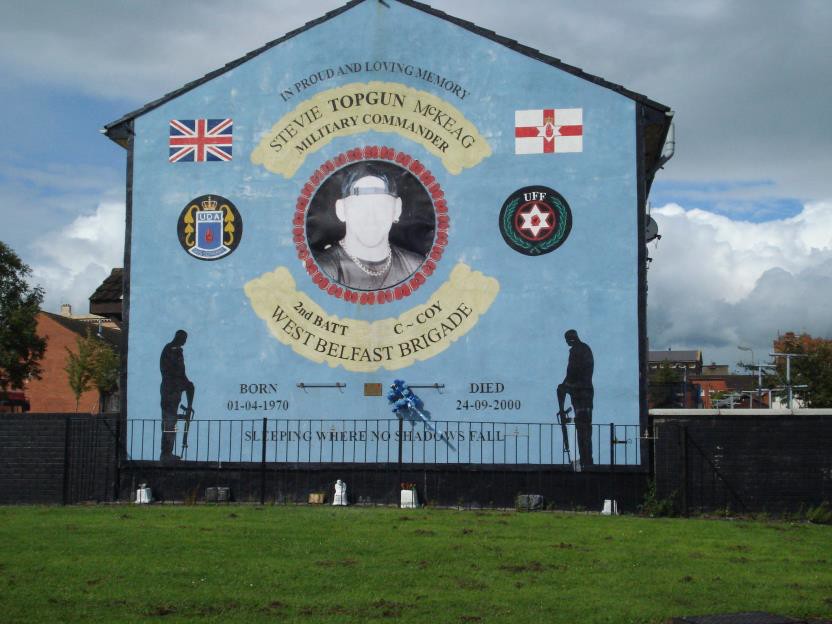
More decisively, it has been argued that the Re-imaging programme fell short of achieving reconciliation and more positive community relations. Hill and White suggest that the programme could be criticised for bringing about superficial change instead of much needed social and economic regeneration (Hill and White 80), which raises the wider question of the possible outcomes of regeneration through the arts. More crucially, the Re-imaging Communities programme has not prevented the permanence of sectarian visual discourses. The first reason for this is the obviously limited scope of the Re-imaging programme: 39 projects had been completed in 2009 which means that most of the 2,000 murals or so that are on display throughout Northern Ireland have remained untouched (Hill and White 78). Indeed, many paramilitary murals are still visible today. What is more, some of the most aggressive of these murals are located just a few steps away from Re-imaging murals, some of which have replaced earlier compositions that were no more militaristic or sectarian than those that remain. Thus, one can still see a hooded gunman aiming his weapon at the observer as well as a memorial to Stevie ‘Top Gun’ McKeag, who was allegedly responsible for over a dozen murders, just next to the much more peaceful representation of the 1969 Gold Rush (fig. 7-8).
More disturbingly still, some of the very murals that were produced under the Re-imaging programme incorporate a divisive, sectarian imagery. One of the new Re-imaging murals on Hopewell Crescent thus depicts Martin Luther apparently confronting Catholic churchmen. Together with the accompanying text, which states that “Luther’s Reformation founded Protestantism and divided Catholicism throughout Europe,” this mural is more likely to confirm than to challenge sectarianism (Hill and White 77). Similarly, in another Loyalist neighbourhood, the Village area in South Belfast, a sinister Grim Reaper mural was replaced with the old-style, pre-Troubles iconography of King Billy on his horse. Although the theme of the new mural is undoubtedly less brutal than the previous one, it is hardly a neutral choice, this iconography having served to buttress unionism since the early twentieth century and to provide a visual assertion of Protestant Unionist identity (Jarman 1998: 2-3). Rolston actually reveals that the negotiations between the ACNI and the Greater Village Regeneration Trust, in which the UDA played a part, were particularly long and tense and that, although the ACNI found the King Billy theme too political and potentially offensive, it had to give in and accept it as a cultural and historical mural (Rolston 2012: 455). As MacAtackney says, some of the art works produced by the Re-imaging Communities programme have contributed to “reinforcing single identities rather than any shared message” (MacAtackney 94), thus falling short of the mission initially ascribed to the programme. In spite of all the political and media talk of a shared future based on reconciliation, the permanence of a sectarian iconography can thus be analysed in terms of the policy of maintaining peace in Northern Ireland by separating the communities rather than by bringing them together, which is also made visible through the permanence–and indeed the proliferation–of peace lines and dividing walls in many of Belfast’s interface areas (McAtackney).
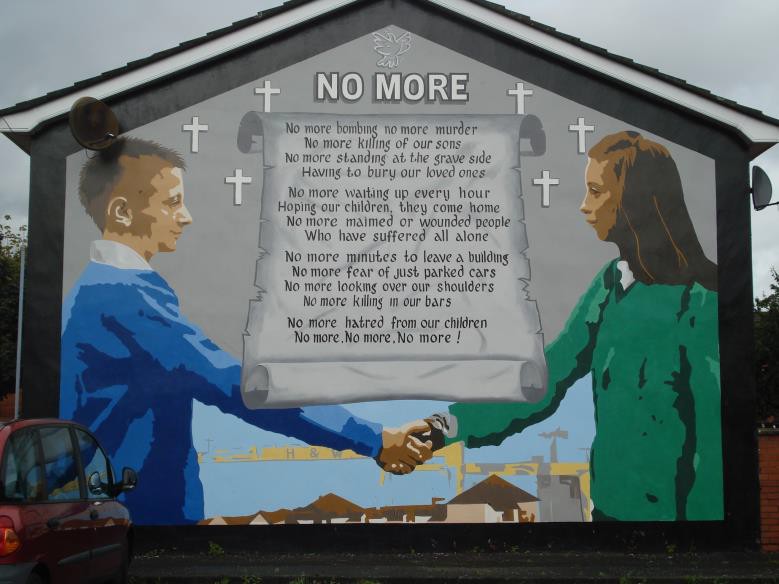
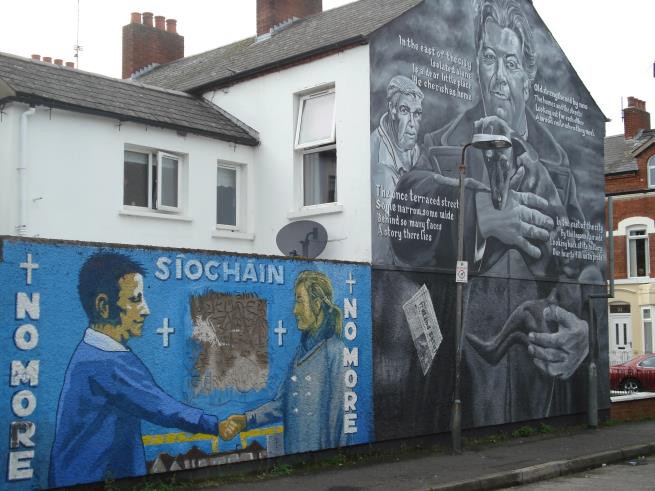
In spite of all these limitations, the Re-imaging Communities programme did produce some rare instances of visual–and effective–reconciliation. The clearest example of a visual rapprochement between the two communities is to be found in two murals with a largely similar iconography which appear in East Belfast on either side of the peace wall that divides this interface area. The two murals, which were created in 2010 as part of the Re-imaging Communities programme, are not entirely identical, but they both feature the same boy and girl shaking hands from each side of the painting, and a common text reading “No more,” with little white crosses symbolising the dead of the Troubles (fig. 9-10). Beyond the obvious message of peace and reconciliation conveyed by the two murals, the fact that the same iconographic themes should be used on both sides of the sectarian divide shows that the two communities can share symbolism, which is obviously meant to imply that they also share aspirations for a better future. Moreover, both murals include a reference to a conspicuous feature of East Belfast’s cityscape, the Harland & Wolff cranes, nicknamed Samson and Goliath by the local residents. Because of their link with Belfast’s shipbuilding industry, which long provided jobs for Protestants rather than Catholics, the cranes have featured in Protestant murals quite often over the last decade. Including them in a mural located in a Catholic neighbourhood could be read as a recognition that Belfast’s skyline belongs to both communities, a thing which is highly significant given the importance of territory in the conflict. This mural with its pendant on the Protestant side could therefore be interpreted as an instance of Catholics reclaiming Northern Irish territory, not as their own, but as a shared space.
To understand the full significance of these murals, we also need to go beyond symbols and iconography. As explained in the News Letter, one of Northern Ireland’s most widely circulated daily newspapers, the two murals emerged out of a cross-community partnership and implied close collaboration between Nationalist and Loyalist community workers (Rainey). The very process of producing the murals therefore involved people on both sides coming together to create them. Other instances of cross-community partnerships have occurred elsewhere. As a former Red Hand commando Loyalist, now reconverted as a cross-community activist involved in the Re-imaging Communities programme said: “I sit down in rooms with guys who were trying to kill me and I was trying to kill them” (Latimer). In that respect, it can be said that in some (unfortunately still rare) cases, re-building the image of Belfast has been an effective means of bringing the two estranged communities together.
Attempts at rebuilding the image of Northern Ireland through isolated and then coordinated, government-led initiatives illustrate the ambiguities of the transitional period the province is presently going through: just like its muralscape, Northern Ireland is torn between aspirations to peace and the remnants of paramilitary violence and sectarianism. In spite of the efforts of individuals, local communities and state agencies, many images of paramilitary violence remain today in Northern Ireland, and this not only maintains the memory of a troubled past, but actually asserts the continued influence of paramilitary groups. This is all the more significant as those re-imaging projects that came to completion usually involved seeking the support and collaboration of paramilitaries, which at least partly explains why the iconography of re-imaged buildings often remains divisive, albeit less aggressive and intimidating.
In spite of the multiplication of cultural and historical themes in murals produced in both communities in the past few years, there are few examples of truly shared imagery. Just as the consociational model of power-sharing applied after the Good Friday Agreement perpetuated–and indeed reinforced–ethnic-bloc politics (Tonge, 2008), the Re-imaging programme has often contributed to strengthening separate community identities rather than allowing expressions of a shared identity to emerge. With very few, isolated exceptions, interventions in the visual environment have only very marginally succeeded in helping to rebuild a truly inclusive Northern Ireland.5
Images
Notes
- 1For a detailed typology of the political uses of murals in Northern Ireland, see Jarman 1998.
- 2The Northern Ireland Housing Executive is in charge of the maintenance of council housing in Northern Ireland. It is therefore directly concerned by the question of preserving, erasing or replacing murals as many have actually been painted on the walls of buildings run by the NIHE.
- 3New projects have been carried out since that date.
- 4The so-called “Gold Rush” took place in July 1969, when children discovered gold sovereigns while playing in the rubble of recently demolished flats on Christopher Street in the Shankill area (see http://www.belfastcity.gov.uk/ publicart/default2.aspx?id=113, consulted on 25 January 2013).
- 5Thanks are due to Malcolm Stuart for his precious comments on an early version of this text.
Bibliography
- Belfast Telegraph. “Writing is on the Wall for Murals.” Belfast Telegraph 16 February 2002: 5.
- Brunn, Stanley D. et al. , “Belfast Landscapes: From Religious Schism to ConflictTourism.” Focus on Geography, 53.3 (Fall 2010): 81-91.
- Burrows, Emma. “Belfast’s Walls Lose their Tribal Warpaint.” The Observer 20 Sept. 1998.
- Causevic, Senija & Lynch, Paul. “Tourism development and contested communities. The issue of Belfast, Northern Ireland.” EspacesTemps.net, Travaux (21.10.2008). 25 January 2013 http://www.espacestemps.net/articles/tourism-development-and-contested-communities/
- Coulter, Colin & Michael Murray, eds. Northern Ireland after the Troubles. A Society in Transition. Manchester: Manchester UP, 2008.
- Dixon, Paul. Northern Ireland: The Politics of War and Peace (2001). New York: Palgrave, 2008.
- Hill, Andrew & Andrew White. “Painting Peace? Murals and the Northern Ireland Peace Process.” Irish Political Studies 27.1 (2012): 71-88.
- Independent Research Solutions. Evaluation of the Re-imaging Communities Programme: A Report to the Arts Council of Northern Ireland. N.p.: Independent Research Solutions, 2009.
- Jarman, Neil. “The Ambiguities of Peace: Republican and Loyalist Ceasefire Murals.” Causeway (spring 1996): 23–27.
- Jarman, Neil. Material Conflicts: Parades and Visual Displays in Northern Ireland. Oxford: Berg, 1997.
- Jarman, Neil. “Painting Landscapes: The Place of Murals in the Symbolic Construction of Urban Space.” Symbols in Northern Ireland. Ed. Anthony D. Buckley. Belfast: Institute of Irish Studies, Queen’s University, 1998. 121-147.
- Jarman, Neil. “Not an Inch.” Peace Review: A Journal of Social Justice 13.1 (2001): 35-41.
- Latimer, Joanne. “A Project to Replace Infamous Belfast Murals under Fire. Something a Can Can’t Fix?” Maclean’s (6 July 2011). 8 November 2012 <http://www2.macleans.ca/2011/07/06/something-a-can-of-paint-can-fix-2/>.
- Lisle, Debbie. “Local Symbols, Global Networks: Rereading the Murals of Belfast.” Alternatives: Global, Local, Political 31.1 (2006): 27–52.
- Lowry, Ben. “Belfast’s Wonder Walls….” Belfast Telegraph 3 May 2007.
- McAtackney, Laura. “Peace Maintenance and Political Messages.” Journal of Social Archaeology 11.1 (2011): 77–98.
- McCormick, Jonathan. “A Directory of Murals in Northern Ireland.” CAIN Web Service: Conflict and Politics in Northern Ireland. 2003. University of Ulster, Derry. 25 January 2013 <http://cain.ulst.ac.uk/mccormick>.
- McCormick, Jonathan & Neil Jarman. “Death of a Mural.” Journal of Material Culture 10:1 (2005): 49-71.
- McKee, Ross. “Shankill Murder Mural Wiped Out.” News Letter 26 July 2000: 5.
- McNeilly, Claire. “A Change of Image for Shankill Murals.” Belfast Telegraph 17 June 2009.
- Murray Brown, John. “The Art of Keeping the Peace.” Weekend Financial Times 3-4 October 1998.
- News Letter. “Plan to Paint Out Terrorist Murals.” News Letter 25 Sept. 2001: 7.
- Perry, Grayson. “We Cannot Airbrush the Dark Side of History.” The Times 19 July 2006.
- Rainey, Mark. “Mural ‘Sends Message of Hope’.” News Letter 23 Mar. 2010: 7.
- Rolston, Bill. Politics and Painting: Murals and Conflict in Northern Ireland. Rutherford: Fairleigh Dickinson UP, 1991.
- Rolston, Bill. Drawing Support: Murals in the North of Ireland. Belfast: Beyond the Pale Publications, 1992.
- Rolston, Bill. Drawing Support 2: Murals of War and Peace. Belfast: Beyond the Pale Publications, 1995.
- Rolston, Bill. Drawing Support 3: Murals and Transition in the North of Ireland. Belfast: Beyond the Pale Publications, 2003.
- Rolston, Bill. “Re-imaging: Mural Painting and the State in Northern Ireland.” International Journal of Cultural Studies 15.5 (2012): 447-466.
- Sluka, Jeffrey A. “The Writing’s on the Wall: Peace Process Images, Symbols and Murals in Northern Ireland.” Critique of Anthropology 16.4 (1996): 381-396.
- Tonge, Jonathan. Northern Ireland: Conflict and Change (1998). Harlow: Pearson, 2002.
- Tonge, Jonathan. “From Conflict to Communal Politics: The Politics of Peace.” Northern Ireland after the Troubles. A Society in Transition. Eds. Colin Coulter & Michael Murray. Manchester: Manchester UP, 2008. 49-72.
- Wallace, Ashleigh. “Councillor Pays Price for Removing Mural.” Belfast Telegraph 28 May 2002.
- Wallace, Ashleigh. “Removal of Murals Led to Attack.” Belfast Telegraph 12 June 2002.
About the author(s)
Biography: A former pupil of the École Normale Supérieure of Cachan, Caroline Lehni holds the agrégation in English and is a lecturer at the Institute of Political Studies of Strasbourg where she teaches English language and civilisation, including a fourth-year course on Northern Ireland’s visual history since Partition. Her research confronts methods and approaches borrowed from the fields of British civilisation, cultural history, history of art and book history and focuses on visual representations of travel, foreign places and foreign people as well as on visual representations of the conflict in Northern Ireland. Her dissertation entitled « Lire l’égypte en images : la représentation de l’égypte au Royaume-Uni à travers l’illustration des récits de voyage (1798-1914) » earned her a PhD from University Paris Diderot (Paris 7) in 2007. She is the author of several papers inspired by her doctoral research. She has also published an article on the illustrations of an exploration account on the American West (« De l’exploration au récit grand public. Usages de l’image dans Canyons of the Colorado par John W. Powell (1895) » (From Exploration to Mainstream Literature: The Uses of Pictures in John W. Powell’s Canyons of the Colorado, 1895), Études photographiques, n°18, mai 2006, p. 72-95).